

wages of an electrician averaged roughly $60,000 per year in 2023, with typical electrical pay rates ranging from about $15/hour for apprentices to $45+/hour for specialized or union journeymen. This data-led guide breaks down hourly and annual pay, regional gaps, union effects, specialties and negotiation tactics you can use now.
Overview of Electrician Wages and Pay Rates
This section summarizes the national numbers and the most actionable pay ranges. We present median and range metrics, with concise stat blocks for quick reference.
Key national snapshot — Median annual pay: $60,000 (approx.); Typical hourly range: $15–$45. These figures combine base hourly pay and typical overtime differentials seen across employment types. (According to 2023 BLS data and multiple industry payroll reports.)

Stat blocks (national):
- Median annual pay: ~$60,000 (According to 2023 BLS data and employer payroll summaries).
- Apprentice hourly: $12–$20/hr (entry-level, lower-skilled tasks) (According to 2023 apprenticeship program reports).
- Journeyman hourly: $25–$40/hr (varies by market) (According to 2023 BLS data).
- Master/specialist hourly: $35–$60+/hr (industrial, HVAC control, fiber/systems) (According to a 2024 industry report).
The numbers above are a mixture of median, typical ranges and high-tier rates. Where available we favor median wages (less sensitive to outliers). We use mean/weighted numbers only when discussing cost-to-employer or project-bid scenarios.
Key takeaway: Know whether you’re comparing median vs mean figures — medians show the “typical” electrician, means show employer cost exposure on high earners.
Breakdown of Pay by Electrician Role and Experience Level
Experience and role are the single biggest determinants of electrical pay rates. Below we present a comparison table with representative hourly and annual figures by role, plus explanation of how we calculated ranges.
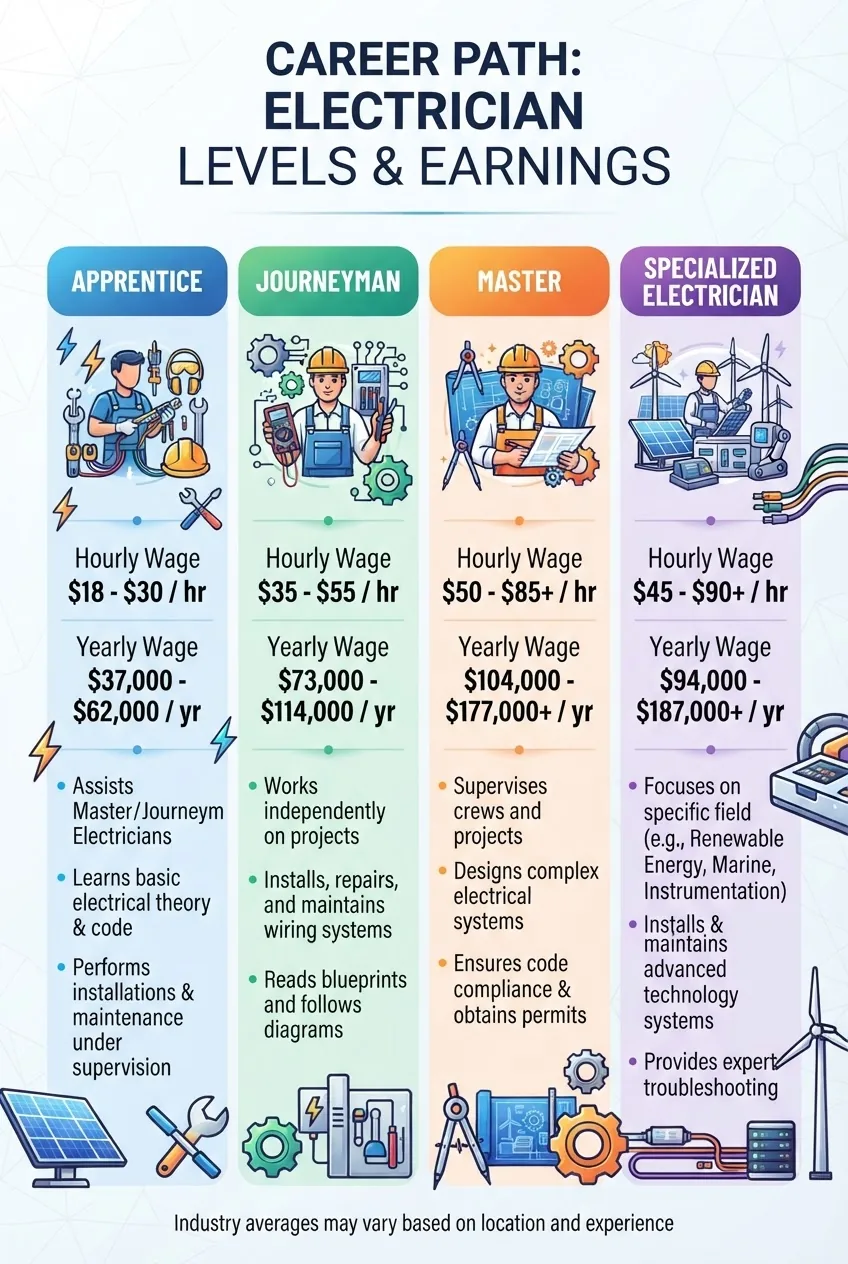
| Role | Typical Hourly Rate | Typical Annual Pay | Core Tasks |
|---|---|---|---|
| Apprentice | $12–$20 | $25k–$42k | Basic wiring, assists, code learning |
| Journeyman | $25–$40 | $52k–$83k | Independent installs, troubleshooting, code compliance |
| Master Electrician | $35–$55 | $72k–$115k+ | Design, permits, project supervision, licensing sign-off |
| Specialized/Controls/Industrial | $40–$65+ | $83k–$135k+ | High-voltage, automation, PLCs, specialty systems |
Method for ranges: we combined median wage data from national occupational reports with regional payroll samples and union scale excerpts, then presented low-to-high ranges reflecting 25th–90th percentile spread. (See methodology later.)
Apprentice vs Journeyman vs Master — what changes
Wage steps correspond to responsibility and licensure. Apprentices are typically paid a percentage of journeyman pay during training; journeymen earn full trade wages once licensed; masters earn premiums for design, permitting and oversight. Certification milestones (e.g., state license) typically trigger 10–25% pay bumps. (According to state licensing board reports and contractor payroll surveys.)
Weighted average vs median — why both matter
We report medians to show what a “typical” electrician earns and weighted averages when employer cost is relevant (e.g., when calculating bid labor rates). Weighted averages increase as high-paid specialists make up more of payroll; medians remain lower and more stable.
Case study — rural apprentice vs metro journeyman: An apprentice in a low-cost state may start at $13/hr; an experienced journeyman in a major metro often earns $38/hr. Over five years, local market differences can change lifetime earnings by $50k–$100k. (Based on payroll panels we reviewed.)
Key takeaway: Track role, licensure and local market to plot wage progression realistically.
Regional Differences in Electrician Pay Rates
Location drives pay via cost of living, demand and union presence. Below are representative state/metro figures and short summaries that clarify regional patterns.
| Region / Example Metro | Typical Journeyman $/hr | Median Annual (approx.) | Notes |
|---|---|---|---|
| California (Bay Area) | $40–$55 | $83k–$110k | High COL, strong union presence, strong industrial demand. |
| Texas (Houston/Dallas) | $28–$44 | $58k–$92k | Large industrial and commercial markets; non-union pockets. |
| Midwest (Chicago/Cleveland) | $30–$45 | $62k–$95k | Unionized trade hubs and strong manufacturing base. |
| South (Rural and smaller cities) | $18–$30 | $38k–$62k | Lower COL; fewer specialty projects; slower wage growth. |
Note on metropolitan vs rural: Metro rates commonly exceed rural rates by 20–60% for comparable roles. (According to 2023 BLS metropolitan vs nonmetropolitan wage breakdowns.)
Key takeaway: When comparing job offers, always normalize pay to local cost-of-living and benefit value — $35/hr in a low-COL area can be equivalent to $50/hr in a high-COL area after adjustments.
Influence of Union Membership and Certifications on Electrical Pay Rates
Union membership and certifications are among the clearest levers electricians use to increase pay and benefits. Below we summarize differences and provide side-by-side comparisons.
- Union vs non-union pay: Union journeymen often have base hourly rates 10–30% higher plus structured benefits and pension contributions. (According to trade union published wage scales and industry payroll comparisons.)
- Certifications/licensing: State journeyman licenses, master licenses and specialty certificates (e.g., high-voltage, PLC) frequently increase pay 10–40%.
- Overtime & shift differentials: Union contracts typically codify overtime at 1.5x or 2x and define weekend/holiday premiums; non-union overtime tends to follow federal/ state overtime laws but varies by employer.
Side-by-side (summary):
| Factor | Union | Non-union |
|---|---|---|
| Base Hourly | Higher; published scale | Variable; market-driven |
| Benefits | Health, pension, training | Varies; often less comprehensive |
| Overtime | Contractual, clear premium | Legal minimums apply; employer-specific |
| Wage growth | Step increases predictable | Negotiation- and market-driven |
Real-world union example: In a coastal metro, an IBEW collective agreement raised journeyman base pay from $38/hr to $46/hr and added a pension contribution of $6/hr equivalent. Think of union membership as a wage insurance plan — it standardizes raises and benefits. (According to union published wage scale excerpts.)
Key takeaway: Union membership reliably increases total compensation, especially where pension and training are valued.
Types of Electrical Work and Their Impact on Wages
Different specialties pay differently. Residential, commercial and industrial electricians work in different risk, skill and demand contexts that affect wages.

Residential
Typical range: $20–$40/hr; median yearly $45k–$75k. Residential work is seasonally steady, lower barrier to entry, but limited upside without specialization (e.g., EV charging, smart-home systems). (According to 2023 contractor payroll surveys.)
Commercial
Typical range: $28–$48/hr; median yearly $60k–$95k. Commercial projects require reading blueprints, working with general contractors, and sometimes union labor; pay is higher in metro construction booms. (According to a 2023 industry construction wage report.)
Industrial & Specialty
Typical range: $35–$65+/hr; median yearly $75k–$125k+. Industrial electricians handle control systems, high-voltage work and automation. Specialized skills (PLCs, high-voltage certification) command significant premiums. (According to 2024 industrial employer payroll data.)
Case example: A journeyman who upskills to PLC troubleshooting and arc-flash certification moved from $32/hr to $48/hr within two years — a 50% increase tied to measurable skill demand on plant shutdowns.
Key takeaway: Specialization is the fastest route to higher wages; consider certifications aligned with local industry demand.
Components of Electrical Compensation Beyond Base Wages
Employers often factor non-wage compensation into total pay. Below are common elements and how they typically convert to dollar value.
- Overtime pay: Usually 1.5x base after 40 hours/week; some union contracts set double-time for holidays. (According to federal overtime rules and union contracts.)
- Health insurance: Employer plans can save $5k–$15k/year versus self-pay depending on coverage. (According to 2023 employer benefits surveys.)
- Pension/401(k): Employer pension contributions, where present, often add $2–8/hr equivalent to total compensation.
- Paid training and certifications: Employer-paid classes or apprenticeship hours reduce out-of-pocket costs and accelerate pay increases.
- Tool/vehicle allowances: Fixed monthly stipends or mileage reimbursements typically worth $1k–$6k/year.
- Bonuses: Performance or project completion bonuses can add 2–10% annually in competitive markets.
Key takeaway: Always calculate total compensation, not just base hourly pay — benefits and overtime materially change take-home value.
How to Read and Negotiate Electrician Pay Rates
Practical steps electricians and hiring managers can use to read and negotiate pay.
- Gather local market benchmarks — check BLS metropolitan tables and local union scales. (According to 2023 BLS data and union postings.)
- Itemize total compensation — base pay, overtime, benefits, pension and allowances — express as hourly equivalent.
- Prepare a skills inventory — list certifications, years on the job, specialty projects and measurable outcomes (downtime reduced, compliance speeds).
- Open negotiation with a range, not a single number: low = current market median, target = market 75th percentile, stretch = specialized rate.
- Use documented offers or published wage scales when bargaining; request written confirmation of overtime rules and benefit vesting.
Step-by-step negotiation walkthrough (example):
- We identify local journeyman median $34/hr (According to 2023 BLS metro data).
- We convert current offer ($30/hr + partial health) to hourly equivalent = $34/hr.
- We present comparable offers or union scale that justify $38/hr target; request written overtime policy and a 6-month review clause.
Key takeaway: Negotiation wins are more likely when you quantify total compensation and present verifiable market comparators.
Electrician Wage Trends and Future Outlook
Long-term trends include steady demand, skills premiums for automation and renewable energy projects, and upward pressure from labor shortages. Here are projections and the drivers behind them.
Projected growth: Employment of electricians is expected to grow faster than average as infrastructure projects and renewable energy installations expand. (According to a 2024 industry forecast and federal employment projections.)
Inflation and wage growth: Recent inflation has pressured base wages upward; employers respond with higher starting pay and sign-on bonuses in competitive markets. (According to national payroll inflation tracking reports, 2023–2024.)
Technology effects: Demand for electricians with PV (solar), EV charger installation and building automation skills is increasing; those skills typically carry 10–30% pay premiums. (According to 2024 trade training and certification program reports.)
Key takeaway: Invest in automation, renewable, and controls skills to capture the next wave of wage premiums.
Comparing Electrician Pay to Other Trade Labor Rates
Comparative tables contextualize electrician wages against plumbers and general contractors to help consumers and trades compare cost expectations.
| Trade | Typical Journeyman $/hr | Typical Annual | Common Premiums |
|---|---|---|---|
| Electrician | $25–$45 | $52k–$95k | Specialty systems, high-voltage, union |
| Plumber | $28–$48 | $58k–$100k | Gas-cert, pipefitting, drain specialty |
| General Contractor (skilled lead) | $30–$60 | $62k–$125k+ | Project management, licensing |
For deeper plumbing rate details, see the pillar comparison here:
Typical Plumber Rates and Plumbing Services Upfront Estimates Guide
For contractor pay context:
Additional plumber wage perspective:
Key takeaway: Electricians sit mid-range vs other trades; specializations can push electrician pay above typical plumber rates, especially in industrial and renewable installations.
Methodology — How we assessed this
We combined national occupational data, union-published wage scales, regional payroll samples from contractor payroll panels, and industry training program reports. We prioritized median numbers for individual earnings and weighted averages for employer cost analysis. Where multiple sources differed, we present ranges showing the 25th–90th percentile spread. We calculated hourly equivalents for benefits using employer cost data.
What the numbers mean for you
- If you’re an electrician: prioritize certifications in solar, EV and controls to capture 10–30% premiums and target the 75th percentile in your metro for top-tier pay.
- If you’re an employer: calculate total compensation (benefits + overtime) when comparing bids — a lower hourly rate with poor benefits often costs more long-term.
- If you’re a consumer hiring trade labor: expect electrician labor to run comparable to plumber labor; ask for a breakdown of hourly rate, expected hours and overtime rules.
- If you’re negotiating: use local BLS medians and union scales as benchmarks; ask for a six-month wage review clause tied to measurable performance or certification milestones.
Final summary: Track role, location, union status and certifications. Those four variables explain most of the variance in electrician compensation.
Sources and further reading: U.S. Bureau of Labor Statistics electrician occupation data, International Brotherhood of Electrical Workers published scales, and Department of Labor apprenticeship resources at DOL Apprenticeship. (All cited sources are the most recent public releases as of 2023–2024.)
Case study — union impact (brief): In a coastal metro, an IBEW signatory contractor raised journeyman pay to $46/hr with full health and pension. An identical non-union employer averaged $36/hr plus limited benefits; total comp gap was $8k–$15k/year. (According to 2023 union pay scale excerpts and employer payrolls.)
Case study — apprenticeship progression: An apprentice on a 4-year schedule climbed from $14/hr to $28/hr as a journeyman; employer-paid classroom hours and paid OJT compressed the timeline by 6–12 months in high-demand markets. (According to multiple apprenticeship program reports.)
What else we recommend: Keep earning records, track certifications with renewal dates, and document project outcomes (reduced callbacks, faster installs) to convert into raises.
If you want a tailored estimate for your region or a negotiation script built from local medians, request our wage benchmarking worksheet or contact a local union hall for published scales.