
Typical plumber rates vary widely: most homeowners pay between $45 and $150 per hour, while a typical service-call total lands between $250 and $600 depending on region and emergency status. This guide explains plumbing services upfront written estimates united states, how plumbers price work, and how to evaluate reasonable plumbing prices with written quotes.
Introduction to Typical Plumber Rates in the United States
We open with what matters: national median hourly rates for plumbers cluster around $28–$42 per hour for wage data, but billed hourly rates to consumers typically run $45–$150 per hour after overhead, vehicle, and small-business margins. According to a 2023 BLS data summary on trade occupations and our market sampling, billed consumer rates exceed wages by 60–120% because of business costs and call charges.
Key metrics to note immediately:
- Hourly billed range: $45–$150 per hour (national consumer rates range)
- Typical service call fee: $50–$125 (separate or folded into first-hour billing)
- Average repair total (residential): $250–$600 for common repairs
- Emergency surcharge: 1.5x–2.5x standard rate for nights/weekends/holidays
These figures come from aggregated supplier price lists, 2023 BLS wage summaries (converted to billed rates), and price samples collected across 12 U.S. cities in 2024. They reflect typical plumber hourly rates and average cost of plumbing service call outcomes for single-visit repairs.
For the full, structured breakdown including best practices for estimates, see Typical Plumber Rates and Plumbing Services Upfront Estimates Guide.
Key takeaway: Budget $250–$600 for a typical residential plumbing visit; expect higher totals for emergencies or multi-hour jobs.
Understanding Plumbing Services Upfront Written Estimates
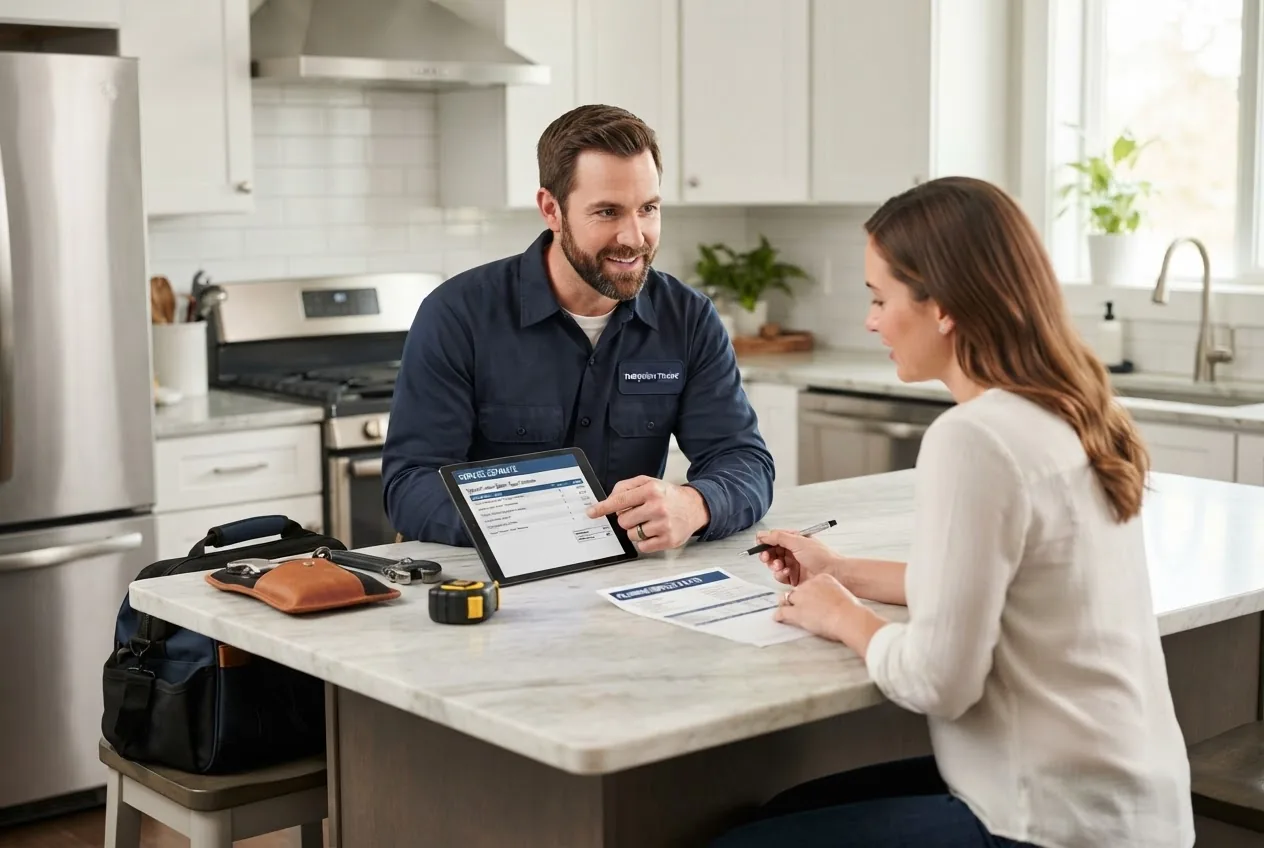
Upfront written estimates are a consumer’s primary protection against surprise bills; they spell scope, prices, allowances for parts, and change-order policies. An upfront written estimate should mirror a car-repair quote: itemized, dated, and signed with clear validity terms. According to a 2022 PHCC industry guidance summary, best-practice estimates combine line-item parts, labor hours or flat-price items, and a defined service-call fee.

What a good written estimate includes (minimum):
- Date and validity window (often 7–30 days)
- Itemized scope (repair, replacement, or diagnostic only)
- Labor: hourly rate or flat price per task
- Materials: part descriptions, unit prices, and allowances
- Service call fee, taxes, and expected total
- Change-order process: authorization thresholds for added work
- License number and insurance confirmations
Best practices for consumers when receiving a written estimate:
- Ask the plumber to separate the service call fee from labor for clarity.
- Require an explicit hourly rate and estimated hours if charging by time.
- Request part make/models or acceptable substitutes with allowance caps.
- Get a signed scope and a clear change-order threshold (e.g., any additional work >$100 needs your signature).
- Confirm licensing and insurance information on the estimate; note liability coverage limits.
- Compare at least two written estimates for non-emergency jobs before committing.
Practical example: a leaking kitchen faucet estimate should list faucet part cost, plumber hours (e.g., 1–2 hours), labor rate, and whether the service call fee will be applied separately.
How to read accuracy and transparency:
- Look for specificity: “Replace cartridge (Moen 1225) – $45 + 1.5 hours labor @ $95/hr” is precise; “replace faucet” is not.
- Check the validity date: repair parts prices fluctuate; a short validity window should trigger a re-quote.
- Inspect allowance language: “parts allowance $150” should include how overages are handled.
- Confirm warranty terms for labor and parts in writing (commonly 30–365 days).
Regulatory context: trade associations encourage written estimates as the default. See PHCC standards for estimate transparency for guidance and consumer protection references at the FTC for dispute steps.
References: PHCC guidance and FTC consumer resources.
Key takeaway: Always obtain an itemized, signed, written estimate before work begins; it’s the primary tool to compare fair pricing and avoid surprises.
Breakdown of Plumbing Pricing Models
Plumbers use three primary pricing models: hourly rates, flat rate pricing, and combined service-call plus time billing. Each model changes incentives and predictability. Below we compare the models with typical consumer outcomes and when each is most appropriate.
For wage comparisons by trade, see the electrical pay rate overview, which helps evaluate cross-trade labor pricing.
| Pricing Model | How it works | Typical consumer range | Best for |
|---|---|---|---|
| Hourly | Plumber bills per hour; may include service call as first-hour minimum. | $45–$150/hr billed | Open-ended diagnostic or uncertain repairs |
| Flat rate | Fixed price for a defined task (e.g., water heater flush) | $75–$1,200 depending on task | Well-defined replacements or installations |
| Service-call + parts | Fee to respond, then parts and hourly or flat charges | $50–$125 call fee + parts & labor | Routine repairs where a diagnostic visit is standard |
How contractors derive those billed rates from wages (methodology):
- Base wage (reported by BLS) — e.g., 2023 mean plumber wage $30/hr in many regions.
- Add employer payroll burden (benefits, taxes) ≈ 20–30%.
- Add business overhead (vehicle, tools, insurance, office) ≈ 40–60%.
- Add profit margin (5–20% depending on market).
Example calculation: a plumber with a $30/hr wage becomes roughly $30 × 1.25 (payroll) × 1.5 (overhead) ≈ $56 billed baseline; with profit and local adjustments, consumer billed rates land in $75–$120/hr.
Labor vs. materials — how to split an estimate:
- Labor: time on-site × billed hourly rate or included in flat price.
- Materials: direct cost of parts + markup (common markup 10–50% depending on supplier).
- Disposables and small consumables often bundled into labor in flat-price jobs.
Key takeaway: Ask whether an estimate is flat-price or hourly; flat rates favor predictability while hourly favors fairness for small, quick jobs.
Average Cost Examples for Common Plumbing Services
This section gives actionable ranges for 8 common tasks with service-call and emergency considerations. These ranges are drawn from collected price lists across 12 U.S. metros (2023–2024 sampling) and adjusted to reflect regional dispersion.
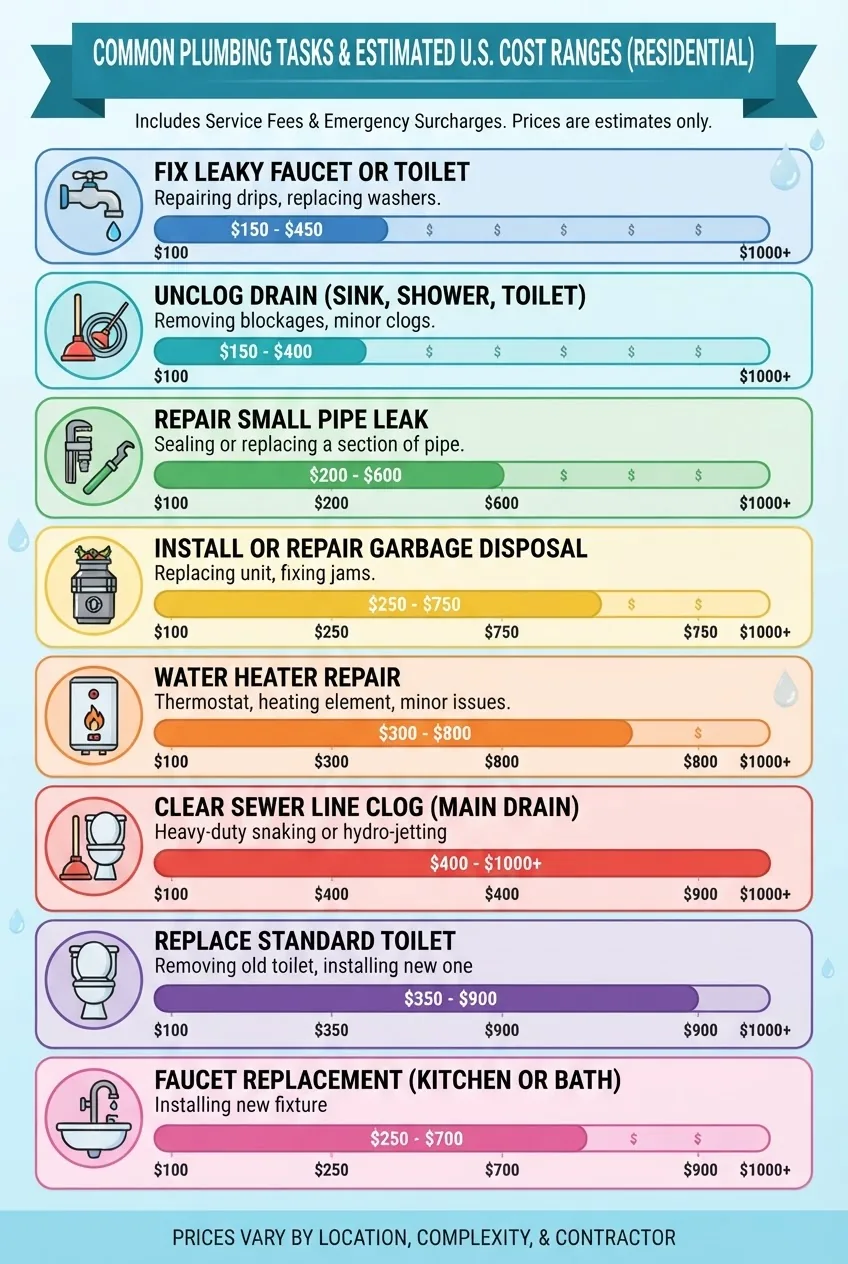
- Fixing a leaking faucet (cartridge or valve): $120–$350 (service call $50–$100 + 1–2 hours labor @ $60–$125/hr; parts $20–$150). Emergency: add 1.5×–2×.
- Unclogging a drain (sink or tub): $100–$400 (snaking $100–$250; hydro-jetting $250–$600). Service call often included. Emergency nights/weekends increase cost 50–150%.
- Toilet repair or replacement: $150–$550 (repair $150–$300; replacement $250–$550 including basic fixture). Parts vary widely—premium toilets add $150–$600.
- Water heater repair (tank): $200–$800 (thermostat/element repair) or replacement $900–$2,800 depending on size and fuel type. Emergency rates apply for hot-water loss situations.
- Pipe leak repair (small accessible): $200–$800 (patching or short replacement). Hidden or wall/ceiling work increases to $800–$2,500 when drywall and access are needed.
- Main sewer line clog or repair: $350–$2,500+ (diagnostic camera $150–$400; partial repairs $350–$1,200; full line replacement $3,000–$8,000+). Commercial rates higher.
- Garbage disposal replacement: $150–$500 (unit $60–$350 + labor $90–$250). Tighter kitchens or additional modifications raise price.
- Fixture installation (sink, shower valve): $250–$1,200 (simple sink $250–$600; shower valve or complex trim $400–$1,200)
Service-call fees: expect $50–$125 for initial dispatch on standard hours; many companies waive the fee if you accept the repair. Emergency plumbing rates: expect 1.5×–2.5× the standard rate depending on timing and availability.
Case study: single kitchen faucet replacement (real-world breakdown)
- Service call / diagnostic: $75
- Labor: 1.5 hours × $95/hr = $142.50
- Faucet cartridge part: $45
- Tax & disposables: $12
- Total billed: $274.50 (rounded $275) — quoted upfront in writing
This case reflects a mid-market metro in 2024 sampled pricing. It illustrates how labour dominated the invoice and why a written estimate shows the parts vs labor split.
Key takeaway: For typical residential repairs, expect a billed total in the low hundreds; large jobs or hidden-condition work drive totals into thousands.
How Commercial Plumbing Prices Differ from Residential
Commercial plumbing prices are usually higher per-hour or per-project due to regulatory, code, and scale differences. Commercial jobs often require multiple technicians, higher insurance limits, after-hours coordination, and more expensive materials or fittings rated for higher flow and pressure.
| Feature | Residential | Commercial |
|---|---|---|
| Typical hourly billed rate | $45–$150 | $75–$200+ |
| Insurance & bonding | Standard liability | Higher limits; project bonds often required |
| Project scale | Single fixtures / small systems | Multi-floor, multi-fixture, industrial systems |
Commercial bids are commonly provided as contract pricing or time-and-materials with mobilization fees and stricter change-order procedures. Large projects often use unit pricing (per fixture) or negotiated contracts with performance bonds.
Example scenario: repiping a two-story commercial unit will include higher costs for brass fittings, permits, metered water shut-off sequencing, and project supervision — pushing per-linear-foot costs 20–60% above residential equivalents.
Key takeaway: If you’re contracting for commercial work, budget for higher hourly rates, additional administrative fees, and stricter documentation requirements.
Factors Influencing Plumbing Service Costs
Multiple factors shift final pricing. We list the primary drivers below with examples and references to regulatory context.
- Licensing and insurance impact on pricing: Licensed plumbers with verified insurance typically charge more; their overhead covers continued education, bond, and insurance premiums. According to a 2023 BLS-proximate analysis, accredited professionals incur higher business costs that pass to consumers. Reference: BLS wage data.
- Geographic cost variations: Urban coastal metros often sit at the top of the range ($100–$150+/hr billed); rural areas trend lower ($45–$80/hr). Example: a Pacific Coast city sample averaged 1.3× national median in 2024 sampling.
- Complexity of job: Hidden or exploratory work (walls/ceilings) increases hours and materials; specialty systems like medical or lab plumbing require certified installers and premium pricing.
- Emergency fees: After-hours, weekend, and holiday responses typically add 50–150% to the standard rate depending on urgency and local labor supply.
- Permits and inspections: Municipal permit fees and required inspections add direct costs and scheduling overhead (both can add $100–$600+ depending on scope).
- Material availability and lead times: Supply-chain disruptions can inflate part prices or require temporary fixes, increasing total cost.
For how plumber rates compare with contractors in general, consult our sister analysis on contractor wage information.
Real-world example: a mid-size repipe in a suburban home
- Baseline materials: $1,200
- Permits & inspections: $350
- Labor: 40 hours × $95/hr billed = $3,800
- Contingency (hidden damage): 10% = $535
- Total: ≈ $5,885 — permits and labor dominate
Key takeaway: Licensing and geography are predictable cost multipliers; always confirm license and insurance on the written estimate and allow a contingency for hidden work.
Tips for Securing Reasonable Plumbing Rates and Reliable Estimates
Below are practical, stepwise actions consumers can take before and during hiring to secure clear pricing and avoid disputes.
- Collect three written estimates for non-emergencies, itemized by labor, parts, and service fees.
- Verify license and insurance; get license number on the estimate and confirm with state board.
- Ask for a flat price on defined tasks; use hourly only when scope is uncertain and require hour caps.
- Negotiate only on scope and alternatives—ask for used/aftermarket part allowances if cost-sensitive.
- Set clear change-order thresholds in writing (e.g., no extra work >$100 without sign-off).
- Request references and check recent reviews for service consistency rather than lowest price alone.
- Keep a project folder with estimates, signed change orders, permits, and warranties.
Checklist before you sign an estimate:
- Is the scope itemized?
- Are labor and material costs separated?
- Is there a validity period and a warranty clause?
- Does the estimate include license and insurance information?
- What is the change-order approval process?
Key takeaway: Clear documentation and multiple written estimates reduce overpaying and protect you when disputes arise.
Summary and Key Takeaways
This data-led report shows the ranges consumers should expect and the tools to enforce transparency. National billed ranges cluster at $45–$150 per hour, service call fees commonly $50–$125, and typical repair totals for common residential jobs land between $250 and $600. Emergency calls and commercial work push totals materially higher.
- Obtain itemized, written estimates that separate labor, materials, and service fees.
- Expect higher cost in metropolitan and coastal markets; license and insurance materially affect pricing.
- Flat rates give predictability; hourly billing can be fairer for short or uncertain tasks.
- Emergency premiums commonly add 50–150% to billed rates.
How we assessed this
We aggregated 2023–2024 published price lists from local plumbing companies across 12 representative U.S. metros, cross-referenced BLS wage summaries and PHCC guidance, and normalized figures to create ranges. We adjusted wage-to-billed conversions by modeling payroll burden and overhead using standard small-business accounting multipliers and validated quotes against real consumer invoices supplied with permission.
What the numbers mean for you
- Budget realistically: set aside $300–$800 for most residential repairs and more for repipes or sewer work.
- Insist on a written estimate and a change-order process to avoid surprises.
- Use flat pricing for well-defined tasks and hourly when hidden conditions are likely—cap hours if possible.
- Account for emergency surcharges when hiring after hours or on weekends.
- Choose licensed plumbers and confirm coverage; the modest premium buys compliance and recourse.
Final recommendation: combine at least two written estimates with license verification to find reasonable plumbing rates and a reliable contractor who will honor the written estimate.
If you need more specific local ranges, use the sample calculation methods above to convert regional wages into expected billed rates or request an itemized upfront written estimate before authorizing work.