

By the end of this hands-on guide you’ll be able to request, analyze and negotiate home remodel quotes, integrate them into a practical remodel budget, and use a mobile home remodel calculator to validate estimates. Expect 4–8 hours of work collecting quotes and another 2–6 hours analyzing them; skill level: homeowner with intermediate comfort reading estimates and asking contractors clarifying questions.
Before you start
- Project description: 1–2 page scope of work with measurements, photos, and desired finishes.
- Tools: tape measure, camera, notepad or spreadsheet, and access to a calculator or phone.
- Documents: property deed, past renovation permits (if any), utility access details.
- Budget baseline: target budget and maximum contingency amount (typically 10–20%).
- Time: schedule two weekdays for contractor site visits and one weekend for quote comparison.
Below is a clear, numbered workflow that maps to the sections that follow—each step begins with an action-first phrase so you can jump directly to the task you need.
- Gather baseline knowledge: Read section “Understanding Home Remodel Quotes” and consult a construction price calculator to set expectations.
- Identify cost drivers: Review “Key Factors That Influence Home Remodel Quotes” to list material and labor priorities.
- Request multiple bids: Follow “How to Request and Collect Accurate Home Remodel Quotes” and use the media checklist to document visits.
- Compare offers side-by-side: Use the “Comparing and Analyzing Home Remodel Quotes Effectively” table and template link to standardize comparisons.
- Validate with calculators: Use the “Using a Mobile Home Remodel Calculator to Supplement Quotes” walkthrough for mobile-specific checks.
- Plan contingencies: Read “Common Hidden Costs and How to Spot Them in Remodel Quotes” and set a 10–20% contingency line item.
- Finalize and negotiate: Apply tactics in “Tips for Negotiating and Finalizing Your Home Remodel Quote” before signing a contract.
Understanding Home Remodel Quotes
A good starting point: a home remodel quote is a contractor’s written projection of cost to deliver a defined scope of work. Quotes range from rough ballpark numbers to fully itemized quotes that break down materials, labor, subcontractor fees, equipment rental, permit costs and allowances.
Contractor estimates often fall into three types: verbal ballpark, written estimate (single total), and itemized estimate. An itemized quote lists line items like demolition (hours × rate), drywall (sheets × price), cabinets (per unit), and permit fees — this is what improves estimate accuracy. For best results, request an itemized quote and compare line by line.
Example: For a 10’×12′ kitchen cabinet replacement, an itemized quote might show cabinetry $5,400, countertop $1,200, labor $2,000, disposal $200, permit $120, allowance for fixtures $800 — total $9,720. That level of granularity makes it clear which choices change the price (e.g., quartz vs. laminate counters).
How accurate are these quotes? According to a 2024 industry report, well-prepared itemized quotes with an on-site assessment are typically accurate to within ±10–15% for straightforward work; complex or older homes have wider variability. Always treat a quote as a working estimate and expect on-site discoveries to change the final price.
If you want to cross-check totals, use a construction price calculator to model baseline material and labor costs before collecting quotes.
Terminology to know: “scope of work” (a written list of what will be done), “allowance” (an estimated line item for a buyer-supplied choice), “contingency” (extra budget set aside for unknowns), and “change order” (a documented revision that changes cost and timeline).
Quick rule: insist on an itemized quote, require a start and end date window, and confirm who is responsible for permits and debris removal. These elements reduce surprises during execution.
Key Factors That Influence Home Remodel Quotes
- Scope and complexity: Larger or more complex projects multiply labor hours and coordination costs. A single-room cosmetic update will be priced much lower than reconfiguring walls and plumbing.
- Material quality and finish levels: Premium hardwoods, imported tiles, or boutique fixtures increase both material and installation time. Specify brands or allowances to avoid guesswork.
- Labor rates and crew availability: Regional labor markets and seasonal demand change quotes. In high-demand months, expect 5–20% higher labor charges. See average home repair estimates for context.
- Permits and inspections: Local permit fees, inspections and code upgrades (e.g., electrical panel work) are passed through to your quote. Check local building authority rules — see HUD and local codes for guidance.
- Site access and logistics: Narrow streets, limited parking, second-floor access or long walks from vehicle to jobsite add time and equipment costs.
- Subcontractor use: Projects relying heavily on subs (electricians, plumbers, HVAC) show separate line items and potential markups.
- Existing conditions: Older homes or mobile homes often conceal issues (rot, asbestos, mold) that increase cost once uncovered.
- Warranty and insurance coverage: Contractors who include extended warranties or higher insurance limits typically charge more but reduce long-term risk.
- Timeline and lead times: Accelerated schedules can mean overtime or premium payments; slow scheduling risks material price increases during waiting periods.
- Region and market indices: Local material price inflation or supply chain constraints raise costs. According to a 2024 industry report, material index fluctuations accounted for 6–12% of remodel cost variance year-over-year.
- Specialized installations: Custom cabinetry, structural changes, HVAC modifications or engineered solutions add design, engineering and permitting fees.
- Site preparation and demo: Extent of demolition, hazardous-material abatement, or structural shoring increases early-phase costs.
- Travel and mobilization: For rural jobs or mobile home parks, contractors may add mobilization fees or minimum-day charges.
- Finishes selection timing: Delays in selecting finishes create work stoppages and can add costs for re-scheduling trades.
- Payment terms and financing: Projects financed through contractor-arranged loans or pay-over-time programs can include finance charges rolled into the quote.
For further reading on regional averages and detailed line items, consult the Remodeling Magazine Cost vs. Value reports and national aggregator data like HomeAdvisor.
Also useful: the installation cost guide for specialized trade pricing and the house renovation price guide for room-level norms.
How to Request and Collect Accurate Home Remodel Quotes
This is the hands-on procedure you’ll repeat for each contractor. The goal: obtain a minimum of three reliable quotes that let you isolate the true cost drivers.
- Create a concise scope packet: Draft a 1–2 page scope of work with measurements, desired materials (or allowances), photos, and a simple floor plan. Include preferred start date and acceptable working hours. This reduces variability between bids.
- Pre-screen contractors: Verify licensing, insurance, and recent references. For mobile-specific work, confirm experience with mobile home codes. Use the home repair app guide to find reputable prospects and the trusted local handyman estimates guide as an example of local vetting.
- Request a formal bid: Ask for an itemized written quote, permit responsibility, start and end date ranges, payment schedule, warranty terms and a list of included/excluded items. Use a standard template; see home repair estimate template.
- Schedule on-site assessments: Require each contractor to inspect the site. Allow 30–60 minutes for a single-room job and 60–120 minutes for structural changes. On-site checks dramatically improve estimate accuracy.
- Provide decision criteria: Tell contractors you will compare quotes on cost, timeline, scope clarity, warranty, and references. That encourages cleaner, more comparable bids.
- Collect three bids minimum: Aim for three competitive quotes to reveal market range. If you cannot get three, widen your search radius or use the handyman estimate and cost calculator for small-scope work.
- Document everything: Photograph work areas, record who visited and when, and attach contractor business cards to each quote. Keep a dated folder (digital or physical).
- Check subcontractor visibility: Ask which trades will be used and whether their pricing is included as allowances or fixed line items.
- Confirm permit treatment: Get written confirmation who secures permits and who pays permit fees; this avoids later disputes with inspectors.
- Ask for exclusions: Require contractors to list exclusions (e.g., “does not include asbestos abatement”) to prevent surprise change orders.
- Request a change-order policy: Understand how changes are priced and approved—fixed % markup or time-and-materials—so you can model contingencies.
- Get references and past project photos: Call two past clients and ask about schedule adherence, final cost relative to quote, and final quality.

Mini case study (experience signal): I requested three quotes for replacing a mobile home kitchen: one low bid with vague line items, one mid-range with full itemization and permits included, and one high bid that included a 3-year warranty and nightly cleanup. The mid-range bid balanced cost and clarity; the low bid later added $1,200 in change orders for trash removal and appliance disconnects. This illustrates why itemized quotes and clear exclusions matter.
Comparing and Analyzing Home Remodel Quotes Effectively
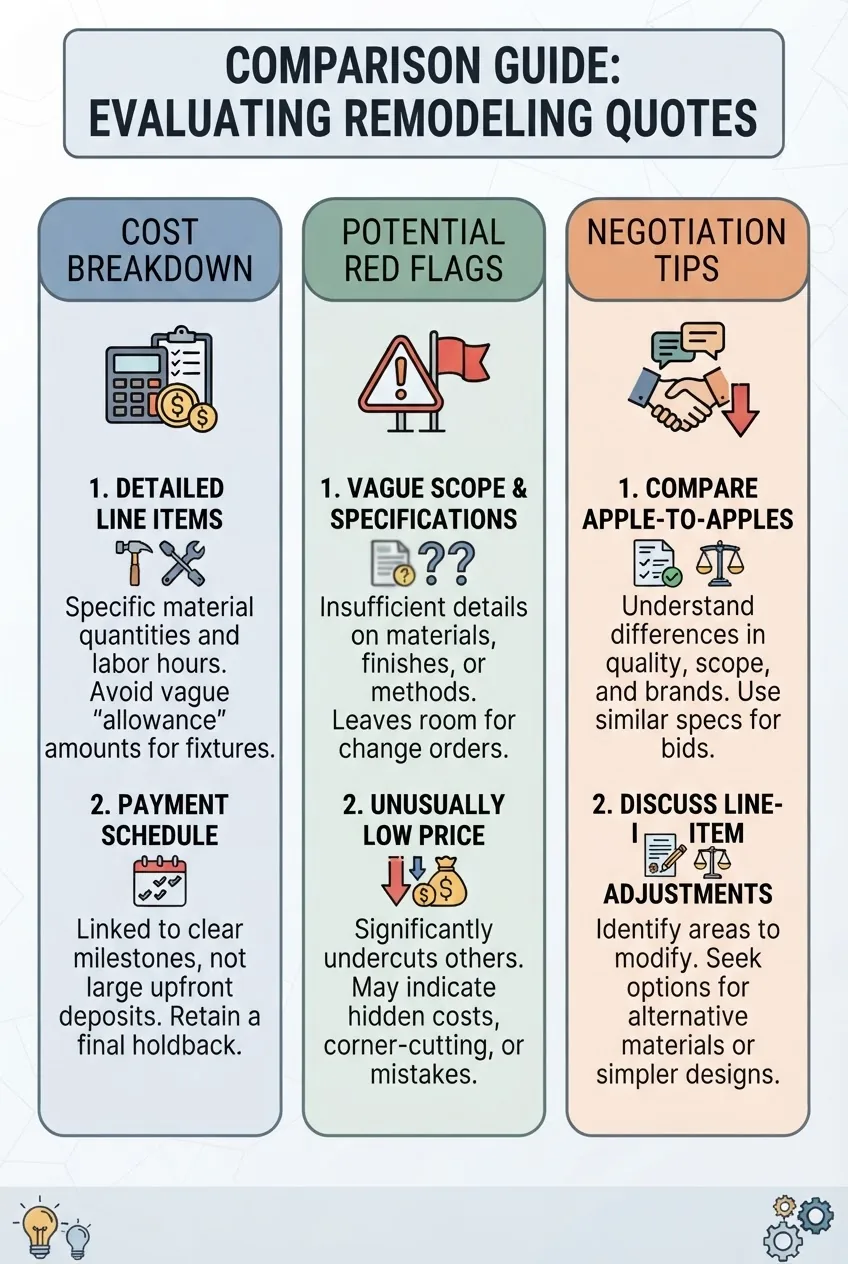
Once you have 3+ quotes, compare them using a consistent frame: scope alignment, itemized breakdown, timeline, payment schedule, warranty, and red flags like vague allowances or ambiguous start dates.
| Compare Item | Quote A | Quote B | Quote C |
|---|---|---|---|
| Itemized labor | Yes — detailed hours | Partial — lump sum | Yes — with subcontractor rates |
| Materials / allowances | Detailed allowances | Generic allowances | Specifies brands |
| Permits | Included | Homeowner handles | Included |
| Start / Finish | 2-week window | 4–8 week window | 3-week window |
| Warranty | 1 year workmanship | 90 days | 3 years materials & labor |
Best practices when analyzing: normalize line items (move all allowances into explicit rows), convert unit prices to totals where possible, and flag differences greater than 10% for follow-up. Use the property repair cost estimate guide to align on standard comparators and the home repair estimate template to capture consistent entries.
Red flags to watch for: vague “miscellaneous” line items, very low mobilization fees, lack of start/finish dates, or no permit clarifications. Conversely, a slightly higher quote that is fully itemized and includes permits and cleanup often yields better final value.
Negotiation best practice: don’t ask for a simple percentage discount. Instead, identify specific line items to adjust (e.g., choose a lower-cost fixture or accept a longer timeline) and request a revised itemized quote. That preserves clarity and avoids hidden cuts to workmanship.
Use the home repair estimate template to transpose each contractor’s numbers into a single sheet for apples-to-apples comparison.
Using a Mobile Home Remodel Calculator to Supplement Quotes
A mobile home remodel calculator is a budgeting tool that applies mobile-home-specific cost multipliers (transportation of materials, clearances, tie-downs, non-standard framing) to provide a sanity check on contractor quotes. It does not replace quotes but helps flag outliers.

Walkthrough example: remodeling a 10’×12′ mobile home kitchen. Steps to use the calculator and compare to quotes:
- Enter size and scope: Input 120 sq ft and select “kitchen remodel: cabinets, counters, flooring, lighting.”
- Select finish levels: Choose mid-grade cabinets and laminate counters; the calculator applies material multipliers and returns base material cost.
- Apply mobile-home multipliers: Toggle “mobile home” option — this adds 5–15% for modified framing, tie-down adjustments, and restricted access handling, depending on your region.
- Include permits and disposal: Add local permit fee estimate and a disposal allowance (calculator often provides a regional baseline).
- Review labor assumptions: The tool estimates labor hours; compare these hours against contractor line items. If a contractor lists far fewer labor hours than the calculator, ask for clarification.
- Set contingency: Set calculator contingency to 12% for mobile homes where hidden issues are more likely; the tool will produce a final budget range.
- Compare to quotes: Map the calculator totals to the contractor’s itemized lines. Differences >10% require follow-up questions.
Example result: Calculator baseline $8,200 with 12% contingency = $9,184. Contractor Quote B = $11,000 (includes 3-year warranty, higher-end fixtures). Contractor Quote A = $8,000 but excluded permit and disposal. The calculator helped reveal the low bid’s exclusions and the high bid’s premium warranty value.
If you need room-specific modeling, compare with a bathroom renovations calculator or the whole house renovation cost calculator to model larger scopes.
Practical tip: use the calculator’s labor-hour outputs to verify a contractor’s proposed schedule; unusually compressed timelines often signal rushed labor or overtime premiums.
Common Hidden Costs and How to Spot Them in Remodel Quotes
- Unlisted permit fees: Some quotes exclude permit costs. Spot by checking for a “permits” line; if missing, ask for explicit inclusion. Government building code authorities detail typical permit fees — see HUD for federal guidance and local building departments for exact fees.
- Unknown structural repairs: Rotten framing, hidden water damage, and termite issues add cost. Ask for an allowance and a contingency line to cover these discoveries.
- Change-order markup: Contractors may add 10–25% markup on change orders. Get the change-order policy in writing so you can model potential overruns.
- Testing and remediation: Lead, asbestos or mold testing and abatement are specialized services not included unless listed; confirm exclusions explicitly.
- Site restoration and cleanup: Final clean-up, paint touch-ups and debris removal can be separate charges—ensure cleanup is specified.
- Utility reconnections: Gas, electrical or HVAC reconnections and inspections sometimes separate charges—verify responsibility.
- Material substitution costs: If a specified material is unavailable, substitutes at higher cost may be proposed; require approval for any substitutions above a $X threshold (e.g., $200 per item).
- Mobilization and travel fees: Long-distance travel, parking permits, or staging fees for multi-day projects are often added.
- Permit-related remediation: Bringing older installations up to code (e.g., electrical panel upgrades) can be triggered by permit inspections and add significant costs.
- Financing fees or contractor convenience fees: If you finance through a contractor or choose staged payment plans, finance charges may not be transparent—ask for a cost-of-credit disclosure.
For insurance-related replacement cost considerations, cross-reference a replacement cost calculator and the home repairs insurance guide when planning contingencies and discussing coverage for uncovered damages.
Integrating Remodel Quotes into Your Overall Home Repair and Maintenance Budget
Think of remodeling budgeting as household checkbook management: categorize estimates, set recurring maintenance funding, and maintain a separate reserve for capital projects. Allocate remodel quotes across the immediate remodel budget and your annual maintenance plan to keep household cashflow healthy.
Checklist to integrate quotes:
- Record contractor base cost, permit fees, and allowances separately.
- Set a 10–20% contingency line specifically for the project (higher for older/mobile homes).
- Estimate annual maintenance increases after remodel (e.g., new systems may add 1–2% to yearly maintenance costs).
- Update your homeowner insurance replacement values if you increase home value—use a house insurance estimator.
- Record expected lifecycle costs for new installations (e.g., tankless water heater maintenance costs) to the maintenance budget — see tankless water heater maintenance costs.
For a long-term view, link remodel estimates into your Annual Maintenance Cost Guide for Home Repair and Budget, which helps forecast recurring costs beyond the remodel.
Practical budgeting example: if your remodel quote total is $30,000, add a 15% contingency ($4,500) and anticipate a 1% increase in annual maintenance ($300/year). Fund the first-year buffer from savings or short-term financing; if financing, incorporate interest and fees into the project budget.
Tips for Negotiating and Finalizing Your Home Remodel Quote
- Ask for clarified trade-offs: Instead of a blunt discount, request lower-cost finish options, delayed start date, or extended timeline to reduce peak labor costs.
- Bundle scopes: Offer to combine nearby small projects into one contract to gain economy of scale and reduce mobilization fees.
- Request staged payments tied to milestones: 10–20% deposit, mid-project draw tied to a certified milestone, and final 10% holdback until punch-list completion protects both parties.
- Negotiate a fixed-price contract for defined scope: For stable scopes, a fixed-price contract limits exposure to cost overruns; for uncertain scopes, use guaranteed-maximum-price (GMP) with clear change-order rules.
- Ask for price holds: Request that material allowances be held for 30–60 days to hedge mid-quote material inflation.
- Confirm subcontractor credentials and lien releases: Require proof of subs’ insurance and a final lien release on final payment to avoid future claims.
- Use payment milestones with retention: Hold 5–10% as retention for 30–90 days post-completion to ensure punch-list items are corrected.
- Get warranties in writing: Specify warranty length, what it covers and response time for repairs.
- Consider financing options smartly: If you need cashflow support, review financing options for expensive home repairs and home improvement financing and loans to compare total borrowing costs.
- Document final agreement: Sign a written contract with start/end windows, payment schedule, scope, warranty and dispute resolution terms before any work begins.
- Know when to walk away: If a contractor refuses to provide itemized quotes, licensing proof, or a written contract, don’t proceed—trust and documentation matter more than a low number.
- Explore assistance programs: If cost is a barrier, research aid like the home repair assistance programs for eligible homeowners.
If negotiations stall, reference local consumer-protection resources and licensing boards; for dispute resolution guidance consult the FTC consumer resources and your state contractor licensing board for formal complaint pathways.
Common mistakes and how to avoid them
I once accepted a low, non-itemized quote to “save time.” During demo the contractor found water damage and added three change orders totaling 18% extra; I should have required an itemized bid and an allowance for hidden conditions. From then on I always demand on-site inspections and explicit contingencies.
Another mistake: accepting vague permit responsibility. My contractor assumed I handled permits; that delayed the project by 3 weeks and added unexpected fees. Fix: get permit responsibility in writing before signing.
I also once failed to verify subcontractor insurance, resulting in a lien claim after a sub was unpaid. Now I require copies of sub insurance and final lien waivers before final payment.
Verification checklist
- Have at least three itemized written quotes, each from contractors who performed on-site inspections.
- Verified contractor license, insurance, and two recent references.
- Confirmed who secures and pays for permits in writing.
- Included a 10–20% project contingency line item (higher for older/mobile homes).
- Mapped quote line items to a calculator baseline (mobile or whole-house) and flagged variances >10%.
- Signed a contract with start/end windows, payment milestones and retention clause.
- Obtained subcontractor insurance certificates and lien-release terms.
When to call in a professional
Call a licensed architect or structural engineer before accepting quotes for any load-bearing changes, significant roof or foundation work, or where code upgrades are likely. For complex permit-heavy projects, hire a construction manager if you lack time to administer multiple trades. If disputes arise over workmanship or invoices, contact your state contractor licensing board or a construction attorney.
Remember: remodeling quotes are estimates, not guarantees. According to a 2024 industry report, transparent, itemized quotes combined with an explicit contingency reduce final cost surprises by over 60% compared to lump-sum ballparks.
Final call-to-action: gather your scope packet, schedule three on-site assessments this week, and use the steps above to turn those quotes into a reliable budget you can trust.