

Home repair Austin TX: Get reliable local handyman estimates tailored to Austin’s climate and market—this guide shows where to find trusted handymen, what drives Austin-specific pricing, and exactly how to compare and verify detailed bids so you hire confidently and avoid low-quality or fraudulent offers.
Estimate: a written projection of work, labor, materials, timeline, and price that a handyman provides before starting a job.
Understanding Home Repair Needs in Austin, TX
Answer: Austin homeowners face specific repair needs—roof flashing, exterior paint, AC servicing, foundation stabilization, and termite-related wood repairs are common—often driven by hot, humid summers, seasonal storms, and older housing stock.
Austin’s housing stock ranges from historic Bungalows and older ranch homes to newer subdivisions; each building type presents distinct maintenance needs. Below are the most frequent repair categories Austin homeowners request from handymen, with short examples showing why local climate and construction age matter.
Common types of home repairs in Austin and why they occur
- Exterior wood and paint touch-ups — UV, sun, and seasonal rains accelerate paint failure on wooden trim and decks.
- AC and HVAC minor repairs — heavy summer use causes frequent thermostat, blower, and condensate issues requiring quick handyman maintenance.
- Roof flashing and gutter fixes — spring storms and hail damage lead to leaks at roof penetrations; flashing repairs are typical.
- Foundation and slab adjustments — clay soils and drought cycles cause settling; small-leveling, crack sealing, and door/frame tweaks are common handyman tasks.
- Flooring and tile repairs — humidity-driven tile grout failure and loose boards in older homes.
- Pest-related wood repair — termite damage in older properties often needs localized carpentry repair.
Seasonal repairs: spring and fall are busiest for exterior and roof work; summer spikes for AC service. Urgent vs. scheduled repairs: leaks, broken stairs, and electrical hazards require immediate attention, while paint, cabinet fixes, and minor carpentry can be planned.
Mini case: quick Austin estimate example
In East Austin, a homeowner received a written estimate of $425 for deck board replacement (3 boards), labor (2 hours at $75/hr), and materials ($200). The handyman listed disposal, timeline (same day), and a 30-day workmanship guarantee.
Older homes often require pre-inspection to reveal hidden issues; for example, replacing siding may expose rot, increasing scope. The best practice is to plan for a 10–20% contingency on handyman estimates for older Austin homes.
Transition: Next, learn exactly how to find and vet a reliable Austin handyman before you request any estimates.
How to Find a Trusted Local Handyman for Home Repairs in Austin
Answer: Use a mix of referrals, verified online reviews, licensing checks, and in-person interviews—prioritize handymen who provide written estimates, proof of insurance, clear references, and a defined specialty that matches your job.
Start locally: neighbors, HOA groups, and community social networks often reveal reliable pros. Follow this numbered step-by-step process to find a trusted local handyman who can give accurate estimates for your Austin home repairs.
-
Collect referrals — ask neighbors, property managers, or real estate agents for recent Austin handyman contacts; look for multiple repeat mentions.
-
Check online reviews and platforms — compare Angi, Yelp, Google, and local Facebook groups; watch for consistent patterns rather than single raves or rants.
Trusted review platforms help validate reputation; cross-check BBB records for complaints.
- Verify licensing and credentials — while Texas does not license “handymen” statewide for small jobs, many specialty trades require licenses; always verify contractors for trades like electrical or plumbing.
- Request proof of insurance and bonding — ask for general liability and worker’s comp certificates; confirm policy numbers with the insurer before work begins.
- Interview and test communication — ask for examples of similar Austin projects, timelines, materials used, and a warranty or guarantee term.
-
Ask for multiple written estimates — never hire on a verbal promise; request itemized, signed estimates.
home repair estimate template -
Check local consumer protection resources — verify complaint history with the city consumer protection office and review contractor dispute guidance.
For help confirming license requirements and rules, consult the Texas Department of Licensing and Regulation.
-
Consider community assistance for seniors — if you need low-cost help, look into assistance programs for older Austin homeowners.
senior repair assistance program -
Use apps and marketplaces carefully — apps can speed discovery but always verify credentials and read full reviews before hiring.
home repair app guide
Term: Background check — a verification process covering identity, criminal and civil records, and employment history when available.
Regulatory and consumer protection sources: check license requirements for specialized trades and consumer complaint procedures via the Texas Department of Licensing and Regulation.
External authority resources for hiring standards:
- Texas Department of Licensing and Regulation — verify trade-specific licenses and consumer protections.
- National Association of the Remodeling Industry (NARI) — standards for remodeling and contractor professionalism.
- Better Business Bureau guidelines — consumer guidance on disputes and evaluating contractor reputation.
Transition: With vetted candidates, the next step is understanding what drives the numbers on any handyman estimate in Austin.
What Affects Handyman Estimates in Austin: Key Cost Factors
Answer: Handyman estimates in Austin depend on labor rates, material costs, job complexity, seasonality, travel time, permit needs, and emergency premiums; these combine to create the final written price.
Term: Labor rate — the hourly charge for a worker’s time, typically including overhead and profit.
Major cost drivers to expect in Austin:
- Local labor rates: average handyman hourly rates in Austin typically range from $60–$95/hr depending on experience and trade; specialized work commands higher rates.
- Materials and supply costs: wood, fasteners, HVAC parts, and specialty items fluctuate with national supply chains and local supplier markups.
- Job complexity: concealed damage (rot, termite damage, water infiltration) increases scope and cost rapidly.
- Travel and mobilization: jobs requiring multiple trips or long drives add fees—expect a small trip charge for quick, small calls.
- Permits and inspections: some repairs that affect structural, electrical, or plumbing systems may require permits (additional fees and time).
- Timing and seasonality: emergency or after-hours service typically carries a premium; summer AC-related work is often priced higher due to demand.
- Hidden fees and disposal: waste hauling, hazardous material handling, and site cleanup can be line items on estimates—ask for those explicitly.
- Warranty and service guarantees: longer workmanship guarantees may be reflected in higher initial estimates but reduce long-term risk.
According to a 2024 industry report on regional trades, material price volatility remains a significant factor—expect 5–12% seasonal swings on lumber and metal parts which can affect estimates when projects are delayed.
For complex jobs beyond a handyman’s scope, use a construction price calculator to model detailed costs and trade-specific line items.
construction price calculator
Practical tip: Get itemized pricing for labor and materials separately, and ask how the handyman calculates labor rate multipliers (e.g., per-worker vs. per-job flat rates). That transparency avoids surprise increases.
Transition: Now that you know the cost factors, here’s a detailed how-to for requesting and comparing estimates so you can choose the best value.
How to Request, Review, and Compare Handyman Estimates Effectively
Answer: Request at least three itemized written estimates, use a consistent scope of work, compare labor and material line items, check timelines and warranties, and score proposals on clarity, price, and reliability.
Term: Scope of work — the specific list of tasks, materials, outcomes, and responsibilities the handyman agrees to perform.
Follow these procedural steps and use the checklist below to compare bids accurately.
- Write a consistent job brief — list exact tasks, desired materials, access windows, and any matching specifications so each handyman quotes the same work.
property repair cost estimate guide - Request three written estimates — encourage local pros to inspect in person and provide itemized bids that separate labor, materials, permits, disposal, and contingency.
- Ensure clarity on timelines — a good estimate states start date, expected days on site, and work hours per day; this prevents scheduling surprises.
- Compare line-by-line — use a table or spreadsheet to align labor rates, hours, material costs, markups, and exclusions; treat missing items as risks.
- Ask about warranties — confirm the duration and coverage of workmanship guarantees and what triggers a warranty repair.
- Check payment terms — typical practices: small deposit (10–30%), progress payments for larger jobs, final payment on completion and signed satisfaction; avoid large upfront cash-only demands.
- Confirm subcontracting and permits — if the handyman will subcontract plumbing or electrical work, ensure those trades are licensed and included in the estimate.
- Use a scoring checklist — rank each estimate on Price (40%), Scope Clarity (25%), Timeline (15%), Warranty (10%), and References (10%).
- Negotiate sensibly — ask for price matching on identical scopes, value engineering for material substitutions, or staged payments rather than large discounts that may reduce quality.
- Document the agreement — convert the chosen estimate into a signed service agreement that includes payment schedule, scope, start/end dates, warranty, and change-order process.
handyman estimate and cost calculator
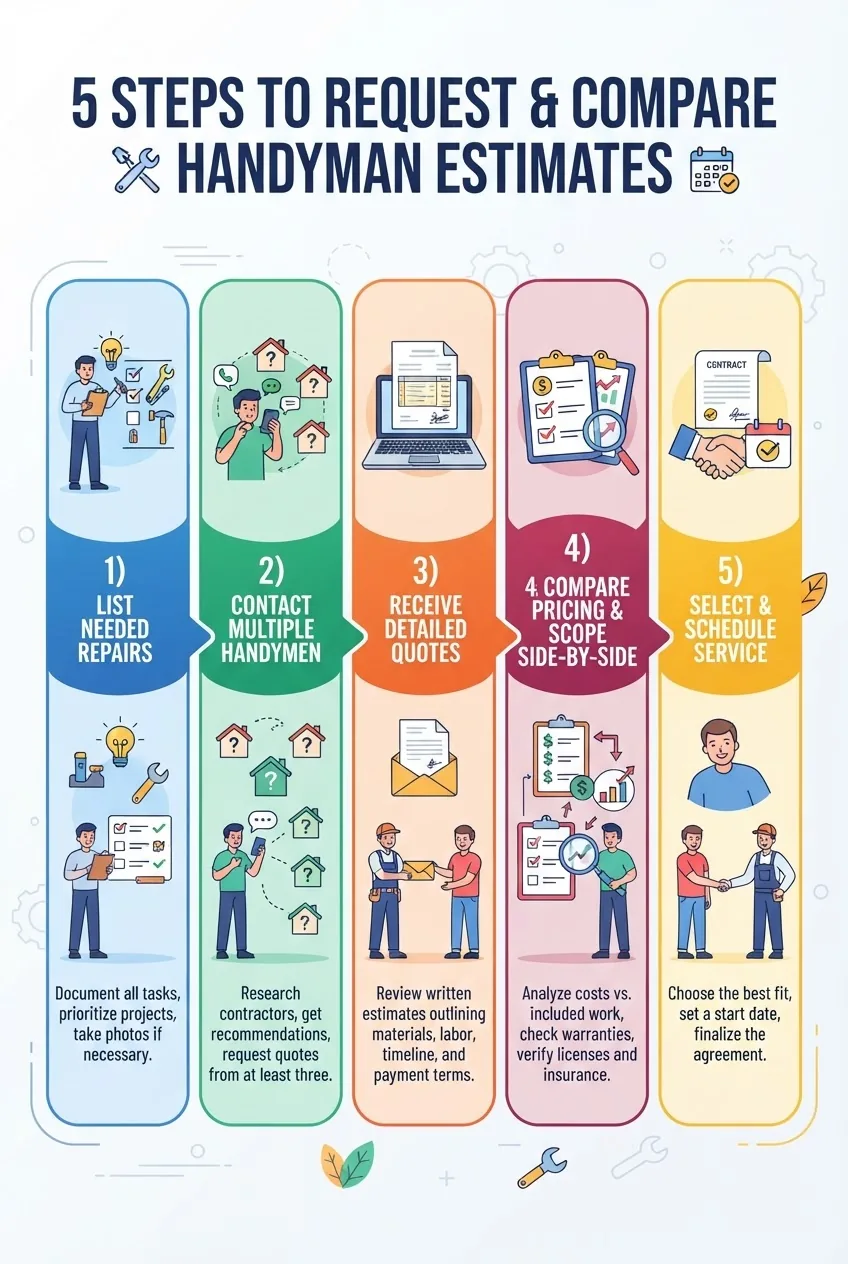
Checklist for reviewing a single estimate:
- Is the scope of work fully described and measurable?
- Are labor and materials itemized separately?
- Are exclusions and contingencies listed?
- Is the start date and duration included?
- Is there an explicit warranty and payment schedule?
- Are references and proof of insurance provided?
For standardization, use a home repair estimate template to collect comparable bids and reduce miscommunication.
home repair estimate template
Mini example: For replacing a bathroom vanity top, three estimates returned: $450 (single blended labor rate, vague material), $625 (itemized labor $75/hr, materials $225), and $710 (licensed subcontractor for plumbing included). Using the scoring checklist, the $625 bid scored highest for transparency and lowest post-job risk.
Transition: With comparison methodology in hand, review typical cost ranges and example estimates for popular Austin repairs to set realistic expectations.
Typical Home Repair Costs and Example Estimates in Austin, TX
Answer: Typical Austin handyman costs vary by job: small repairs $75–$400, medium projects $400–$2,500, and larger tasks nearing $3,000–$8,000 when permits, trades, or significant materials are needed; see the table for common examples and ranges.

Note: All figures below are approximate and include labor+materials; regional differences and job specifics change totals. According to a 2023 regional labor survey, Austin’s average handyman labor rate was $72/hr (median); material markups vary by supplier.
| Repair Type | Typical Scope | Estimated Cost (Austin) | Notes |
|---|---|---|---|
| Drywall patch & paint | Small hole repair, sanding, paint | $120–$450 | Hidden mold raises cost. |
| Deck board replacement | Replace 2–6 boards, stain | $200–$900 | Composite materials cost more. |
| Minor roof flashing repair | Replace flashing, reseal | $250–$950 | Access and pitch increase cost. |
| AC condensate line/installation service | Unclog, replace small parts | $150–$550 | Licensed HVAC work may be pricier. |
| Tile repair (small area) | Replace 6–20 tiles, regrout | $300–$1,200 | Pattern or specialty tiles add cost. |
| Fence post and gate repair | Replace posts, realign gate | $250–$1,000 | Concrete footings increase labor. |
| Minor plumbing repair (non-permit) | Fix leak, replace valve | $150–$600 | Permits/major reroute excluded. |
| Small carpentry project | Shelving, trim, cabinet touch-up | $200–$1,100 | Custom work pushes higher. |
| Bathroom vanity top replacement (handyman) | Remove/replace top, minor plumbing | $450–$1,200 | Licensed plumbing raises cost. |
| Large scope (permit-required) | Structural, electrical, major plumbing | $3,000–$8,000+ | Often requires contractors, not handymen. |
For broader context and national trends, see the average home repair estimates article which compares local Austin prices to national averages.
average home repair estimates
Specialized calculators: for bathroom or kitchen work, use targeted calculators before switching to contractor quotes.
bathroom renovations calculator
kitchen remodel cost estimator
Example estimate breakdown (deck boards example from earlier): Labor 2 hrs @ $75/hr = $150, Materials = $200, Disposal = $25, Travel = $25, Contingency = $25. Total = $425. This transparency is what to expect in clear estimates.
Transition: Knowing costs helps you avoid problems—next, learn how to ensure quality work and avoid common pitfalls with Austin handymen.
Tips to Ensure Quality Work and Avoid Common Pitfalls with Austin Handymen
Answer: Ensure quality by requiring written contracts, checking references, confirming insurance and warranties, monitoring work progress, and avoiding unusually low bids that lack detail or references.
Use these practical safeguards to reduce risk:
- Require a written agreement — must include scope, price, schedule, payment terms, warranty, and change-order steps.
- Validate insurance — confirm general liability and worker’s compensation with carriers; get certificate of insurance before work starts.
- Check references and recent work — ask for photos and contactable references for similar Austin jobs.
- Document site condition — take photos before work and after; keep records of communications and change orders.
- Watch for red flags — cash-only demands, extremely low bids, no verifiable references, pressure to sign immediately, or no written estimate.
- Retain partial payments — structure payments to hold final payment until satisfactory completion and signed acceptance.
- Confirm warranty terms — industry associations recommend at least a 30–90 day workmanship guarantee; longer for structural work.
- Use progressive acceptance — for multi-step jobs, sign off on each stage to confirm satisfaction and avoid disputes.
- Prefer local businesses — local handymen are easier to hold accountable and may have a stronger reputation in Austin neighborhoods.
Industry-standard advice from contractor associations emphasizes written agreements and transparent pricing; the National Association of the Remodeling Industry outlines best practices for warranties and clear contract terms.
National Association of the Remodeling Industry (NARI)
Example pitfall: a homeowner accepted a $200 “special deal” for extensive tile repair; the handyman subsituted lower-grade tile and left gaps, requiring rework costing $900. Low initial prices can mask poor materials, lack of permit compliance, or rushed workmanship.
Transition: Finally, translate these practices into a realistic budget and next steps for Austin homeowners.
Planning Your Home Repair Budget and Next Steps in Austin, TX
Answer: Create a prioritized repair list, estimate costs with a 10–20% contingency, stage projects by urgency, set aside emergency funds, and explore financing for large repairs or renovations.
Start by categorizing repairs as emergency, high-priority, and deferred maintenance. Allocate a monthly or annual maintenance budget—many experts recommend 1–3% of home value annually for upkeep.
Budgeting tools and resources:
- Use an Annual Maintenance Cost Guide to map recurring expenses and plan for seasonal work.
Annual Maintenance Cost Guide for Home Repair and Budget - Compare repair vs. replacement costs with an Estimated Replacement Cost Calculator when deciding whether to repair or upgrade.
replacement cost calculator - For large projects, review financing and loan options.
how to pay for expensive home repairs
financing and loan options - Verify insurance implications for large repairs with a house insurance estimator.
house insurance estimator - Consider long-term planning with a whole house renovation calculator if multiple repairs become a remodel.
whole house renovation cost calculator
Action checklist:
- List and prioritize repairs by urgency.
- Obtain 3 written itemized estimates for each prioritized job.
- Set a 10–20% contingency in your budget for surprises.
- Confirm insurance coverage and whether permits are required.
home repairs insurance guide - Schedule work in off-peak seasons where possible to save on labor premiums.
Transition: Use these steps to act now—get estimates, compare fairly, and secure a written agreement before repairs begin.
Conclusion
Summary: For home repair Austin TX, prioritize trusted local handymen who provide itemized, written estimates, proof of insurance, and clear warranties; expect Austin-specific cost drivers like climate-driven wear, labor rates, and seasonal demand; compare at least three bids using a consistent scope and a contingency plan.
Ready to get estimates? Start with your prioritized repair list, request three itemized quotes, and consult the Annual Maintenance Cost Guide for Home Repair and Budget to align short-term repairs with long-term planning.
Annual Maintenance Cost Guide for Home Repair and Budget