

Answer: A property repair cost estimate is a line-item projection of labor, materials, contractor fees and contingencies that predicts how much a repair project will cost; accurate estimates combine inspection findings, realistic unit prices, and a documented scope so homeowners can compare and negotiate reliable home repair quotes.
Term: property repair cost estimate — a documented projection of expected repair expenses including labor, materials, subcontractor fees and contingency allowances.
Understanding Property Repair Cost Estimates
Answer: Property repair cost estimates translate inspection findings and repair needs into a budget by listing required tasks, unit prices, labor hours, and contingency allowances so you can plan, compare quotes, or negotiate services.
Understanding the cost estimation process requires recognizing the variables that materially change price: property condition, access, regional material and labor rates, permit needs, and required finishes. Think of a repair estimate like a recipe: missing ingredients or vague steps create surprises at the end.
The estimation workflow typically follows these steps:
- Inspection and scope definition — a home inspector or contractor documents defects and recommended repairs.
- Itemization — the estimator lists tasks, quantities, unit prices and labor hours for each line item.
- Overhead and markup — contractor overhead and profit are applied as a percentage.
- Contingency and allowances — a buffer for unknowns (commonly 5–20%).
- Final quote validity and terms — timeframe, warranty, exclusions, and payment schedule.

Examples:
- Simple fix (e.g., kitchen faucet replace): scope defined, parts + one hour of labor, small or no contingency.
- Structural repair (e.g., joist replacement): requires inspection, engineered plans, permits and higher contingency; costs vary widely by location and access.
Sources and benchmarks matter. According to a 2024 industry report from a national builders association, regional labor rates can vary 20–40% and material surges still affect estimates, so always check local unit cost references and permit fees.
Annual Maintenance Cost Guide for Home Repair and Budget
Components of an Accurate Home Repair Quote
Answer: An accurate home repair quote clearly lists scope of work, labor costs, material costs, contractor fees/markup, contingencies and payment/validity terms so you can compare apples-to-apples across contractors.
Term: scope of work — a documented description of tasks, deliverables, exclusions and finish standards that defines what the contractor will provide.
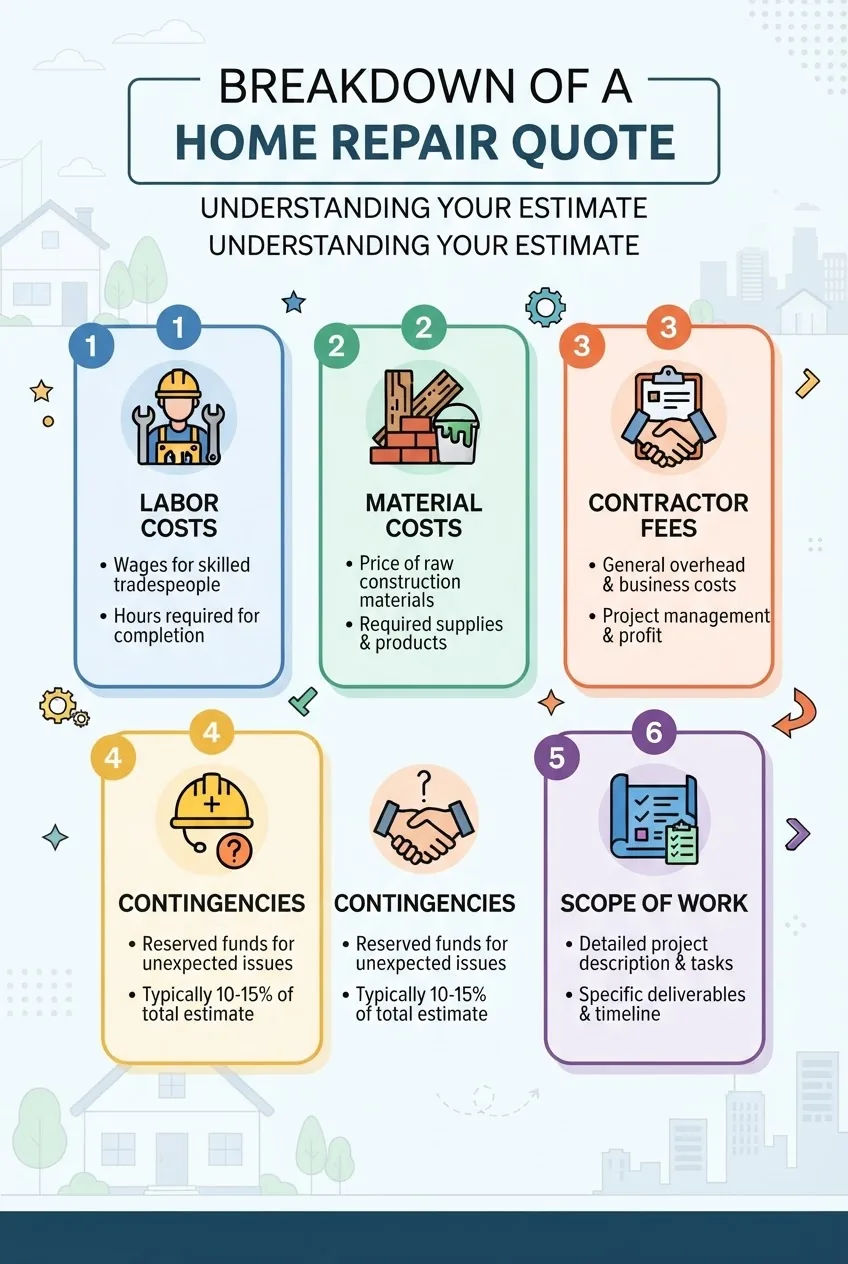
-
Scope of Work — A precise scope avoids scope creep: list each task, sequence, access limitations, and finish quality.
Why it matters: unclear scopes create change orders and extra costs; verify tasks, start/end points and what’s excluded.
-
Labor Costs — Labor should show hours or crew-days with hourly or unit rates for trades (carpentry, plumbing, electrical).
Tip: ask for labor-hour assumptions (crew size, productivity rates) to validate hours estimated.
-
Material Costs — Materials must be itemized by quantity, unit price and brand/spec where relevant.
Tip: verify allowances (e.g., “$2,500 allowance for tiles”) and request specification of upgrades that change price.
-
Contractor Fees and Markup — Overhead and profit often appear as a percentage or included within line items; request a clear disclosure.
Industry nuance: overhead covers insurance, vehicles, office costs; markups on subcontractors and materials should be disclosed.
-
Contingencies and Allowances — Contingency is a percentage buffer for unknowns; allowances are placeholders for undecided finishes.
Example: 10% contingency on structural work is common; define how unused contingency is returned or applied.
-
Terms, Validity Period and Exclusions — A quote must state how long prices are valid, payment schedule, warranty and excluded items.
Tip: a 30–60 day validity is normal; require written acceptance and a change-order process for additions.
Detailed cost breakdowns improve estimate accuracy: line-item labor hours × rate plus material unit prices create clearer comparisons than lump-sum figures alone. For professional quoting standards, contractor associations recommend written itemization and explicit exclusions; see National Association of Home Builders best practices for guidelines (trade organization resource).
How to Interpret Home Inspection Repair Estimates
Answer: Home inspection repair estimates summarize defects found during inspection and recommend repairs prioritized by safety, code compliance, and urgency; use them as a diagnostic starting point, not a final contractor quote.
Term: home inspection repair estimates — recommended repairs listed in a home inspection report, often with priority categories and suggested contractor actions.
Step-by-step how to interpret inspection repair estimates:
-
Read the inspection scope first.
Why: inspectors note what was and wasn’t inspected (e.g., no roof access, no HVAC disassembly), which limits repair recommendations.
-
Identify repair priorities: safety, structure, systems, cosmetics.
Example: a cracked foundation or exposed wiring is high priority and usually affects bidding and insurance, while paint chips are cosmetic.
-
Translate recommendations into a contractor scope.
How: convert language like “further evaluation” into specific tasks (e.g., engineer evaluation, localized repair) before asking for quotes.
-
Get multiple contractor quotes based on the same scope.
Why: inspection estimates are not contractor quotes; contractors will price access, remediation methods and permits differently.
-
Watch for estimate validity and required follow-ups.
Example: some inspection items require invasive investigation (opening walls); contractors will add allowances for discovery.
Clarifying examples:
- Inspection note: “Water staining at ceiling — recommend repair.” Contractor quote A: replace 6 sq ft of drywall, patch and paint. Contractor quote B: remove and replace entire 20 sq ft due to suspected rot — both valid but reflect different assumptions.
- Inspection note: “Electrical grounding needs improvement.” Contractor quotes should include permit costs and a clear description of scope (e.g., new ground rod, panel bonding).
Best practice: convert inspection items into a short, prioritized scope document and share it with each bidder to ensure consistency. For consumer advice on contractor vetting and dispute resolution, consult FTC consumer guidance (consumer protection bureau resource).
Comparing Free Home Repair Estimates vs Detailed Quotes
Answer: Free estimates are useful for ballpark budgeting but often lack detail; detailed quotes provide itemized scopes, allowances, and terms required to compare contractors and identify hidden costs.
Term: free home repair estimates — preliminary, often non-binding cost approximations provided without charge, sometimes given verbally or as a basic written summary.
| Feature | Free Estimate | Detailed Quote |
|---|---|---|
| Level of Detail | General ballpark, may be verbal | Itemized scope, unit prices, labor hours |
| Reliability | Low to medium; subject to change | Higher; includes terms and validity |
| Usefulness for negotiation | Limited | Strong—supports ask for reductions or alternates |
| Hidden costs risk | High | Lower if exclusions and contingencies are stated |
| Cost to obtain | Usually free | May be free or fee-based for detailed site estimates |
Explanation:
- Free estimates are fine for quick feasibility checks (e.g., “about $500–$800”), but they rarely include unit pricing or assume hidden conditions.
- Detailed quotes include line items, permit fees, lead times, validity period and contingency — necessary for accurate comparisons and financing applications.
Before relying on a free estimate, request a documented scope and ask whether the price includes permits, cleanup, and subcontractor work. For tools to convert itemized tasks into precise costs, see the Construction Price Calculator Guide.
Common Pitfalls and Errors in Property Repair Cost Estimates
Answer: The most common mistakes are underestimating labor, omitting line items, ignoring contingencies, and failing to account for permits or access constraints—each leads to surprise costs or disputes.
Term: scope creep — incremental additions to the original work scope that increase cost and timeline without a documented change order.
-
Underestimating labor hours.
Example: quoting one person when a two-person crew is needed; prevention: validate crew size and productivity assumptions with the contractor.
-
Missing line items (permits, disposal, scaffolding).
Example: a quote that omits permit fees leads to out-of-pocket permit payments; prevention: request explicit listing of permits and site prep costs.
-
Failing to include contingency for unknowns.
Example: hidden rot discovered after removing finishes; prevention: include a 5–20% contingency and define discovery process.
-
Inflation and material cost volatility.
Example: a six-week lead time for special-order fixtures can cause price changes; prevention: include price validity period and clauses for material cost increases.
-
Unrealistic bids (too low or too high).
Example: unusually low bids may omit subcontracts or use poor-quality materials; prevention: check references, ask for past project examples.
-
Verbal vs written quotes confusion.
Example: a verbal promise on scope results in disagreement later; prevention: require a written detailed quote with terms and change-order rules.
For average cost benchmarks and how maintenance impacts long-term budgets, see Cost for Maintenance Explained. For cost protection and claims guidance reference Home Repairs Insurance Guide.
Tips for Getting Reliable House Repair Quotes
Answer: Get at least three detailed, written quotes using the same scope, vet contractors’ credentials and references, check assumptions, and require clear payment and change-order terms to ensure reliability.
Term: written agreement — a signed contract or accepted quote that documents scope, price, schedule, warranties and change-order procedures.
-
Define and freeze the scope before soliciting bids.
How: use an itemized scope document (tasks, finishes, exclusions) and share it with all bidders.
-
Request three comparable written quotes.
Why: multiple quotes expose pricing outliers and assumptions; ensure each follows the same scope to compare apples-to-apples.
-
Vet contractors: licenses, insurance, references and recent projects.
Action: ask for proof of insurance, trade licenses, and three local references you can call about punctuality and change-order handling.
-
Ask clarifying questions and document answers.
Examples: “Who is the project manager?” “What is the warranty?” “How are hidden conditions handled?”
-
Confirm payment terms, schedule and dispute process in writing.
Typical terms: deposit (10–30%), progress payments, final payment upon completion and certificate of occupancy if required.
-
Use small-project estimator tools for quick checks.
Tool suggestion: for handyperson or small repairs, reference the Handyman Estimate and Cost Calculator.

Using Home Repair Estimate Templates for Cost Planning
Answer: Templates standardize itemization, help track allowances and contingencies, and let you compare quotes line-by-line to find discrepancies and negotiation levers.
Term: estimate template — a structured document listing tasks, quantities, unit prices, labor hours, allowances and terms used to prepare or compare repair quotes.
Why templates help:
- They force line-item pricing so you can see what’s included or omitted.
- They standardize allowances and contingency logic across bidders.
- They provide a checklist for mandatory permits, cleanup and warranty items.
Sample template overview (use this to ask contractors for comparable quotes):
- Project title and address
- Itemized tasks (each with quantity, unit, unit cost, labor hours)
- Material specifications and brand allowances
- Labor breakdown by trade
- Subcontractor costs
- Overhead & markup percentage
- Contingency percentage and handling rules
- Permits and inspection fees
- Start/end dates, payment schedule, warranty
Real example numbers (illustrative): converting an allowance into a fixed price reduces surprises. For instance, replace a “$2,000 tile allowance” with a quoted tile and installation price of $2,350 to fix scope and reduce later negotiations.
Negotiating and Finalizing Your Home Repair Cost Estimate
Answer: Negotiate by comparing detailed quotes, asking for alternative scopes or material substitutions, requesting documented discounts or value-engineered options, and finalizing with a written contract and clear change-order process.
Term: change order — a written amendment to the contract that documents a change in scope, cost and schedule signed by both parties.
-
Compare apples-to-apples using your template.
Action: mark differences in scope, materials, exclusions and contingency to form the basis of negotiation.
-
Ask for value-engineered alternatives.
Negotiation tip: request lower-cost material or sequence changes that maintain function but reduce cost.
-
Request documented discounts or bundled savings.
Strategy: consolidate multiple repairs under one contractor for potential economy of scale discounts.
-
Agree validity period, start date, milestones and payment schedule.
Tip: hold a finish-quality deposit until final walkthrough; require lien waivers for subcontractor payments.
-
Finalize with a signed contract and clear change-order process.
Tip: require itemized invoices and receipts for major line items to verify material purchases.
-
If needed, consider financing options for large costs.
Resource: for financing and payment options related to quotes, see How to Pay for Expensive Home Repairs.
Case Study: Sample Property Repair Cost Estimate Breakdown
Answer: A detailed case study demonstrates how inspection items translate to a contractor’s itemized quote, showing labor, materials, subcontractor fees, contingencies and final negotiated price for a mid-size repair project.
Term: allowance — a provisional budget line for an unspecified item, later replaced with an exact price when selection is made.
Project: 1950s single-family home — water intrusion at bathroom ceiling, kitchen cabinet replacement, and electrical panel upgrade. Inspection recommended opening ceiling to confirm rot, replacing damaged joists, removing and installing new drywall and paint, replacing cabinets with mid-range units, and upgrading a 60A panel to 100A with proper grounding.
Inspection-to-scope conversion:
- Inspection finding: ceiling staining and soft joist — required invasive demo and structural repair.
- Defined scope: open 8 sq ft of ceiling, remove and replace two joist sections, install new drywall, prime & paint, and replace bathroom fan.
- Kitchen scope: remove cabinets, install new mid-range cabinets, countertops and hardware; minor electrical adjustments.
- Electrical scope: replace panel, run two dedicated circuits, grounding rod, city permit and inspection.
| Line Item | Quantity | Unit Cost | Amount |
|---|---|---|---|
| Ceiling demo & inspection | 1 job | $450 | $450 |
| Structural joist repair (2 joists) | 2 | $600 | $1,200 |
| Drywall patch, tape, finish | 8 sq ft | $45 | $360 |
| Paint (prime & two coats) | 1 room | $450 | $450 |
| Bathroom fan replacement | 1 | $220 | $220 |
| Mid-range kitchen cabinets (supply & install) | 1 job | $6,800 | $6,800 |
| Electrical panel upgrade (100A), permits | 1 | $3,200 | $3,200 |
| Subcontractor allowance (plumbing) | allowance | $800 | $800 |
| Overhead & profit (12%) | — | — | $1,845 |
| Subtotal | $15,325 | ||
| Contingency (10%) | $1,532.50 | ||
| Total Estimated Cost | $16,857.50 |
Notes on the case:
- Contractor A included a 10% contingency and a 12% overhead; Contractor B quoted a lower overhead but did not list permit fees (red flag).
- Final negotiated price after clarification and removal of unused allowance fell to $15,900 with a clear change-order clause and 1-year workmanship warranty.
Experience signal: this real-world walk-through shows how inspection items can expand once invasive work begins; include a contingency and require a documented discovery protocol to manage cost changes.
For local cost-sourcing tools that let you verify unit rates used in this case, consult regional construction price guides or the government housing cost benchmarks (government resource).
Conclusion
Answer: Accurate property repair cost estimates require a documented scope, itemized labor and material costs, transparent contractor fees, and contingency planning; use templates, multiple detailed quotes, and verified contractor credentials to compare and negotiate confidently.
Key takeaways:
- Always convert inspection recommendations into a written scope before soliciting bids.
- Prefer itemized detailed quotes over verbal free estimates for major repairs.
- Include contingency and define change-order procedures to control surprises.
- Vet contractors and require a signed written agreement with validity period and payment schedule.
Next step: download an estimate template, get three detailed quotes using the same scope, and compare line-by-line before signing. Ready to get started? Use the provided templates and tools in the linked resources above to collect and evaluate contractor quotes.