
By the end of this guide you will be able to determine senior eligibility, prepare and submit a Section 504 application, compare loans vs grants, and plan repair budgets. Realistic time: 2–6 weeks from preparation to submission (varies by local office). Skill level: basic paperwork and phone/email communication; caregiver or caseworker assistance recommended when mobility or cognition is limited.
Overview of the Section 504 Home Repair Program for Seniors
Section 504 Home Repair Program refers to a USDA Rural Development initiative providing low-interest home repair loans and grants to very low- and low-income homeowners in eligible rural areas. This hands-on guide centers on how seniors and their caregivers can use Section 504 to address safety and accessibility issues—think leaky roofs, failing heating, or grab-bar-ready bathrooms—without taking on high-interest debt.
The program has two core paths for homeowners: a direct repair loan (up to a set maximum) and a grant option for qualifying seniors aged 62 and older who cannot repay a loan. Both are administered by local USDA Rural Development offices and are intended to bring homes up to safe, sanitary, and useful living conditions.
How this guide reads: practical, step-based, and case-oriented. It includes a real case study, described official-form excerpts, and step-by-step application instructions so you can act confidently.
What counts as “rural”? USDA defines eligible areas in local RD maps; many small towns and some suburban fringes qualify, but city centers often do not. According to a 2023 USDA Rural Development data summary, thousands of home repair loans and grants were issued to seniors nationwide, showing continuing program activity and funding availability (source type: federal program data summary).
Transition: now that you know what the Section 504 Home Repair Program is, the next section walks through exactly who can qualify and the common eligibility details for senior citizens.
Eligibility and Qualification Criteria for Senior Citizens
The eligibility check is a gatekeeper step. Below I list each requirement with practical notes from working with seniors. For nuanced cases (e.g., shared ownership, mobile homes), read the notes carefully.
-
Age requirement (for grants):
Seniors aged 62 and older are eligible for the Section 504 grant option if they cannot repay a loan. Grants are specifically targeted at elderly homeowners with very low incomes.
-
Ownership and occupancy:
Applicant must own and occupy the home as a primary residence. Title or deed evidence is required. If the property is jointly owned (e.g., with adult children), the applicant must still be on title and demonstrate primary residency.
-
Income limits:
Income thresholds are set by household size and county; they vary by location and are updated annually. According to a 2024 USDA Rural Development notice, “very low income” is typically below 50% of area median income, while “low income” may extend to 80% of area median income (source type: federal income limits table). Local USDA staff will verify current caps.
-
Geographic eligibility (rural requirement):
The home must be in a qualifying rural area as defined by USDA Rural Development. Use your county lookup on the USDA site or contact the local RD office. For borderline addresses, ask the RD specialist for an official determination.
External resource: USDA Rural Development provides area eligibility maps and local office contacts.
-
Property type and mobile home rules:
Single-family detached homes and certain manufactured/mobile homes on owned land are eligible. Mobile home eligibility depends on permanent foundation requirements and local RD rules; if the home is rented land or in a park, it often disqualifies. See the next section for mobile-home specifics.
-
Ability to repair (loan capacity):
For loans, USDA will evaluate the household’s ability to repay based on income, monthly expenses, and existing debts. Loan terms are designed to be affordable; applicants with limited income may qualify for grants instead.
-
Credit and prior debts:
USDA does not demand perfect credit but will review credit history to determine loan feasibility. Past bankruptcies require documentation and explanation. Minor derogatory items are often workable if income covers repayment and the applicant demonstrates stability.
-
Scope of need (safety/essential repairs):
Priority is given to repairs that affect safety, sanitation, and structural integrity—roofing, plumbing, heating, electrical hazards, wheelchair access—rather than luxury remodels.
-
Documentation readiness:
Applicants must provide photo ID, proof of income (Social Security, pensions), recent bank statements, proof of ownership (deed, tax bill), and contractor estimates or invoices. See the application section for a full required-document checklist.
-
Local program variations and waiting lists:
Local USDA offices may have waiting lists when funds are limited. Some counties receive more applications than they can fund immediately, so early contact and complete paperwork improve chances. According to a 2023 USDA Rural Development regional memo, waiting times vary from immediate processing to several months (source type: regional program memo).
Transition: eligibility confirmation leads directly to deciding what repairs are allowed and what restrictions apply—read on to match your repair needs to program allowances.
Types of Repairs Covered and Restrictions
Below are grouped categories of common repairs, with examples and quick notes about restrictions. Use this to prioritize your repair list before applying.
- Safety and emergency repairs
- Roof replacement or major repairs (leaks affecting structure)
- Severe electrical hazards, rewiring to code
- Heating system replacement or safe repairs
- Health and sanitation
- Septic system repairs/installation
- Plumbing fixes to ensure potable water and safe sewage
- Mold remediation when linked to structural leaks
- Accessibility modifications
- Ramps, widened doorways, grab bars, roll-in showers
- Bathroom modifications to reduce fall risk
- Stair lifts in cases where no alternative access exists
- Note: Accessibility work must be tied to a demonstrable functional need
- Structural repairs
- Foundation stabilization and major framing repairs
- Replacement of floor systems where safety is compromised
- System replacements and upgrades
- Water heaters, HVAC, and limited energy-efficiency upgrades if essential
- Windows/doors replacement when related to security or climate control for health reasons
- Interior cosmetic work (restricted)
- Minor interior painting or non-essential aesthetic upgrades are rarely approved unless tied to a health or safety issue.
- Mobile homes repair and servicing
- Eligible if the manufactured home is permanently sited on land you own and meets current local RD specifications.
- Replacement of skirting, tie-downs, or adding insulation may be allowed when linked to safety/energy concerns.
- If the mobile home is in a rent lot or park, the program may decline eligibility—confirm with the local office.
- Examples with cost context
- Simple ramp installation: $1,500–$5,000 (varies widely by site) — see Cost of Bathroom Renovations Calculator for Budget Planning for bathroom-specific modification ranges.
- Full roof replacement: $6,000–$15,000 depending on home size and materials — consult Cost for Maintenance Explained with Average Home Repair Estimates for typical repair cost baselines.
- Kitchen safety updates (non-structural): eligible only when tied to health/safety or accessibility concerns; see Home Improvement House Guide for Renovation and Repair Projects for scope planning.
- Installation and setup costs
- Contractor mobilization and basic disposal fees are typically allowed; consult Installation Cost Guide for Accurate Home Repair and Setup Pricing for line-item estimates.
- Old homes and historic issues
- Work on older homes is eligible if it addresses health/safety; for larger rehabilitation projects, note that Section 504 targets repairs rather than total historic restorations—see Old Home Renovation Guide for Managing Repair Costs and Updates for managing expectations on older homes.
Transition: with repair types and limits clear, you’ll need to weigh the financial choices—loans vs grants—and how each affects your budget and repayment expectations.
Financial Assistance Options: Loans vs Grants under Section 504
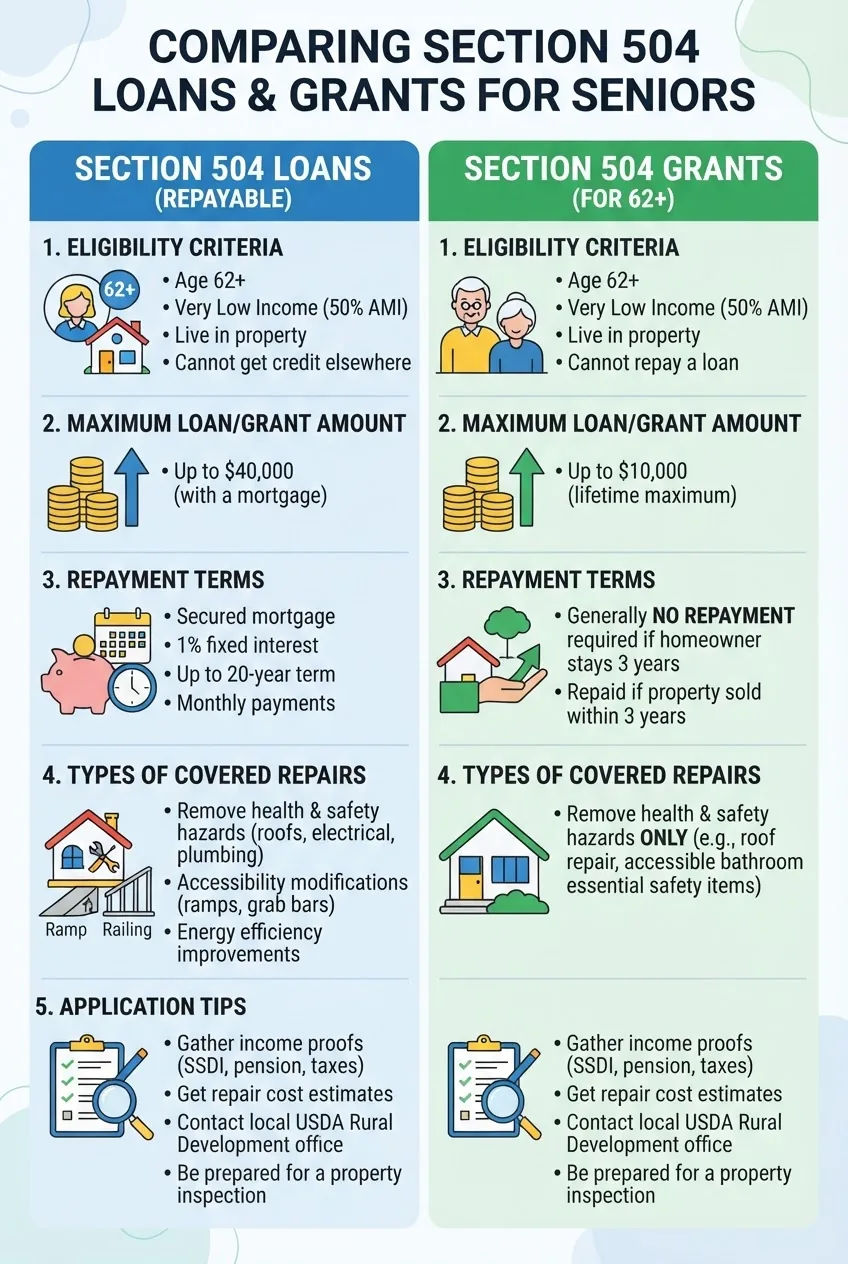
This section compares the two financial paths the program offers. Read both sides, and use the comparison table to decide which route fits your situation.
| Feature | Section 504 Loan | Section 504 Grant |
|---|---|---|
| Maximum amount | Typically up to $40,000 (varies by year/local office) | Typically up to $10,000 for eligible seniors (amounts vary) |
| Interest/terms | Low-interest, long-term loans (e.g., 1%–2% fixed; loan term up to 20 years depending on amount) | No repayment required (for qualifying seniors unable to repay loans) |
| Repayment obligation | Borrower repays monthly per schedule; may be secured by a lien on property | No repayment if eligible; may require proof of inability to repay |
| Best for | Seniors who can afford modest monthly payments to fund larger repairs | Seniors with very low income and no ability to repay loans |
| Typical use | Major repairs (roof, HVAC, foundation) and bundled projects | Cost-limited safety or accessibility repairs |
Explanatory notes and trade-offs:
-
Loan size versus monthly cashflow:
A loan can cover larger projects (e.g., whole-roof replacement), but even a low fixed rate creates a monthly obligation. When I helped a widow evaluate a $25,000 low-interest loan at 1.5% for 20 years, her monthly payment was approximately $120 — manageable when compared to deferred repair risks that could force a move. Use contractor quotes to estimate monthly payment vs. rent/relocation costs.
-
Grant eligibility strictness:
Grants are limited, designed for those truly unable to repay. Be prepared to document fixed income sources (Social Security, VA, pension) and unavoidable expenses (medical, dependent care). In many offices grants are prioritized for the oldest and most vulnerable applicants.
-
Documentation and lien expectations:
Loans typically require a lien on the property to secure repayment. If your estate planning must keep the home transferable, consult a financial counselor before accepting a lien. For grants, liens are usually not placed but the USDA will verify inability to repay.
-
Estimating project vs. financing cost:
Before choosing, assemble contractor estimates and compare them to loan limits and grant caps. Use the Home Repair Estimate Template for Accurate Project Cost Planning to organize quotes and line items. If you plan larger remodels beyond Section 504 scopes, consult the House Renovation Price Guide for Accurate Home Remodeling Costs.
-
When to combine funds:
Sometimes seniors pair a small personal fund with a Section 504 loan to cover a deductible or upgrade that is outside grant limits. If considering multiple funding sources, track each source’s allowable uses and reporting requirements.
For help comparing bids and financing, consult the Home Remodel Quotes Guide for Accurate Project Cost Estimates.
Transition: ready to apply? The next section gives a step-by-step application process tailored for seniors with concrete timelines and document lists.
Step-by-Step Application Process for Seniors
This section is the practical heart of the guide. Follow each step in order. Expect to spend 1–3 weeks gathering documents and 2–8 weeks for USDA processing depending on local workloads. Below are steps with tips based on common senior-candidate issues.

-
Contact your local USDA Rural Development office — call or visit the county RD office.
Find the local office using the USDA Rural Development website or the number listed on local county social services pages. Ask for the Section 504 program specialist and request the latest application packet and area income limits. Tip: request both electronic and paper copies so a caregiver can help complete forms.
External resource: USDA RD state and local office listings.
-
Collect required identification and ownership documents.
Required items typically include government photo ID, Social Security number documentation, deed or title, recent property tax bill, and proof of homeowner’s insurance (if available). If you don’t have a deed, obtain a copy at the county recorder’s office; many seniors find a brief telephone appointment with a county clerk helps speed retrieval.
-
Assemble proof of income and expenses.
Gather 2–3 months of bank statements, current Social Security award letters, pension statements, proof of any rental income, and records of regular medical expenses. For self-employed seniors, prepare a recent tax return and profit/loss summary. USDA will calculate gross monthly income and verify against area limits.
-
Secure contractor estimates and scope-of-work documents.
Obtain at least one detailed contractor estimate (two preferred). Each should list materials, labor, permits, and a clear timeline. Use the Home Repair Estimate Template for Accurate Project Cost Planning to standardize quotes. Make sure contractors are licensed where required and provide references—USDA often requires proof of licensure if local law mandates it.
-
Complete the official application forms.
Fill out the USDA application packet: Request form RD 410-4 (or local equivalent) and supporting questionnaires. When I helped a senior fill the forms, I transcribed income lines directly from statements to avoid arithmetic errors that commonly delay processing. Below I describe what an excerpt from RD 410-4 looks like and what you should expect to complete:
Excerpt description: RD 410-4 asks for applicant name, SSN, property address, household composition, gross monthly income with line items (SSA, pensions, wages), and a certification signature line with date. Photocopy ID and attach all income statements as exhibits.
Tip: sign and date every form and initial corrections; unsigned forms are a common cause of delay.
-
Undergo credit and eligibility screening with the RD specialist.
The RD officer will do a credit and property assessment. Be prepared to explain any credit events (bankruptcy, foreclosure) and to provide proof of disability or medical expenses if applying for grant consideration. Typical timeframe: credit and verification step takes 1–3 weeks.
-
Receive conditional approval and work with USDA on scope refinements.
If approved conditionally, USDA will issue a Notice of Conditional Commitment detailing approved amount, whether it’s a loan, grant, or a mix, and required reparative work. Review carefully; this is your opportunity to verify contractor details, schedule, and budget line items. If the approval is partial, ask for a written explanation and required remedy steps.
-
Sign loan/grant closing documents and secure contractor scheduling.
Loan closing may require meeting at a local office to sign promissory notes and lien documents. Grants require certification of inability to repay. After closing, schedule contractor work within the USDA-approved scope and timeline. Keep copies of all signed closing documents and contractor agreements.
-
Inspections and payments — coordinate inspections and disbursements.
USDA requires inspections at key milestones (e.g., foundation work complete, roof dried-in, final). Payments to contractors may be issued after USDA inspection or by check to you for direct payment—follow the RD specialist’s instructions. Retain receipts and change orders; unauthorized changes can delay final payment.
-
Final inspection and file closure.
Once work is complete and final inspection passes, USDA will close the file. If a loan applies, your repayment schedule begins per the promissory note. For grants, you receive written confirmation that no repayment is due.
-
Appeals, denials, and re-submission.
If denied, request a written denial explanation and the appeal steps—often there is a local review or ability to supply additional documentation. A common remedy is supplying clearer medical expense records or a second contractor quote. If denied for geographic reasons, check adjacent county eligibility.
Practical timelines: preparation (documents & quotes): 1–3 weeks; USDA intake & verification: 2–8 weeks; work schedule varies by project scale. For urgent safety repairs, ask the RD specialist about expedited reviews.
Transition: after learning the application steps, you should know where to find supplemental help and community resources if Section 504 alone isn’t enough.

Additional Senior Assistance Programs and Resources
Section 504 can be the primary resource, but combining assistance often gives the best result. Below are federal, state, and nonprofit resources that commonly work alongside USDA assistance.
Federal resources:
- Department of Housing and Urban Development (HUD) — HUD offers home repair resources and cross-links to local public housing agencies; consult HUD for programs like HOME or local rehabilitation grants (source type: federal housing portal).
- Area Agencies on Aging (AAA) — Local AAAs often coordinate volunteer repair programs or provide minor home modification grants targeted at seniors.
State and local resources:
- Many states run minor home repair and weatherization assistance programs; check your state housing agency or local community action agency.
- Municipal senior services sometimes provide handyman vouchers or referrals for low-cost labor.
Nonprofit organizations and volunteer programs:
- Habitat for Humanity (repair arm) — operates in many communities to assist low-income seniors with critical repairs.
- Rebuilding Together — a national nonprofit focusing on safe housing repairs for seniors and veterans.
- Local faith-based volunteer groups — often provide free labor for ramps and other simple accessibility projects.
Practical resource list (contact these early):
- Local USDA Rural Development office — first contact for Section 504.
- County Area Agency on Aging — for case management and local program referrals.
- Local housing authority or community action agency — for emergency repair vouchers or weatherization.
Transition: after evaluating programs and resources, you’ll need solid management practices to keep repairs affordable and safe—see the next section for hands-on tips and budgeting strategies.
Tips for Successfully Managing Home Repairs as a Senior
Managing repairs requires planning, budgeting, and safety-first choices. Below are practical steps and tools I recommend.
-
Create a prioritized repair list — rank by safety, function, then comfort.
Start with items that prevent immediate danger (roof leaks, broken steps) and move to accessibility needs (bathroom grab bars) before cosmetic upgrades. Keep the list in document form and add contractor estimates next to each line item.
-
Build a simple repair budget — set a contingency of 10–20%.
Example: a $10,000 project should include a $1,000–$2,000 contingency. Use the Annual Maintenance Cost Guide for Home Repair and Budget to plan long-term costs. For detailed cost estimation tools, consult the Construction Price Calculator Guide for Accurate Cost Estimation.
-
Compare multiple quotes — do not accept the first price without verification.
Obtain at least two to three written quotes, check references, and verify licenses and insurance. Use the Handyman Estimate and Cost Calculator for Home Repair Services to sanity-check hourly rates.
-
Plan for insurance and valuation issues — check coverage before starting work.
Confirm that homeowner’s insurance (or a related policy) covers relevant damage. For insurance valuation and replacement cost issues, see the Estimated Replacement Cost Calculator for Home Insurance Values.
-
Track invoices, permits, and change orders meticulously.
Use a simple spreadsheet or the Home Repair Estimate Template for Accurate Project Cost Planning to keep receipts and dates organized.
-
Use cost calculators for major decisions.
Estimate major system replacements and remodel implications with online tools like the Whole House Renovation Cost Calculator for Accurate Budget Planning when considering projects beyond Section 504 scope.
-
Consider phased repairs if funding is limited.
Break projects into safety-first phases. For example, replace a failing roof first, then address interior finishes in a later phase. Keep an up-to-date priority list and contractor availability window.
-
Look for volunteer or low-cost labor for simple tasks.
Ramps, painting, and some accessibility installs are often handled by local nonprofits or volunteer groups—search local AAAs and Rebuilding Together chapters.
-
Use technology and apps for contractor vetting.
When selecting services, consult the Home Repair App Guide for Finding Reliable Handyman Services to locate vetted professionals.
-
Annual maintenance planning and insurance review.
Schedule an annual checklist for HVAC servicing, gutter cleaning, and water heater inspections to prevent major failures. See the Annual Maintenance Cost Guide for Home Repair and Budget for budgeting templates. Also consider the Tankless Water Heater Maintenance Cost Guide for Annual Budgeting and Water Heater Service Cost Guide for Inspection and Tune-Up Pricing for appliance-specific planning.
-
Get help estimating smaller tasks quickly.
Use local examples like Home Repair Austin TX Guide for Trusted Local Handyman Estimates as templates when researching local contractor rates.
-
When comparing insurance implications, use an estimator.
Check replacement cost and coverage changes using the House Insurance Estimator for Calculating Home Coverage Costs.
-
Use project calculators for final budgeting.
Before finalizing financing, test budget sensitivity using the Handyman Estimate and Cost Calculator for Home Repair Services and Estimated Replacement Cost Calculator for Home Insurance Values to see how unexpected costs influence monthly payments.
-
When sourcing large contractor work, validate detailed quotes.
For remodeling larger than basic repairs, reference the House Renovation Price Guide for Accurate Home Remodeling Costs and consider additional financing resources like How to Pay for Expensive Home Repairs with Financing Options if repairs exceed Section 504 scope.
Transition: armed with these tips, you’ll avoid common application and project mistakes described next.
Additional internal resources: Home Repairs Insurance Guide for Coverage and Cost Protection, Handyman Estimate and Cost Calculator for Home Repair Services, and Home Repair App Guide for Finding Reliable Handyman Services.
Additional links for precise cost tools: Tankless Water Heater Maintenance Cost Guide for Annual Budgeting, Water Heater Service Cost Guide for Inspection and Tune-Up Pricing, and Handyman Estimate and Cost Calculator for Home Repair Services.
Key internal anchor for detailed budgeting: Annual Maintenance Cost Guide for Home Repair and Budget
Frequently Asked Questions about Section 504 Home Repair Program
Below are concise answers to the most common questions seniors and caregivers ask.
What is the Section 504 Home Repair Program for seniors?
The Section 504 Home Repair Program provides USDA Rural Development loans and grants to eligible low-income homeowners in rural areas to make repairs that ensure safety, sanitation, and accessibility; grants specifically assist seniors 62+ who cannot repay a loan. (Source type: federal program description.)
How does the Section 504 loan differ from the grant under this program?
Loans are low-interest, repayable over long terms and can cover larger projects; grants are limited, reserved for applicants 62+ who cannot repay and have strict income/documentation requirements. Both are administered by local USDA RD offices. (Source type: USDA program guidance.)
Are mobile homes eligible for repair assistance under Section 504?
Manufactured/mobile homes can qualify if permanently sited on owned land and meeting USDA foundation and local code requirements; homes in rental park lots often do not qualify—confirm with your local RD office. (Source type: USDA eligibility notes.)
How can seniors apply for home repair grants through the Section 504 program?
Contact your local USDA Rural Development office, request the Section 504 application packet, assemble proof of income, ownership, contractor estimates, and submit completed forms; ask for grant consideration if age 62+ and unable to repay. (Source type: USDA intake procedure.)
What types of home repairs are covered by the Section 504 Program?
Covered repairs focus on safety, sanitation, accessibility, and structural integrity—roofing, heating, septic, plumbing, accessibility ramps, and foundation fixes; cosmetic-only projects are rarely approved. (Source type: USDA program description.)
How long does the Section 504 application process typically take for seniors?
Preparation takes 1–3 weeks; USDA verification and conditional approval commonly take 2–8 weeks depending on local office workload; project timelines vary by repair scope. Expedited reviews may be possible for urgent safety issues. (Source type: local RD processing guidance.)
What should I do if my Section 504 loan application is denied?
Request a written denial with reasons, supply missing documentation (income, medical costs), consider appeals or re-application with corrected info, and explore local nonprofit or state programs for interim help. (Source type: USDA appeals guidance.)
Is the Section 504 program the only assistance available for seniors needing home repairs?
No. Seniors can combine Section 504 with HUD programs, state/local repair grants, Area Agency on Aging services, and nonprofit programs like Rebuilding Together and Habitat for Humanity (source type: federal and nonprofit resource lists).
Hands-On Case Study: Mrs. Alvarez
Mrs. Alvarez, age 74, lives alone in a small rural house she’s owned 30 years. Her roof had active leaks and the furnace failed. Steps taken:
- Initial contact: Called local USDA RD; requested Section 504 packet.
- Document prep (2 weeks): Gathered Social Security award letter, deed, bank statements, two contractor quotes ($12,400 and $13,100) for roof and furnace replacement.
- Application completion (1 week): Completed RD forms, attached quotes, medical expense documentation, and signed application.
- USDA verification (3 weeks): RD issued conditional approval for a $12,400 low-interest loan at 1.25% for 20 years; monthly payment estimated ≈ $57.
- Work and inspection (4 weeks): Contractor completed replacement; RD performed final inspection and closed file.
Outcome: Mrs. Alvarez avoided displacement, had safe heating restored, and maintained the home. Lesson: early documentation and two clear quotes shortened her approval time.
Transition: common mistakes below help you avoid pitfalls I’ve seen repeatedly in practice.
Common mistakes and how to avoid them
I once assisted a senior who delayed tax and bank statement collection; the RD office placed the application on hold for three weeks while awaiting documents. That delay cost additional months on the waiting list. From that and many other cases, here are the most common failures and how I helped fix them:
- Missing signatures: I saw forms rejected due to missed signature pages. Always initial corrections and sign every page; double-check before submission.
- Vague contractor quotes: Quotes without line-item materials and labor caused scope disputes. Request and keep detailed, dated quotes with contractor contact info.
- No proof of property ownership: Some seniors assumed tax bills suffice; RD often wants the recorded deed—order it early from the county recorder.
- Not verifying mobile home siting: One applicant assumed a mobile home on leased land qualified; RD denied due to lot rental—confirm siting eligibility with RD staff first.
- Failure to document medical or disability-related expenses: For grant consideration, I’ve had seniors denied for not showing recurring medical outflows. Keep receipts and statements of regular medical payments.
Checklist before you submit your Section 504 application
- Proof of identity (government ID) and Social Security documentation
- Deed/title or county-recorded proof of ownership
- Recent property tax bill and utility bill
- Two–three contractor estimates with line items
- Proof of income (SSA letters, pensions) and 2–3 months bank statements
- List of regular medical or disability-related expenses (if applying for grant)
- Signed and dated USDA application forms (all pages)
- Contact info for a family member or caregiver and permission to share information if needed
When to call in a professional
Call a housing counselor, attorney, or certified financial counselor when you face any of the following: complex title issues, estate/LIHTC conflicts, potential foreclosure, or when a lien would jeopardize a planned sale/transfer. For structural engineering questions (foundation, severe settling), hire a licensed structural engineer for written reports to submit to USDA.
Transition: final summary below and next steps.
Conclusion
Key takeaways: The Section 504 Home Repair Program offers seniors a realistic path to safe, accessible housing through low-interest loans or grants for those unable to repay. Start by contacting your local USDA Rural Development office, assemble ownership and income documents, secure at least two detailed contractor estimates, and prioritize safety-related repairs. Use the budgeting and cost-estimation tools linked throughout this guide to validate quotes and plan contingencies.
Next steps: gather your documents using the checklist above, call your local USDA RD office to request the Section 504 packet, and schedule two contractor quotes within two weeks. If you need more budgeting help, consult the Annual Maintenance Cost Guide for Home Repair and Budget to map out costs and cashflow.
Call to action: Contact your local USDA Rural Development office today and request the Section 504 application packet; if you need help gathering documents or evaluating quotes, reach out to your Area Agency on Aging or a trusted caregiver to start the process within the next 7–14 days.