
By the end of this hands-on guide you’ll have formed a legal entity, prepared and filed a Certificate of Organization, and started the permit process to como sacar un permiso para poner un negocio as a contractor. Expect 2–6 hours of focused work for a basic filing (plus state processing time), and this guide assumes beginner-to-intermediate administrative skills.
Before you start, gather documents, state-specific fee amounts, and access to a computer with internet for online filings.
Before you start
- Photo ID for owners (passport or driver’s license)
- Proposed business name (3–5 alternatives) and phone for name searches
- Articles/Certificate draft and basic member/officer information
- Payment method ready for state filing fees (credit card or check)
- Employer Identification Number (EIN) application access or plan to apply
- Contact for a Registered Agent (individual or service)
- Estimated start date and primary business address
- Time block: 2–6 hours for preparation; state processing varies (same-day to 4+ weeks)
Understanding Legal Entities and Their Importance for Contractors
Choosing a business structure determines taxes, liability protection, registration steps, and how you later obtain licenses and permits. For contractors, the right structure affects risk management (liability for jobsite incidents), bonding, insurance requirements, and how state licensing boards view your business. Below I compare common types with contractor-focused notes.
| Entity Type | Liability | Tax & Paperwork | Contractor considerations |
|---|---|---|---|
| Sole Proprietorship | No separation — owner personally liable | Simple taxes (Schedule C), minimal filings | Harder to get large contracts or bonding |
| Partnership | Shared liability unless LLP/LLC | Pass-through taxes; partnership return | Agreement needed for work split and liability |
| LLC (Limited Liability Company) | Limited liability for members | Flexible taxation (sole, partnership, S or C corp rules) | Preferred for contractors: liability protection and easier to bond |
| Corporation (C or S) | Limited liability | More complex taxes and corporate formalities | Best for growth, hiring payroll, and investor relationships |
This comparison emphasizes practical contractor concerns: bonding, insurance, and how licensing boards may require entity documents. If you plan to bid on public contracts, an LLC or corporation is usually preferred.
Transition: Now that you understand the stakes, follow the next section for the hands-on, step-by-step filing workflow.
Step-by-Step Guide to Forming a Legal Entity for Your Business

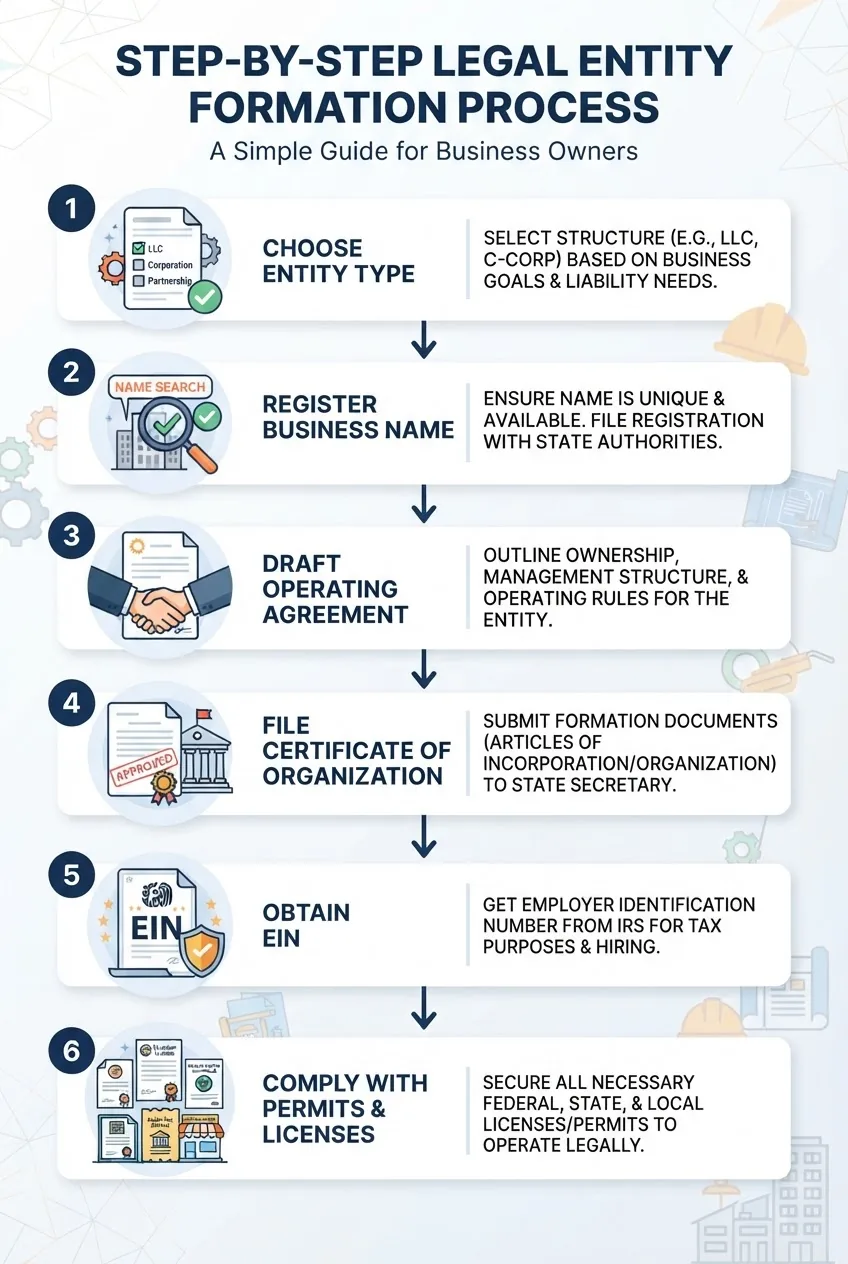
Follow these numbered, action-first steps. Each step lists exact data fields, timing, and common state variations. If you want to complete online registration after the entity formation walkthrough, see the
business registration application guide.
- Decide your legal entity — Choose LLC, Corporation, Partnership, or Sole Proprietorship. Note: for contractors I recommend an LLC or Corporation because they provide limited liability and make bonding and insurance clearer. Record your decision and reasons (tax, liability, funding). Time: 30–90 minutes.
-
Confirm name availability and format — Run a state name search on the Secretary of State site, check trademark databases, and ensure the name includes required words (e.g., “LLC” or “Inc.”). Keep 3 backup names. Example: if your primary choice is “Riverbend Contractors LLC,” confirm no exact matches and reserve if your state allows name reservation (typically $10–$50 for 30–120 days). Time: 10–30 minutes.
Reserving a name (if needed)
Some states allow a short reservation window; filing a reservation is not the same as formation but protects the name while you prepare documents.
- Collect required organizer/member/officer information — Prepare full legal names, addresses (principal and mailing), roles (member, manager, officer), and business start date. For multi-member LLCs list ownership percentages. This exact data is required on the Certificate of Organization/Articles of Organization. Time: 20–40 minutes.
- Draft an Operating Agreement or Corporate Bylaws — Even if not required by the state, prepare a simple operating agreement for LLCs or bylaws for corporations. Include: ownership percentages, voting rules, profit distribution schedule, decision thresholds (e.g., majority vs supermajority), and dissolution steps. Use 90–120 days as an internal deadline to finalize if you file first. Time: 1–3 hours (template).
- Decide on a Registered Agent — Appoint an in-state Registered Agent (individual or commercial service). The agent must have a physical street address in the state and be available during business hours to accept legal documents. Typical annual fee for a commercial agent: $99–$299. Think of the registered agent as your business’s official mailbox and legal contact. Time: 10–20 minutes.
-
Prepare the Certificate of Organization (filing document) — This step focuses on the exact fields states commonly require. See the detailed drafting section below for a sample and a hypothetical contractor example. Required data typically includes:
- Entity name (with LLC/Inc suffix)
- Purpose statement (many states allow a general purpose: “to engage in any lawful business”)
- Principal office address and mailing address
- Registered agent name and address
- Organizer name and signature
- Duration (perpetual or fixed term)
- Member-managed vs manager-managed indication for LLCs or names of officers for corporations
Time: 30–90 minutes to draft; allow state processing time after filing.
-
File the Certificate of Organization with the state filing office — You can file online or by mail. Typical filing fees range from $50 to $500 depending on state and entity type. Online filings are usually faster (same-day to 10 business days); mail filings take longer. Use the state’s business filing portal on the Secretary of State site. For an external reference on taxation and basic structure, use the Small Business Administration:
SBA guidance on business structures.
Time: filing 15–30 minutes; processing depends on state. - Pay state fees and obtain confirmation — After filing, download and save the stamped Certificate of Organization and acceptance email. Print two copies and store the certified copy with your operating agreement and insurance docs. If you used expedited processing, keep the receipt. Time: immediate after acceptance.
-
Apply for an EIN (Employer Identification Number) — Obtain an EIN from the IRS online (fastest), by mail, or by fax. According to a 2023 IRS guideline, most online EIN applications are processed immediately. See the dedicated EIN section below for step instructions and a direct link to the IRS:
IRS EIN information.
Time: 10–20 minutes online. - Register for state tax accounts and payroll (if applicable) — If you will hire employees or collect sales tax, register with your state’s Department of Revenue or equivalent. Typical timelines: payroll accounts must be set up before your first payroll; sales tax registration should occur before taxable sales.
-
Obtain business licenses, permits, and contractor-specific credentials — After entity formation and EIN assignment, apply for municipal permits, building permits, trade-specific licenses, and contractor bonding. Permit requirements vary by city and state. For location-specific steps, consult resources such as local permit portals and, for Washington state, see:
licenses and permits for business registration in Washington. - Recordkeeping and compliance setup — Open a business bank account using the certified Certificate of Organization and EIN, set up accounting software, and calendar annual report deadlines. Typical state annual report fees: $20–$300; filing windows vary. Time: 1–3 hours initial setup.
Choosing the Right Legal Entity for Your Contracting Business
Entity advantages vary: an LLC generally offers limited liability with flexible pass-through taxation; an S-corp election can reduce self-employment taxes for profitable contractors who pay themselves a reasonable salary. Corporations are better for contractors planning to scale with investors. For tax nuances and liability trade-offs, consult a CPA — but for many small contracting firms an LLC provides the best balance of protection, ease, and eligibility for bonding.
Reserving or Registering Your Business Name (DBA)
- Name search: Use your Secretary of State database and a USPTO trademark search to avoid conflicts.
- DBA/Fictitious name: If you plan to operate under a different trade name, file a DBA with the county or state as required; fees typically $10–$100.
- Name formats: Ensure required suffixes (LLC, Inc.) and avoid restricted words (bank, insurance) that may trigger additional filings.
- Record your reservation: If you file a name reservation, note the expiration (commonly 30–120 days) and file the Certificate of Organization before it lapses.
Drafting and Filing the Certificate of Organization
This section gives the detailed, field-by-field walkthrough and a hypothetical contractor example to model your submission. Think of the Certificate of Organization as the official birth certificate of your business — it tells the state who the company is, where it lives, and who accepts legal papers on its behalf.
- Locate the correct form — Visit your state Secretary of State business filing portal and download the Certificate of Organization or Articles of Organization form. If your state offers an online form, prefer online for speed. Example links: state Secretary of State sites and commercial filing portals. Time: 5–15 minutes.
-
Complete required fields exactly — Standard fields and a suggested entry example:
- Entity name: “Riverside Remodeling LLC”
- Purpose: “The purpose is to engage in general contracting and related services.” (Many states accept a general statement: “Any lawful business”.)
- Principal office address: street, city, state, ZIP (no P.O. Box for principal office in many states)
- Registered agent: “John A. Doe, 120 Main St, Anytown, ST, ZIP”
- Management: “Member-managed” or list manager names
- Organizer signature: printed name and signature date
- Contact email or phone: for filing confirmation
Time: 20–60 minutes.
- Attach supplemental forms if required — Some states ask for initial reports, name reservation proof, or U.S.-based physical address verification. Attach copies if filing by mail. Time: 10–30 minutes.
- Calculate and include the correct fee — Check the state fee schedule. Example ranges: $50 (Wyoming-style) to $500 (Delaware corp expedited). If you need expedited service, include the associated fee and method. Time: 5–10 minutes.
- Submit online or by mail — For online filing: upload PDF, complete credit card payment, and download the stamped document. For mail: send with a self-addressed stamped envelope for return or include payment method as instructed. Processing example: online same day to 10 business days; mail 7–21+ days. Time: 15–30 minutes to submit.
- Verify filing acceptance and correct errors quickly — Once you receive the state confirmation, verify the entity name, agent name, and management designation. If errors exist, most states allow amendment filings (fee applies). Keep the certified copy and a digital backup. Time: immediate to 10 business days.
-
Hypothetical contractor example — Riverside Remodeling LLC files in State X:
- Filed online on March 2; paid $150 filing fee; chose member-managed
- Registered agent was a commercial service; processing time quoted: 3 business days
- Received certified Certificate of Organization March 6; used the certified copy to apply for a general contractor license three days later and provided it to the licensing board as proof of legal formation.
This flow demonstrates practical timing and how the Certificate serves licensing boards and bonding agencies.
Role and Appointment of a Registered Agent

A Registered Agent is the person or service designated to receive legal and official notices for your entity. Think of the registered agent as your business’s official mailbox and legal contact. Requirements: must be physically located in the state and available during standard business hours. Responsibilities include accepting service of process, receiving state correspondence, and forwarding compliance notices promptly (within 24–72 hours is best practice).
Choosing between an individual and a commercial service: individuals are cheaper (possibly free) but have availability and privacy drawbacks; commercial agents cost $99–$299/year and provide privacy, consistency, and compliance reminders. If your business moves or you travel between jobsites, a commercial agent prevents missed legal notices.
Obtaining an EIN from the IRS
- Apply online (fastest) — Use the IRS online EIN Assistant on IRS.gov. According to a 2023 IRS guideline, most online EIN applications are processed immediately and a number is issued at completion.
- Apply by mail or fax (slower) — Complete Form SS-4 and mail or fax; expect 4 weeks by mail. Time: online: 10–20 minutes; mail: 2–6 weeks.
- Use your EIN for bank accounts and payroll — Banks require a certified filing document and EIN to open a business account. Employers must have EIN before their first payroll run.
Transition: With the entity formed and EIN in hand, the next major phase is compliance and integrating entity documents with contractor licensing and permits.
After Filing: Compliance, Permits, and Contractor Licensing Integration
Filing the Certificate of Organization starts your regulatory timeline: annual reports, business licenses, contractor credentials, bonding, and permit applications follow. Below I lay out the post-filing tasks and a compliance checklist so you don’t miss renewal windows that can suspend licensing or incur fines.
Linking Legal Entity to Contractor Licensing Requirements
Forming an entity feeds directly into state and local licensing systems: you will usually submit your Certificate of Organization and EIN when applying for a contractor license or permit. To verify and maintain licenses, you’ll use resources for license searches and verification; begin with your licensing board and the
contractor license status check and general contractor verification.
Examples of specialty pages that show how entity formation differs by trade and state:
certified plumbing contractor licensing requirements
— Example of trade-specific license documentation after formation.
food business application guide
— Shows a different compliance path for food retailers using entity documents.
contractors board and certification in California
— Use for CA-specific certification and entity-to-license mapping.
New Jersey home improvement contractor license search
— State-level verification example for NJ.
licenses and permits for business registration in Washington
— For Washington-specific permit workflows.
Checklist items after filing (use with dates):
- Store certified Certificate and file Operating Agreement: DONE (store both physical and digital)
- Apply for EIN: DONE (EIN # recorded)
- Open business bank account: DONE (account established)
- Apply for contractor license(s) with proof of entity, bond, insurance: schedule within 7–30 days after certificate receipt
- Register for state tax accounts (sales, withholding): within 30 days of hiring or taxable sales
- Calendar annual report and renewal deadlines: file before due date to avoid penalties
For specialized permit steps in Washington and others, refer to the state-specific guides listed above and consult local building departments for permit-by-permit requirements. Transition: next I cover common filing mistakes I’ve seen and how to avoid them.
Common Filing Mistakes and How to Avoid Them
I’ve reviewed hundreds of filings and these errors cause the most rejections and delays. Read them and check your filing before submission.
- Wrong Registered Agent address: I once saw a filer put a P.O. Box where the state required a physical street address — rejection followed. Always use a physical street address.
- Misspelled entity name: Typographical errors create name conflicts. I recommend typing the name into a text editor and copy-pasting into the form.
- Incorrect management selection: Selecting “manager-managed” but not listing a manager led to an amendment. If unsure, choose “member-managed” for small teams.
- Not attaching required supplemental documents: Some states want an initial report or filing-specific attachments; missing attachments cause rejection.
- Wrong fee or payment method: Using a personal check for a state that requires corporate checks caused a two-week delay in one case. Verify acceptable payment types.
- Failing to follow up on returned mail: If the state mails a deficiency letter, respond within the stated deadline—failure can result in forfeiture.
Troubleshooting tips:
- If your filing is rejected, request the exact rejection reason in writing and correct it within the state’s amendment window (commonly 30–90 days).
- Use a tracked mailing method for mail filings and save all confirmation numbers for online submissions.
- When in doubt, call the Secretary of State business filings office — their clerks can often point to the exact missing field.
Resources and Tools for Filing Your Certificate of Organization
Below are practical resources and tools to streamline filing, including state portals, templates, and reputable online registrars. For automated online formation, see the sibling guide:
starting a company in the USA with online registration
- State Secretary of State business filing portals — Use your specific state SoS portal for the authoritative forms and fee schedules. Example for California: California Secretary of State.
- IRS — EIN and tax guidance — IRS.gov provides the EIN application and federal tax rules (As of 2023, online EIN issuance is immediate in most cases).
- SBA — business structure and compliance — SBA offers overviews of entity types and permit processes.
- Commercial Registered Agent services — If you choose a service, select providers with 24/7 document scanning and compliance reminders.
- State contractor licensing boards — Visit your state licensing board for trade-specific forms and bond requirements; many have searchable license verification tools.
- Local building department portals — For permits and inspections, check city and county permit websites for submittal checklists and fee calculators.
- Templates and checklists — Use operating agreement templates tailored to contractors (include capital contributions, profit splits, and work assignment clauses).
Transition: final section compiles the FAQs that contractors ask most often when forming an entity and filing certificates.
Frequently Asked Questions
The following clear, precise answers help with quick decision-making and qualify for featured snippet use.
Common mistakes and how to avoid them (practitioner notes)
I once missed the “manager” name on an LLC filing and faced a 10-day processing interruption. Since then, I always proof every form field against a printed checklist and set a 48-hour window to respond to state requests.
Compact compliance checklist
- Certified Certificate of Organization saved physically and digitally
- Operating Agreement or bylaws drafted and signed
- EIN obtained and recorded
- Business bank account opened using Certificate and EIN
- Registered Agent confirmed and contract on file
- State tax accounts registered (sales, withholding)
- Contractor license applications submitted with entity proof
- Annual report and renewal dates entered into calendar
When to call in a professional
Hire an attorney or CPA if you plan to: raise investor capital, form a complex ownership structure, elect S-corp tax status (requires payroll structuring), or if your contracting trade requires specialty licensing with complicated bond or insurance conditions. If you’re unsure about state-specific license equivalencies, call the relevant licensing board or a licensed business attorney.
Final transition: below are targeted FAQs for quick reference.