

By the end of this guide you’ll have a prioritized financing plan for your project, a clear checklist of loan options to apply for, and step-by-step actions to secure and manage funds. Expect to spend 3–8 hours researching and preparing applications; this guide assumes basic comfort handling documents, phone calls and online forms.
Before you start
- Gather 12 months of bank statements, pay stubs (or proof of income), recent mortgage statement, and homeowner insurance policy.
- Have a written project scope, contractor estimates, or at least a materials-only budget—aim for a minimum of three quotes.
- Check your credit score (FICO or Vantage) and dispute errors if any; use a free credit monitoring tool if needed.
- Know your home’s estimated value (recent appraisal, tax assessment, or online estimator) and current mortgage balance to compute equity.
- Open a spreadsheet to compare APRs, fees, repayment terms, and monthly payments for each option.
Understanding Your Home Improvement Financing Needs
This section helps you decide whether to repair, remodel, or add to your home and what that means for financing choices. Different goals change the ideal funding path: routine home repair costs and small updates favor short-term or unsecured credit, while major remodels and finance home addition projects usually need secured, larger loans.

Example scenarios:
- Small repairs and cosmetic updates (under $5,000): Paint, minor plumbing, and replacing fixtures—use savings, 0% credit card offers, or a small personal loan.
- Medium remodels ($5,000–$50,000): Bathroom or kitchen refresh—consider a home equity loan or HELOC if you have 20%+ equity, or an unsecured personal loan if you prefer no-lien options.
- Major renovation or addition ($50,000+): Room additions or structural updates—cash‑out refinance or specialized mortgage rehab loans (FHA 203(k)) usually give the needed capital and repayment term length.
If you want comprehensive budgeting advice before choosing a loan, read the Annual Maintenance Cost Guide for Home Repair and Budget. For basic project scope and planning, review the home renovation project basics. If your home is older and has special needs, consult the managing costs in older home renovations.
Transition: Now that you’ve clarified needs and gathered basic documentation, let’s compare the available financing types with pros, cons and practical use cases.
Types of Financing Options for Home Improvements

Below is a structured comparison of common options. First use of key categories is marked with bold for clarity.
| Loan Type | When to use it | Pros | Cons |
|---|---|---|---|
| Home equity loan | Fixed-sum remodels where you want predictable payments. | Lower interest than unsecured loans; fixed rate; tax-deductible interest in some cases. | Requires equity and puts lien on home; closing costs. |
| HELOC | Phased projects, emergency repairs, or contingency funds. | Revolving credit; borrow only what you need; interest-only payments during draw period. | Variable rates; risk if home value falls; requires equity. |
| Cash‑out refinance | Large projects when you can lower or accept a new mortgage rate/term. | Single mortgage payment; potentially lower rate than personal loans; large cash sum. | Closing costs, resets mortgage term; longer approval process. |
| Personal loan (unsecured) | Quick financing for medium projects if you prefer no lien. | Fast funding (days), no collateral, fixed monthly payments. | Higher APR than secured loans; loan size typically capped. |
| Credit cards | Small purchases, materials, or when using 0% promotional offers. | Convenient, rewards and intro 0% APR offers can be attractive for short term. | High APR after promo; can damage credit if balances high; not ideal for large sums. |
| Government rehab loans (FHA 203(k), Section 504) | Structural rehab, health & safety repairs, and accessibility modifications. | Lower down payments, accessible to moderate-credit borrowers, program support for inspections. | Complex paperwork; allowed uses and caps vary; processing time can be longer. |
Brief explanations below clarify technical terms and selection logic for each method.
Home equity loans and HELOCs use your home’s equity as collateral; lenders calculate a loan-to-value ratio (LTV). Personal loans are unsecured—no lien on your home—but typically carry higher APR. Cash‑out refinance replaces your mortgage and increases its balance to provide cash. Government options like the FHA 203(k) combine purchase or refinance with rehabilitation costs.
Transition: Next we dig deeper into Home Equity Loans and Lines of Credit, how they work and the exact steps to apply.
Home Equity Loans and Lines of Credit Explained
Think of a HELOC like a credit card tied to your home’s value: you have a draw period (commonly 5–10 years) and then a repayment period (often 10–20 years). A home equity loan is a lump-sum, fixed-rate loan with set monthly payments. Both are secured loans and require sufficient equity—commonly lenders allow combined LTV up to 80–90% depending on the lender.
How the math typically works: if your home value is $400,000 and you owe $200,000, your available equity before LTV limits is $200,000. At an 80% combined LTV, the lender lets total loans be up to $320,000, so you could borrow up to $120,000 ($320k – $200k). Specific terms vary by lender and credit profile.
- Check your equity and LTV. Pull a recent appraisal or reliable online estimate and subtract mortgage balance. Target lenders typically want combined LTV ≤ 80%.
- Review current rates and terms. HELOCs have variable rates tied to prime; home equity loans can be fixed. Compare APRs, not only rates—include fees.
- Gather documentation. Lenders require income proof, tax returns (if self-employed), mortgage statements, and an appraisal in many cases.
- Apply with 2–3 lenders. Use the first 30 days to rate-shop; multiple credit inquiries for the same product within a window often count as one inquiry.
- Close and access funds. HELOCs often have short closing times (2–4 weeks); home equity loans similar but final numbers depend on appraisal and title work.
Steps to apply (numbered for action):
- Get an accurate home value estimate. Use an appraisal or three quiet market comps; lenders may require an appraisal—budget $300–$700.
- Calculate maximum safe borrow amount. Use combined LTV target ≤80%: (home value × 0.80) − mortgage balance = max borrow.
- Pull and review your credit report. Correct errors; lenders usually want credit scores 620+ for HELOCs and higher for best rates.
- Collect income documentation. Two recent pay stubs, W-2s, or 2 years tax returns if self-employed.
- Submit application and accept estimate. Compare APR, fees, draw period terms, early closure fees, and prepayment penalties before signing.
Transition: If you prefer an unsecured route or need faster access to smaller sums, read on to compare personal loans and credit cards.
Personal Loans and Credit Cards for Home Remodeling
Use this section to decide when a fast, unsecured option is better than using your home as collateral.
- Pros of personal loans
- Fast approval and funding—often 1–7 business days.
- No collateral required—no lien on home.
- Fixed monthly payments make budgeting simple.
- Cons of personal loans
- Higher APRs (typically 8–36% depending on credit) than secured loans.
- Smaller maximum loan amounts—many lenders cap at $50,000–$100,000.
- Pros of credit cards
- Convenient for materials and short-term purchases; 0% APR promotions offer interest-free periods.
- Rewards on purchases can offset small costs.
- Cons of credit cards
- High post-promotional APRs (often 18–25%+).
- Large balances increase credit utilization and can lower your score.
Application tips for unsecured options:
- Check your prequalified rates. Soft pulls show likely APRs without harming credit—use lender prequalification tools.
- Compare total cost. Calculate the full repayment over the term including origination fees; APR alone can be misleading.
- Aim to keep utilization under 30%. If using cards, keep balances low relative to limits to protect credit score.
- Consider term length. Longer terms lower monthly payments but increase total interest—run amortization examples for 3, 5 and 7 years.
Transition: For large-scale projects where mortgage restructuring makes sense, the cash‑out refinance and mortgage-based options follow.
Cash-Out Refinance and Mortgage-Based Loan Options
A cash-out refinance replaces your existing mortgage with a new loan for a larger amount; the difference goes to you for remodeling. This is useful when you need a large sum and can accept a new mortgage term.
Typical steps to execute a cash-out refinance:
- Calculate break-even and closing costs. Closing costs are typically 2–5% of loan amount—estimate to see if refinancing is cost-effective compared to alternatives.
- Shop mortgage rates and lenders. Compare not just rate, but APR, lender credits, and required mortgage insurance.
- Order appraisal and lock rate. Appraisals commonly cost $400–$700; lock the mortgage rate early if rates are rising.
- Undergo underwriting. You must provide income verification, title work, and proof of assets.
- Close and allocate funds. After closing, funds are disbursed—ensure contractor milestones and lien releases are scheduled.
Checklist of requirements for cash‑out refinance and mortgage-based loans:
- Minimum credit score often 620–680 for conventional cash‑out; FHA has program rules.
- Debt-to-income (DTI) ratio typically must be below ~43–50% depending on lender and program.
- Recent appraisal supporting home value.
- Verification of income (pay stubs, tax returns) and assets.
- Title clearance and homeowner insurance up to new loan terms.
Transition: If you need subsidized or program-specific loans, read the government and specialized loan section next.
Government Assistance and Specialized Home Development Loans
Government-backed programs can be excellent for qualifying borrowers, seniors, and those needing repairs for safety. Two common programs are the FHA 203(k) and USDA Section 504 repair programs.
Summary table of selected programs and eligibility:
| Program | Best for | Key eligibility |
|---|---|---|
| FHA 203(k) | Buyers or owners doing rehabilitation and renovations | FHA credit requirements, property standards, and approved contractor process |
| USDA Section 504 | Low-income homeowners in eligible rural areas (repairs, accessibility) | Income limits by county, must be owner-occupant, loan/grant options |
| State and local rehab grants | Seniors, low-income homeowners, historical property programs | Varies by jurisdiction; often require applications and proof of need |
For program details and eligibility check official sources like the U.S. Department of Housing and Urban Development.
External resources: FHA 203(k) program details and Consumer Financial Protection Bureau for consumer loan guidance. For market context and financing trends, see National Association of Realtors.
For a program-specific walkthrough of the Section 504 loan, see the Section 504 home repair program.
Transition: With program and product types explained, let’s list the common requirements lenders evaluate when you apply.
What Requirements Are Needed for Home Improvement Loans?
Short checklist followed by brief explanations of each requirement:
- Credit score minimum — many secured loans prefer 620–700+ for favorable APRs; FHA options can allow lower credit with compensating factors.
- Proof of income — two recent pay stubs, W-2s, or 2 years tax returns for self-employed.
- Collateral — for secured loans, the property serves as collateral; liens will be recorded.
- Debt-to-income (DTI) ratio — lenders typically prefer DTI ≤ 43%–50%; calculate monthly debt payments divided by gross monthly income.
- Appraisal and home value — required to compute LTV and confirm that renovation increases or preserves value.
- Proof of contractor licensing and permits — some lenders (especially FHA 203(k)) require licensed contractors and permits for permitted work.
- Title insurance and clear title — outstanding liens or title defects delay approval.
Explanations:
- Credit score: Lenders price risk on credit history—improving score by even 20–30 points can reduce APR noticeably.
- Income documentation: Full documentation avoids manual underwriting; if self-employed, prepare profit and loss statements and 1099s.
- Collateral and LTV: For HELOC/home equity loans, keep combined LTV generally under 80% to access best rates.
- DTI: Include projected new payment when calculating DTI to ensure you qualify post-loan.
Transition: Next, a pragmatic action plan to improve your chances of approval and speed the process.
How to Qualify and Get Approved for a Home Improvement Loan
This step-by-step action guide helps you move from prequalification to funded loan, emphasizing documentation and common pitfalls to avoid.
- Prepare your financial packet. Assemble pay stubs (30 days), W-2s (2 years), tax returns (2 years if self-employed), bank statements (last 2–3 months), mortgage statement, and ID.
- Estimate project cost with quotes. Get at least three written quotes—request line-item breakdowns for materials vs. labor; this helps lenders validate project costs.
- Choose appropriate loan product. Match project size to loan: <$10k use cards/personal loan; $10k–$100k consider HELOC/home equity; $100k+ consider cash‑out refinance or FHA 203(k).
- Shop for rates and get prequalified. Use online prequalification tools (soft credit pull). Collect rate quotes, APRs, origination fees, and required documentation lists from 2–4 lenders.
- Address credit and DTI issues. Pay down revolving balances to lower utilization; defer large purchases before application; avoid job changes during underwriting.
- Submit complete application. Provide all documents promptly; respond to underwriter requests within 48–72 hours to avoid delays.
- Confirm contractor timeline and lien releases. For disbursement, many lenders require progress inspections, invoices and signed lien waivers before partial draws.
Common reasons for rejection: incomplete documentation, high DTI, insufficient equity, or title issues. If denied, request a written reason and fix the specific issue—often paying down debt or correcting credit report items can reverse a denial.
Transition: Financing is only part of the project—here are practical affordability tips to make your money go further.
Tips for Affording Home Improvements Without Breaking the Bank
Practical, actionable techniques to reduce project cost and financing burden.
- Phase the project. Break large projects into 2–3 phases; tackle the highest ROI items first (kitchen resurfacing vs full gut remodel).
- Use cost estimation tools. Run material and labor numbers through reliable calculators to avoid underbudgeting—see cost estimation tools.
- Negotiate fixed-price contracts. Ask contractors for guaranteed maximum price (GMP) on scope to limit surprises; require a 10–20% contingency for unforeseen issues.
- Buy materials during sales. Time big purchases (appliances, fixtures) for seasonal discounts—save 10–20% on big-ticket items.
- Get accurate quotes. Avoid scope creep by securing multiple bids and comparing line-item costs—see getting accurate remodeling quotes.
- Insure and protect your investment. Review home repairs insurance options to understand coverage and avoid unexpected out-of-pocket costs.
Practical budgeting rules: keep contingency 10–20%, aim for monthly payment ≤ 20% of take-home pay for new debt, and prefer loans with no prepayment penalties if you plan to pay early.
Transition: With cost control and loan planning in hand, use the final comparison and recommendation table to seal your choice.
Comparing the Best Loan Options for Remodeling Your Home
Use the table and recommendations below to decide which loan is the best fit for your specific project and borrower profile.
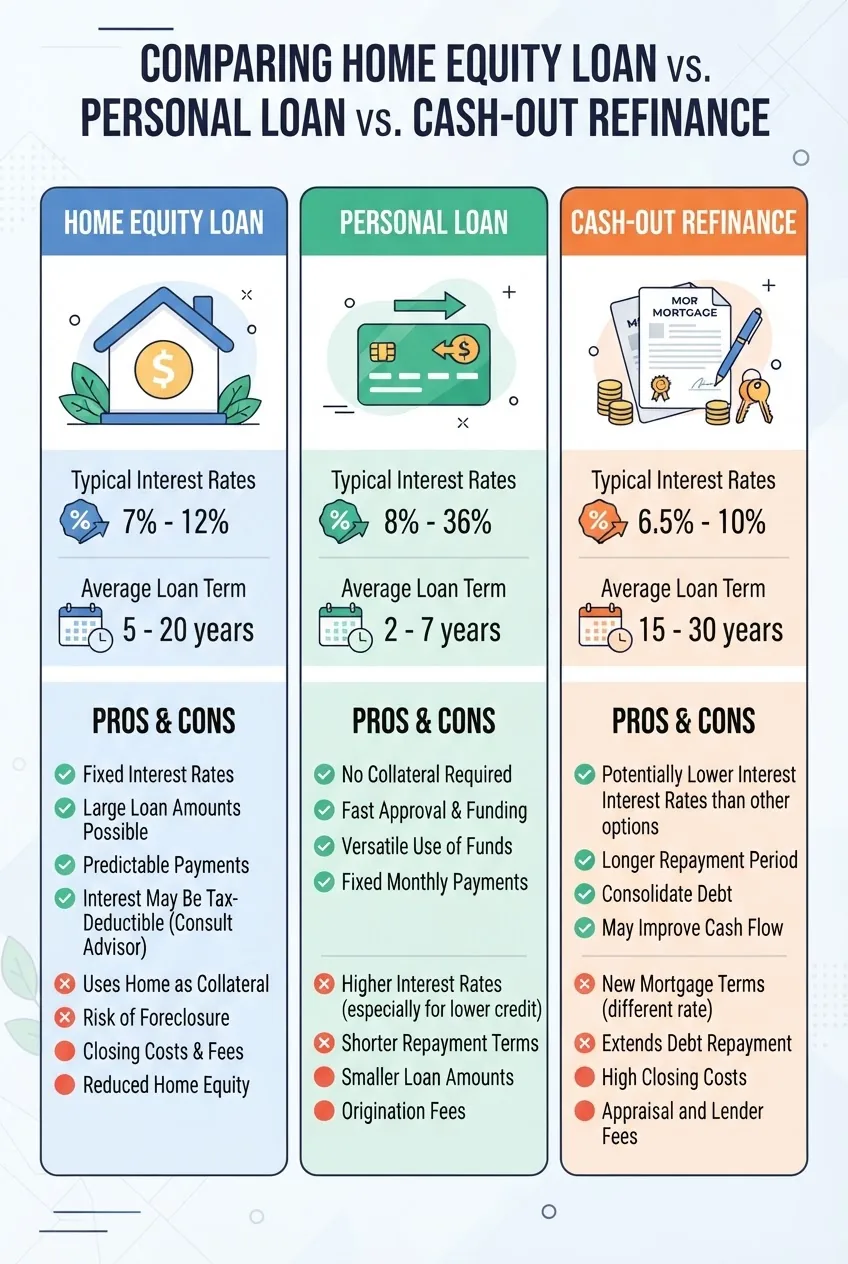
| Option | Typical APR / term | Best for | Recommendation |
|---|---|---|---|
| Home Equity Loan | ~4–8% APR; terms 5–15 yrs | Fixed-cost, medium-large remodels | Choose if you want fixed payments and have >20% equity. |
| Personal Loan | ~8–36% APR; terms 2–7 yrs | Quick needs, no home lien, smaller sums | Use when you need speed and want to avoid collateral on home. |
| Cash‑out Refinance | Current mortgage rates (varies); 15–30 yrs | Major projects or when refinancing saves money | Consider when you can lower your mortgage rate or need large lump sum. |
Final recommendations:
- Small updates under $10,000: Use savings, 0% APR cards, or a short-term personal loan.
- $10,000–$75,000 remodel: Home equity loan for fixed rate; HELOC for phased work.
- $75,000+ or whole-home: Cash‑out refinance or FHA 203(k) if eligible and you need long-term financing.
- Limited credit or income issues: Explore government rehab programs, local grants, or contractor financing with caution and full cost disclosure.
For options focused on large repairs and their loan pathways, see our guide on financing expensive home repairs.
Common mistakes and how to avoid them
I once recommended a cash‑out refinance to a homeowner who needed only $30,000 for a kitchen; they paid 3% in closing costs and extended the mortgage by 25 years—total interest far exceeded the project cost. We should have used a home equity loan instead. To avoid this, always run a break-even analysis comparing closing costs vs. interest saved.
I also saw contractors submit vague quotes causing loan delays. Insist on itemized quotes—lenders and appraisers need scope clarity to release funds.
Checklist: Verify before you apply
- Estimate project cost with at least three itemized quotes.
- Calculate available equity and combined LTV.
- Confirm credit score and correct any errors.
- Gather proof of income, bank statements, mortgage statement, and ID.
- Compare APR, fees, prepayment penalties and draw schedules across 3 lenders.
- Plan contractor milestones and lien waiver schedule for draws.
When to call in a professional
Hire a financial advisor or mortgage broker if your project involves complex financing (multiple loans, investment properties, or tax implications) or if refinancing could affect other investments. Call a real estate attorney if you find title defects or unresolved liens. Engage a certified contractor and building inspector for structural work—many lenders require licensed professionals for permits and draws.
Transition: Below are compact Frequently Asked Questions to answer the most immediate queries concisely.