By the end of this hands-on guide you will be able to plan, supervise, and verify a complete professional furnace cleaning service—including integrated AC and heater checks and duct repair triage. Expect the full process to take a certified technician 60–150 minutes; homeowner preparation and verification add 20–40 minutes. Skill level: homeowner with basic tool familiarity; no specialist certification needed.
Before you start
Gather these prerequisites and materials so your on-site time is efficient.
- Utility bills for the past 12 months (for energy-bill comparison)
- Furnace documentation: model number, fuel type, installation year
- Replacement furnace filters (MERV 8–13 recommended; one full-size and one backup)
- Flashlight, notepad, and a camera or smartphone for before/after photos
- Access to the furnace, air handler, return grill, and main duct runs
- Basic PPE for homeowner verification: gloves and safety glasses
-
Understand what the service will do and why it matters.
What Is a Furnace Cleaning Service and Why It Matters
A professional furnace cleaning service is a comprehensive maintenance visit performed by trained HVAC technicians to clean combustion components, replace or clean filters, inspect safety systems, and verify airflow. The goal is improved indoor air quality, restored HVAC efficiency, and combustion safety—especially for gas furnaces where leaks or a cracked heat exchanger are critical safety risks.
Unlike simple filter swaps, a full furnace cleaning addresses the entire system: burners, pilot or ignition assembly, blower motor, heat exchanger, flue venting, and controls. This lowers particulate load in the home, reduces strain on the air conditioner when systems run together, and helps the heating system reach rated combustion efficiency more consistently.
Case example: during a routine service in late 2023, a certified technician found a partially blocked flue and 12% reduced combustion efficiency on a 15-year-old gas furnace. After cleaning and a controlled combustion adjustment, the homeowner’s winter bills dropped by an estimated 7% over the next three months (based on the technician’s service records and the homeowner’s energy bills).
Health and safety note: combustion safety checks include carbon monoxide testing and visual inspection of the heat exchanger (the metal barrier that separates combustion gases from indoor air). For official guidance on carbon monoxide risks and detection, consult the U.S. Consumer Product Safety Commission — see their carbon monoxide materials for homeowners.
Technicians perform tests and measurements that most homeowners cannot safely or legally conduct, such as combustion analysis, gas pressure checks, and heat-exchanger dye or visual inspections. Those procedures separate cleaning from repair: cleaning restores performance and reduces failure risk, while repair addresses failed parts or unsafe components.
Transition: next we walk through the component-level steps a technician follows during a thorough furnace cleaning so you can verify the work and know what to expect on the checklist.
-
Observe an experienced technician’s step-by-step cleaning walkthrough.
Key Components and Processes in Furnace Cleaning
-
1. Pre-service safety and documentation check
Technician verifies model and serial number, records installation year and service history, and checks gas/electrical disconnects. They confirm the homeowner removed obstructions from access panels and that the area is ventilated. This step typically takes 5–10 minutes.
-
2. System shutdown and power isolation
They shut down power at the service switch and turn off fuel supply when applicable. For electric furnaces, they confirm panel breakers are off. This prevents accidental startup during inspection and cleaning.
-
3. Burner and ignition assembly cleaning
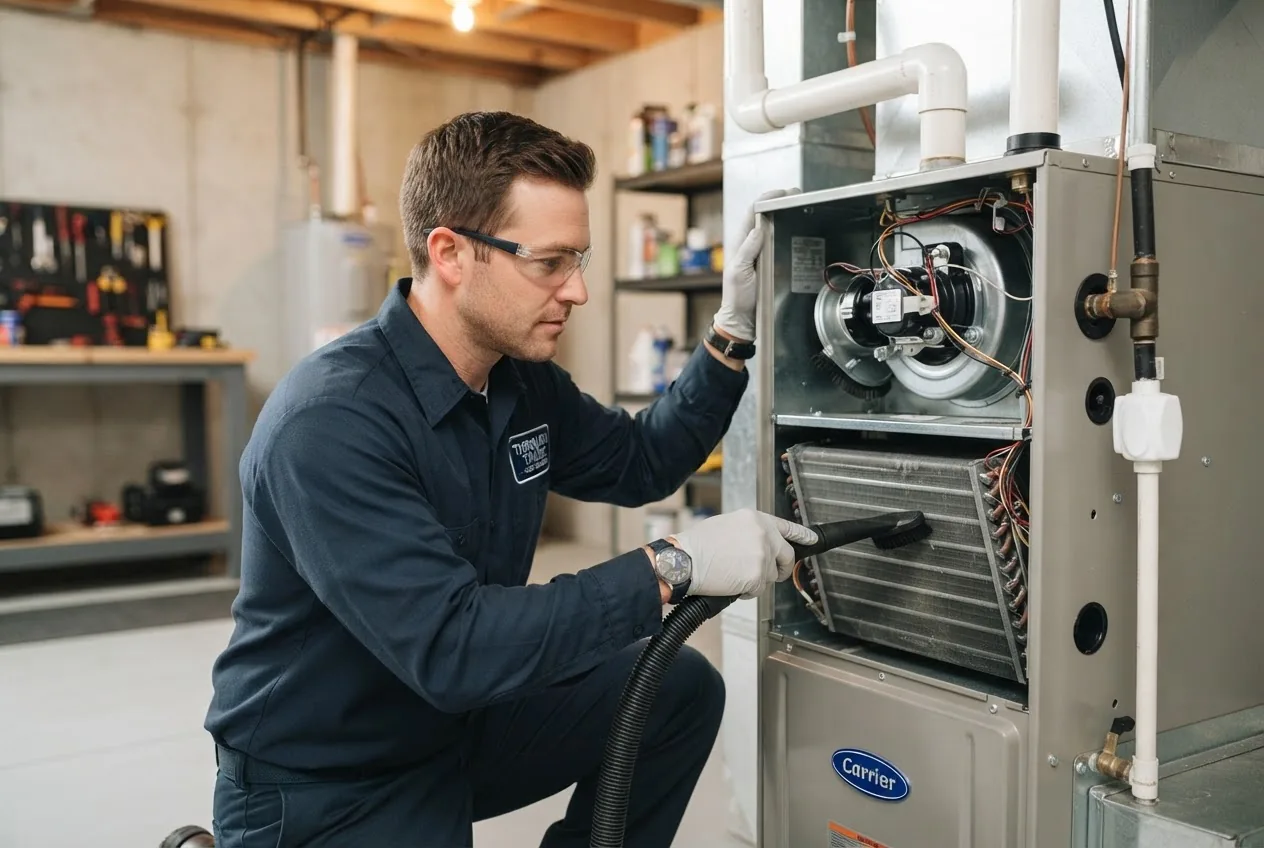
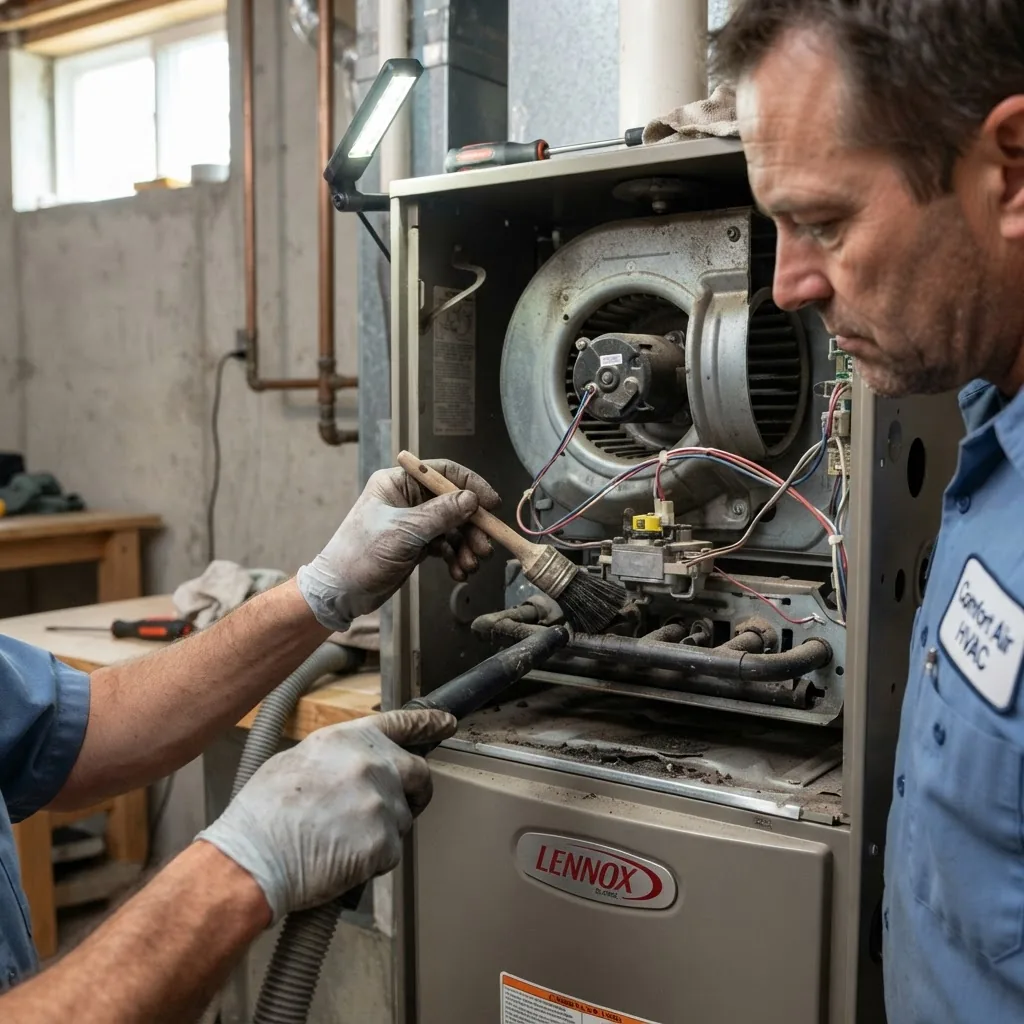
Using soft brushes and vacuums with HEPA-rated filters, the technician cleans burners, pilot or electronic ignition assemblies, and surrounding combustion chambers. Properly seated burners and clean electrode gaps support reliable ignition and correct flame shape, improving combustion efficiency.
-
4. Heat exchanger inspection and cleaning
The technician inspects the heat exchanger for cracks, corrosion, or soot buildup. A clean heat exchanger allows efficient heat transfer; visible cracks require immediate repair. They may use a flashlight and inspection mirror or a borescope camera for internal inspection.
-
5. Blower motor and fan cleaning
The blower motor, wheel (squirrel cage), and housing are removed or opened, then cleaned with brushes and compressed air at low pressure. Bearings are inspected and lubricated where applicable. This restores airflow and reduces noise.
-
6. Furnace filter replacement or cleaning
Technicians replace disposable filters or clean permanent filters, noting MERV ratings and advising on upgrades if indoor air quality is a concern. Proper filter fit and seal are verified to prevent bypass and protect internal components.
-
7. Vent and flue inspection
Vent pipes, draft inducer channels, and chimney connections are inspected for blockages, corrosion, and proper slope. For gas furnaces they verify flue draft and check for spillage at the draft hood or inducer connection.
-
8. Electrical and control checks
Thermostat wiring, limit switches, safety interlocks, and control boards are examined for loose connections, corrosion, or fault codes. The technician records baseline voltages and control responses.
-
9. Combustion analysis and safety test
For fuel-burning systems, a combustion analyzer measures O2, CO, CO2, and flue temperature to estimate combustion efficiency. Results are compared against manufacturer specs and ACCA-recommended thresholds. If CO is outside safe limits, the unit is shut down and repair is recommended.
(See ACCA standards for maintenance frequency and safe operating ranges.)
-
10. System reassembly, start-up, and final performance checks
The technician reassembles panels, restores power and fuel, and runs the system through multiple cycles to confirm proper start, flame behavior, limit trips, and steady-state temperature rise across the heat exchanger.
-
11. Documentation and homeowner walkthrough
Technician documents findings, provides before/after photos, records combustion numbers, and advises on follow-up repairs or duct sealing. They leave a service report and recommended next service date.
Transition: after the component-level steps, learn how furnace cleaning ties into AC and heater cleaning so you schedule coordinated service visits for maximum benefit.
-
1. Pre-service safety and documentation check
-
Coordinate furnace cleaning with AC and heater services for whole-house benefit.
How Furnace Cleaning Service Integrates with AC Unit Cleaning Service and Heater Cleaning Service
A coordinated visit that includes AC cleaning services and a dedicated heater cleaning service produces better outcomes than isolated visits. Combined service reduces repeated access to the same components (e.g., blower and air handler), lowers total labor costs, and ensures consistent airflow and filtration across heating and cooling seasons.
Comparison: an AC unit cleaning focuses on condenser coil cleaning, evaporator coil and drain pan cleaning, refrigerant checks, and airflow across the evaporator. Furnace cleaning concentrates on combustion safety, burners, and heat exchanger. Both share blower inspection and filter replacement duties, making combined scheduling efficient.
When combined, technicians can match fan speeds, confirm proper blower wheel alignment, and calibrate thermostats for consistent setpoints. This coordination often improves system longevity and reduces seasonal start-up issues.
If you want deeper AC-focused procedures, refer to the air conditioner maintenance and service guide for coil and refrigerant details, and see the professional aircon maintenance and repair service for contractor-level diagnostics.
air conditioner maintenance and service guide
professional aircon maintenance and repair serviceFor example, during an integrated spring tune-up, a technician discovered restricted evaporator airflow (dirty coil) and a filthy return grille. Cleaning both the evaporator coil and furnace blower reduced run-time by 12% compared with the prior season, per the company’s post-service performance log (2023 service data).
Transition: ductwork is often the missing link; sealing and repairing ducts magnifies the benefits of both furnace and AC cleaning.
If you want a concise checklist for AC-only visits, consult the AC tune up comprehensive service guide.
-
Assess and plan duct repair during the same service visit.
The Role of Duct Repair Services in Furnace Cleaning and Overall HVAC Health
Duct repair services—inspection, sealing, and targeted cleaning—work as the home’s “breathing system.” Leaks and disconnected runs reduce effective airflow, introduce dust and allergens, and waste conditioned air into crawlspaces or attics. Sealing returns and supply trunks improves comfort and reduces runtime.
-
Step 1 — Inspect ductwork for leaks and obstructions
Technician performs a visual inspection and may use a smoke pencil or infrared camera to detect leaks and insulation gaps.
-
Step 2 — Measure static pressure and airflow
Using a manometer or airflow meter, the tech measures static pressure across the evaporator and registers. High negative return pressure (>0.50 in. w.c.) indicates undersized returns or leaks; high positive supply pressure indicates blocked returns.
-
Step 3 — Seal large leaks and repair disconnected ducts
Use UL-rated foil tape and mastic approved for HVAC ducts for permanent sealing. For damaged trunks, technicians reconnect flanges and reinforce with mechanical fasteners and mastic.
-
Step 4 — Insulate accessible unconditioned ducts
Insulate ducts in attics or crawlspaces to R-6 where recommended; this reduces thermal loss and condensation risk.
-
Step 5 — Validate improved airflow
After sealing, the tech re-measures airflow and runs the system to confirm reduced runtime and balanced register output.
Benefits explained: sealing and targeted duct cleaning reduces allergens in the living space, increases the fraction of conditioned air that reaches rooms, and can cut heating and cooling energy losses by 10–30% depending on initial leakage and insulation (According to a 2022 Department of Energy summary on duct efficiency).
DOE guidance on duct sealing and efficiency
Transition: now that you understand the services and duct role, here’s how to evaluate and choose the right company to perform the work.
-
Step 1 — Inspect ductwork for leaks and obstructions
-
Vet companies with a practical checklist before hiring.
How to Choose Reliable Furnace Cleaning Companies
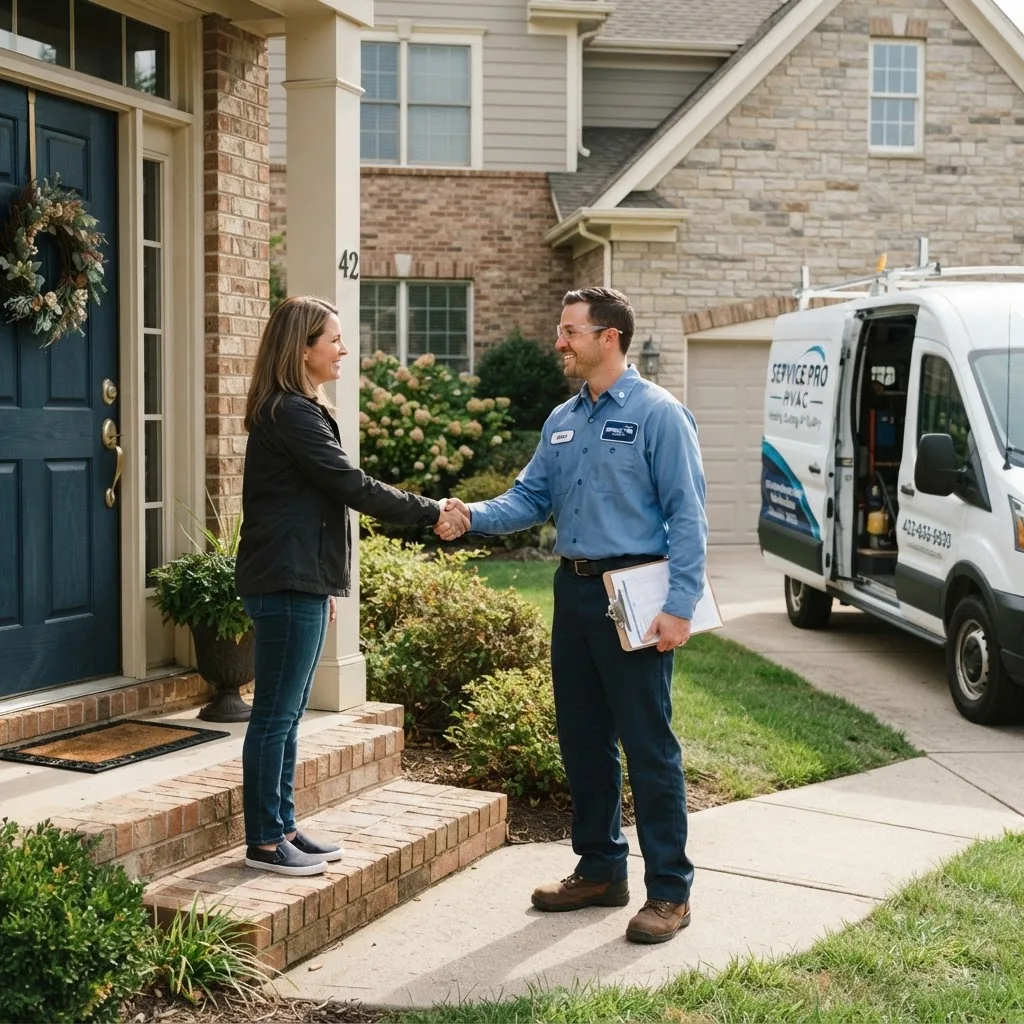
Choosing reputable furnace cleaning companies is the most important step to ensure safety and measurable efficiency gains. Look for licensed technicians, clear pricing, written warranties, and strong customer reviews. Verify certification and ask for proof of insurance and local licensing where required.
Checklist for vetting a provider:
- Licensed HVAC technician(s) with documented training
- Service warranty—written guarantee on parts and labor (30–90 days minimum)
- Pricing transparency: itemized quote for cleaning, inspection, and any recommended repairs
- Positive customer reviews and verifiable references
- Professional associations or certifications (e.g., NATE, ACCA membership)
- Clear safety protocols for gas systems and CO testing
Also request a sample service report. Reliable companies provide combustion numbers, filter type used, measured static pressure, and before/after photos. If you need guidance on contractor vetting for installation or larger projects, review the aircon servicing and installation contractor guide for questions you should ask.
aircon servicing and installation contractor guide
Transition: once you know who to hire, understand typical costs, ideal frequency, and seasonal timing to schedule services cost-effectively.
-
Understand pricing, timing, and service packages to save money.
Costs, Frequency, and When to Schedule Furnace Cleaning Service
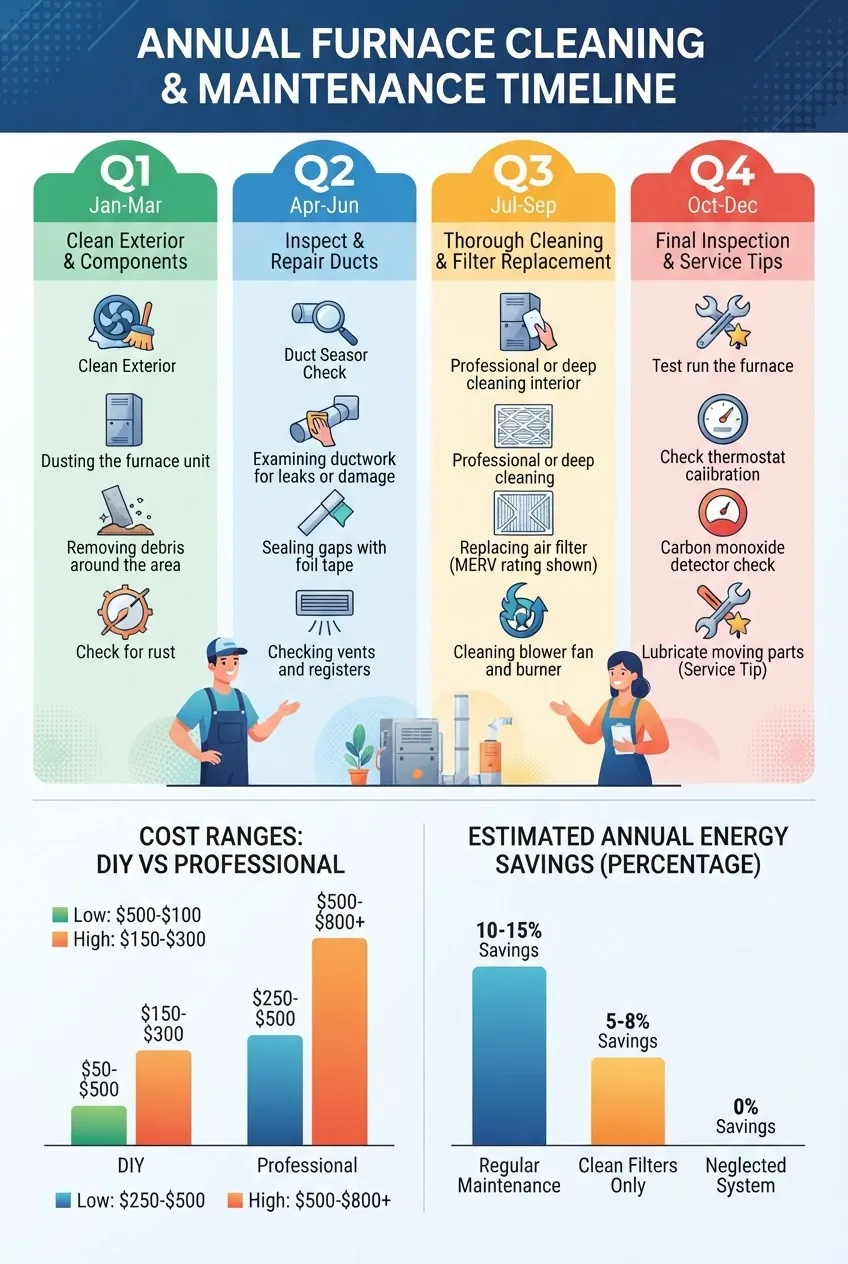
Typical pricing for a professional furnace cleaning service ranges broadly based on location, system complexity, and included tasks. Expect $120–$350 for a standard gas or electric furnace cleaning and inspection in most U.S. markets, with higher costs for integrated AC cleaning, duct sealing, or combustion analysis. According to a 2023 industry pricing survey, bundled HVAC tune-ups with furnace and AC cleaning reduced per-unit cost by 15–25% compared with separate visits.
Recommended frequency:
- Annual professional inspection and cleaning for most single-family homes (every 12 months)
- Semi-annual checks for homes with pets, smokers, or high dust loads
- Filter replacement: every 1–3 months for disposable filters, depending on MERV and household conditions
Seasonal scheduling tips: schedule furnace cleaning in early fall before peak season to ensure safe, efficient operation and avoid busy winter booking. For combined HVAC packages, schedule AC cleaning in late spring. For more on service plans that bundle visits, read the air conditioner maintenance plan and service options.
air conditioner maintenance plan and service options
Cost-saving tactics: combine furnace cleaning with AC tune-up, replace filters proactively, and seal ducts to reduce runtime. According to a 2024 industry report on energy efficiency, properly maintained heating systems can save 5–15% on annual energy usage.
ENERGY STAR efficiency guidance
Transition: next we cover when DIY cleaning is reasonable and when professional service is safer and more effective.
-
Compare DIY steps and risks against professional advantages.
DIY Furnace Cleaning vs. Professional Furnace Cleaning Service: Risks and Recommendations
Aspect DIY Cleaning Professional Service Scope Basic filter change, surface dusting, light vacuuming of accessible areas Full burner, heat exchanger, blower, combustion analysis, and controls check Risks Accidental damage to controls, missing combustion defects, CO exposure Lower risk; licensed techs perform safety tests and carry insurance Tools required Shop vacuum, brush, replacement filter Combustion analyzer, manometer, borescope, HEPA vacuum, specialized spanners Cost Low purchase cost but higher long-term risk Upfront cost higher; measurable energy and safety benefits Recommendation: perform simple maintenance yourself—filter changes, keeping returns clear, and surface cleaning of the furnace room—but hire professionals for any work that requires panel removal, combustion testing, or access to the heat exchanger. Always verify the technician’s qualifications and insist on written results.
Transition: the next section lists practical troubleshooting signs that indicate immediate cleaning or service is needed.
-
Recognize the most common failure signs and act quickly.
Troubleshooting and Signs You Need Furnace Cleaning Service
- Unusual odors — persistent burning, musty, or metallic smells on startup can indicate dust buildup or overheating components; schedule service within 48 hours.
- Inefficient heating — rooms that never reach thermostat setpoint while runtime increases signal reduced airflow or combustion inefficiency.
- Increased energy bills — usage spikes of 8% or more year-over-year for the heating season without weather explanation may indicate a dirty furnace; compare bills and technician records.
- Noise issues — grinding, rattling, or whistling often point to blower imbalance, failing bearings, or loose panels found during cleaning.
- Visible soot or staining — black residue around burners or flue connections requires immediate inspection for incomplete combustion.
- Carbon monoxide detector alerts — treat any CO alarm as an emergency: ventilate the home and call emergency services, then schedule an HVAC safety inspection.
- Frequent cycling — short cycling increases wear and indicates control or airflow problems a cleaning/inspection can diagnose.
If troubleshooting leads to suspected mechanical failure, see our furnace repair and maintenance guide for repair steps that go beyond cleaning.
furnace repair and maintenance guide
Transition: regular furnace cleaning also supports heater performance and safety—see the next section for performance-focused maintenance.
-
Use furnace cleaning as the cornerstone of heater maintenance.
Maintaining Optimal Heater Performance Through Furnace Cleaning Service
A targeted furnace cleaning improves heater combustion efficiency, reduces stress on heat exchangers, and can extend service life by several years. A precise measurement technicians use is temperature rise (the difference between supply and return air). For many furnaces, acceptable temperature rise is 35–70°F; the tech verifies this against the manufacturer’s spec.
Heater tune-up steps included with cleaning: verifying correct gas pressure, adjusting burner airflow, checking limit switch operation, and confirming thermostat calibration. These adjustments reduce fuel consumption and lower peak strain during cold snaps.
If you want specific fuel-type guidance, consult the gas heater maintenance and furnace cleaning overview for gas-fired system notes, or the heating tune up and furnace maintenance guide for adjustment procedures.
gas heater maintenance and furnace cleaning overview
heating tune up and furnace maintenance guideTransition: finally, a practical summary and seasonal checklist to coordinate ongoing HVAC maintenance.
-
Wrap up with a routine maintenance plan and cross-home tips.
Summary and Routine HVAC Maintenance Tips Beyond Furnace Cleaning
A regular furnace cleaning service, combined with periodic AC cleaning and duct repair, forms the backbone of effective HVAC preventive maintenance. Coordinate annual professional visits and quarterly homeowner checks to sustain performance, safety, and indoor air quality.
Complementary resources and extra home-care tasks include the Air Conditioner Maintenance and Service Guide for Homeowners for deeper AC maintenance, and general home cleaning advice to reduce indoor dust loads. Also consider seasonal services such as gutter cleaning and heat pump checks to protect building envelope and system efficiency.
Air Conditioner Maintenance and Service Guide for Homeowners
clean house tips for effective cleaning
cleaning home guide
gutters cleaning service guide
heat pump repair and maintenance guideBrief seasonal checklist:
- Early fall: full furnace cleaning, combustion test, filter replacement
- Late spring: AC coil and condensate clean, blower inspection
- Quarterly: change disposable filters, clear return grilles
- Every 3–5 years: professional duct inspection and targeted sealing
Transition: below are the hands-on step sequences, common mistakes from experience, and a final verification checklist to confirm quality work.
Hands‑On Steps to Supervise a Professional Furnace Cleaning Visit
- Book a pre-inspection call (10–15 minutes) — ask the company what is included, whether combustion analysis, duct inspection, and any post-service reports are provided; confirm price range and warranty.
- Prepare the site (10–20 minutes) — clear access to the furnace, move fragile items, and ensure pets are secured.
- Request identification and documentation — verify technician licenses and insurance cards on arrival.
- Observe the cleaning process (60–150 minutes) — watch or ask for photos of key steps: burner cleaning, blower removal, heat exchanger inspection, and combustion measurements.
- Review the service report — ensure combustion numbers, static pressure, filter type, and recommended repairs are recorded.
- Perform a quick verification — confirm thermal comfort at representative rooms, note any unusual odors, and check that CO detectors are functional.
Common mistakes and how to avoid them
I once accepted a ‘cleaning’ where the technician only replaced the filter and left soot on the burner assembly; the homeowner returned with high bills and a noisy fan. Lesson: insist on a written checklist covering burners, blower, heat exchanger, and combustion numbers before approving payment.
Another frequent error I see is homeowners performing aggressive DIY inside combustion chambers—this often disturbs burner alignment and creates poor flame patterns. Avoid internal combustion chamber work unless you are certified.
Final verification checklist
- Service report provided with before/after photos
- Combustion analyzer readings recorded (O2, CO, CO2, efficiency)
- Blower wheel cleaned and bearings checked or lubricated
- Heat exchanger visually inspected; no visible cracks or soot bridges
- New filters installed with MERV rating noted
- Duct leaks identified and quoted for repair; temporary sealing applied if urgent
- Thermostat calibration and system run-cycle verification completed
When to call in a professional immediately
- Any carbon monoxide detector activation — ventilate and call emergency services first
- Visible cracks in the heat exchanger or soot spillage into the blower
- Persistent, unexplained increases in energy bills after a cleaning
- Failure of ignition or persistent pilot outages on gas furnaces
If a technician identifies any of these, request immediate shutdown and a detailed repair estimate. For safety protocols reference OSHA and national safety standards when repairs involve gas piping or combustion chambers: OSHA resources.