


By the end of this guide you will have a contractor-ready, step-by-step framework to prevent, manage, document, and resolve construction conflicts; you’ll know when to negotiate, mediate, arbitrate, or litigate, and how to preserve the evidence that wins claims. Estimated time to implement the core process: 4–8 hours to set up templates and controls, then ongoing day-to-day application. Skill level assumed: experienced contractor or project manager with intermediate contract literacy.
Before you start
- Tools: digital photo camera or smartphone (set to auto-save date/time), cloud storage (e.g., project folder), simple schedule software (MS Project or Primavera; or cloud-based like Procore), and an email template library.
- Documents to gather: signed contract, all variations/change orders, baseline programme/schedule, recent progress reports, payment applications, and correspondence logs.
- People: designate a dispute point person (site manager or contract manager), identify an in-house reviewer for notices, and list two external advisors (one construction lawyer, one technical expert).
- Templates to create: claims notice template, daily site report template, photographic log, and a correspondence register spreadsheet.
Transition: With those preparations in place, start by understanding what you’re up against—how disputes look in practice and what triggers them on site.
Understanding Construction Disputes
Construction disputes arise when two or more parties disagree about rights, obligations, or outcomes under a building contract. Typical dispute categories include payment disagreements, delay and disruption claims, quality or workmanship issues, scope changes, and latent condition discoveries.
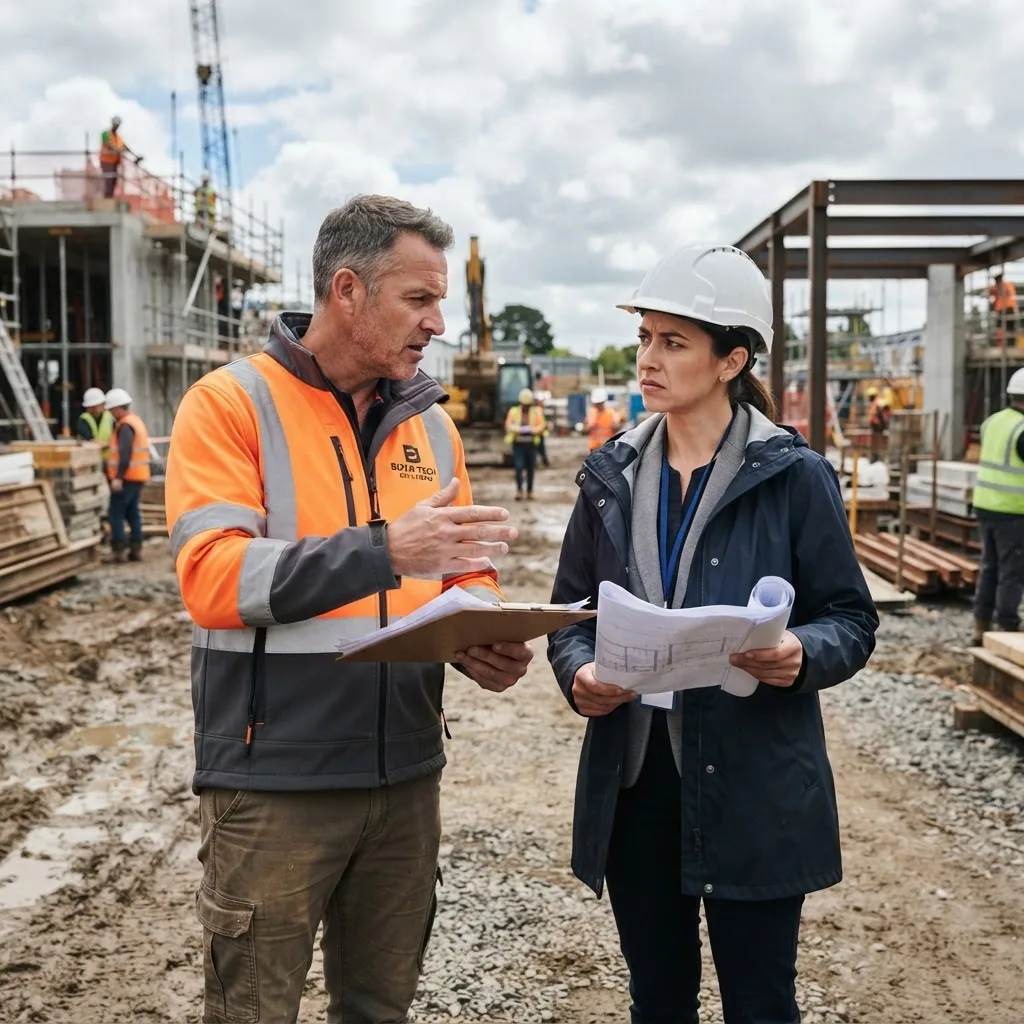
Example: A contractor is asked to accelerate works after a late design change. The principal refuses to pay an acceleration premium and the contractor refuses to absorb the additional labour cost. That escalates into a schedule dispute (delay) and a payment dispute.
Common forms you’ll see when a job goes sour:
- Construction claims disputes — formal demands for money or time based on contract entitlements.
- Building disputes — often used interchangeably but can emphasize defects, compliance with building codes, or approvals.
- Contractor dispute — disputes where the contractor is the claimant or respondent; these frequently turn on scope, delays, or payment.
Why contractors should lead with prevention: proactively managing communications and records reduces the likelihood of escalation and strengthens your position if a claim is required. According to a 2023 industry report by Arcadis, parties that maintained contemporaneous records reduced dispute resolution time by an average of 28% and settlement costs by about 20% (source: 2023 industry report).
Transition: Now that you can spot the main dispute types and why documentation matters, let’s list the frequent causes you’ll encounter.
Common Causes of Construction Disputes for Contractors
- Contract ambiguities — Vague scope, undefined standards, or contradictory clauses create interpretive fights. If the contract lacks a clear statement of works, expect change claims.
- Delay claims — Late delivery of drawings, late access to site, or owner-driven design changes; contractors often claim EOT (extensions of time) and associated prolongation costs.
- Payment disputes — Unpaid interim certificates, withheld retention, or disputed variations. Late payments create cash-flow stress that often leads to formal claims.
- Workmanship or quality issues — Differences on compliance with the specification or building code. Defects can produce rectification orders and counterclaims.
- Change orders and variations — Client or consultant changes without contemporaneous pricing or instructions; disputes occur when parties disagree on whether a variation is a contractual change.
- Site conditions and latent defects — Unexpected ground conditions require cost and time adjustments; debates arise over who bears the risk.
- Liquidated damages and delay clauses — Money-for-time clauses (see definition of liquidated damages below) can trigger disputes when completion dates are contested.
- Poor communication — Unclear instructions, missing meeting minutes, or informal verbal directions lead to misunderstandings and later claims.
- Health & safety stoppages — Site shutdowns for safety may lead to disputes over responsibility and compensation for lost time.
- Third-party approvals — Delays from authorities (planning, code approvals) pass through to contractors under some contracts; when they don’t, disputes arise.
Definitions: liquidated damages are a pre-agreed sum payable for delay; they are not punitive but a genuine pre-estimate of loss. A claims notice is a formal written notification a party must give to preserve the right to claim time or money under a contract—missing the notice window often kills the claim.
Transition: Most of these causes are avoidable with early risk controls. The next section shows the practical steps to stop disputes before they start.
Early Prevention and Risk Mitigation Strategies
This section maps a contractor-centric, actionable prevention plan. Follow these how-to steps and use the checklist at the end of this section to lock your controls in.
How to Handle Construction Disputes Guide for Contractors
-
Screen subcontractors and suppliers — Run a two-step check: (1) financial viability (request 3 months of bank statements or references) and (2) past performance (get 3 recent project references with contactable owners). Threshold: do not award work over £50k without a credit check or performance bond.
- Tip: include a simple pass/fail checklist for safety record, insurance, and previous claim history.
-
Use clear, allocation-driven contracts — Standard form contracts are preferred (e.g., NEC, JCT, FIDIC depending on jurisdiction) because judges and adjudicators interpret them predictably. Insert precise clauses: scope annex, baseline programme, notice periods, and a defined process for variations.
- Action: set contract thresholds for variations (e.g., all changes > £1,000 require written variation order).
-
Set expectation and communication protocols — Daily stand-ups, weekly progress reports, and written minutes. Protocol: all site instructions given orally must be confirmed in writing within 48 hours.
- Template: create a two-line meeting minutes template (date, attendees, agreed actions, owner, due date).
-
Document site conditions continuously — Implement a photographic log: minimum 3 photos per critical activity per day (wide shot, mid shot, detail shot). Store images to cloud with date/time metadata preserved.
- Tool walkthrough: use a tablet to capture photos directly into the project cloud folder, naming files with yyyy-mm-dd_location_activity (e.g., 2026-10-01_SlabCast_ZoneB.jpg).
-
Establish a notice culture — Educate site staff to trigger a claims notice within 7 days of any event that might affect cost or time (even if you intend to negotiate). Set a review meeting within 5 business days to assess whether a formal notice is required.
- Checklist item: does the event change the critical path? If yes, issue notice immediately.
-
Keep a running contemporaneous record — Maintain a daily site diary that includes weather, manpower, plant on site, and key instructions. Retain original signed handover sheets for deliveries.
- Timing: keep diaries updated within 24 hours of the shift end.
- Quantify and price variations promptly — When a change is instructed, issue a written price proposal within 5–10 business days with a clear method of valuing labour, plant, and overheads. If pricing exceeds 10% of the original contract, flag for senior commercial review.
- Mitigate delay risk with schedule buffers — Insert 5–10% float for discretionary items (window procurement, long-lead materials). For critical path activities, record baseline and any agreed re-sequencing in an approved programme change log.
- Insure and bond smartly — For high-risk packages, require performance bonds or parent company guarantees. Check insurance limits annually against your largest contract value.
- Train staff on claim preservation — Run a 60–90 minute workshop for site supervisors on when and how to issue a claims notice, how to log photographs, and how to save email threads. Role-play a notice issuance.
Checklist — quick verification (tick each):
- Subcontractors screened and documented
- Baseline programme uploaded and approved
- Claims notice template ready
- Daily photographic log protocol in place
- Communication protocol distributed and embedded
Transition: When prevention doesn’t stop an issue, follow a clear escalation path. The next section lays out a step-by-step dispute response for contractors.
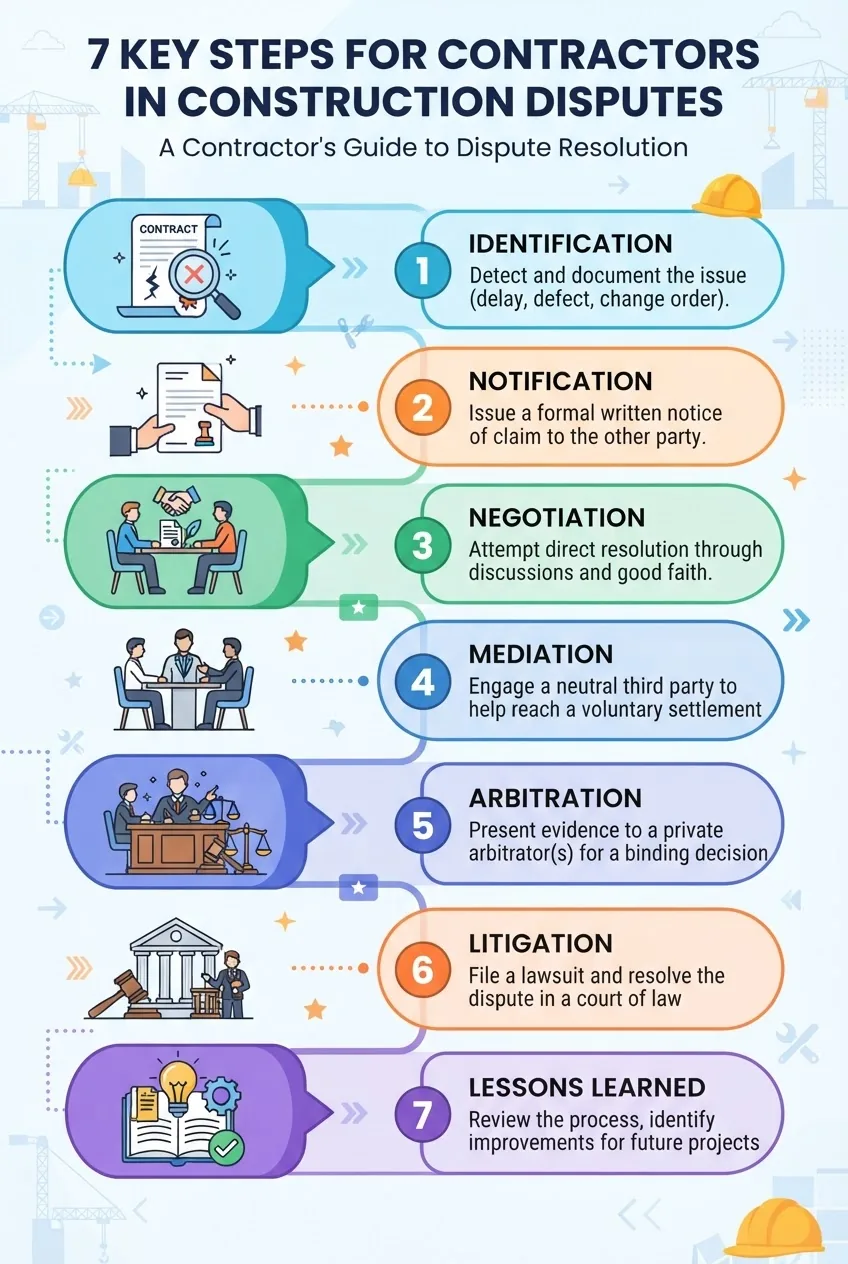
How to Handle Construction Disputes — Step-by-Step Guide for Contractors
-
Identify the dispute event immediately — Within 24 hours of noticing a potential claim event (e.g., delayed drawings, unforeseen site conditions), create an incident record with: date/time, location, people present, description of event, and immediate impact estimate (hours lost, cost estimate). Use a one-page incident form and save to the project cloud.
- Thresholds: if expected delay > 3 days or additional cost > 0.5% of contract sum, escalate to commercial manager.
-
Preserve evidence — Lock in photos, delivery records, daily diaries, and any instructions. Set a preservation folder and duplicate it to an external backup within 48 hours. Capture metadata and ensure filenames follow yyyy-mm-dd conventions.
- Example: For a concrete pour delayed by rain, capture temperature, site puddle photos, plant logs, and the supervisor’s entry in the daily diary within the same day.
-
Issue a timely claims notice — Use your claims notice template and issue a preliminary notice within the contract’s notice period (often 7–28 days). Include: date, event summary, immediate effect on time/cost, and intent to submit full particulars.
- Practical tip: send notices by email and recorded delivery where the contract requires written notice; keep proof of delivery and receipt.
-
Quantify your claim — Produce a claims schedule: (a) time impact analysis using the critical path, (b) labour and plant cost calculation (use daily rates multiplied by recorded lost days), (c) overhead and profit at your agreed percentage (state %) and back-up calculations.
- Method: run a time-impact analysis comparing baseline programme to as-built sequences. If required, hire a scheduling expert when the time impact is complex.
-
Prepare the substantiating pack — Bundle the notice, incident records, daily logs, photos, correspondence, delivery dockets, and pricing worksheets into a claim pack. Use a table of contents with hyperlinked documents for quick review.
- Minimum set: signed contract, notice, diaries, photos, pricing worksheet, and any meeting minutes that reference the event.
-
Attempt early negotiation — Arrange a formal meeting within 10 business days of issuing the detailed claim. Bring a concise one-page executive summary and 2–3 solution options (time extension, cost sharing, or negotiated lump sum). Think of negotiation as building a bridge: propose a path across that preserves relationships.
- Negotiation tactic: open with your lowest acceptable settlement (reserve 10–20% for downward movement) and use documented evidence to anchor your position.
-
If negotiation stalls, propose mediation — Mediation is a voluntary, structured negotiation with a neutral facilitator. Propose a mediator from an agreed panel and set a timetable: mediation within 30–45 days, each side provides a concise position paper 7 days ahead.
- Advantages: confidentiality, faster resolution, and much lower cost than litigation.
-
Escalate to adjudication or arbitration when contract requires — Understand your contract’s dispute resolution clause: some require adjudication (a quick interim decision), others default to arbitration (final, binding). Adjudication is a rapid, interim decision process (often 28–42 days) used in many jurisdictions to keep cash-flow moving.
- Practical flow: if adjudication is available, prepare a focused bundle (notice, core evidence, and a short schedule). If arbitration is triggered, expect a longer timetable and higher costs.
-
Engage experts early — For technical or delay disputes, appoint an expert witness (planning engineer, QS, or structural engineer) before arbitration or litigation. Select experts with demonstrable experience on similar projects; require an availability confirmation and a delivery timetable (draft report within 21–35 days).
- Budgeting: expert reports commonly cost from £5,000 to £50,000 depending on scope; price early and record approvals.
- Monitor cost and cash-flow during dispute — Reforecast project cash-flow weekly, isolate disputed costs, and protect recoverable costs within a separate ledger. Continue to pursue interim payments and decide on withholding strategically—do not withhold items that could breach the contract or safety obligations.
-
Keep negotiating even during formal processes — Most cases settle before final award. Maintain a settlement posture: review offers against best alternative to negotiated agreement (BATNA) and quantify risks and costs of continuing (legal fees, time to award, enforcement risk).
- Decision thresholds: if the opponent’s offer exceeds 70% of your expected award less anticipated legal costs, consider settlement.
- Close out correctly after resolution — When a settlement or award is achieved, document terms in a release and ensure payment terms and schedules are clear. If awards include time relief, update the programme officially and archive the claim pack for 6 years (or longer per jurisdiction).
Case study (practitioner example): On a medium fit-out project, a late MEP design change caused a six-week delay. We preserved daily photos, issued a claims notice within 5 days, priced a time-impact claim within 12 days, and proposed mediation. The mediator helped negotiate an agreed EOT and a 60% recovery of direct costs; savings over arbitration: estimated £45,000 in legal and expert fees (internal record, contractor testimonial).
Common mistakes and how to avoid them
I once failed to issue a claims notice within the contract window because the site supervisor thought the delay was “temporary.” We lost entitlement to money even though evidence proved the delay. I now enforce a 7-day rule: any event possibly affecting time or cost gets a preliminary notice within 7 days, reviewed by the contract manager.
I also used to rely on verbal agreement for variations; several months later the client denied instruction. Now all variations are logged, priced, and signed within 10 business days.
When to call in a professional — bring in a construction lawyer when potential exposure exceeds 5% of contract sum or when enforcement may require injunctions. Engage delay experts for complex critical-path disputes exceeding three concurrent activities.
Transition: Legal context heavily shapes the tactical choices above; read the next section for legal trade-offs and claim mechanics.
Legal Considerations and Construction Claims Disputes
Contracts control dispute pathways. Common clauses that materially affect outcomes include dispute resolution clauses, liquidated damages, time bars for claims, and retention terms. A contractor must understand obligations to give notice and the consequences of missing them.
Comparison of dispute resolution pathways — high-level pros and cons:
| Method | Pros | Cons |
|---|---|---|
| Negotiation | Fast, low cost, preserves relationships. | Non-binding; may stall without third-party pressure. |
| Mediation | Confidential, flexible, cost-effective. | Requires both parties to engage in good faith. |
| Adjudication | Quick interim decision; keeps money flowing. | Decision may be revisited later; procedure is compressed. |
| Arbitration | Final and binding; specialist arbitrators available. | Expensive and lengthier than adjudication; limited public precedent. |
| Litigation | Public record, coercive remedies, clear enforcement mechanisms. | Most expensive, slowest, and adversarial. |
Trade-offs in practice:
- Cost vs speed: adjudication and mediation are faster and cheaper; arbitration and litigation cost more but can provide finality.
- Confidentiality: mediation and arbitration keep disputes private; litigation becomes public record.
- Enforceability: arbitration awards are generally easier to enforce internationally (New York Convention) than local court decisions in cross-border contexts.
Jargon defined: adjudication — a statutory or contractually agreed rapid decision process giving interim relief to one party, often used in the UK and other common-law jurisdictions to keep works and cashflow moving.
Claims notice mechanics: Many contracts have strict notice requirements. A notice should be clear, timely, and preserve the right to claim. If a contract requires notice within 14 days, missing that window typically deprives you of entitlement unless the other party waives the defect.
Authority and standards: consult government or recognised industry guidance for local rules. For regulatory or building-code issues, check your relevant authority. For example, refer to US Department of Housing and Urban Development guidance for federal compliance matters, RICS for industry dispute guidance and standards, and Chartered Institute of Arbitrators for arbitration processes.
According to a 2023 industry report by Arcadis, delay and disruption accounted for the largest share of construction disputes worldwide, with median dispute values rising by 7% year-on-year in projects over $5m (source: 2023 industry report). Another 2024 industry report by Turner & Townsend noted that projects with early dispute avoidance measures settled faster and at lower cost (source: 2024 industry report).
Caveat: laws and procedural requirements differ by jurisdiction. Always confirm local notice rules, limitation periods, and adjudication statutes with a local legal advisor before taking formal steps.
Transition: With the legal landscape mapped, the next section lists concrete documentation best practices that support claims and defence.
Documentation and Evidence Best Practices

- Daily site diary: record workforce numbers, weather, plant, instructions, and events. Update within 24 hours. Example entry: “2026-10-01: 08:00–17:00, crew 12, rain 10mm, concrete pour Zone B delayed 6 hours due to contamination — instructed by PM 10:15.”
- Photographic evidence: three-angle photos per critical activity; keep originals with timestamp and GPS where possible. Store in folders by date and activity.
- Correspondence log: maintain a spreadsheet listing all emails, phone calls, and meetings with date, subject, participants, and a short note of outcome. Attach PDF copies to entries.
- Version control for drawings: number drawings and keep an approved-for-construction register. Any superseded drawing must be archived with a change log.
- Contracts and variations ledger: a single place (digital) where you record instructions, change orders, pricing, and approvals with signatures and dates.
- Expert reports: when commissioning an expert, set a clear scope, timelines (draft in 21 days), and acceptability criteria, and retain correspondence confirming instructions.
- Scheduling records: keep baseline and all approved programme updates. When asserting delay, attach time-impact analyses that use the baseline critical path.
Examples of tools and templates contractors can implement immediately:
- Photographic naming convention: yyyy-mm-dd_activity_location_userinitials.
- Email subject template for claims: “NOTICE: Potential Claim — [Project] — [Short description] — [Date]”.
- Document retention: keep all dispute-related documents for at least 6 years or as required by local statute.
Transition: Many contractors prefer to resolve disputes without court. The next section compares alternative dispute resolution methods against litigation.
Resolving Contractor Disputes Outside Court
ADR (Alternative Dispute Resolution) includes negotiation, mediation, adjudication, and arbitration. Below is a concise table comparing ADR with litigation.
| Process | Speed | Cost | Confidentiality | Enforceability |
|---|---|---|---|---|
| Negotiation | Very fast | Low | Private | N/A (agreement required) |
| Mediation | Fast (weeks) | Low–Medium | Private | Dependent on agreement |
| Arbitration | Medium (months) | Medium–High | Private | High (award enforceable) |
| Litigation | Slow (years) | High | Public | High (court judgment enforceable) |
Pros and cons summary:
- Mediation often saves 50–80% of the time and cost of litigation and keeps business relationships intact.
- Arbitration gives a binding result with specialist decision-makers but costs more than mediation.
- Litigation provides public precedent and coercive remedies but is the slowest and most expensive path.
Transition: If ADR fails and you face litigation, follow the checklist below to prepare for court.
What to Do If a Construction Dispute Becomes Litigation
Litigation changes the tempo: deadlines are determined by the court, discovery is formal, and evidence must be produced under oath. Below is a practical plan with timelines and contractor actions.
- Immediate (first 7 days): Instruct legal counsel, preserve all evidence, suspend any routine document deletion policies, and prepare an issues list summarising disputed items with approximate values and estimated timeline impacts.
- Short term (2–6 weeks): Prepare a pleadings-ready bundle: contract, notices, diaries, photos, and correspondence. Counsel will draft defence/claim documents. Meet with your expert to scope a report (deliver draft within 21–35 days).
- Pre-trial (2–6 months): Engage in disclosure/discovery. Expect requests for witnesses, documents, and expert interrogatories. Budget for counsel and expert fees—legal costs can run from £50,000 to £500,000 depending on case complexity.
- Trial and judgment (6–24 months+): Hearings vary in length; judgment may take weeks to months post-hearing. Enforcement may follow if the opponent is ordered to pay.
Contractor checklist before trial:
- Confirm all original records are secure and produce certified copies
- Ensure all key witnesses are available and prepare witness statements early
- Confirm expert availability and finalise scope and reports
- Run a costs-benefit analysis comparing likely judgment with ongoing legal costs
Timeline example: from filing to first trial date in a mid-complexity building dispute: 9–18 months (varies by jurisdiction).
Transition: After a dispute is closed, use lessons learned to tighten future delivery—see the next short section.
Post-Dispute: Lessons Learned and Improving Future Practices
After resolution, conduct a formal dispute review meeting and document actionable improvements. Typical action items:
- Update contract templates to close ambiguous clauses—add explicit notice timelines and variation pricing mechanics.
- Revise onboarding for subcontractors, adding a compulsory evidence and notice training module.
- Implement new documentation tools (e.g., structured photo repository, weekly programme baselines).
- Run a 90-minute refresher for site teams on notice issuance and evidence preservation.
- Record a short case summary in the corporate lessons log for future tenders and risk assessments.
Final checklist for contractors:
- Claims notice template implemented and staff trained
- Daily diary and photographic protocol active
- Baseline programme and change log maintained
- Subcontractor screening process applied to new hires
- Budget allocated for expert reports where threshold exceeded
When to call in a professional — hire external counsel if potential liability or recovery exceeds 5% of the contract value, if criminal or regulatory issues arise, or when cross-border enforcement will be needed.
Conclusion — Key takeaways: prevent disputes by tightening contracts, preserving contemporaneous records, and training staff on notice culture. When disputes occur, act fast: identify, preserve, notify, quantify, and seek early negotiation or mediation. Use adjudication or arbitration per your contract, and only litigate when necessary. Start by implementing the checklist above; it takes 4–8 hours to set up, and that investment will typically save weeks and tens of thousands in avoidable costs. Ready to strengthen systems? Begin with your claims notice template today.