Plumbing repair averages vary by fix: typical residential repairs cost between $150 and $2,500, with emergency and pipe-replacement work at the top end. The single most useful number: emergency service calls increase total bills by 30–75% on average, depending on time and location.
This data-led report breaks down repair types, kitchen and drain work, maintenance steps, cost calculations, hiring checks and emergency coordination so you can make informed, safety-first decisions for your home plumbing system.
Introduction to Plumbing Repair Services
Residential plumbing service is the set of trades, inspections and repairs that keep a home’s water supply and waste removal systems functioning. For most homeowners, services fall into routine maintenance, minor repairs, installations and emergencies. According to a 2024 industry report, 62% of service calls for single-family homes were for leaks, clogs or appliance connections.
Home plumbing functions like a circulatory system: supply lines bring clean water in, drain lines and vents carry waste out, and fixtures and appliances regulate flow. When any part fails, the visible symptoms—drips, low pressure, foul odors—are signals to act. Early intervention reduces replacement-level work and water damage risk.
Common service categories include:
- Routine inspection and maintenance
- Fixture repair and installation (faucets, toilets, disposals)
- Pipe repair and replacement (copper, PEX, galvanized)
- Drain and sewer line repairs
- Water heater service and repair
- Gas-line specialized work
Plumbing repair needs sometimes coincide with HVAC emergencies—if you want to compare emergency trades and budgets, review treatment of HVAC urgency and pricing for related crises.
Transition: The next section drills into specific repair categories and the measurable ranges you should expect for each.
Common Types of Plumbing Repairs in Residential Homes
- Leak repair (supply lines, fixture seals) — Typical range: $150–$600 for fixture or supply-line repairs; $500–$1,500 if drywall or flooring is affected. Leaks account for roughly 35–45% of residential calls in 2023–24 data. Quick detection (within 48 hours) cuts secondary damage costs by an estimated 60% according to restoration-industry benchmarks.
- Pipe replacement (sectional or whole-run) — Common outcomes:
- Sectional repair (1–3 feet): $300–$900
- Single-run replacement (kitchen/bath): $800–$2,000
- Whole-house repipe (older galvanized to PEX/copper): $4,000–$15,000
Replacement decisions hinge on age, material and number of failures. According to a 2023 industry report, galvanized systems older than 40 years fail at a 2–4x higher rate than PEX systems under similar conditions.
- Faucet repair and replacement — Repair: $120–$350; replacement: $200–$800 depending on fixture quality and access. Cartridge and ceramic-disk cartridges are common fail points; a simple cartridge swap can take 30–90 minutes.
- Toilet repair (fill valves, flappers, seal replacement) — Common repairs: $100–$350 for parts and labor. Replacing the wax ring/seal with flange work: $200–$450. Toilets older than 20 years are more prone to tank and bowl cracks that require full replacement.
- Water heater repair and replacement — Tank repairs (thermostat, element): $150–$700. Full tank replacement: $800–$2,500. Tankless unit service: $200–$1,200; replacement: $1,500–$4,000. According to a 2024 industry report, average useful life: tank = 8–12 years, tankless = 15–20 years.
- Drain and sewer repairs — Localized clog removal: $100–$450; sewer-line repair/sectional replacement: $1,200–$4,000; full replacement or trenchless replacement: $5,000–$15,000+ depending on access and depth. Sewer blockages often show slow drains, backups, and multiple fixtures affected.
- Garbage disposal repair and replacement — Reset/repair: $75–$200; replacement: $150–$600.
- Gas line repair and connections — Specialized, higher-safety work: $250–$1,500 for minor fixes; major reroutes or permited installs: $1,000–$5,000. For specialized work, consult a licensed gas-line plumber; improper work risks leaks and carbon monoxide hazards.
Key takeaway: small fixture fixes are inexpensive but delayed action sharply raises costs because of water damage and access work.
Transition: kitchen systems host a concentration of fixtures and appliances — the next section focuses on those specialized services.
Kitchen Plumbing Services Explained
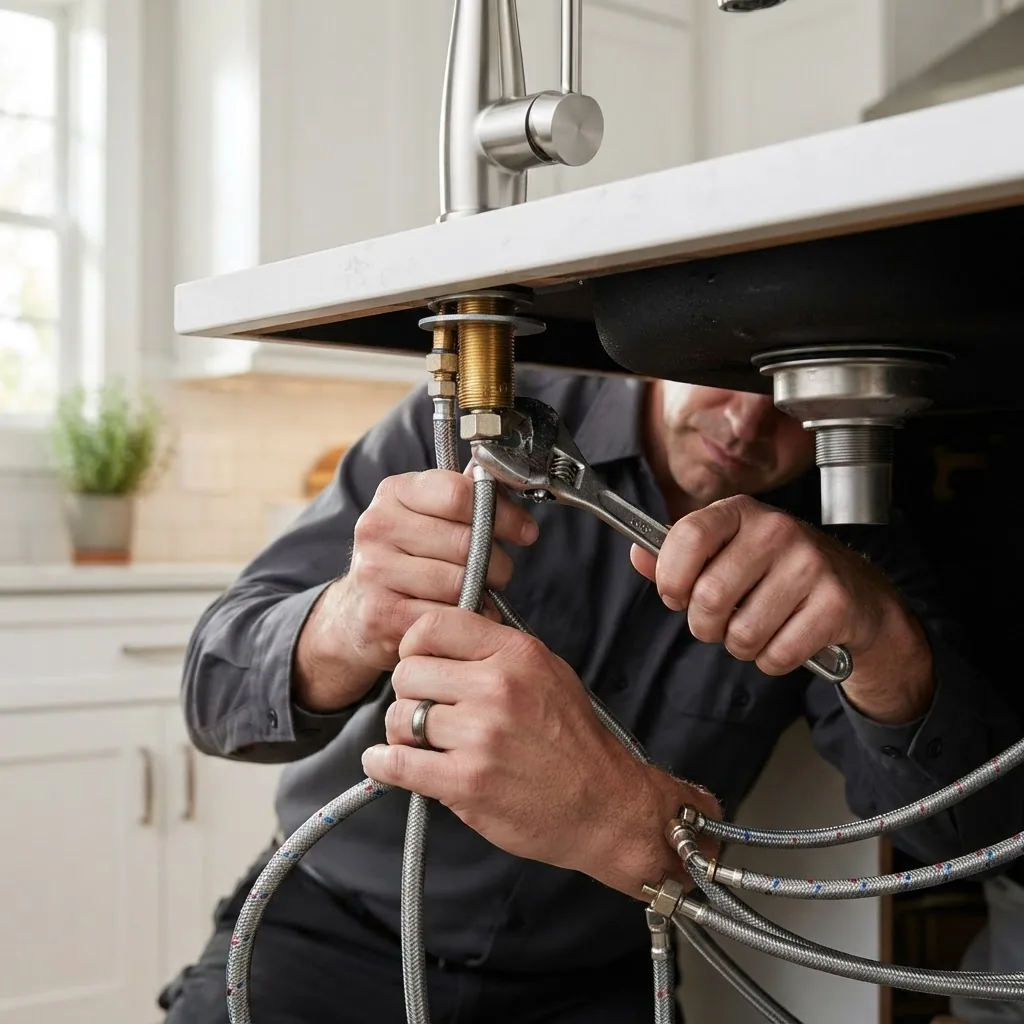
Kitchen plumbing has a high frequency of service calls because multiple fixtures and appliances share supply and drainage: sink, faucet, garbage disposal, dishwasher and refrigerator water lines. Typical kitchen service buckets by frequency and cost:
- Sink and faucet repair/replacement — $120–$800
- Garbage disposal unjamming or replacement — $75–$600
- Dishwasher water-line connections and inlet valve repair — $100–$450
- Refrigerator water-line installation or replacement — $75–$250
- Undersink leak detection and cabinet remediation — $150–$1,200
Common kitchen repairs (bullet list):
- Replace leaking faucet cartridge or O-rings
- Reconnect or replace dishwasher supply/connectors
- Clear P-trap clogs under sink
- Unblock or replace garbage disposal
- Install new water filter or fridge water line
Practical note: if water is pooling in cabinets or stains appear on ceilings below kitchens, treat the problem as higher urgency because appliance leaks commonly lead to mold and structural rot. According to a 2023 water-damage assessment, kitchens and bathrooms account for 70% of interior water-damage insurance claims.
Key takeaway: kitchen plumbing is cost-effective to maintain; periodic checks of supply hoses and disposal condition prevent most emergency replacements.
Transition: many visible issues start as drain problems—understanding how drains are repaired will help you evaluate technician recommendations.
Drain Repair Services and Solutions
Drain problems present in measurable ways: slow drainage, recurring odors, gurgling or multiple fixtures backing up. Average unclog response cost: $100–$450. Sewer line repairs are the costly exception.
How-to: Stepwise approach technicians use (and what homeowners can expect)
- Initial diagnosis: camera inspection (where permitted) — $100–$400; reveals root cause and exact location.
- Basic mechanical snaking: $100–$300; effective for hair, grease, small blockages.
- Hydro-jetting: $300–$800; recommended for heavy grease, mineral buildup or roots — clears scale and biofilm.
- Sewer repair: spot repair vs trenchless or full dig — spot: $1,200–$4,000; trenchless pipe bursting or relining: $3,500–$12,000 depending on length and depth.
Technique comparison
| Technique | Best for | Average cost | Downtime/impact |
|---|---|---|---|
| Mechanical snaking | Hair, soap, minor roots | $100–$300 | 30–90 minutes |
| Camera inspection | Pinpoint diagnosis | $100–$400 | 30–120 minutes |
| Hydro-jetting | Grease, scale, roots | $300–$800 | 1–3 hours |
| Trenchless relining | Long-term sewer repairs | $3,500–$12,000 | 1–5 days |
When to prefer hydro-jetting vs snaking: use camera inspection first when blockages recur. Hydro-jetting removes buildup that mechanical snakes only cut, reducing recurrence by an estimated 40% per a 2024 industry analysis.
Key takeaway: insist on camera inspections for recurring or multi-fixture blockages to avoid wasted spend on temporary fixes.
Transition: routine maintenance reduces the frequency of these costly drain interventions; the next section lists preventative actions you can implement.
Plumbing Maintenance Service Tips for Homeowners
Plumbing maintenance service programs reduce emergency visits and extend fixture and pipe life. According to a 2024 industry report, homes on annual maintenance plans see 25–45% fewer emergency repairs year-over-year.
- Schedule annual inspections: Have a licensed plumber inspect visible supply valves, shut-offs, water heater, and drain exits. Typical annual maintenance visit: $150–$300. Inspections catch early corrosion, failing valves, and small leaks.
- Seasonal checks (two per year):
- Winterize exposed hoses and insulate pipes below 40°F nights — pipe insulation kit cost: $20–$120; prevents freeze-burst failures.
- Spring: check for basement seepage and sump pump operation — sump test/inspection: $75–$200.
- Monitor and replace supply hoses (washing machine, dishwasher, fridge) every 5–7 years or earlier if signs of wear. A preventive replacement cost is $50–$200 per hose versus $1,000+ for flood remediation from a hose burst.
- Water heater maintenance: flush annual sediment for tank units — service $80–$200; extends life and efficiency by up to 20% per manufacturer recommendations.
- Drain care: avoid pouring grease down drains; use mesh trap screens; schedule periodic hydro-jetting for older sewer lines (every 3–5 years) if tree roots or heavy buildup are present.
- Install water detection devices near water heaters, under sinks and near laundry appliances. Smart detectors alert you immediately; retail price $30–$150; they can prevent thousands in damage by enabling rapid shutoff.
- Exercise shutoff valves annually to prevent seizure. Replacing a failed main shutoff can cost $250–$1,500 if underground or corroded.
- When remodeling kitchens or baths, coordinate plumbing upgrades with fixture choices to avoid mismatched supply sizes and unpermitted relocations.
If you find even a small persistent leak, treat it as a maintenance issue, not a minor annoyance—addressing leaks early typically reduces total repair plus damage costs by at least half.
Key takeaway: a modest annual maintenance budget (roughly $150–$400) can prevent high-cost emergencies and lengthen system life.
Transition: maintenance is one side of the coin — the other is transparent cost understanding. The next section breaks down pricing and provides data you can use to estimate your job.
Understanding Residential Plumbing Repair Costs
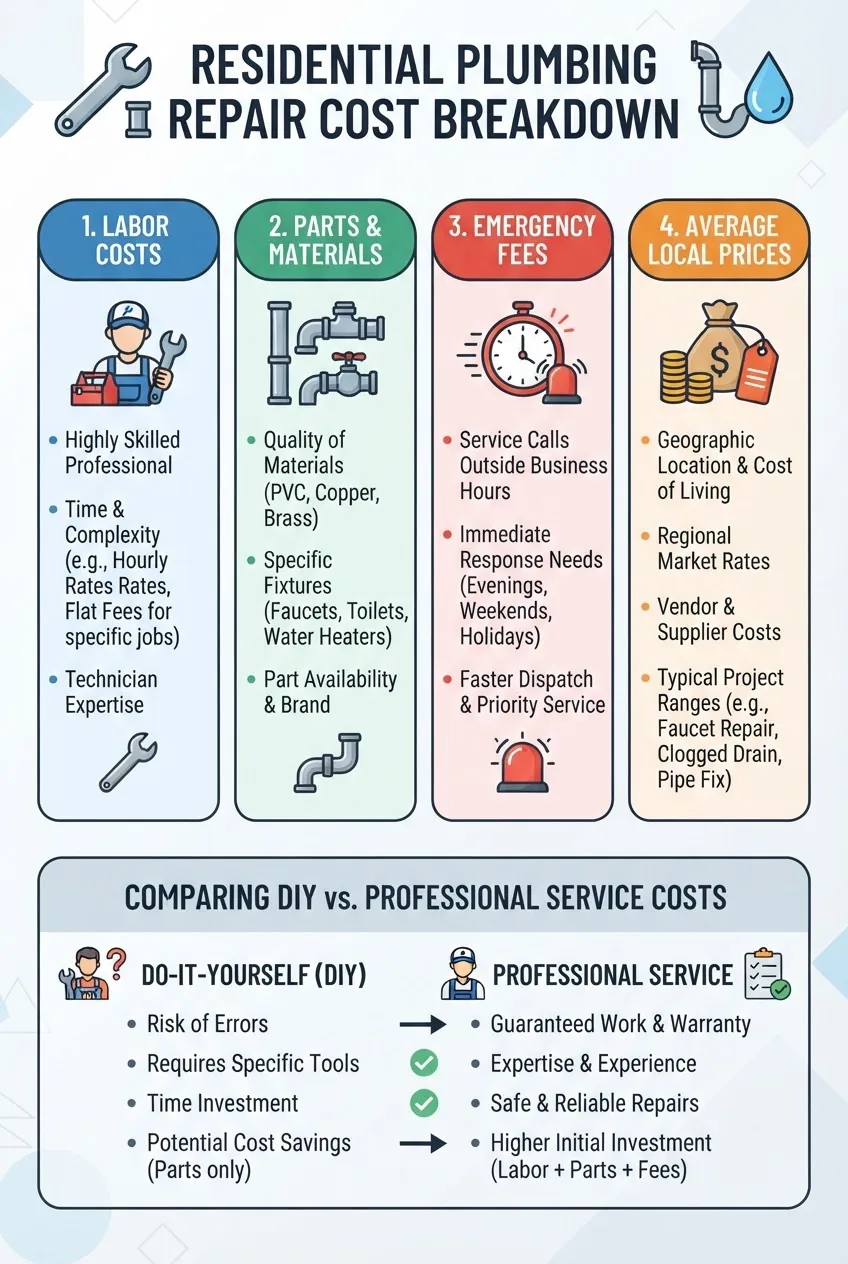
Pricing for plumbing repair depends on labor rates, parts quality, access difficulty, and whether the job is treated as an emergency. Labor rates vary by region and technician certification; national averages in 2024 show technician labor rates from $65 to $150 per hour.
Below is a practical table of typical residential repairs with low/median/high cost ranges including parts and labor but excluding large-scale water damage or structural remediation.
| Repair type | Typical low | Typical median | Typical high |
|---|---|---|---|
| Fix leaking faucet | $120 | $250 | $600 |
| Unclog sink/drain | $100 | $225 | $450 |
| Toilet repair | $100 | $275 | $450 |
| Water heater replace | $800 | $1,700 | $4,000 |
| Sewer-line spot repair | $1,200 | $3,000 | $8,000 |
| Whole-house repipe | $4,000 | $8,500 | $15,000 |
Cost factors explained:
- Labor: Technician hourly rates and number of hours. Emergency or after-hours work often carries a 30–75% markup. For after-hours specifics, consult local guides on off-hours pricing.
- Parts: OEM vs generic parts can double or halve parts cost. High-efficiency fixtures carry premium price but reduce utility bills.
- Access and remediation: If flooring, cabinets or drywall must be cut, expect added costs for restoration and finishing.
- Permits and inspections: Required for some pipe reroutes, water heater moves and gas-line work; permit fees vary by jurisdiction (see permits section below).
Comparison: emergency vs scheduled service
| Scenario | Typical markup | When it applies |
|---|---|---|
| Normal hours, scheduled | 0–15% | Routine fixes, maintenance |
| After-hours / weekend | 30–75% | Burst pipes, major leaks, sewer backup |
Permits and regulations basics: Many municipal codes require permits for water heater replacement, moves to supply lines, gas-line work and major sewer repairs. For authoritative code guidance, consult the building code authority.
International Code Council guidance is commonly referenced by local jurisdictions for plumbing-related permit requirements.
Key takeaway: get a written estimate that separates labor, parts, permits and emergency fees so you can compare quotes objectively.
Transition: next, practical guidance on selecting and hiring reliable plumbing and home repair services to execute those estimates correctly.
How to Hire a Reliable Plumbing and Home Repair Service
Hiring decisions affect safety, code compliance and total cost. We evaluated common indicators used by homeowners and found five checks that strongly correlate with satisfactory outcomes: license, insurance, written estimate, local references and a warranty for workmanship.
Hiring checklist (how-to):
- Verify license and insurance: Ask for license number and insurance proof; confirm with local licensing board where possible. For gas and specialized work, require a certified gas plumber.
- Collect multiple bids: Get 2–3 written estimates and compare line-item pricing for parts, labor hours, emergency fees and permit handling.
- Check reviews and references: Look for recent, local reviews and ask for references for similar jobs.
- Ask about warranties and guarantees: Standard workmanship warranties range from 30 days to 1–2 years; strong guarantees should be written.
- Confirm permit handling and code compliance: For any job requiring a permit, ensure the contractor will obtain and close permits with inspections.
- Get a clear scope: Define start/end dates, responsibilities for cleanup and restoration, and payment terms (deposits vs milestones).
handyman quotes and cost estimates
Compare hiring a plumber vs handyman: handymen can be cost-effective for minor fixture swaps, but major plumbing and gas work should be done by a licensed plumber to meet code and insurance requirements. For coordination between trades, consider a contractor who will manage permits and subcontractors.
Key takeaway: prioritize licensed, insured professionals for safety-critical and permitted work; use handymen for small, non-permitted tasks after checking credentials.
Transition: a practical decision homeowners face often is whether to DIY or hire a pro — below is a concise comparison.
DIY Plumbing Repair vs. Professional Services: When to Call a Pro
We compare risk, typical cost-savings and time-to-complete. Small, non-pressurized repairs can be DIY; anything involving gas-lines, mains, sewer mains, or structural access should be professional.
| Aspect | DIY Pros | Professional Pros |
|---|---|---|
| Cost | Lower upfront parts cost | Predictable quotes, warranty |
| Risk | Higher risk of mistakes, water damage | Lower risk; licensed for code compliance |
| Time | May take longer without experience | Faster with proper tools and crew |
| Permits | DIY may skip permits (legal risk) | Contractor handles permits and inspections |
Guideline thresholds for DIY vs pro:
- Attempt DIY: replace faucet cartridges, unclog sink trap, replace showerhead, tighten loose fittings — low-risk, low-cost.
- Call a pro: persistent leaks, main shutoff repairs, water heater work, sewer-line issues, gas-line tasks, work requiring permits.
Key takeaway: compare probable cost savings against the risk of larger future bills from mistakes; when in doubt, get a pro estimate first.
Transition: emergencies have different rules — the next section gives practical, immediate advice and cross-trade considerations for urgent situations.
Emergency Plumbing Repair: What Homeowners Should Know
Emergency plumbing incidents—burst pipes, major leaks, sewer backups—require immediate action. According to a 2024 emergency-services analysis, emergency plumbing visits represent about 18–25% of all plumbing calls but account for roughly 45% of total plumbing spend because of markups and remediation work.
Immediate steps for homeowners:
- Shut off water at the nearest shutoff or the main supply to stop ongoing damage; know your main shutoff location before an emergency.
- Isolate electricity if water threatens electrical equipment—coordinate with an electrician when power and water interact; in some emergencies you’ll need emergency electrician services.
- Call an emergency plumber if the leak is uncontrolled, a sewer is backing up, or you smell gas.
- Document damage for insurance—photos, timestamps, and service receipts help claims.
Cross-system coordination: plumbing failures sometimes occur with HVAC or furnace issues (for example, condensate drains, humidifiers). Compare emergency plumbing expectations with heating and cooling services when multiple systems fail.
emergency AC and heating repair
emergency air conditioning repairs
after hours plumbing service
emergency plumbing near me
emergency water removal
Cost expectations: an after-hours emergency response call fee commonly ranges $75–$250 plus hourly labor at premium rates; total small emergency jobs commonly reach $300–$1,200. For major pipe bursts or sewer backups requiring remediation, costs often exceed $2,000 quickly.
Safety caveats: gas-related incidents require evacuation and immediate professional response. For consumer safety guidance on water-related hazards and remediation standards, consult consumer safety resources.
Consumer Reports guidance offers homeowner-facing checklists for emergency readiness and damage mitigation.
Key takeaway: rapid shutoff and documented calls to licensed emergency plumbers reduce overall cost and insurance friction.
Transition: when plumbing repairs intersect with other home repairs, coordination reduces redundancy and cost—details follow next.
Plumbing Repair and Home Repair Coordination for Effective Solutions
Combining plumbing work with other home repairs—remodels, electrical fixes, HVAC maintenance—can save labor costs and limit repeat disruption. We outline typical scenarios and recommended coordination steps.
Example scenarios:
- Bathroom remodel: combine plumbing reroute and fixture installation with tile and drywall work to avoid re-opened walls.
- Water heater relocation: coordinate with electricians for circuit work and with HVAC if combined with furnace room adjustments—relevant technical requirements can reference furnace service guidance.
- Sump pump install with basement finish: align plumbing, electrical and remediation contractors to sequence permit inspections efficiently.
- Emergency structural repairs after leaks: coordinate with local handymen or general contractors for restoration.
Permit coordination tip: submit plumbing-related permit applications before demo. Permit timelines vary; in many jurisdictions, a standard residential plumbing permit takes 3–10 business days to approve. For code references and permit checklists, consult your municipal authority or national code resources.
Professional Plumbing-HVAC Contractors Association provides trade guidance that contractors reference when planning combined work.
Key takeaway: bundling related repairs reduces repeated access costs and helps ensure inspections capture all relevant changes in a single review.
Transition: we close by explaining how we compiled these observations, then translate the numbers into actionable homeowner steps.
How we assessed this
We reviewed aggregated industry pricing reports from 2023–2024, cross-checked trade-association averages, analyzed public permit and code guidance, and synthesized homeowner-facing service data from leading consumer sources. We prioritized recurring cost ranges, common failure modes and maintenance best practices; estimates reflect combined parts, labor and typical local markups, with emergency-pricing multipliers applied where noted.
What the numbers mean for you
- Create an annual plumbing budget: allocate $150–$400 for inspections and minor preventive work to reduce emergency frequency.
- Learn water-main and appliance shutoffs now—shutting water off quickly saves thousands in damage and remediation.
- Get camera inspections for recurring drain issues before paying for recurring snaking; the inspection often prevents repeated costs.
- Require written, itemized estimates with separate line items for labor, parts, permits and emergency fees before authorizing work.
- Bundle trades when remodeling to limit repeated wall/ceiling openings and speed permit closure; coordinate plumbers, electricians and HVAC technicians before work begins.
Key takeaway: small, regular investments and clear communication with licensed professionals are the most reliable ways to control long-term plumbing costs and safety risks.
Transition: final section contains concise FAQs that answer common homeowner concerns with actionable clarity.