
Home repairs insurance reimburses homeowners for repair costs caused by covered perils, reducing out-of-pocket expense and managing repair risk through policy limits, deductibles, claims handling and optional endorsements that expand or limit protection.
What Is Home Repairs Insurance and How Does It Work?
Answer: Home repairs insurance is a policy feature or a standalone product that pays for repairs to your dwelling, systems or personal property when damage results from covered perils, after you meet your deductible and subject to policy limits and exclusions.
Term: Deductible: the amount you pay out-of-pocket before insurance pays on a covered claim.
At its core, home repairs insurance sits within the household risk-management toolkit: it can be an explicit coverage line on a homeowners policy, an endorsement (also called a rider), or a standalone repair warranty-type product. The mechanism is consistent across formats:
- Covered event occurs. A covered peril (for example, fire or accidental water damage) damages a component of the home.
- Policyholder documents damage. The homeowner preserves evidence, takes photos, and collects repair estimates and receipts.
- Claim is filed. The insurer assigns an adjuster, verifies peril and damage, and evaluates whether the loss falls under the policy language.
- Deductible applied. The homeowner pays the deductible; the insurer pays the remainder up to policy limits.
- Repairs completed. Payment occurs directly to the homeowner, a contractor, or in staged payments based on progress.
Examples of structures:
- Built-in homeowners coverage: Standard homeowners insurance (HO-3) typically covers sudden, accidental perils that damage structures—repairs are paid as part of a property claim.
- Endorsement/rider: A specific “home repairs” rider may broaden coverage (e.g., older systems) or lower the deductible for certain repairs.
- Stand-alone repair protection: Home warranty programs or separate repair insurance products focus on systems and appliances, usually with service-call fees and limits rather than standard claim processes.
Repair cost flow example: A burst pipe causes $6,000 in water-damage repairs. With a $1,000 deductible and a $10,000 limit, the insurer pays $5,000 after verifying the peril (accidental discharge) and approving documented estimates and invoices.
Policy language controls whether insurers use actual cash value (ACV) or replacement cost for paying repair costs; many homeowners policies pay replacement cost on the dwelling if the insured carries adequate coverage. Term: Replacement cost: the amount to rebuild or repair without depreciation applied.
Real-world claim walkthrough: a homeowner discovers roof leak damage during an inspection, documents photos and temporary tarp receipts, calls the insurer, gets an adjuster visit, secures two contractor estimates and receives payment after submitting the lowest compliant invoice. This step-by-step shows the typical interaction cycle and where delays commonly occur (documentation and adjuster scheduling).
According to a 2023 industry report, timely documentation increases claim payout acceptance rates; insurers cite missing estimates and late notifications as top causes of delays. External regulatory guidance varies by state, so check your state insurance department for timelines and specific consumer protections: National Association of Insurance Commissioners.
Transition: After you understand the mechanics, the next section breaks down the specific types of repairs typically covered so you can map potential out-of-pocket exposure.

What Types of Home Repair Coverage Are Included in Home Repairs Insurance?
Answer: Home repairs insurance typically covers repairs from specified covered perils—fire, accidental water discharge, vandalism, theft-related damage and some accidental structural or appliance failures—subject to limits, deductibles and exclusions.
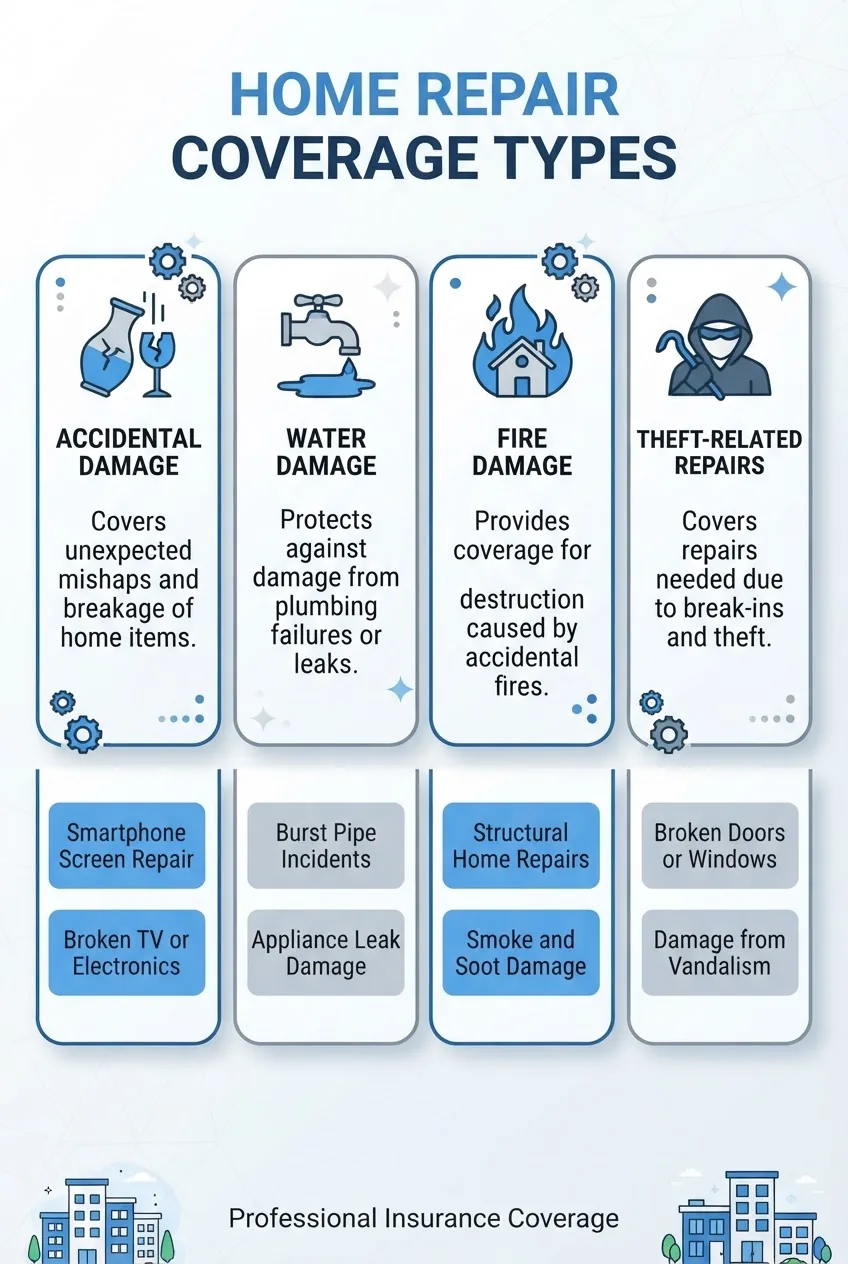
Below are common coverage types listed with examples and notes about how insurers typically evaluate them.
- Fire and smoke damage — Example: repair of charred roof rafters, smoke-cleaning of drywall and contents restoration. Most homeowners policies include this as a core covered peril.
- Water damage from accidental discharge — Example: burst supply line, failed HVAC condensation pan overflow. Insurers cover sudden and accidental discharge; they typically exclude slow leaks from neglect.
- Accidental damage — Example: someone drops a heavy object damaging engineered wood flooring; an accidental damage endorsement may cover this. Many standard policies exclude intentional and certain cosmetic damages unless an endorsement applies.
- Theft-related repair coverage — Example: forced entry that damages doors, frame and interior trim. Coverage often extends to repairs required to secure the property.
- Roof and structural repairs for covered perils — Example: storm-driven debris or fallen tree branch that damages roof decking. Coverage depends on the peril (wind, hail, falling objects) and on roof age limits in some policies.
- Appliance and system repairs for covered mechanical breakdowns — Example: sudden electrical short causing an HVAC failure. Some insurers cover mechanical breakdown as an endorsement or through a home warranty product rather than standard homeowners insurance.
- Temporary living expenses and mitigation — Example: insurer pays for alternate lodging and mitigation costs if repairs render the home uninhabitable after a covered loss. This coverage appears as Additional Living Expense (ALE) or Loss of Use.
- Debris removal and emergency repairs — Example: insurer reimburses reasonable costs to remove debris or make temporary repairs to prevent further damage, like boarding windows or placing tarps.
- Code upgrade/ordinance coverage — Example: rebuilding to meet current codes after covered fire damage. This is often an optional endorsement that helps cover increased costs to bring systems or structures up to code.
- Vandalism and malicious damage — Example: graffiti removal is rarely covered, but structural vandalism that requires repair typically is, provided the policy lists vandalism as a covered peril.
How perils are defined matters: insurers list covered perils (named-perils policies) or provide all-risk coverage with listed exclusions; coverage type affects whether a loss is payable. Term: Covered peril: a listed cause of loss in a policy that triggers coverage when damage results directly from that cause.
Examples and policy mechanics:
- Named-perils coverage pays only for perils explicitly listed (e.g., fire, theft); all-risk pays for all perils not explicitly excluded.
- Endorsements add or expand coverage (for example, a “water backup” endorsement covers sewer or sump pump backups often excluded in base policies).
- Deductible structure may differ by peril—some policies have separate hurricane or windstorm deductibles in coastal zones.
Cost example to illustrate scope: a covered water discharge causing $8,500 in damage with a $1,500 deductible yields $7,000 insurer payment; with an additional ordinance upgrade of $3,000 only an ordinance endorsement would pay that extra amount.
Transition: Knowing usual inclusions helps you anticipate exclusions and limitations covered next to avoid surprise denials.
What Home Repairs Insurance Typically Does Not Cover: Exclusions to Know?
Answer: Home repairs insurance typically excludes damage resulting from neglect, routine wear and tear, floods, earthquakes (unless specifically endorsed), intentional acts, and poor maintenance; these exclusions create common coverage gaps homeowners must address.
Common exclusions and why they matter:
- Wear and tear or maintenance-related failures: Policies often exclude losses due to normal deterioration—e.g., a failing water heater from age generally isn’t covered. This is why preventative maintenance matters for insurability and claims acceptance.
- Flood damage: Flooding from natural accumulation or rising water is usually excluded and requires a separate flood policy or National Flood Insurance Program coverage.
- Earthquake damage: Earthquakes are typically excluded unless you buy an earthquake endorsement or policy.
- Intentional or fraudulent acts: Deliberate damage by the homeowner or fraud is excluded and may lead to claim denial and policy cancellation.
- Pest and vermin damage: Damage from pests (termites, rodents) is often considered maintenance-related and excluded.
- Cosmetic defects and minor imperfections: Policies often won’t cover purely cosmetic damage unless it impairs function or is part of a covered loss.
- Acts of war or certain government actions: These are commonly excluded in standard property policies.
- Business-use exclusions: Damage related to commercial activities on the property may need a separate policy.
Examples where exclusions commonly cause disputes:
- Slow leak causing mold over months: insurer may deny as maintenance neglect.
- Old roof failing after wind event: insurer may apply wear-and-tear depreciation or deny if roof condition was unacceptable per policy terms.
- Flooding from heavy rain entering at ground level: excluded without flood insurance through NFIP or private flood market.
Tools to assess exclusions: review your policy’s exclusions section and compare to state-mandated consumer protections. For homeowner-oriented guidance from regulators, consult your state insurance department; for federal flood guidance consult FEMA.
Resource note: If planning a bathroom overhaul (a common expensive repair often limited by coverage), consider budgeting with a bathroom renovations cost calculator to separate insured repair expectations from elective renovation costs.
Transition: After recognizing exclusions you must prepare documentation and follow claim steps precisely—details covered in the next section guide you through filing a claim and expected timelines.
How to File a Claim for Home Repairs and What to Expect?
Answer: To file a home repairs claim, document damage immediately, contact your insurer, obtain repair estimates, schedule an adjuster inspection, submit required documentation, and follow insurer instructions; expect verifications, possible disputes over scope, and staged payments for major repairs.
Term: Adjuster: an insurance representative who inspects damage, evaluates coverage applicability, and recommends settlement amounts.
- Immediate steps after damage: Ensure safety, mitigate further damage (tarps, shut-offs), preserve evidence (photos, time-stamped video), and keep receipts for temporary repairs.
- Contact your insurer: Call the claims number on your policy as soon as possible; record the claim number and assigned adjuster contact details.
- Obtain repair estimates: Get at least two contractor quotes when possible and keep written itemized estimates. Use an accurate estimator tool such as a construction price calculator to validate line-item costs.
- Submit documentation: Photos, estimates, receipts for temporary work, and any pre-loss maintenance records strengthen your claim. Include permit and inspection records if relevant.
- Adjuster inspection: Attend the inspection, present estimates, show damaged areas, and point out concealed damage you documented. Keep communications written when possible.
- Claim decision and settlement: Insurer issues a scope of loss and payment offer less deductible; you can negotiate or provide supplemental estimates for concealed damage discovered during repairs.
- Repair phase: Choose approved contractors, sign contracts that reflect insurer scopes, and submit invoices. For large repairs, insurers may release payments in stages (initial advance, mid-project, completion).
- Closing the claim: Submit final invoices, proof of payment, and any code-compliance evidence; the insurer issues final settlement and closes the claim.
Detailed tips and an illustrative client story (experience signal): A homeowner found a slow attic leak causing insulation and drywall damage. They photographed the damage weekly, called the insurer immediately, and used a handyman to temporarily remove wet insulation (saving photos and receipts). The adjuster initially underestimated mold remediation. The homeowner supplied contractor test results and a second remediation estimate, which led to a supplemental payment after independent code references were provided. This shows how documentation and professional reports influence outcomes.
Practical checklist for your claim packet:
- Claim form and claim number
- Time-stamped photos and videos
- Contractor estimates (itemized)
- Receipts for emergency work and temporary repairs
- Maintenance records proving prior condition
- Permits, inspection reports and professional assessments
Helpful tools to gather accurate estimates and contractors: use a handyman cost calculator, consult the home remodel quotes guide, and use a home repair app guide to find vetted contractors.
How to handle disputes and denials:
- Request a written explanation of denial and the specific policy language cited.
- Provide supplemental evidence (inspection reports, third-party estimates, maintenance records).
- File an internal appeal and if unresolved, contact your state insurance regulator; consumer protections exist and vary by state.
Transition: With the claim process clear, the next section explains what drives your premium costs so you can make choices that reduce long-term repair expense exposure.
What Factors Affect Home Repairs Insurance Costs and Premiums?
Answer: Premiums for home repairs coverage are driven by risk factors like location (weather and crime), home age and condition, construction materials, claim history, deductible level, coverage limits and optional endorsements.
Term: Premium: the periodic payment you make to maintain insurance coverage.
Key drivers explained with examples and quick stats:
- Location and local perils: Homes in flood-prone, hurricane, or high-wind areas face higher premiums and often separate deductibles for specific perils. According to a 2024 industry report, properties in high-hazard zones can pay 30–70% more for comparable coverages.
- Home age and condition: Older homes with aging roofs, wiring or plumbing create higher likelihood of claims; insurers may charge more or require inspections.
- Construction materials: Fire-resistant materials lower risk; wooden structures in wildfire zones often carry surcharges or discounts for mitigation measures.
- Claims history: Frequent past claims increase premiums; insurers use loss runs to price future risk.
- Deductible amount: Higher deductibles reduce premiums. Trade-off example: choosing a $2,500 deductible instead of $1,000 might lower your annual premium by several hundred dollars, but increases out-of-pocket amount on each claim.
- Coverage limits and endorsement breadth: Higher limits and additional endorsements (e.g., water backup, ordinance) raise premium costs proportionally.
- Security and mitigation features: Burglar alarms, monitored smoke detectors, backup generators with transfer switches, and roof coverings rated for severe weather can yield discounts.
- Insurer underwriting and competitive pricing: Different insurers price similar risk profiles differently based on their loss experience and appetite for particular perils.
Practical cost scenarios:
| Scenario | Typical Effect on Premium |
|---|---|
| Older roof, history of leaks | Premium increases; possible roof inspection requirement |
| High deductible elected | Lower annual premium, higher out-of-pocket per claim |
| Install smoke and security systems | Available discounts reduce premium modestly |
Budgeting intersection: Integrating insurance costs into repair budgets is essential. For detailed planning, consult the annual maintenance cost guide for home repair and budget and consider broader annual maintenance cost planning to align premium trade-offs with expected maintenance spend.
Quick decision rule of thumb: choose a deductible level you can comfortably cover from an emergency fund; if increasing the deductible saves less than you would realistically invest in lower-risk mitigation each year, the trade may not be worth it.
Regulatory note: Premium calculations and available discounts vary by state; check state regulations or your state insurance department website for mandatory filings and consumer protections regarding rate increases. For industry-wide guidance, consult NAIC resources.
Transition: With premium drivers understood, you can use policy features and maintenance strategies to protect repair budgets — the next section covers cost-protection strategies.
What Strategies Can Homeowners Use Home Repairs Insurance for Cost Protection?
Answer: Use a combination of higher deductibles aligned with emergency savings, targeted endorsements, preventative maintenance, staged repair budgeting, and selective claims to protect repair costs and minimize premium increases.
Practical strategies with implementation steps:
- Align deductible with emergency savings. Choose a deductible you can pay without financial strain. Example: If you have a dedicated emergency fund covering a $2,000 deductible, you can benefit from lower premiums versus a $500 deductible.
- Prioritize preventative maintenance. Regular inspections, roof cleaning, HVAC tune-ups and timely plumbing repairs reduce claim frequency; insurers reward documented maintenance with fewer disputes. Term: Preventative maintenance: routine upkeep that prevents deterioration and reduces risk of covered claims.
- Buy targeted endorsements for costly gap exposures. Common endorsements include water-backup, ordinance or code upgrades, and equipment breakdown. Evaluate expected repair exposure vs. endorsement premium to decide value.
- Use staged repairs and supplements wisely. For complex losses, submit initial claim and then a documented supplement if additional damage is discovered during repairs. Keep clear records and contractor change orders.
- Limit small-claim submissions to avoid surcharge. If the repair cost is only slightly above your deductible, paying out-of-pocket may be less costly over time than filing a claim that increases premiums. Use expected claim impact vs. immediate expense analysis.
- Document and negotiate repair scopes. Obtain itemized estimates and question ambiguous cost items; provide independent contractor reports where insurers undervalue repairs.
- Bundle coverages and shop insurers annually. Bundling home and auto or switching carriers can yield discounts; compare replacement cost versus actual cash value offers carefully.
- Coordinate insurance with renovation planning. If renovating, separate cosmetic or planned improvement costs (not covered) from repair costs that may be insurable after a covered loss; use a average home repair estimates reference when deciding whether to claim.
- Leverage financing strategically for large non-covered repairs. In cases where insurance excludes certain upgrades, consider targeted financing while preserving insurance for covered perils; see financing options in related guides such as How to Pay for Expensive Home Repairs with Financing Options.
- Use checklist-driven maintenance budgets and guides. Plan annual maintenance to avoid claims and smooth costs; consult the home improvement house guide and “average home repair estimates” for project baselines.
Illustrative calculation (repair budgeting): If a $10,000 repair is covered but you would face a 20% premium increase for filing small claims frequently, paying $10,000 once and absorbing the premium change may be worse than using your emergency fund and avoiding the claim. Use the property repair cost estimate guide to estimate repair costs before deciding to file.
Resource connections: For typical cost ranges see average home repair estimates and for project-specific calculators use the handyman cost calculator to validate quotes during a claim.
Transition: With strategies in place, it helps to understand how home repairs insurance compares with other insurance options and tools that cover home risk and repair costs.
How Does Home Repairs Insurance Compare with Other Home Insurance Options?
Answer: Home repairs insurance overlaps with standard homeowners insurance, home warranties and specialty policies, but differs in scope, claim triggers, payment methods and exclusions—compare limits, deductibles and covered perils to choose the right mix.
Comparison table of core options:
| Option | Primary focus | Typical payment model | When to use |
|---|---|---|---|
| Standard homeowners insurance (HO-3) | Structural and personal property from covered perils | Claim-based with deductible | Sudden accidental damage and major perils |
| Home repairs endorsement/rider | Expanded repair coverage or lower deductible for specific items | Often claim-based, may have service fees | When base policy gaps affect certain costly repairs |
| Home warranty / appliance protection | System and appliance breakdowns from wear or mechanical failure | Service contract, service-call fees, capped payments | When appliances/systems are aging and you want predictable service costs |
| Flood / earthquake policies | Peril-specific catastrophic coverage | Claim-based with separate deductibles | When property is exposed to natural disaster perils |
Summary: Standard homeowners insurance is the backbone of repair coverage for covered perils, while endorsements and warranties fill gaps—coordinate the three to reduce unexpected repair expenses. For valuation approaches when choosing limits, consult a replacement cost calculator to decide on dwelling limits and replacement-cost versus ACV choices.
Transition: With these comparisons clear, you can better evaluate challenges and apply tips to choose the right home repairs insurance setup for your situation.
What Are Common Challenges and Tips for Choosing the Right Home Repairs Insurance?
Answer: Common challenges include coverage gaps, unclear policy language, surprise exclusions, rising premiums after claims and valuation disputes; effective selection requires reading policy details, asking targeted questions and documenting home condition.
Key tips, warnings and best practices:
- Read exclusions and definitions carefully. Many disputes hinge on phrasing—ask insurers to clarify ambiguous language in writing.
- Watch for age or roof condition limits. Some carriers cap coverage or impose higher deductibles for older roofs and systems.
- Ask about separate peril deductibles. Coastal and catastrophe zones frequently have named deductible structures (percentage-based hurricane deductibles) that affect repair affordability.
- Understand valuation methods. Replacement cost delivers full repair value (subject to limits) while ACV deducts depreciation—ask which applies to your dwelling and contents.
- Avoid small frequent claims. Frequent small claims can raise premiums or result in non-renewal; weigh paying small repairs out-of-pocket versus long-term premium effects.
- Keep maintenance logs. Documenting maintenance work, inspection dates, and receipts improves your position in disputing denials that allege neglect.
- Use endorsements where valuable. For example, a water-backup endorsement often costs less than repeatedly replacing basement finishes after sewer backups.
- Consult multiple carriers and agents. Coverage nuances vary; an independent agent can compare options and highlight carriers that accept older homes or offer favorable endorsements.
- Escalation path for denials: If you disagree with a denial, follow insurer appeal steps, request internal review, obtain independent inspections, and if unresolved, file a complaint with your state insurance department. For consumer advocacy and dispute frameworks see Consumer Financial Protection Bureau.
Warning signs when selecting a policy:
- Unclear limits on specific repairs (e.g., HVAC) without written clarification.
- High frequency of complaints against an insurer in state regulator filings.
- Agents who cannot provide written answers to coverage questions.
Practical selection checklist before purchase:
- Request policy sample and read exclusions/endorsements.
- Compare deductibles and calculate break-even points against premium savings.
- Confirm claim handling timelines and emergency response procedures.
- Check insurer complaint ratios via your state insurance department and NAIC reports.
- Ask about bundling discounts and mitigation credits (security, roofing, Sprinklers).
Transition: Below are targeted FAQs that answer specific homeowner questions for fast reference.
Conclusion: Key Takeaways and Next Steps
Home repairs insurance can be a powerful tool for protecting repair budgets when you understand what it covers, what it excludes, how deductibles and endorsements affect claims, and how preventative maintenance lowers risk. Review policy language, document maintenance, gather estimates before filing claims, and align deductibles with emergency savings. To start planning your repair budget alongside insurance choices, consult our annual maintenance cost guide for home repair and budget. Contact your agent with specific documentation questions and check your state insurance regulator for consumer protections before filing major claims.