How to verify contractor insurance: by the end of this hands-on guide you’ll be able to verify a contractor’s insurance and license, spot red flags, and document compliance. Expect to spend 60–120 minutes per candidate; skill level required: basic web navigation, phone calls, and reading documents.
Before you start
- Printed or digital copies of the contractor’s business card, license, and any COI they provide
- List of questions to ask the contractor and the insurance company (see Step sections)
- Device with internet access for state portal lookup and email
- Notebook or digital folder to save screenshots, PDFs, and dates
- Optional: copy of local building department or HOA insurance requirements
Why Verifying Contractor Insurance and Licensing Is Crucial
Verifying contractor insurance and licensing mitigates risk, provides financial protection for damages, and ensures legal compliance on your project. Think of verification as installing a safety net: if a worker is injured or property is damaged, valid insurance and the right license keep liability and unexpected costs off your balance sheet.
Homeowners who skip verification can face project liability, repair costs, and legal exposure. According to a 2024 industry report, an estimated portion of construction-related claims involve unlicensed contractors, increasing homeowner out-of-pocket costs (source type: industry report). Many states impose fines and stop-work orders for unlicensed work (source type: state contractor board advisory).
Key benefits of verification:
- Risk mitigation: confirms coverage limits and effective dates for liability and workers’ compensation.
- Financial protection: prevents you from being treated as the employer for injuries when uninsured labor is used.
- Legal compliance: verifies bonding and licensing matches the project type and value.
- Project continuity: licensed and insured contractors are less likely to have permits delayed.
- Homeowner protection: you get documentation to present to mortgage lenders or insurers.
Transition: once you understand why verification matters, next is a concise primer on the specific insurance types and licenses you’ll encounter.
Understanding Contractor Insurance and Licensing Basics
Before you begin live verification, understand the terms you’ll read on documents and online records. This reduces errors and speeds the process.
Liability insurance (general liability) covers third-party property damage and bodily injury arising from the contractor’s work. Workers’ compensation insurance covers employee medical costs and wage replacement if a worker is injured on your property. Bonding (surety bonds) assures completion and payment to subcontractors or suppliers if the contractor defaults.
Licenses are issued by state or local authorities and define legally what work a contractor can perform. Licenses vary by trade (e.g., electrical, plumbing, general contracting), by project value thresholds, and by jurisdiction.
Common insurance and license types (quick list):
- Commercial General Liability (CGL) — insures property damage and third-party injuries
- Workers’ Compensation — required in many states when a contractor has employees
- Professional Liability (Errors & Omissions) — for design or consulting services
- Commercial Auto — covers business vehicle operation
- Surety Bond — protects against contractor default or non-payment
- State-issued trade license — qualifies the contractor for specific trades and project sizes
For an in-depth explanation of policy differences, see our guide on contractor insurance coverage and liability options . That piece covers premium drivers, coverage limits, and exclusions in depth; use it if you need to interpret policy wording or assess adequacy of limits.
Transition: with basics covered, the practical verification process below walks you through checking a Certificate of Insurance (COI), contacting carriers, and documenting results.
Step-by-Step Guide: How to Verify Contractor Insurance
This section is a detailed, actionable walkthrough for verifying insurance: COIs, coverage limits, expiration dates, and carrier validation. Follow each numbered step and use the checklist at the end of the article to confirm completion.

- Request a Certificate of Insurance (COI) — Ask the contractor to email or hand you an ACORD-form COI or equivalent before any work begins. A COI summarizes policy type, policy number, effective/expiration dates, limits, and certificate holder. If the contractor refuses or claims “we’re covered” without paperwork, stop and escalate; that’s a red flag.
- Confirm the effective and expiration dates — On the COI, write down the policy start and end dates. Do not accept a policy with an expiration date during your project. If the project spans longer than six months, require proof of renewal or a policy that extends beyond project completion by at least 30 days.
- Check coverage limits against project value — Typical minimums many homeowners should expect: General liability at least $1,000,000 per occurrence and $2,000,000 aggregate; higher for larger projects. According to a 2023 contractor insurance guidance bulletin, many states recommend $1M per occurrence for residential work (source type: industry guidance). If your project exceeds $50,000, request higher limits or specific project endorsements.
- Verify the insurer and policy numbers — On the COI, note the insurance carrier name and policy number. Use the carrier’s customer service phone number (from the insurer’s official website, not the COI) to confirm the policy details and that the certificate is authentic. Ask the carrier to confirm: policy number, named insured, effective/expiration dates, coverage types and limits, and whether the policy is in good standing.
- Confirm the named insured matches the contractor’s company — The “Named Insured” should match the contractor’s legal business name and the name on the license. If the COI lists a parent company or an individual’s name that doesn’t match, ask for documentation linking the entities (DBA filings, business license). Do not accept a COI where the named insured is different and cannot be explained.
- Look for Additional Insured and Waiver of Subrogation endorsements — Request an endorsement adding you (the homeowner) as an “Additional Insured” on the general liability policy for the duration of the work and a “Waiver of Subrogation” on the workers’ comp policy if you live in a state that allows it. Endorsements are separate from the COI and should be provided as policy documents or endorsements referencing the policy number.
- Check workers’ compensation status — If the contractor has employees, workers’ compensation is essential. On the COI, confirm the policy type and whether the carrier lists “Workers’ Compensation” with appropriate values or a statement of “Not Covered — covered by subcontractors.” If the contractor claims subcontractors cover workers’ comp, require subcontractor COIs or insist the prime contractor maintain coverage and hold subcontractors to the same standard.
- Confirm commercial auto coverage if vehicles will be used — For projects involving material delivery or equipment transport, confirm commercial auto insurance. Personal auto policies often exclude business use and may leave you exposed if a vehicle-related accident occurs on your property.
- Ask for the insurer’s contact details and call — When you call the insurer: identify yourself, provide the policy number, and ask the representative to confirm coverage for the named insured, active status, effective/expiration dates, and whether the policy includes the endorsements you requested. Note the representative’s name, call time, and confirmation details. If the insurer refuses to speak with you, request a written verification.
- Validate surety bonds — If the project or your state requires bonding, ask for the bond number and surety company name. Verify with the surety company (contact from the surety’s official website) that the bond is active and its penal sum. Bonds guarantee contractor performance and payment to subs/suppliers up to the bond amount.
- Collect policy declarations page excerpts when necessary — For large projects, request a copy of the declarations page showing endorsements. This gives you direct evidence of coverage terms, endorsements, and exclusions. It may take carriers several days; plan accordingly before contract signing.
- Document everything — Save emailed COIs, endorsements, call notes, and screenshots of carrier confirmations in a dated folder. Use PDF naming conventions like “ContractorName_COI_YYYYMMDD.pdf” and record the contact person at the carrier. Documentation is critical if a claim arises.
- Confirm coverage during long projects — For projects longer than 90 days, set calendar reminders to request updated COIs every 90 days or attach a contract clause requiring continuous insurance with immediate notice of cancellation. Consider escrowed progress payments tied to proof of continuous coverage.
- Ask targeted verification questions — When speaking to insurers or contractors, ask: “Is this coverage primary and non-contributory?”, “Does this policy cover subcontractors when they work under the named insured?”, and “Are there any exclusions for water damage, property subsidence, or other risks relevant to my project?” Save precise responses.
- Spot-check for COI fraud — Fake COIs sometimes show valid-looking carriers and logos. Inspect for signs: misspelled insurer names, inconsistent policy numbers, low-quality PDFs, or COIs issued from generic email addresses. Confirm with the carrier using contact details from the insurer’s official website (not those on the COI).
- Include insurance requirements in the contract — Insert contract clauses requiring minimum limits, added insured endorsements, and proof of renewal. Example clause: “Contractor shall maintain Commercial General Liability coverage of no less than $1,000,000 per occurrence/$2,000,000 aggregate and Workers’ Compensation as required by law; homeowner shall be named as Additional Insured for the duration of work plus 30 days.” See the “Additional Tips” section for sample contract language.
- When subcontractors are used, verify their coverage — Require the prime contractor to provide COIs for all subcontractors, and confirm each COI lists the prime contractor as the certificate holder or named insured where applicable. If the prime claims they “cover” subs, obtain proof: either the prime’s policy must show a subcontractor coverage endorsement or individual COIs for each sub must exist.
- Consider requiring an Owner’s Protective Policy for very large projects — For commercial-scale residential projects, consider an Owner’s Protective Liability policy naming the homeowner as the insured. Discuss this with your insurer or legal counsel.
- Escalate suspicious cases — If you suspect a fake COI after carrier checks, file a complaint with the state insurance regulator and the state contractor licensing board. Provide documentation and the carrier confirmation notes. For national guidance, refer to the National Association of Insurance Commissioners at NAIC .
- Understand independent contractor nuances — Independent contractors may carry different policy structures, sometimes with lower premiums and narrower coverages. For details on what to expect from independent contractors, read our independent contractor insurance coverage guide.
Transition: verifying insurance is only half the job; next we verify the contractor’s license, check official records, and ensure trade authority and reciprocity where applicable.
Step-by-Step Guide: How to Know If a Contractor Is Licensed and Insured
This section covers step-by-step license checks using state portals, license number validation, verifying subcontractor credentials, and documenting official records. The walkthrough below includes a mock verification scenario and text directions that mimic on-screen actions since screenshots are not embedded.

- Gather the contractor’s basic details — Collect the contractor’s legal business name, DBA (if any), license number shown on their business card or COI, business address, phone, and the full name of the person signing contracts. If a license number is not provided, request it before signing.
- Identify the licensing authority for your state and trade — Every state or county has a licensing board or contractor licensing office. Use an official source like your state’s business licensing directory or the national directory. For state-level examples, California’s board is the Contractors State License Board at cslb.ca.gov . If you’re uncertain, call your local building department and ask which licensing body regulates the trade.
- Access the official online license lookup portal — Most states provide a public license verification portal. Search for “[your state] contractor license lookup” and open the state government URL ending with .gov or the state board domain. On the portal: enter the license number, business name, or contractor’s name. If the portal requires a captcha or user validation, complete it. The portal will return license status, issuance and expiration dates, classification (trade), and disciplinary actions if any.
- Mock verification walkthrough (text-based) — Example: to verify a “General Contractor” license in State X: open the state board site > click “License Lookup” > choose “Contractor License” > enter license number ABC123456 > press “Search” > read the returned record: “Status: Active; Classification: General B; Expiration: 2026-09-30; Disciplinary Actions: None.” Take a screenshot or print the result. If the portal shows “Expired,” do not proceed until valid renewal evidence is provided.
- Validate license classifications and project thresholds — Ensure the license classification covers your project. Some states separate trades and set thresholds by contract amount (e.g., a “Class B” license covers projects up to $X). If your project exceeds that threshold, require a higher-class license or ask for proof of reciprocity/certification.
- Check for disciplinary history or consumer complaints — Review any enforcement actions or judgments listed on the state board portal. If the portal shows unresolved complaints or pending litigation, request explanation and documentation from the contractor. According to a 2024 state board summary, unresolved disciplinary complaints can predict future disputes (source type: state contractor board data).
- Confirm license number authenticity — Some fake documents present plausible license numbers. Cross-check the number and the listed business name on the portal. If the portal returns “No record found,” request an alternative like a bond number or contact the licensing board for verification over the phone.
- Ask for documentation tying the license to the person who will do the work — If the company lists a qualifying individual (qualifier) or responsible managing employee, verify that person’s name on the license record. If the person who signs the contract is not the qualifier, confirm authority to act on the license holder’s behalf in writing.
- Investigate license reciprocity issues — If the contractor is from out-of-state, confirm whether your state accepts reciprocal licensing or requires local registration. Reciprocity rules vary: some states allow limited practice for nonresident contractors with registration; others require full licensing. Check the licensing board’s reciprocity webpage or call the board directly for specifics.
- Verify subcontractors separately — Even if the prime contractor is licensed and insured, subcontractors must also have relevant licenses and insurance. Request subcontractors’ names, company names, license numbers, and COIs. Verify each sub through the same state portal and insurer verification steps. Document all verifications in your project folder.
- Confirm business status and tax registrations where appropriate — Verify the contractor’s business registration (Secretary of State database) and whether they are current with state tax registrations. This helps confirm legitimacy and reduces the risk of scams. Use your state’s business registry .gov portal.
- Call the licensing board for ambiguous cases — If online records are unclear, call the licensing board. Ask a board representative to confirm whether a license is active, whether it covers the project scope, and whether there’s been recent disciplinary action. Record the representative’s name and the date/time of the call.
- Request an official license copy if digital records are sparse — Some jurisdictions issue laminated cards or paper licenses that contain security features. Ask the contractor to provide a photographed or scanned copy of the license and confirm numbers and names against the portal.
- Confirm insurance and licensing cross-match — Cross-reference the licensee name on the state portal with the named insured on the COI. If the two differ for legitimate reasons (e.g., parent company vs DBA), ask for formal documentation linking the entities and a written statement explaining coverage relationships.
- Document the full verification chain — Save portal result PDFs, COIs, endorsements, screenshots, and notes from insurer or board phone calls. Label files with dates and store them in a folder tied to the project and contract. This reduces ambiguity during disputes or claims.
- Use consumer protection resources when necessary — If you find evidence of fraud, report it to your state contractor board and consumer protection agency. For federal resources and guidance on scams, refer to the Federal Trade Commission at consumer.ftc.gov .
- Include license verification in the contract — Add a clause that the contractor must maintain a valid license for the entire project and provide updated license proof upon request. Example clause: “Contractor warrants it holds all required licenses and will provide updated state-issued license documentation upon request. Failure to maintain required licenses is a material breach.”
- Mock case study: homeowner cautionary tale — A homeowner hired a contractor who provided a convincing COI and a business card with a license number. After work began, a worker was injured. The contractor disappeared; the COI had been canceled two weeks earlier. Because the homeowner had documented calls to the insurer and saved screenshots of the portal showing “Active” status before work, the homeowner’s insurer and the state board were able to trace the fraud, and the homeowner avoided claim denial (source type: cautionary case study from practitioner records).
Transition: after completing these verification steps, learn common red flags and legal variations to strengthen protection.
Common Red Flags When Verifying Contractor Credentials
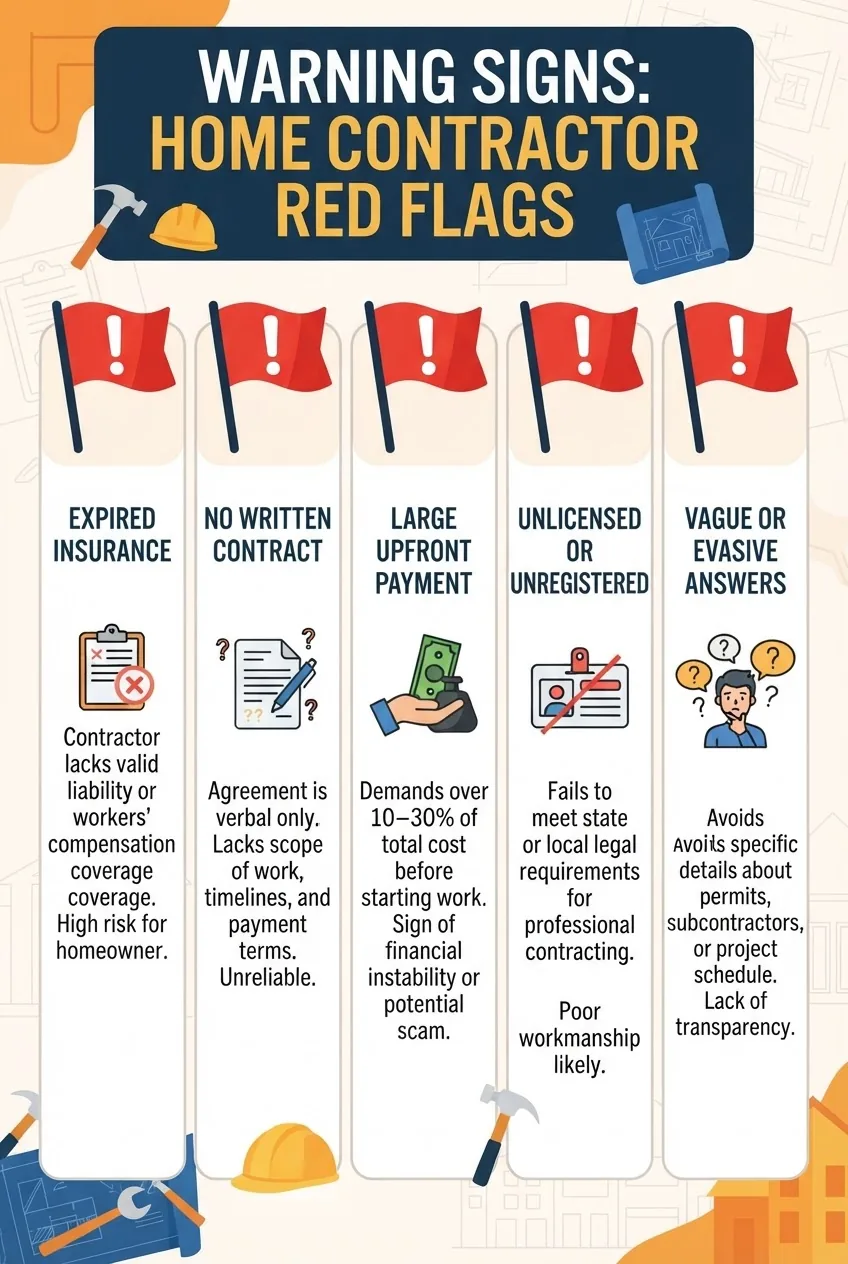
- Expired insurance or imminent expiration — COIs with expiration dates inside your project timeline. If I ever accepted an expiring COI, the policy lapsed mid-job and left me liable for out-of-pocket repairs.
- Inconsistent names between license and COI — A contractor’s business name on the COI doesn’t match the state license record; can’t be explained with DBA paperwork.
- Refusal to provide carrier contact details — If a contractor won’t let you contact the insurer directly, that’s a major red flag.
- Low coverage limits for large projects — General liability limits below $1,000,000 for projects >$50,000 should trigger renegotiation.
- Unverifiable license numbers or “no record found” — The license number doesn’t return a record in the state’s portal.
- No workers’ compensation when employees are present — Contractor claims “my workers are subcontractors” but provides no subcontractor COIs.
- High-pressure or cash-only payment requests — Urgent cash demands or refusal to sign a written contract often accompany fraudulent operators.
- Vague or evasive answers — The contractor cannot explain endorsements, coverage scope, or the name on the policy.
Each red flag should prompt immediate validation: call the insurer, check the state portal, and consider alternative contractors if answers are unsatisfactory. For a visual summarizing these flags, see the infographic above.
Transition: legal obligations and state variation matter; below is a concise comparison and practical legal considerations.
Legal Considerations and State Variations in Licensing and Insurance Requirements
Legal requirements for insurance and licensing vary by state. Some states mandate workers’ compensation for any contractor with employees; others allow exemptions for sole proprietors without employees. Minimum required liability limits may exist in state procurement rules but are often set by local jurisdictions or lenders.
Key legal considerations:
- Who is liable: homeowners vs contractors in the event of injury — in many states, if the worker is an employee without coverage, injured parties may try to hold the homeowner liable (source type: legal aid guidance).
- License ceilings: states often restrict the dollar value a specific license class may contract for.
- Bonding requirements: some states require surety bonds for licensed contractors or for public projects.
- Reciprocity: out-of-state contractors may need to register or obtain a local license depending on the state.
- Enforcement: active disciplinary records can result in stop-work orders or civil penalties.
| State / Rule | Typical Minimum Liability | Workers’ Comp Requirement | Reciprocity Notes |
|---|---|---|---|
| California | Commonly $1M per occurrence | Required if employees exist | Limited reciprocity; nonresidents must register |
| Florida | Varies; local governments may demand higher | Required for employers | Some reciprocal recognition; check state board |
| Texas | Often $1M recommended | Required for employers; subs may be exempt if sole proprietor | No broad reciprocity; locals may require registration |
Note: this table is illustrative; check your state contractor board for exact rules. Where state law is ambiguous, contact the licensing authority directly. For national insurance standards and regulatory advice, consult the NAIC at NAIC .
Transition: practical contract language, communication tips, and next-step protections increase homeowner safety; see the following tips section.
Additional Tips for Protecting Yourself When Hiring a Contractor
Prevention is the most efficient protection. Use these practical tips to combine credential checks with contract-level insurance and payment protections.
- Include clear contract clauses — Insert precise insurance clauses: minimum limits, Additional Insured, waiver of subrogation, and requirement to deliver updated COIs every 90 days. Example language: “Contractor shall maintain CGL of $1,000,000 per occurrence / $2,000,000 aggregate, name homeowner as Additional Insured, and furnish renewal COIs 30 days prior to expiration.”
- Verify references and past work — Call at least three recent clients and ask specifically about claim events, whether the contractor used subs, and whether there were insurance or licensing disputes. Ask for permission to inspect completed work in person.
- Use staged payments tied to milestones — Avoid large upfront payments. Use an agreed schedule (e.g., 10% deposit, balanced payments at defined milestones) and tie each payment to proof of continuing insurance and satisfactory inspection. For payment handling and secure bids, explore estimate software for contractors to compare and log estimates.
- Consider escrow or joint-check arrangements — For projects with costly materials, use escrow accounts or joint-payment checks to suppliers to prevent non-payment claims and reduce lien risks.
- Keep written records of all verifications — Email confirmations, carrier call notes, and state portal screenshots are admissible evidence and speed dispute resolution.
- Know how insurance claims work — If a loss occurs, notify both your homeowner insurer and the contractor’s insurer. Document damage with photos and dated notes. Understand that your insurer may subrogate against the contractor’s carrier if the contractor is at fault.
- When hiring trades, confirm skill and certification along with credentials — Insurance and license checks do not replace skill verification. To properly vet tradespeople, consider using our guide to hire skilled professionals for complementary steps like trade certification checks and workmanship guarantees.
- Find reliable local options — After verification, if you need a wider pool, consult local directories and our finding reliable home contractors near me guide for trusted options and referral strategies.
- Hold short retention on final payment when warranted — For complex or structural work, withhold 5–10% retention for 30–60 days after completion to ensure punch-list items are finished and to allow subs to file any liens first.
- Get homeowner-friendly warranty and maintenance terms in writing — Ensure warranties are assignable and in writing; confirm whether warranties are backed by the contractor, the manufacturer, or an insurer.
Transition: you now have a practical set of actions and contract language; next are common mistakes I’ve seen and how to avoid them.
Common mistakes and how to avoid them
I once accepted a COI emailed as a JPEG without calling the insurer — the policy had been canceled a month prior. After that experience I always validate the policy number with the insurer’s official phone line and save their confirmation. If I had required the endorsement listing me as Additional Insured in the written contract, my exposure would have been minimized.
I have also seen contractors claim “our subs are insured” while providing no subcontractor COIs. Now I require the prime contractor to supply COIs for every subcontractor and add contract language making the prime contractor responsible for uninsured sub work. This prevents surprises when a supplier or worker later files a claim.
Finally, I have underestimated license classifications: a licensed “handyman” was not authorized to perform structural work. I now verify classification codes on the state portal and confirm the license covers the exact scope before signing.
Checklist: Verify you have completed these items
- COI received and saved (ACORD or equivalent) with policy number and carrier noted
- Carrier contacted and coverage confirmed (record rep name, date, and call notes)
- Named Insured on COI matches license record or DBA documentation
- Additional Insured endorsement and Waiver of Subrogation requested and provided
- Workers’ Compensation coverage verified if employees are present
- Subcontractor COIs and license verification collected
- License verified via state portal and classification checked
- Contract contains explicit insurance and license clauses and renewal obligations
- Payment schedule tied to milestones and documented verifications
- All documents saved in a dated digital folder with clear filenames
When to call in a professional
Call an insurance broker or construction attorney if:
- You can’t determine whether the policy language actually covers the risk (e.g., subsidence, mold, design defects).
- The contractor’s coverage approach uses unusual endorsements or primary/non-contributory language that could affect claim recovery.
- There are unresolved disciplinary actions, license revocation threats, or legal disputes tied to the contractor.
- The project is high-value (commonly > $250,000) or involves structural, historical, or regulated work.
According to a 2022 legal aid summary, homeowners who involve counsel early in large disputes resolve claims faster and more cost-effectively (source type: legal aid organization report).
Conclusion: You now have a complete, practical method for how to verify contractor insurance and how to know if a contractor is licensed and insured. Spend a focused 60–120 minutes per candidate: collect documents, validate with carriers and state portals, document calls, and include firm contract language. If anything seems off, pause hiring until verified — it’s the most effective prevention against financial and legal risk.
Ready for the next step after verification? Use our pillar resource to refresh the full process and return here when you compare candidates: how to verify contractor insurance