
Independent contractor insurance gives self-employed tradespeople financial protection against third‑party injury, property damage and professional errors; it typically includes general liability, professional liability, workers’ comp (if required), commercial auto and equipment cover, tailored to residential, solo contracting risks.
This guide explains what independent contractor insurance covers, the cost drivers, typical premium ranges and practical steps an independent residential contractor can take to pick affordable, compliant policies.
What is Independent Contractor Insurance?
Answer: Independent contractor insurance is a package of policies and endorsements that protect self-employed contractors from liability, property loss, vehicle and equipment damage, and claims arising from professional services while working as a solo or freelance operator.
Independent contractor insurance definition: insurance held by a self-employed individual (not a corporation or large firm) that covers risks tied to performing contracted services on behalf of clients.

Independent contractors—roofers, plumbers, electricians, carpenters and handypersons working alone or with a small helper—face different exposures than larger firms: fewer employees, limited capital, and heavier reliance on personal tools and vehicles. That means coverage choices prioritize liquidity for claims payments, portable equipment protection, and professional error coverage where advice or workmanship could trigger losses.
Key distinctions from standard contractor insurance include:
- Policy sizing for one-person operations (lower payroll assumptions).
- Greater emphasis on tools & equipment insurance and commercial auto endorsements.
- Flexible policy periods and certificates for short-term jobs or subcontracting.
Thought experiment (case example): Mark, a residential tiler working alone, bought a $1M general liability policy with a tools floater and commercial auto coverage; when a client slipped on a wet patch, the liability claim was handled through his general liability, avoiding personal bankruptcy. That illustrates how targeted policies act as a financial safety net for solo tradespeople.
Types of Insurance Coverage Essential for Independent Contractors
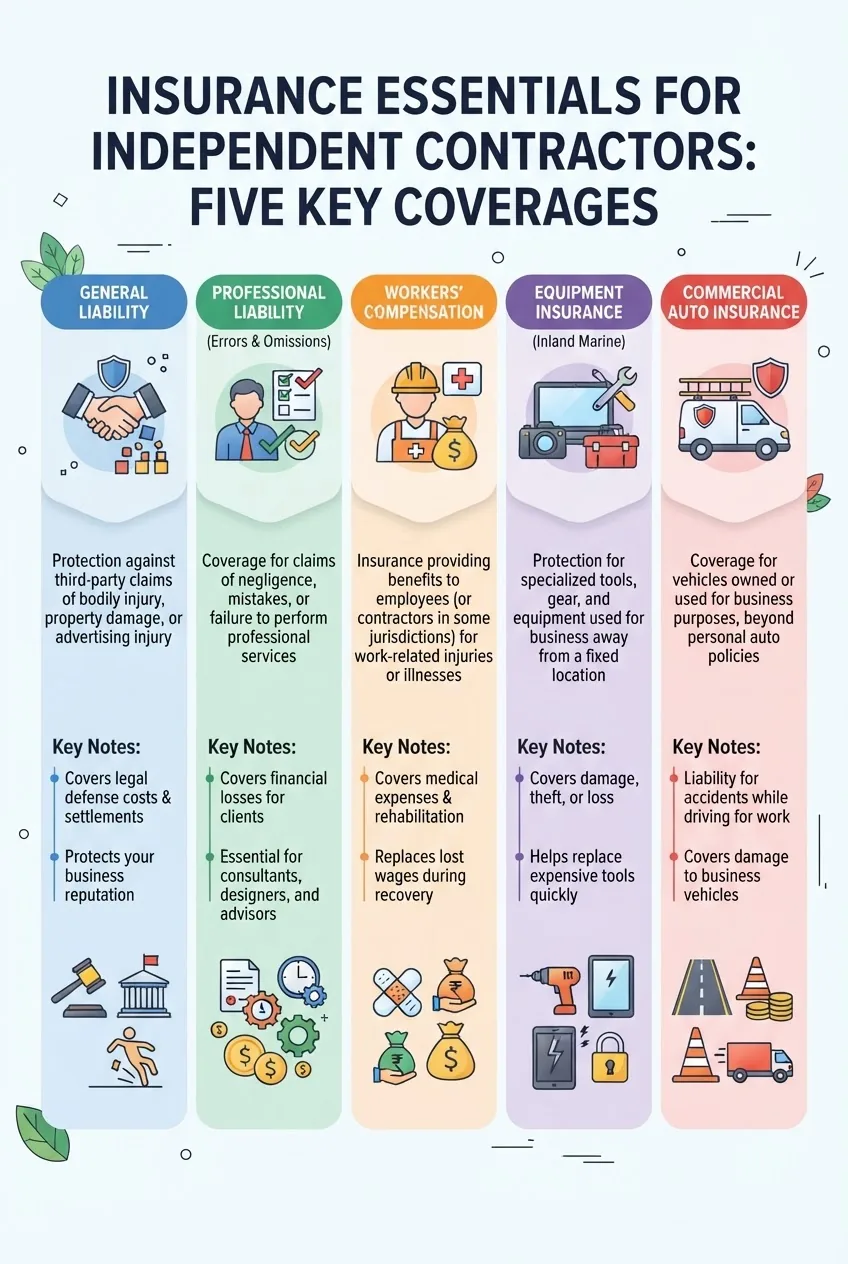
Answer: Independent contractors typically need a combination of general liability, professional liability, workers’ compensation (if required), commercial auto, and tools & equipment insurance; the exact mix depends on the trade, contract requirements and state law.
-
1. General liability insurance (GL)
Answer: GL protects against third‑party bodily injury and property damage arising from your work or jobsite operations and pays defense costs and settlements up to policy limits.
Term: General liability covers claims like a visitor injured on a jobsite or accidental damage to a client’s property.
Why GL matters: most client contracts and many permitting authorities require GL certificates. Typical limits are $300,000 to $2,000,000 per occurrence; solo contractors often choose $500,000–$1,000,000 limits depending on project scale.
Common exclusions: professional errors (covered by E&O), employee injuries (workers’ comp), pollution (unless endorsed) and contractual liabilities that exceed your agreement.
-
2. Professional liability (Errors & Omissions, E&O)
Answer: Professional liability covers claims of negligence, design errors or advice that led to financial loss, and is essential when your work involves planning, consulting, or trade-specific design decisions.
Term: Professional liability (E&O) pays for negligence claims where workmanship or professional advice caused loss, even without bodily injury.
Use cases: a self-employed electrician who provides wiring diagrams or a contractor giving structural advice should carry E&O. Limits often range $100,000–$1,000,000 depending on exposure.
-
3. Workers’ compensation
Answer: Workers’ compensation covers medical costs and lost wages for work‑related employee injuries; independent contractors may or may not be required to carry it depending on state law and whether they employ others.
Term: Workers’ compensation is state-mandated insurance that pays injured workers and protects employers from employee lawsuits for on-the-job injuries.
State rules vary: in many states a sole proprietor without employees can waive coverage, but hiring a helper or being classified as an employee by a client often triggers comp requirements. See the State Requirements section below for examples.
-
4. Commercial auto insurance
Answer: Commercial auto insures vehicles used for business tasks—transporting tools, making site visits or hauling materials—providing liability and physical damage coverage distinct from personal auto policies.
Term: Commercial auto insurance covers vehicles while used in a business capacity and usually includes higher liability limits and broader use cases than personal policies.
Note: Personal auto policies often exclude commercial activity; if you drive to multiple job sites daily or carry equipment, upgrade to commercial auto. Consider hired-and-non-owned auto coverage if you rent trucks or use subcontractors’ vehicles.
-
5. Tools and equipment insurance (inland marine / floater)
Answer: Equipment insurance protects tools, portable machinery and owned materials against theft, accidental damage or transit loss—critical for independent contractors whose livelihood depends on tools.
Term: Tools & equipment insurance (sometimes called inland marine or a floater) covers movable property used in business operations.
Coverage options include scheduled (itemized, higher limits per item) or blanket coverage (single aggregate for all tools). Policies may have lower deductibles but higher premiums for high-value tools like tile saws or lifts.
-
6. Commercial property and business interruption
Answer: If you run a small shop or store materials at a fixed location, commercial property and business interruption policies cover damage to premises and income loss during repairs.
Term: Business interruption insurance reimburses lost revenue and ongoing expenses if a covered peril temporarily shuts down operations.
Usually less critical for fully mobile independents but important for those who lease a workshop or warehouse.
-
7. Bonds and surety
Answer: Bonds guarantee contract performance; some residential jobs and municipalities require surety bonds to qualify for permits or to bid on projects.
Term: Surety bond is a guarantee from a third party that the contractor will fulfill contractual obligations; if they fail, the bond pays the client, and the contractor must reimburse the surety.
Bonds are not insurance for the contractor; they are a credit instrument and often required for licensed work or public contracts.
For a deeper legal-liability focus see contractor insurance coverage and liability options.
Factors Affecting Independent Contractor Insurance Costs
Answer: Premiums for independent contractor insurance depend on job type (trade risk), location, payroll/receipts, claims history, coverage limits, deductible size and whether you bundle policies or buy standalone coverages.
Term: Premium is the price you pay for an insurance policy; deductible is the amount you pay out of pocket on a claim before insurance pays.
Major cost drivers explained:
- Trade & job risk: High-risk trades (roofing, tree work) face higher rates than low-risk trades (painting, interior decorating).
- Location & geography: Urban areas with higher claim frequency or regions prone to natural perils increase premiums. According to a 2024 industry report by the National Association of Insurance Commissioners, coastal exposures raise property-related premiums notably.
- Claims history: A clean claims record lowers rates; prior claims increase underwriting scrutiny and surcharges.
- Policy limits & coverage breadth: Higher limits and broader coverages (e.g., pollution, completed operations) cost more.
- Payroll, receipts and subcontractor use: Workers’ compensation and liability rates scale with payroll or declared annual receipts.
- Vehicle and equipment values: More or higher-value commercial vehicles and tools push premiums up.
- Bundling and insurer choice: Multi-policy discounts with the same carrier can reduce aggregate premium.
Embedded data points:
- Average sole-proprietor general liability premium ranges widely—commonly $300–$1,200 annually for low‑risk trades and $1,000–$3,000+ for higher-risk trades, per insurer sampling in 2024 industry surveys.
- Commercial auto endorsements typically add $400–$1,500 per vehicle annually, depending on use and driving records (according to a 2023 insurer benchmark report).
Risk assessment frameworks insurers use include job-class codes, payroll exposure, loss-run analysis (claims history), and physical inspections. Providing accurate documentation—equipment lists, client contracts, safety programs—improves underwriting accuracy and often reduces quotes.
Typical Cost Breakdown for Independent Contractor Insurance Policies
Answer: Typical cost breakdown shows general liability as a baseline annual premium, with added costs for commercial auto, tools floater, professional liability and workers’ comp; bundling and deductible choices significantly affect total spend.

Below is a comparison table showing sample annual cost ranges for a solo residential contractor (estimates aggregated from multiple insurers and market surveys in 2023–2024).
| Policy Type | Typical Limits | Estimated Annual Cost (solo contractor) | Notes |
|---|---|---|---|
| General Liability | $500k/$1M – $1M/$2M | $400 – $1,800 | Base protection; client-required |
| Professional Liability (E&O) | $100k–$1M | $300 – $1,500 | Needed for design/advice exposures |
| Workers’ Compensation | State-defined | $500 – $6,000+ | Varies by payroll and state |
| Commercial Auto | Liability + physical damage | $500 – $2,000 per vehicle | Use-based rating; driving record matters |
| Tools & Equipment (Floater) | Scheduled or blanket limits | $150 – $1,200 | Higher for expensive or transportable gear |
| Bond (bid/performance) | Contract amount | 1%–3% of bond value (premium) | Cost depends on credit and contract |
Analysis: For a typical solo residential tradesperson combining GL ($700), tools ($300) and commercial auto ($800), the annual cost could be $1,800–$2,500. Adding workers’ comp or E&O increases totals. Bundling policies may reduce the aggregate cost by 5–20% depending on carrier.
Monthly vs. annual payments: Many carriers allow monthly installments with small finance fees; paying annually usually avoids those fees and can slightly lower total cost.
Deductible trade-offs: higher deductibles reduce premiums but increase out-of-pocket exposure; for tools and property, contractors often choose moderate deductibles ($500–$1,000) to balance cashflow and claim protection.
State Requirements and Legal Considerations for Contractor Insurance
Answer: Insurance requirements vary by state and local licensing boards; common mandates include workers’ compensation for employees and proof of general liability or surety bonds for licensed trades.
State-level examples and highlights:
- California: Contractors with employees must carry workers’ compensation; many cities require contractor licensing and proof of general liability—according to the California Department of Industrial Relations (2024 guidance).
- Texas: No statewide workers’ compensation mandate for private employers, but clients may require proof of insurance on contracts; licensing requirements vary by trade and municipality (refer to the Texas Department of Licensing & Regulation).
- Florida: Strict licensing and insurance requirements for certain trades, with hurricane-related endorsements sometimes necessary for coastal work (per state licensing boards, 2023–2024 updates).
- New York: Workers’ comp generally required for employers; municipal building departments may request certificates of insurance for permits.
External authority references:
- National Association of Insurance Commissioners — regulatory standards and reporting.
- Occupational Safety and Health Administration (OSHA) — jobsite safety standards that influence underwriting and loss prevention.
- U.S. Department of Labor — wage, classification and workers’ compensation guidance affecting contractor classification.
Caution: legal and licensing requirements change; verify local regulations and confirm whether your trade licensing board requires specific coverages or bond limits. For step-by-step verification processes, see How to Verify Contractor Insurance and Licensing Requirements.
How to Choose the Right Insurance Coverage for Your Independent Contracting Business
Answer: Choose coverage by assessing your trade risks, contract obligations, state mandates, desired limits, deductible tolerance and budget—get multiple quotes, document exposures, and consider a broker who specializes in trades.
Step-by-step selection guide:
- Inventory your exposures: List tools, vehicles, typical job values, and whether you provide advice or design. This inventory grounds accurate quotes.
- Identify contractual and licensing needs: Review client agreements for required minimum limits, additional insured endorsements, or waiver of subrogation clauses.
- Decide on coverage limits: Match limits to project size and client requirements—choose at least $1M aggregate for work involving public interaction.
- Request multiple quotes: Use online marketplaces or trade-specialist brokers; compare premium, deductibles, exclusions and service reputation.
- Compare quotes effectively: Use a side-by-side checklist: limits, exclusions, endorsements, claims handling, and cancellation terms.
- Consider bundling: Ask carriers for multi-policy discounts vs. standalone policies—bundles may save money but check for coverage gaps.
- Secure certificates and endorsements: Obtain Certificates of Insurance (COIs) and required endorsements before starting work.
- Review annually: Update coverage for revenue changes, new equipment purchases, or when taking on subcontractors.
Walkthrough: obtaining a quote (marketplace/broker method)
- Gather documentation: driver’s license, equipment list, recent loss runs (claims history), sample contract, estimated annual receipts.
- Contact 3–5 carriers or a specialized broker and request tailored quotes for GL, E&O, commercial auto and tools floater.
- Compare proposals using a checklist: premium, annual vs. monthly payment options, limits, deductible, exclusions, and claim reporting process.
- Negotiate endorsements: add additional insured language for clients and a primary/non-contributory endorsement if required by contract.
- Bind coverage, pay premium, and obtain COIs to provide clients and permitting authorities.
Software and tools: integrating insurance budgeting into job estimates helps. For tools that combine project estimating and insurance cost planning, consider a contractor quoting app—see contractor estimate software.
If hiring or subcontracting others, prepare resources on finding help: see guidance on finding skilled tradesmen and hiring professionals to manage crew-related exposures and insurance requirements.
Tips to Save on Independent Contractor Insurance Without Compromising Coverage
Answer: You can reduce premiums by improving safety, bundling policies, increasing deductibles cautiously, maintaining clean claims records and documenting risk-control measures.
- Bundle policies with one carrier: Multi-policy discounts often outweigh minor price differences across carriers.
- Raise deductibles wisely: Increasing deductibles lowers premiums but ensure you have reserves for occasional claims.
- Improve jobsite safety: Implement documented safety programs and training—insurers reward formal risk management.
- Maintain clean claims history: Avoid small claims where possible and use preventive maintenance for vehicles and tools.
- Shop annually: Market rates change; re-quote at renewal to capture competitive offers.
- Limit unnecessary endorsements: Only buy endorsements you need; excess coverage adds cost without value.
- Use accurate classification: Ensure payroll and job-class codes are precise to avoid overpaying for risk categories you don’t perform.
- Leverage association group plans: Trade associations sometimes offer discounted commercial insurance to members.
Relationship Between Insurance and Licensing: Why Verification Matters
Answer: Licensing boards and clients require proof of insurance to ensure contractors meet minimum financial responsibility; verifying insurance protects clients and confirms contractor compliance with permit and contract conditions.
Verification steps contractors and clients use include reviewing Certificates of Insurance (COIs), confirming policy effective dates and limits, checking for required endorsements (additional insured, waiver of subrogation), and contacting insurers directly for validation.
For detailed, step-by-step verification processes and templates to validate both insurance and licensing credentials, see How to Verify Contractor Insurance and Licensing Requirements.
Comparing Insurance Quotes and the Claims Process Overview
Answer: Compare quotes by normalizing limits, exclusions and endorsements; during a claim, notify insurer promptly, document loss, and follow the carrier’s claims process to resolution.
Quote comparison checklist:
- Premium amount and payment terms.
- Policy limits (per occurrence and aggregate).
- Deductibles and sublimits.
- Specific exclusions and endorsements.
- Claims-made vs. occurrence policy wording (important for E&O).
- Carrier financial strength and claims service reputation.
Claims process overview (typical steps):
- Immediate incident response: secure the site, seek medical help if needed, and preserve evidence.
- Notify insurer as required by policy (often within 24–72 hours).
- Submit claim with photos, witness statements, contracts and invoices.
- Adjuster investigation and coverage determination.
- Negotiation, settlement or denial; if denied, request written explanation and consider appeal or independent review.
If a claim is denied, review policy language, request loss-run history, and consult a licensed insurance attorney or broker to evaluate appeal options.
Risk Management for Independent Contractors
Answer: Risk management reduces both frequency and severity of losses through safety programs, written contracts with clear insurance clauses, regular equipment maintenance and subcontractor vetting.
Practical risk controls:
- Standard written contracts including indemnity and insurance clauses.
- Site safety checklists and PPE protocols.
- Scheduled maintenance for vehicles and tools.
- Verification of subcontractor insurance and certificates before engagement.
A proactive approach lowers premiums and supports stronger negotiating power with clients and insurers.
Deductibles, Coverage Exclusions and Bundles vs. Standalone Policies
Answer: Higher deductibles reduce premiums but increase out-of-pocket risk; exclusions limit insurer obligations; bundling can save costs but requires reviewing coverage gaps versus standalone policies.
Common exclusions to watch for:
- Professional services (unless E&O purchased).
- Pollution and mold (normally excluded unless endorsed).
- Intentional acts and illegal work.
- Employee injuries without workers’ comp.
Bundling pros and cons:
- Pros: reduced premiums, single insurer relationship, simplified COIs.
- Cons: potential gaps if bundle doesn’t include a needed specialized endorsement; switching carriers can be more complex.
Comparing Insurance Providers for Contractors
Answer: Evaluate providers on experience with trades, claims service, financial strength, underwriting flexibility and willingness to provide tailored endorsements for independent contractors.
Provider selection tips:
- Prefer carriers or brokers with trade-specific programs and references.
- Check insurer financial ratings and complaint indexes.
- Ask for sample policy language and loss-run explanations.
Independent contractors often use specialized brokers to access multiple markets and negotiate endorsements that align with residential contracting exposures.
Cost-saving Strategies and Practical Next Steps
Answer: Implement safety programs, keep detailed inventories, bundle where it makes sense, and shop annually; maintain strong documentation to lower underwriting costs.
- Document tools and vehicles with photos and serial numbers.
- Create a written safety program and training log.
- Maintain a claims diary to avoid small claims when practical.
- Review contract templates to limit indemnity exposure.
- Reassess coverage annually based on revenue and equipment changes.
Conclusion
Answer: Independent contractor insurance protects your livelihood—match coverage to your trade, state rules and contract requirements, compare multiple quotes, and use risk control to lower costs while keeping adequate limits.
Key takeaways: prioritize general liability and tools coverage, verify state workers’ comp obligations, document exposures for accurate quotes, and use brokers or trade-specialized carriers for tailored coverage. To verify credentials and insurance before you sign contracts, consult How to Verify Contractor Insurance and Licensing Requirements.
Ready to secure the right protection? Start by collecting your equipment inventory, past loss history and sample contracts, then request at least three tailored quotes from trade‑specialist brokers.