
A clear, affordable property maintenance plan bundles routine repairs, preventive maintenance and priority service into a low monthly fee, reducing surprise costs and simplifying scheduling. A handyman subscription service replaces unpredictable pay-as-you-go bills with predictable monthly payments, discounts on larger jobs, and faster response for common household fixes.
What Are Affordable Property Maintenance Plans?
Answer: Affordable property maintenance plans are low-cost recurring memberships that cover a set scope of home repairs and preventive services to deliver predictable budgeting and easier scheduling for homeowners.
Term: Affordable property maintenance plans — membership or subscription programs that combine regular upkeep, small repairs and priority service under a fixed recurring fee.
Affordable property maintenance plans (also called handyman subscription service or handyman membership) bundle common repair tasks and preventive work into one monthly or annual fee. These plans vary from plug-and-play flat-rate packages that cover a strict list of services to flexible tiered subscriptions that include emergency call-outs, discounts on parts, or hourly labor credits.
Key features homeowners compare when shopping for value-focused plans:
- Monthly fee and setup costs versus per-visit charges
- List of included repairs (plumbing, electrical, carpentry, appliance tweaks)
- Response times for emergency vs scheduled repairs
- Contract terms, cancellation policies and hidden-fee disclosures
- Provider vetting, warranties and satisfaction guarantees
Practical summary:
- Best for budgeting: homeowners who want predictable monthly expenses.
- Best for convenience: those who prefer scheduled preventive care and priority booking.
- Best for cost-conscious owners: households that average multiple small repairs per year.
Next: compare the main subscription and repair package types to match a plan to your home’s needs.
What types of handyman subscription services and repair packages exist?
Answer: Handyman subscription options include flat-rate plans, tiered monthly subscriptions, hourly labor credits, emergency add-ons, and one-off repair bundles—each trades coverage breadth, flexibility and price differently.
Term: Flat-rate plans — subscription packages that cover a specific list of services for a single recurring price.

| Plan Type | Typical Monthly Cost | Coverage | Best For | Example |
|---|---|---|---|---|
| Flat-rate list plan | $20–$40 | Limited set (e.g., 10 tasks per year) | Small fixes, predictable needs | Basic plan: $25/mo, covers door/window fixes, minor plumbing |
| Tiered subscription (Basic/Standard/Premium) | $30–$90 | Progressive coverage, priority scheduling | Growing households, varied repairs | Standard: $45/mo + 10% off parts |
| Hourly credit plans | $60–$150 (credits monthly) | Blocks of labor hours, flexible use | Projects and recurring needs | 4-hour credit pack: $120/mo |
| Emergency add-on | $5–$20 extra | Faster response, after-hours support | Owners wanting peace-of-mind | $15/mo for 24/7 emergency line |
| Repair package (flat-rate job bundles) | One-time fees $80–$400 | Specific grouped repairs (e.g., plumbing bundle) | Those who prefer pay-per-package | Plumbing package: $199 for 3 common fixes |
How plans differ in practice:
- Flat-rate plans guarantee coverage only for listed tasks—good for tight budgets but limited if you need non-listed work.
- Tiered subscriptions balance monthly cost and coverage; higher tiers add emergency visits and larger job discounts.
- Hourly credit plans function like prepaid labor: flexible but require planning to avoid wasted credits.
- Repair packages (flat rate vs custom): flat-rate bundles are predictable; custom quotes suit one-off larger repairs.
Concrete pricing walkthrough (example):
- Basic monthly plan: $25/mo, includes 6 small repairs/year and 10% parts discount.
- Standard plan: $45/mo, includes 12 small repairs/year, 1 emergency visit annually, and 15% parts discount.
- Pay-as-you-go: $99 call-out fee + $75/hour; average small repair = $175.
Case pricing comparison: if you average 6 small repairs yearly at $175 each (average based on industry pricing), pay-as-you-go ≈ $1,050/year; Standard plan at $45/mo ≈ $540/year plus potential overage—possible savings ≈ $510/year. This walkthrough shows how monthly handyman services can deliver measurable savings when repairs are frequent.
monthly handyman services and subscription guide
Transition: now that you know plan types and pricing patterns, below are the primary benefits to weigh when deciding.
What are the key benefits of handyman membership and subscription plans?
Answer: The main benefits are cost savings through bundled pricing, convenience via priority scheduling, preventive maintenance that reduces big-ticket repairs, and predictable budgeting for homeowners.

- Cost savings.
Bundling routine repairs into a subscription often reduces per-service costs and eliminates high call-out fees. According to a 2024 industry report, homeowners who used monthly plans saved an average of 30% on routine repairs compared to pay-as-you-go—source: industry report.
- Convenience and time savings.
Members get priority scheduling, fewer phone calls arranging service, and consolidated invoices—especially helpful for busy households or property managers who rely on quick turnarounds.
- Preventive maintenance.
Regular checks (e.g., seasonal HVAC tuneups, gutter clearing) lower the chance of emergency failures. Term: Preventive maintenance — scheduled upkeep designed to stop problems before they become costly repairs.
- Budget predictability.
Monthly fees smooth cash flow and remove surprises from household budgets; many plans include annual summaries that make tax or rental accounting simpler.
- Trust and accountability.
Reputable subscription providers supply vetted technicians, service guarantees and clear contract terms—reducing risk compared with hiring unvetted local labor.
Expert caveat: read the fine print—warranties often apply only to work performed under the plan and exclude pre-existing conditions, structural changes, or major system replacements.
Transition: next, see exactly which repairs are typically covered so you can match a plan to your home’s likely needs.
What repairs and services are typically covered?
Answer: Typical coverage lists include minor plumbing, basic electrical work, carpentry fixes, appliance tweaks, seasonal maintenance, and small renovations—coverage varies by plan and provider.
Common tasks usually included in affordable plans (short descriptions):
- Plumbing repairs: fixing leaky faucets, replacing washers, unclogging slow drains, minor toilet adjustments.
- Electrical repairs: replacing switches/outlets, resetting breakers, replacing light fixtures (no major rewiring).
- Carpentry: door alignment, trim repair, loose railing fixes, small drywall patches.
- Appliance maintenance: basic adjustments, filter replacements, testing and minor repairs (major appliance replacement usually excluded).
- Seasonal maintenance: gutter clearing, weatherstripping, exterior caulking touch-ups.
- Fixture installation: mounting shelves, installing smoke detectors, hanging blinds or curtain rods.
- Exterior touch-ups: minor deck repairs, fence tightening, small siding or trim repairs.
- Emergency stabilization: temporary fixes to stop leaks or secure hazards until permanent repair is scheduled (varies by plan).
Coverage exclusions commonly seen:
- Major system replacements (HVAC, full electrical rewiring, sewer line replacement)
- Structural fixes and permitting work
- Materials above a parts allowance or specialty components
- Work required from code violations or pre-existing defects
If you’re preparing a home for sale and wondering which items subscriptions commonly cover, see targeted guidance on repairs to prioritize before selling.
common home maintenance problems and solutions
Transition: with coverage types known, follow the step-by-step checklist below to choose the best subscription plan for your home.
How do I choose the best handyman subscription service for my home?
Answer: Choose by comparing your repair frequency and costs, aligning plan flexibility with your service area and contract terms, checking vetting standards and customer reviews, and testing with a short-term commitment where possible.
Step-by-step decision process:
- Estimate annual repair frequency and average cost. Track household repair history for the past 12–24 months; include small fixes and seasonal jobs.
- Match plan coverage to common tasks. Confirm the plan lists the typical repairs you need and read coverage exclusions line-by-line.
- Compare total yearly cost vs pay-as-you-go. Add monthly fees plus potential overages and compare to your estimated pay-as-you-go spend.
- Check contract terms. Look for clear cancellation policy, prorated refunds, automatic renewals, and maximum liability clauses.
- Verify provider vetting. Ask about background checks, insurance and guarantees; check online reviews and complaint records.
- Test priority response times. Ask for written SLAs (service-level expectations) for emergency and scheduled visits.
- Look for transparent pricing on parts and materials. Confirm mark-ups and whether parts are included up to a limit.
- Trial or short-term plan. Start with a quarterly or annual option that allows exit if expectations aren’t met.
Checklist before you sign:
- Do I regularly need more than X small repairs per year (where X is the plan threshold)?
- Does the plan include emergency response or offer it as an affordable add-on?
- Are cancellation terms reasonable (e.g., 30-day notice, prorated refunds)?
- Can I see technician credentials and insurance verification?
- Are there reasonable parts allowances or transparent mark-up policies?
Tools and further reading: consult curated home improvement resources to verify pricing and vetting standards, and check provider ratings on independent review sites for satisfaction indicators.
Expert tip: request a sample contract and a list of previous jobs in your neighborhood to estimate realistic response times and job quality.
Transition: to decide on budgets, compare subscription costs and pay-as-you-go trade-offs with the stat block below.
How does the cost of subscription plans compare to pay-as-you-go repairs?
Answer: Subscriptions trade a steady monthly cost for lower per-repair prices and fewer surprises; pay-as-you-go is cheaper if you rarely need service but becomes costlier when repairs are frequent.
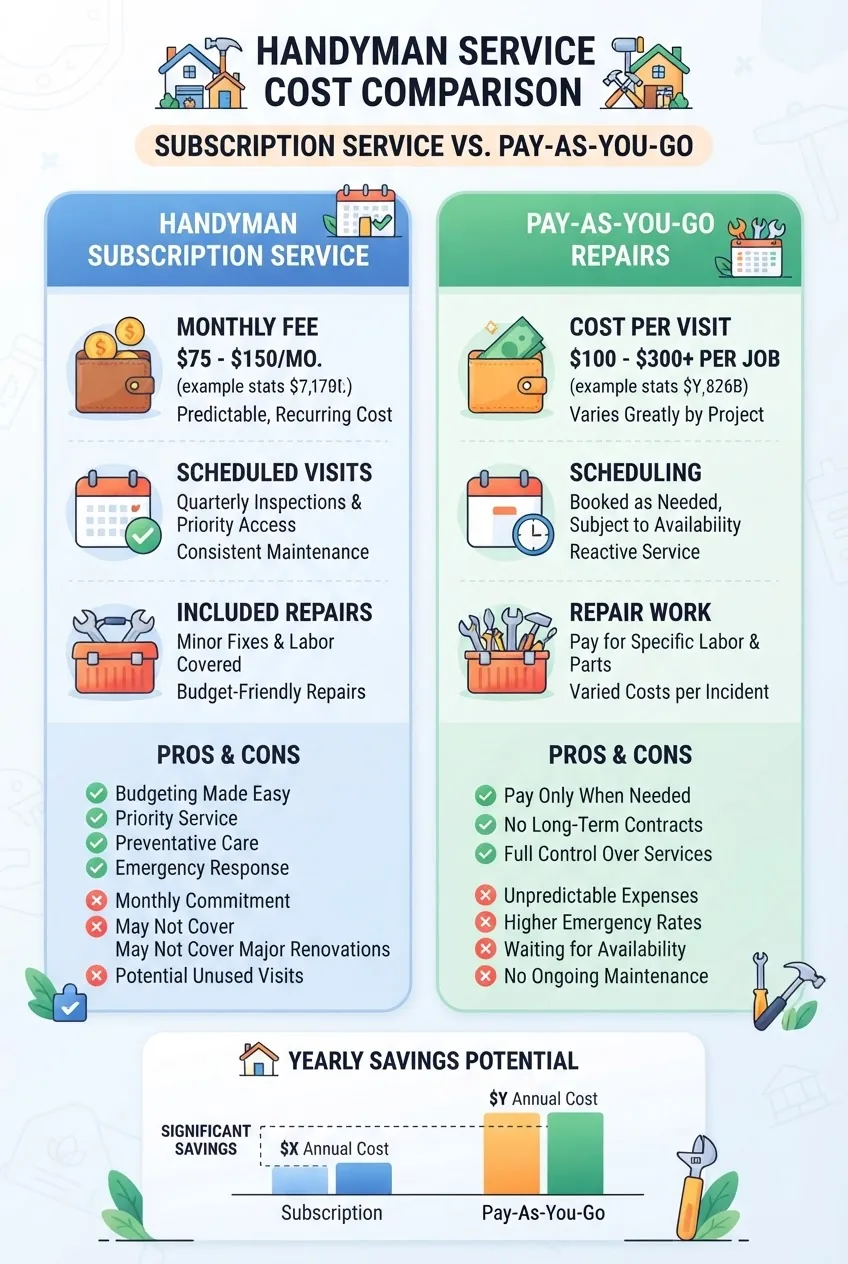
Stat block: According to a 2024 industry report, the average small home repair costs $175; households that file two or more small repairs quarterly reported savings up to 30% when using subscription plans—source: industry report.
According to a 2023 consumer report, 62% of homeowners prefer predictable monthly plans for budgeting—source: consumer report.
Pros and cons:
| Option | Pros | Cons |
|---|---|---|
| Subscription | Predictable cost, priority scheduling, preventive care discounts | Monthly fee even if unused, exclusions, possible overage charges |
| Pay-as-you-go | Pay only when needed, no ongoing commitment | High call-out fees, variable labor rates, unpredictable annual spend |
Hidden fees and cancellation policies often tip the value equation. Consumer protection agencies note common pitfalls like automatic renewals and unclear refund terms—see guidance from government consumer pages for contract rights.
External guidance: for consumer contract protections and complaint procedures, consult the U.S. government’s consumer information pages at https://www.usa.gov/consumer-protection. For reviews and satisfaction stats, refer to https://www.consumerreports.org.
Transition: once cost decisions are made, integrating subscription services into your yearly maintenance makes them most effective; the next section shows how.
How do you integrate subscription services into your home maintenance planning?
Answer: Coordinate subscription visits with your annual maintenance calendar, assign seasonal tasks to membership coverage, and use the plan’s preventive services to replace higher-cost emergency repairs.
Integration strategy steps:
- Map your annual maintenance calendar and flag recurring tasks (spring gutter clean, fall HVAC check).
- Assign each flagged task to a plan inclusion or schedule as a discounted member job.
- Bundle small jobs into single scheduled visits to maximize hourly credit use.
- Track service history and parts costs to justify plan ROI at renewal.
Scenario example (applied knowledge):
Case study: A homeowner in a four-person household used the Standard plan at $45/month. She scheduled seasonal gutter clearing in spring and roof-edge checks, an HVAC filter and minor sealant replacement in fall, and used two small plumbing fixes across the year. Compared with her prior year’s $1,000 outlay in scattered repairs, she paid $540 for the subscription plus $120 in overages—net saving approximately $340 that year. (Practical example built from market pricing and plan features.)
Complete Home Maintenance Checklist for Yearly and Monthly Care
maintenance inspection checklist
home maintenance projects guide
Transition: after integrating plans into your calendar, use the tips below to maximize value and avoid common waste.
What tips help maximize your handyman subscription benefits?
Answer: Track usage, schedule preventive visits, consolidate jobs, communicate expectations clearly, use plan credits efficiently, and use apps or templates to coordinate visits and invoices.
Practical tips list:
- Keep a running log of service requests and outcomes to measure ROI.
- Schedule preventive tasks in off-peak seasons to ensure tech availability.
- Consolidate small fixes into one visit to use hourly credits efficiently.
- Confirm materials pricing before work begins to avoid surprise parts mark-ups.
- Use digital scheduling and invoices to track warranty start dates and claim coverage.
- Ask about loyalty or annual renewal discounts.
Transition: finally, be aware of pitfalls that can erode a subscription’s value and how to avoid them.
What are common pitfalls and how can you avoid them when using handyman subscriptions?
Answer: Common pitfalls include unclear contract terms, coverage exclusions, hidden fees, poor service quality, and overpaying for unused coverage; avoid them by reading contracts, vetting providers and starting with short commitments.
Cautionary advice:
- Contract traps: watch for automatic renewals, non-refundable fees, and vague cancellation rules.
- Coverage exclusions: ensure the plan’s exclusions are acceptable for your home’s age and condition.
- Service quality issues: require references, check independent reviews and confirm insurance/licensing.
- Plan overuse or underuse: choose a tier that matches typical annual usage to avoid waste.
- Hidden fees: ask about call-out fees, parts mark-ups and premium-hour surcharges.
If a task falls outside coverage, you can either pay an agreed one-off price or consider simple DIY alternatives for small fixes; for vetted DIY guidance see DIY home repair projects.
Final expert note: confirm dispute and refund pathways in writing. If service quality is poor, use consumer complaint channels; for U.S. guidance see government consumer protection resources.
Conclusion: Affordable property maintenance plans and handyman subscriptions offer predictable budgeting, preventive care and convenience that often save money when small repairs occur frequently. Compare tiers, read contracts, verify vetting, and trial a short term to confirm value. Ready to choose a plan? Start by listing your annual repair frequency and comparing it to subscription thresholds to find the best fit for your home.