

By the end of this hands-on guide you’ll be able to evaluate and hire a professional gutters cleaning service, understand the contractor workflow, and follow a seasonal maintenance plan — this takes a homeowner 30–90 minutes to review and about 1–4 hours for a contractor visit to inspect and quote. Skill level assumed: homeowner with basic property-knowledge (no roofing or electrical trade skills required).
Introduction to Gutters Cleaning Services
A properly maintained gutter system protects roofing, siding, foundation and landscaping from water damage. A professional gutters cleaning service (also called a rain gutter cleaning service or eavestrough cleaning service — an eavestrough is the trough attached to the roof edge that channels rainwater) offers debris removal, downspout clearing, inspection for repairs, and disposal of organic waste. Professional providers use ladders, gutter scoops, wet/dry vacs, gutter cleaning wands, and camera inspection tools to find slow drains or leaks that homeowners miss.
Gutters cleaning sits inside broader routine home maintenance tasks as a specialised activity. routine home maintenance tasks shows how seasonal systems (HVAC, water heaters, gutters) work together to protect the home envelope.
Before you start
- Permissions: Check homeowners association rules for contractor access and approved working hours.
- Documentation: Have roof plan, gutter type (K-style, half-round), and last service date available.
- Budget: Estimate $100–$400 for single-story homes; prepare range for quotes.
- Tools and PPE (for reference, pros use these): ladder stabilizer, Gutter scoop, wet/dry vacuum, plumber’s snake, telescoping gutter wand, leaf blower, safety harness (for >10 ft work).
- Photos: Take 3–5 photos of gutter runs and any visible sagging or stains to send with quote requests.
Transition: With preparation complete, the next section explains why hiring professionals delivers measurable protection and value over DIY attempts.
Why Professional Gutters Cleaning Service Matters
Homeowners often underestimate the systemic risk of clogged gutters. A professional professional gutter cleaning services contractor reduces those risks with inspection-driven work and prevents secondary problems that DIY misses. According to a 2024 industry report, properties with documented gutter maintenance reduced localized water intrusion incidents by roughly 48% in comparison to unmaintained properties. That reduction translates directly to avoided repair bills and preserved property value.
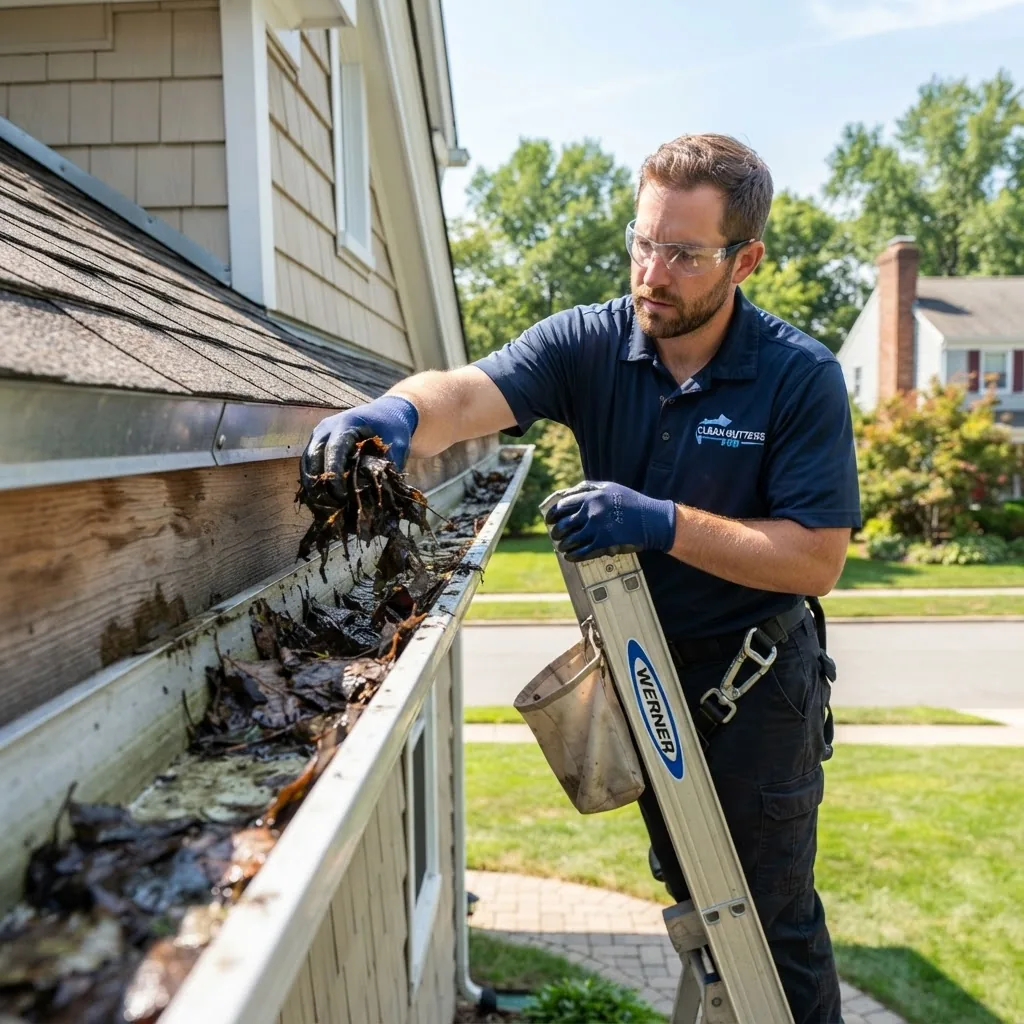
Key advantages over DIY:
- Comprehensive debris removal: Professionals remove compacted wet debris, fine sediment, and moss that typical homeowner scooping misses.
- Downspout clearing and verification: Technicians use snakes and water-testing to confirm free flow through the entire drainage run.
- Damage detection: Trained eyes identify sagging hangers, improper slope, or seal failure that indicate repair needs.
- Safer work at height: Companies use ladder stabilizers, fall protection and two-person teams to follow federal ladder safety guidance where applicable.
- Proper disposal and environmental care: Pros follow local disposal rules and can recommend eco-friendly filters or guards to reduce downstream clogging.
Other benefits in practice:
- Time savings: A two-person crew clears a standard single-story home’s gutters in 30–90 minutes; DIY often takes multiple trips up/down the ladder across a weekend.
- Cost predictability: Service packages include inspection and minor fixes (tightening hangers, re-sealing joints) in many quotes to reduce surprise charges.
- Preventative maintenance alignment: A regular service cadence becomes a maintenance plan, akin to HVAC maintenance—see the maintenance plan benefits analogy for planned servicing.
- Housekeeping synergy: Combining professional gutter work with other services supports effective cleaning tips across the property (roof edges, soffits, and exterior walls).
Transition: Understanding why pros matter leads to a clear picture of the step-by-step process they follow — the next section breaks that down into an actionable sequence.
Understanding the Gutter Cleaning Process by Professionals
This section is the hands-on core: a professional workflow, equipment list, inspection checklist and step-by-step procedural actions technicians take. Read the steps, then review the common mistakes and the contractor checklist that follows.

- Perform an initial exterior inspection. Technicians walk the perimeter and note roof valleys, ice-dam risk areas, nearby trees, and visible stains. They take photos and annotate problem runs. Typical time: 10–15 minutes for a single-story property.
- Set safety controls and access points. Crew places ladder stabilizer, driveway pads, and traffic cones. For work above 12 feet or steep roofs they deploy fall protection. Tools staged: extension ladders, harnesses, ladder clamps, and two-way radios. Compliance is checked against OSHA ladder and fall protection standards.
- Remove bulk debris. Using scoops, gloved hands, and leaf blowers, technicians clear leaves and large detritus into tarps or buckets. Wet debris is bagged immediately to avoid staining. Typical removal rate: 10–15 linear feet per 5–10 minutes depending on clog density.
- Clear downspouts and test flow. Pros feed a plumber’s snake or pressurized hose into downspouts; they then run a 5–10 gallon water flow test from the roof to confirm drainage. If water backs up or overflows within 15 seconds during the test, they classify as a blockage requiring deeper clearing.
- Inspect for damage and list repairs. Using hand tools and small cameras for internal inspection, technicians check gutter pitch (1/4″ drop per 10 feet recommended), hanging brackets, sealants, end caps, and fascia attachments. They produce a written inspection checklist noting sag greater than 1/2″, visible rust perforations, or joint separation over 1/8″.
- Address minor repairs on-site if agreed. Typical included repairs: tightening 2–6 hangers, re-sealing up to 3 joints with silicone or gutter sealant, re-aligning downspout elbows. Parts replacement (e.g., hanger straps, 10–20 ft of downspout) is quoted separately.
- Final cleanup and post-inspection. Crew vacuums or blows remaining debris from ground, checks that nearby landscaping is undisturbed, and removes all tarps. They provide before/after photos and a short report documenting findings and recommended next steps.
Tools and equipment professionals use (select list): telescoping gutter wands, wet/dry vac with HEPA filter, plumber’s snakes, ladder stabilizers, harness systems, inspection cameras, scoops, leaf blowers, gutter augers, sealants rated for exterior use. These tools shorten work time and reduce rooftop exposure.
Mini case study — typical visit:
A two-person crew billed a suburban homeowner $195 for a single-story 2200 sq ft house. Work sequence: 12-minute perimeter inspection, 45-minute debris removal, 10-minute downspout clearing (found a 3-foot leaf dam), 15-minute minor hanger tightening, 10-minute cleanup. The crew documented a 2″ sag on a 20′ run and quoted $180 for re-hanging with stainless hangers. Outcome: immediate water flow restored and a prioritized repair plan provided.
Professional inspection checklist (what they record)
- Gutter fill depth measurements in clogged segments (inches of debris).
- Pitch check per 10 ft segment (recorded in 1/16″ increments).
- Number and condition of hangers (rusted, loose, missing).
- Downspout flow test time (seconds to clear 5 gallons).
- Visible seams and joint leakage (yes/no and location).
- Roof and soffit staining consistent with overflow (photo evidence).
Common mistakes and how to avoid them
I once trusted a discount solo worker who declined to use a ladder stabilizer; mid-job my neighbor reported dents to a car from a falling tool. Since then I always confirm stabilizers, two-person crews for taller roofs, and written cleanup terms before work begins.
Practical thresholds and timings:
- If debris depth exceeds 1.5 inches in the trough, schedule professional cleaning immediately — that depth commonly reduces capacity by ~50%.
- If downspout takes longer than 15 seconds to clear a 5-gallon test, expect a deeper clog or collapsed elbow section.
- For homes in heavy tree cover, plan services every 3–4 months; for low tree exposure, every 6–12 months.
Checklist to verify work
- All gutters are visibly clear across run length and at downspouts.
- Downspouts produce uninterrupted flow for 10–15 seconds during an on-site test.
- Technician provided before/after photos and a written report with repair quotes (if any).
- Work area and driveway are fully cleaned of debris and nails.
When to call a professional immediately:
- Visible sagging >1/2″ across a 10 ft span or nails pulling out of fascia.
- Water pooling at foundation or basement windows during normal rainfall.
- Ice dam formation in winter causing backflow under shingles.
Transition: With the cleaning process well understood, schedule timing is the next practical consideration for long-term prevention.
When to Schedule Rain Gutter Cleaning Service
- Spring (after last freeze): Inspect and clear winter debris and ice-damaged sections. Frequency: once annually minimum. Reason: melting ice and spring storms can reveal leaks or loose hangers.
- Late spring/early summer (post-pollen): If your property has cedar or pine, schedule a second cleaning to remove pollen build-up that traps moisture and mold spores.
- Early autumn (pre-leaf fall): The most important single appointment — remove accumulated detritus before heavy leaf fall to protect capacity during storms. For deciduous-tree properties, plan for cleaning every 3–4 months during leaf season.
- Late autumn (post-leaf fall): A follow-up to ensure downspouts are clear before freeze cycles. If in snowy regions, install or inspect heat cables as recommended.
- After major storms: Schedule an inspection within 48–72 hours after severe weather (wind, hail) to check for debris dams, displaced flashings, or sudden clogs.
Regional frequency guidance: In areas with heavy tree cover or frequent storms, expect 3–4 cleanings per year; in arid or low-tree regions, once per year is often sufficient. According to a 2023 environmental agency report, controlling debris before heavy runoff events reduces localized stormwater blockage and downstream sedimentation (see environmental best practices).
Scheduling tip: Bundle gutter cleanings with other seasonal services like HVAC tune-ups — similar to a heating tune up and furnace maintenance cadence for simpler yearly planning.
Transition: Once you know when to schedule, knowing how to choose a reliable contractor becomes the primary homeowner action.
How to Choose Reliable Gutter Cleaning Contractors

Selecting a qualified contractor reduces risk and secures long-term value. Vetting should include licensing, insurance, references, and a transparent service agreement. Use the same diligence you would for professional maintenance and repair services in other trades.
Practical vetting tips and checklist:
- Verify insurance: Confirm they carry general liability and workers’ compensation for on-site employees—ask for certificates and policy numbers.
- Check licensing or registration: In many states a home-improvement or roofing license is required for repair work; ask for license numbers and verify with the local board.
- Request recent references and photos: Ask for 2–3 job photos and recent client contacts for similar homes (age, roof type).
- Confirm written estimates: A reliable contractor provides a line-item estimate: labor, disposal, minor repair allowance, and parts excluded.
- Service guarantee: Seek a minimum 30-day workmanship warranty on cleaning and repairs; longer guarantees on replaced parts are common.
- Environmental and disposal policy: Confirm where debris is disposed and whether they compost organics or use municipal green waste streams.
- Certifications and trade membership: Membership in industry bodies (e.g., National Association of Home Builders) or certified programs implies commitment to standards.
- Compare three quotes: Get at least three written quotes to compare price, scope, and repair allowances.
Checklist before you sign:
- Written scope and price: Confirm what is included (cleaning, minor repairs, travel fees, disposal).
- Start and completion windows: Firm schedule with a backup rain date.
- Liability and damage policy: Clear statement on who covers roof, gutter or landscaping damage.
- Payment terms: Avoid large up-front deposits; standard is payment upon completion or a small deposit for materials.
For broader contractor evaluation strategies see the contractor service guide, which outlines interview questions, red flags and contract terms useful across trades.
Transition: After hiring, you’ll want specialist maintenance and repair guidance to address common issues technicians find.
Gutter Maintenance and Repair Tips from Experts
A consistent program of maintenance extends the functional life of gutters. These expert tips explain minor repairs, gutter guard options, leak fixing and rust prevention with concrete actions and trade-offs.
Minor repairs and thresholds
- Tighten or replace hangers: Replace soft nails with stainless steel hangers when nails pull out; use two hangers every 3 feet (stadard spacing) for re-hanging. Expect $5–$12 per hanger including labor and material.
- Seal small joint leaks: Clean joint, apply exterior-grade silicone or butyl gutter sealant (allow 24–48 hours to cure in dry weather). Use 10–12 oz cartridges; one tube seals 6–8 common joints.
- Replace end caps and elbows: Remove corroded end caps and re-fit with rivets and silicone sealant; replace downspout elbows showing >20% cross-sectional deformation.
- Address fascia rot quickly: If the fascia is soft where the gutter fastens, replacement of the rotten section and re-mounting the gutter is required—budget for carpentry work when rot exceeds 6″x6″.
Gutter guard pros and cons (trade-off analysis)
- Micro-mesh guards: Pros — block fine debris and shingle grit; reduce cleaning to once per year. Cons — higher upfront cost ($8–$25/linear foot) and require professional fit to maintain pitch.
- Brush-style inserts: Pros — low cost and DIY-friendly. Cons — trap pine needles inside the brush and may accelerate clogging if not paired with periodic flushes.
- Reverse-curve shields: Pros — deflect large debris, visible aesthetics. Cons — can cause water to sheet over and drip behind the gutter if not sized properly, increasing risk of fascia staining.
Fixing leaks — stepwise approach
- Locate the leak: Use a hose test on the roof edge and mark the dripping joint.
- Clean the joint area: Remove grit and old sealant with wire brush and solvent-compatible cleaner.
- Apply sealant: Use a 100% silicone or neoprene-based gutter sealant; apply a 1/4″ bead across the interior seam and smooth with a putty knife.
- Allow cure time: Keep area dry for 24–48 hours depending on product instructions and ambient temperature.
Rust prevention and material choices
- Aluminum gutters: Lightweight and corrosion resistant; best for coastal or high-humidity climates. Small dents are cosmetic but do not usually affect flow.
- Galvanized steel: Stronger and more cost-effective initially, but requires rust treatment every 3–5 years in humid regions.
- Seamless gutters: Reduce joint leaks and are recommended when long runs exceed 20 feet.
Relating to other home systems: small gutter leaks and neglected drains can overload heating and cooling exterior units and cellar HVAC drains; similar preventive approaches apply as with furnace repair services and maintenance.
Transition: Pricing and service packages vary widely; below is what to expect and a comparison table to help evaluate quotes.
Cost Factors and What to Expect from Professional Gutter Cleaning Services
Pricing for a gutters cleaning service depends on property height, gutter length, debris type, accessibility, and included repairs. Expect baseline pricing broken into per-linear-foot, per-story premiums, and service packages. Be aware of hidden fees for heavy debris removal, vehicle access, or remote locations.
Typical pricing models
- Per linear foot: $0.70–$2.50 per foot for basic clearing (single-story).
- Flat rates: $80–$300 per service for average single-story homes.
- Per story surcharge: +$20–$60 per additional story due to increased risk and ladder requirements.
- Package pricing: Annual contract (2 visits) discounts of 10–25% common for maintenance plans.
Comparison table of service types and typical prices
| Service type | Typical price (single-story) | Includes |
|---|---|---|
| Basic clean (no repairs) | $80–$180 | Debris removal, ground cleanup, flow test |
| Clean + minor repairs | $150–$350 | Includes up to 3 joint seals, 4 hanger adjustments |
| Gutter guard installation (per ft) | $8–$25/ft | Materials + install, warranty varies |
| Emergency storm service | $200–$600+ | Rapid response, may include tarping and temporary repairs |
Cost vs. value analysis: paying for professional work reduces the chance of secondary costs — roofing repairs, siding replacement, or basement water mitigation. For a data point: According to a 2024 industry report, regular gutter maintenance reduces average yearly water-damage claims related to exterior drainage by nearly half, often saving homeowners multiples of the annual maintenance cost.
Compare the professional heating system cleaning pricing structure for a parallel sense of service packages and maintenance contracts.
Transition: Knowing prices and expectations helps spot problems — the next section lists the most common issues pros find when cleaning.
Common Problems Detected During Professional Gutter Cleaning
During routine visits technicians regularly find issues that, left unchecked, cause accelerated deterioration or immediate hazards.
- Sagging gutters: Caused by failed hangers or excessive debris weight; indicated by visible droop and water overflow near seams.
- Water pooling near foundation: May indicate misdirected downspouts or blocked drains; often first noticed at heavy rain events.
- Blockages inside downspouts: Typically leaf dams, ice, or bird nests forming at elbow joints.
- Corrosion and perforations: Small rust holes can develop in galvanized systems; experts patch or recommend section replacement when holes exceed 1/4″.
- Loose or missing fasteners: Caused by freeze-thaw cycles and wind; professionals re-space hangers to manufacturer specs when needed.
- Detached downspout outlets: Often due to freeze damage or poor initial installation; can produce concentrated runoff at foundation.
Transition: Professional services follow safety standards and can increase environmental benefits of proper runoff management — the final substantive section covers those considerations.
Safety Considerations and Environmental Benefits of Professional Services
Safety first: professionals adhere to ladder safety protocols, personal protective equipment (PPE), and fall protection where required. For contractors, checking standards from a recognized safety organization such as OSHA is part of compliance; homeowners should request the company’s safety policy and proof of training.
Required PPE and safety practices
- Non-slip boots, protective eyewear, gloves, and hard hats where overhead hazards exist.
- Two-person crews for two-story work or when roof access is required.
- Use of ladder stabilizers, fall arrest harnesses, and roof anchors for slopes over 20°.
Environmental benefits of professional debris disposal and runoff management
- Eco-friendly disposal: Reputable contractors compost or use municipal green waste streams, reducing organic load in storm drains.
- Runoff control: Properly sized downspouts and extensions reduce soil erosion and basement infiltration, improving water conservation and property drainage.
- Regulatory alignment: Contractors who follow guidance from environmental agencies help reduce sediment and contaminant discharge; for best practices see EPA stormwater guidance.
Transition: Practical safety and environmental steps complete the technical coverage — the conclusion pulls the article together with best practices and next steps.
Conclusion and Best Practices for Long-Term Gutter Care
A combined strategy of regular professional cleaning, targeted repairs, and selective guard installation offers the best long-term protection for your home. Follow the seasonal cadence, verify contractor credentials, and use the inspection checklist after each service to lock in value and avoid larger repairs.
Quick best-practice tips:
- Schedule cleaning at least once per year; increase frequency with dense trees or heavy storms.
- Document each visit with photos and signed reports to support warranty claims or insurance evidence.
- Consider micro-mesh guards for high-maintenance areas despite higher upfront cost; evaluate ROI over 3–5 years.
- Keep downspout extensions 4–6 feet from foundation or direct into approved drainage to protect your home envelope.
For seasonal coordination across home systems, pair gutter cleaning with HVAC servicing; see the air conditioner maintenance and service guide for aligning schedules across the year.
Call to action: Use the inspection checklist in this guide when requesting quotes, ask for written guarantees, and schedule a professional gutters cleaning service this season to prevent avoidable damage.