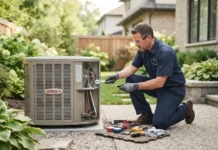
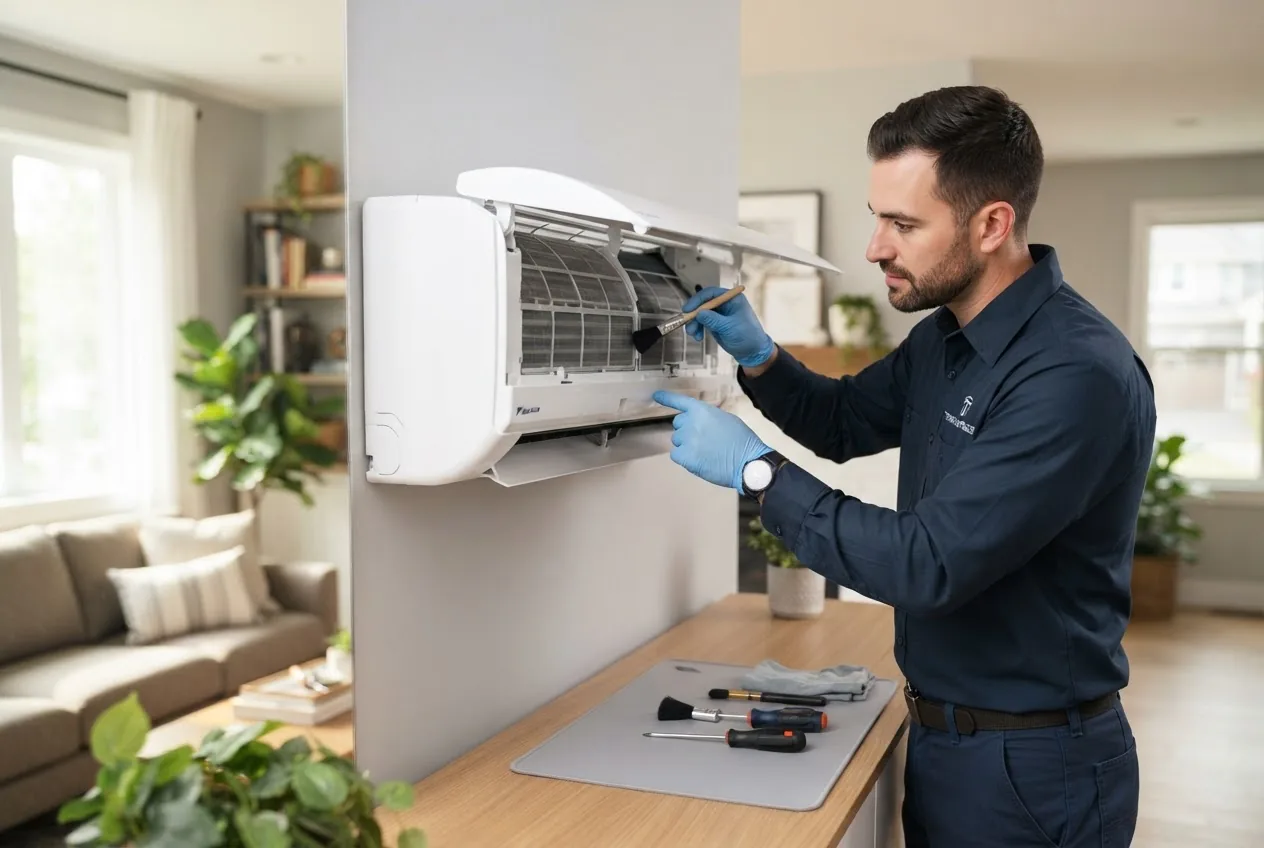
What you will achieve: By the end you’ll know how to hire and evaluate professional aircon maintenance and repair services, understand typical diagnostics and maintenance steps, and be able to read service reports and cost estimates confidently. Estimated read and planning time: 25–45 minutes; typical service visit time: 60–180 minutes. Skill level: homeowner with no HVAC certification required.
Before you start
- Have your unit make, model and installation year available (from the data plate on the outdoor unit).
- Gather these tools and items a technician will often use or reference: manifold refrigerant gauges, digital multimeter/electrical tester, clamp meter, refrigerant leak detector, coil fin comb, vacuum pump, and a temperature probe. (You will not need to operate them.)
- Confirm warranty and service contract documents if any, plus recent energy bills for before/after comparisons.
- Plan for a 1–3 hour on-site window and a safe, unobstructed access route to both indoor and outdoor units.
Refer to the foundational homeowner resource for broader concepts: Air Conditioner Maintenance and Service Guide for Homeowners.
Understanding Professional Aircon Maintenance and Repair
Professional aircon maintenance refers to scheduled, experienced-led servicing and diagnostic work performed by certified HVAC technicians to keep an air conditioning system safe, efficient, and reliable. This section explains the scope of work, technician roles, service warranties, and what a typical visit delivers so you can compare quotes and reports like a pro.
At first glance, a service visit looks like cleaning filters and checking airflow. Professionals, however, follow a methodical inspection and diagnostic sequence that includes refrigerant assessment, electrical checks, airflow measurements and safety inspections. Professionals document findings, propose repairs when necessary, and often provide a written service warranty or follow-up plan.
Key terms defined for clarity: a refrigerant is the working fluid (commonly R-410A or R-32 depending on model) that absorbs heat; the compressor is the system’s pump that pressurizes refrigerant; and scheduled servicing is recurring maintenance (typically annual or biannual) agreed under a service contract.
Service visits also include diagnostics: technicians use manifold gauges to measure refrigerant pressures, multimeters to verify electrical continuity and voltage, and infrared or contact thermometers to confirm temperature differentials across evaporator and condenser coils. A good provider will give you a written checklist and findings so you can track trends over time.
Why documentation matters: the technician’s report establishes baseline performance and supports warranty claims if a part fails later. It also clarifies whether an issue is a simple maintenance item or a repair that affects system longevity.
For an operational reference and homeowner-oriented procedures, see the complete air conditioner maintenance guide for additional background.
complete air conditioner maintenance guide
Transition: Now that you understand the professional scope, next we’ll enumerate the concrete benefits you should expect from hiring pros, so you can assess value beyond the sticker price.
Why Choose Professional AC Maintenance Services?
- Expert troubleshooting and accurate diagnostics: Certified technicians use professional tools—manifold refrigerant gauges, electronic leak detectors, and clamp meters—to identify root causes rather than treating symptoms. This reduces repeat visits and improper fixes.
- Improved energy efficiency: Proper refrigerant charge, clean coils, and calibrated controls can reduce energy use. According to a 2024 industry report, well-maintained systems can improve seasonal efficiency by up to 12% under normal operating conditions.
- Extended equipment lifespan: Replacing worn capacitors, lubricating motors, and correcting refrigerant imbalances reduces stress on the compressor and other components—much like timely oil changes extend a car engine’s life.
- Safety and compliance: Professionals follow local electrical codes and refrigerant handling regulations, reducing fire, shock, and environmental risks. For official safety standards refer to the U.S. Department of Energy guidance on HVAC best practices: Department of Energy.
- Warranty preservation and documentation: Many manufacturer warranties require certified service records. A professional report helps preserve warranty eligibility and can be crucial for parts replacement under warranty.
- Better indoor air quality: Technicians can test and recommend filter upgrades, UV-C treatments, or humidity controls that reduce particulate load and biological growth, improving occupant health.
- Transparent service quality and guarantees: Reputable companies provide written estimates, parts warranties, and follow-up support—minimizing disputes and ensuring accountability.
- Access to specialty repairs and emergency service: Professionals have access to replacement parts, refrigerants, and emergency diagnostics for breakdowns—something homeowners should avoid attempting without certification.
- Time and stress savings: Hiring a pro frees you from troubleshooting and potential safety hazards while ensuring a documented solution with predictable costs and timelines.
Transition: With the benefits clear, below is a step-by-step walkthrough—presented as the practical core of this guide—detailing exactly what professional maintenance includes so you know what to watch for during a visit.
What Does Professional Aircon Maintenance Include?
The numbered steps below are the standard professional procedure for a typical split-system air conditioner—applies to most residential systems. Each item includes the expected duration and measurable thresholds technicians use to confirm satisfactory performance.
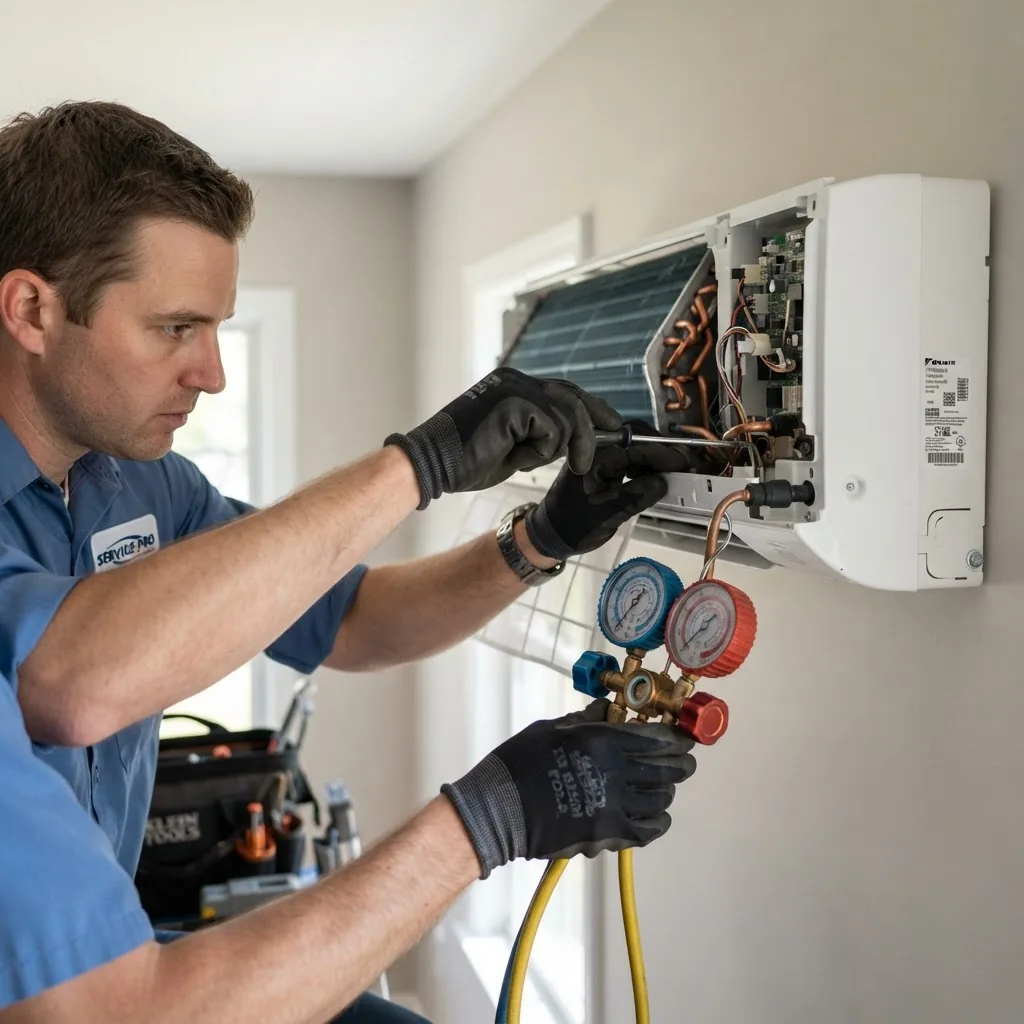
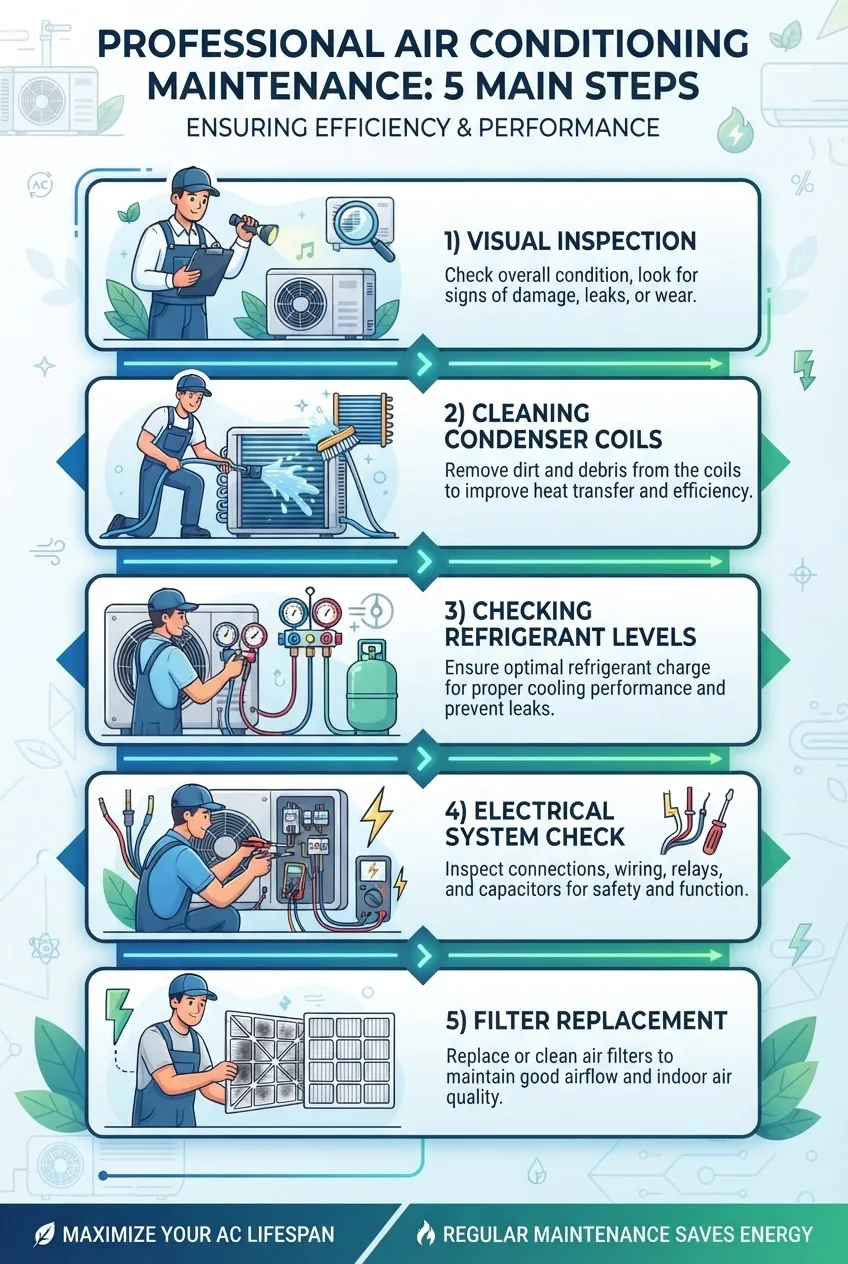
- Perform a complete visual inspection (10–15 minutes)
Technician inspects outdoor condenser, indoor evaporator, ductwork where accessible, and electrical junctions for corrosion, rodent damage, loose panels, or refrigerant oil stains (a common sign of leaks). A clear inspection prevents missed issues—expect the tech to note any oil smell or stain and its location in the report.
- Verify system identification and documentation (5 minutes)
The technician copies model and serial numbers from the outdoor unit data plate and confirms the system type and refrigerant species. This ensures correct parts and refrigerant handling. If your system uses R-22 (now phased out), the tech will note service limitations and recommend retrofit or replacement options.
- Shut down and safety checks (5–10 minutes)
Before touching components, the technician isolates power at the breaker and disconnects the unit’s service switches. Electrical protective devices are tested visually to confirm they match listed ratings.
- Filter inspection and replacement (5–10 minutes)
Filters are inspected for dust-holding capacity. Professionals replace or recommend filter types: minimum MERV 8 for basic protection, MERV 11–13 for improved indoor air quality; note that higher MERV ratings can reduce airflow in undersized systems. Technicians document static pressure if requested—normal residential targets are 0.1–0.3 in. w.g. across filters.
- Evaporator and condenser coil cleaning (20–40 minutes)
Dirty coils reduce heat transfer. Pros use coil cleaners, gentle rinsing, and fin-combing to straighten bent fins. For outdoor condensers, debris is removed, fins cleaned and straightened; for indoor coil cleaning, access panels are removed for inspection. Expect a performance gain: a properly cleaned coil can restore 5–10% efficiency per measured data in many cases.
- Refrigerant pressure measurement and leak detection (15–30 minutes)
Using manifold gauges, techs measure high- and low-side pressures and compare readings to manufacturer specifications and ambient temperature tables. If pressures are low, a leak detection check (electronic detector or tracer dye) is performed. Professionals will not add refrigerant without addressing leaks; adding refrigerant to mask leaks shortens equipment life.
- Electrical system tests (15–25 minutes)
Using a digital multimeter and clamp meter, technicians measure voltage at the contactor and current draw on the compressor and fan motors. Normal operating compressor draw varies by model—techs compare measured amperage to nameplate-rated amps and manufacturer tolerance, and they check capacitor microfarad values (C) for correct operation. Abnormal current or voltage indicates motor or capacitor faults needing repair or replacement.
- Compressor and motor performance checks (10–20 minutes)
With the system running, technicians measure temperature split across the evaporator (normally 15–20°C or 18–22°F delta on many systems) and across the condenser. They also listen for abnormal sounds and use vibration analysis when needed. If the compressor shows excessive amps or poor pressure differential, further diagnostics or part replacement is recommended.
- Drainage and condensate checks (5–15 minutes)
Technicians inspect the condensate drain and pan, clear clogs with water or compressed air, and test secondary safety switches. Standing water can cause microbial growth and overflow; professionals recommend a 1/4” per 10 ft slope and confirm the condensate pump (if present) operates correctly.
- Controls and thermostat calibration (10 minutes)
Thermostat sensors and wiring are tested; technicians calibrate setpoints and confirm the system cycles correctly. Smart thermostats are checked for firmware updates and correct scheduling. Thermostat miscalibration can create phantom system faults.
- System health report and recommendations (10–20 minutes)
At the end, technicians provide a documented report: measurements (pressures, temps, amps), visual findings, recommended repairs with cost estimates, and any warranty actions. Good providers will indicate which items are critical (safety or imminent failure) versus recommended upgrades (e.g., higher-efficiency filter).
- Cleanup and follow-up scheduling (5 minutes)
Technicians restore panels, remove debris, and leave a service tag with the next suggested service date and any temporary fixes performed. They schedule or recommend a maintenance plan if desired.
Transition: Understanding the maintenance sequence helps when you receive a diagnosis. Next we review the typical problems professionals identify and how they resolve them.
Common Air Conditioner Problems Identified by Professionals
Professionals regularly encounter a set of recurring failures; knowing these allows you to parse service reports and prioritize repairs. Below are common issues with practical problem–solution pairs, and references to related heating systems where applicable.
Refrigerant leaks
Problem: Low refrigerant pressures, oil stains at service ports, and reduced cooling capacity indicate leaks. Technicians confirm leaks with electronic detectors or ultraviolet dye. Solution: Pinpoint repair (hose, brazed joint, or evaporator coil replacement), then evacuate and recharge using correct refrigerant charge by weight. Note: adding refrigerant without repairing leaks is a temporary fix and can violate environmental regulations.
Compressor failure
Problem: High amp draw, failure to start, or loud mechanical noises often indicate failing compressors. Solutions vary from replacing start/run capacitors (if the compressor is otherwise sound) to full compressor replacement. Technicians weigh repair vs. replacement costs, especially for units older than 10–15 years.
Thermostat issues
Problem: Incorrect cycling, no call for cooling, or erratic on/off behavior. Solution: Verify sensor location and wiring, recalibrate thermostat, or replace with a modern programmable unit for improved control.
Fan motor malfunctions
Problem: Weak airflow or noisy fans. Solutions: Lubricate motors if applicable, replace bearings or the fan motor assembly, and check belt tension on older systems. Inverters or ECM motors demand specialized parts and diagnostic steps.
Drainage problems and biological growth
Problem: Clogged condensate lines or pans causing overflow and potential interior water damage. Solution: Clear lines, treat pans, and install a secondary safety switch or condensate pump if needed.
Electrical faults
Problem: Tripped breakers, damaged contactors, or burnt wiring. Solution: Replace damaged components, upgrade deficient disconnects, and ensure wiring gauges are appropriate for service load. Professionals also check for harmonics and voltage drop that can shorten motor life.
Cross-reference: for heating-related troubleshooting and overlapping issues, the furnace repair and maintenance insights provide complementary diagnostics and controls guidance.
furnace repair and maintenance insights
Transition: With common faults covered, the next crucial skill is selecting a reliable service provider who can perform these diagnostics competently and ethically.
How to Select a Reliable Aircon Maintenance and Repair Service Provider
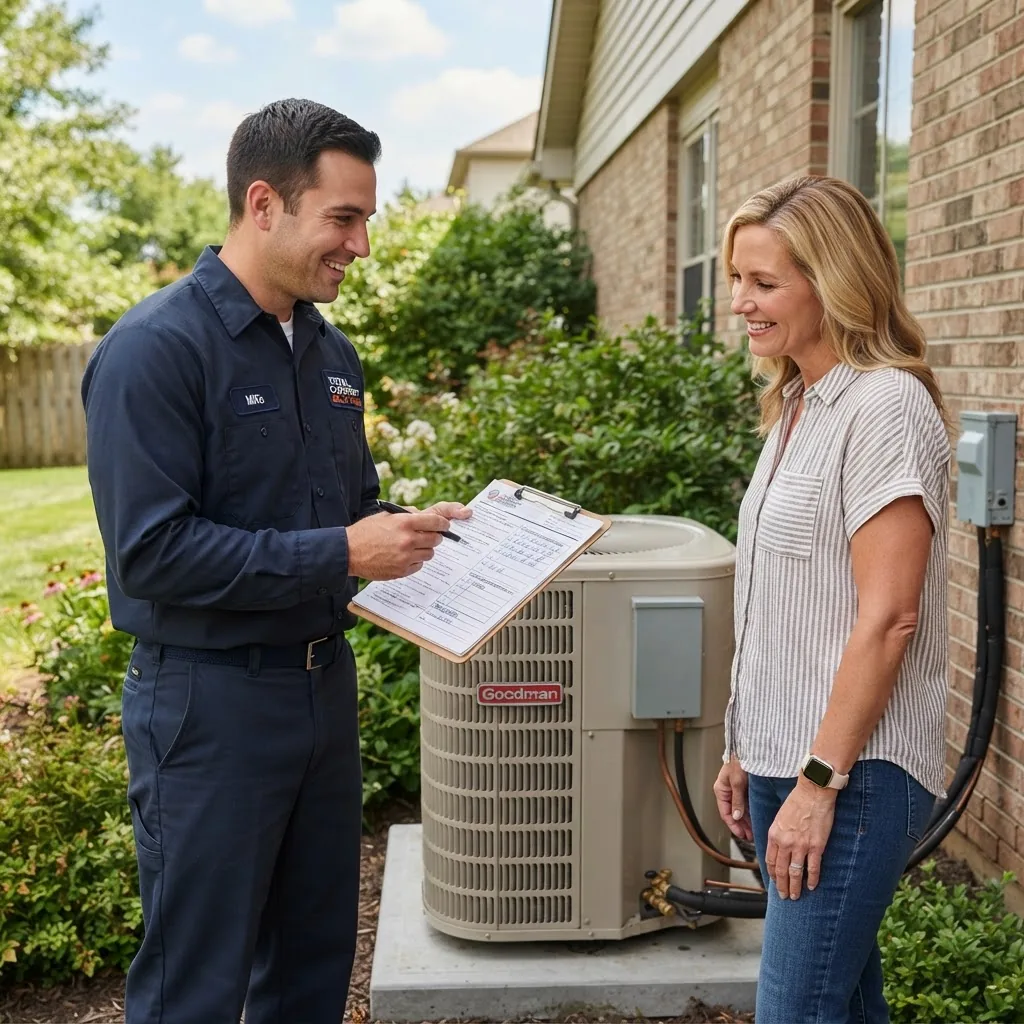
Selecting a trustable service provider reduces risk and ensures value. Look for technicians with certification, verified references, transparent pricing, and documented guarantees. Below are practical selection criteria and red flags.
- Certifications and qualifications: Ask for technician certifications from recognized bodies (for example, HVAC Excellence or industry training credentials). Technicians should also be EPA Section 608 certified to handle refrigerant safely.
- Licensing and insurance: Require proof of local trade licensing and general liability plus worker’s compensation insurance. Reputable contractors will present documentation readily.
- Reviews and testimonials: Read recent reviews on independent platforms and ask for local references. Consistent patterns in reviews (response time, follow-through, post-service support) matter more than isolated comments.
- Service guarantees and warranties: Prefer companies offering 30–90 day workmanship guarantees and manufacturer-authorized parts warranties. Ensure labour warranty duration is clearly stated.
- Transparent pricing and written estimates: Demand itemized written estimates outlining parts, labor, and tax. Avoid vague “call-out” fees that don’t explain what’s included.
- Professional reporting: Look for written performance reports listing measured pressures, temperatures, and amperages—this demonstrates a methodical approach.
- Emergency availability: Confirm whether the company offers emergency service windows and what premiums apply for nights/weekends.
- Tools and diagnostic capability: Ask whether the technician will bring manifold gauges, leak detection equipment, and multimeters—if they do only visual checks, press for a full diagnostic.
- Environmental responsibility: Confirm proper refrigerant recovery and disposal practices in line with regulations.
Quick checklist when vetting quotes:
- Is the technician EPA Section 608 certified?
- Does the quote include a breakdown of parts, labor, and diagnostic time?
- Are emergency response times and rates documented?
- Is there a clear policy on warranty claims and follow-ups?
For installation and contractor selection nuances, especially if you are considering new equipment, see guidance on choosing a qualified aircon contractor.
choosing a qualified aircon contractor
Transition: After selecting a provider, you’ll want a simple schedule to follow. The next section offers practical frequency guidance and a sample schedule to use with service contracts.
Scheduling and Frequency of Professional Aircon Maintenance
How often you schedule maintenance depends on system type, age, and usage patterns. As a rule of thumb, most residential systems benefit from at least annual professional servicing in moderate climates and biannual servicing in hot, high-use regions. According to a 2024 industry report, 60–70% of failures in systems under 15 years could be deferred or prevented with annual preventive maintenance.
Key factors influencing frequency:
- Age of equipment: systems over 10 years demand closer observation.
- Usage intensity: continuous or heavy use (e.g., commercial-style usage at home) benefits from twice-yearly checks.
- Indoor air quality: homes with pets or heavy particulates require more frequent filter and coil attention.
- Warranty requirements: manufacturer-recommended schedules must be followed to keep warranties valid.
Sample schedule table (zebra striped):
| Period | Tasks | Approx. Duration |
|---|---|---|
| Spring (pre-cooling season) | Full service: coils, refrigerant check, electrical tests, filter swap | 1–3 hours |
| Mid-summer (high load) | Quick performance check, drain inspection, filter check | 30–60 minutes |
| Autumn (post-season) | Minor service: clean outdoor debris, safety check; prepare for heating season if heat pump | 30–90 minutes |
| As needed / Emergency | Breakdown repair or urgent diagnostics | 1–4 hours (or longer for parts) |
Consider service contracts that lock in priority scheduling and reduced emergency call-out fees. Explore formal maintenance plan options and benefits to optimize scheduling and cost predictability.
maintenance plan options and benefits
Transition: Scheduling is only part of budgeting. Next we’ll break down typical costs and explain trade-offs so you can evaluate quotes effectively.
Cost Factors and What to Expect from Aircon Maintenance and Repair Services
Costs vary widely by region, unit model, and the specific fault. Disclose: prices in your area may differ from national averages. According to a 2023 EPA-related survey of residential HVAC service pricing, standard tune-ups averaged between $80–$200, while repairs ranged from $150 to $2,500 depending on parts and labor complexity.
Primary cost drivers:
- Labor rates (local hourly rates can range $60–$150/hr depending on market and technician qualification).
- Parts pricing (compressors and control boards are high-cost items; capacitors and contactors are relatively inexpensive).
- Diagnostic time—thorough diagnostics reduce misdiagnosis but add initial service cost.
- Accessibility—difficult or rooftop installations increase labor time and cost.
- Warranty status—under warranty, parts may be covered but labor often is not.
Trade-off discussion: homeowners often face a decision between a low-cost temporary patch (e.g., adding refrigerant) and a professionally diagnosed repair. Temporizing can deliver short-term comfort but typically increases long-term costs and environmental impact. For example, adding refrigerant without repairing a leak may restore cooling for weeks but will accelerate compressor wear and eventual failure.
Cost breakdown example (typical mid-range scenario):
| Item | Estimated Cost (USD) | Notes |
|---|---|---|
| Standard maintenance visit | $90–$180 | Includes inspection, filter swap, coil clean |
| Capacitor replacement | $80–$220 | Part + labor |
| Compressor replacement | $900–$2,500+ | Often cost-effective to replace older system instead |
| Refrigerant recharge (non-R-22) | $150–$400 | Depends on refrigerant type and amount |
Financial decision rules I use as a practitioner:
- If repair >50% of replacement cost and the unit is older than 10 years, favor replacement.
- Prioritize repairs that restore safety or prevent catastrophic failure (electrical faults, blocked condensate leading to water damage).
- Consider energy-cost payback: a $800 coil replacement that yields 10% energy savings often pays back in 3–5 years depending on usage—compare with local energy prices and expected remaining life.
For related cost comparisons on heating tune-ups see heating system tune-ups and costs.
heating system tune-ups and costs
Transition: Beyond cost, track safety and efficiency to protect your household and system lifespan. The next section lays out compliance and energy-focused actions professionals perform.
Ensuring Long-Term Efficiency and Safety Through Professional Service
Professional service directly impacts energy consumption, system lifespan, and safety compliance. Correct refrigerant charge, accurate electrical connections, and clean heat exchange surfaces reduce wasted energy and lower fire and mechanical risks.
Energy and safety standards: Refer to national efficiency and safety guidance when evaluating service quality. For authoritative energy efficiency guidance, see the U.S. Environmental Protection Agency: EPA. For certification bodies and technician qualifications consult organizations such as HVAC Excellence. Consumer protection and dispute resolution resources are available at the Better Business Bureau: BBB.
Safety inspections professionals perform:
- Electrical integrity checks (wire gauge, breaker sizing, grounding).
- Refrigerant recovery and leak repair to meet environmental handling rules.
- Combustion and ventilation checks on systems that share HVAC components with heating appliances.
- Condensate overflow safeguards to prevent water damage and mold growth.
Case example (hands-on practitioner account):
Visit summary: A 9-year-old split system with weak cooling and a steadily rising energy bill. Diagnostics and repair performed: manifold gauge readings showed 12% undercharge; electronic leak detection found a slow leak at a brazed service valve; technician recovered remaining refrigerant, repaired the valve, evacuated the circuit to 500 microns with a vacuum pump, and recharged to manufacturer-specified weight (2.4 kg R-410A). Electrical testing revealed a near-failed run capacitor; it was replaced. Outcome: measured cooling capacity improved by 14% and running amperage dropped by 8%, verified via clamp meter. According to a 2024 industry report, this level of recovery is consistent with expected energy savings when leaks are repaired properly.
Walkthrough of key professional tools used in the visit:
- Manifold gauges: Measure high/low refrigerant pressures and help determine charge accuracy. Technicians compare readings to temperature-pressure charts to validate charge.
- Digital multimeter and clamp meter: Check voltages, continuity, and current draw to find electrical issues and motor health.
- Vacuum pump and micron gauge: Evacuate moisture and non-condensables; target vacuum is typically below 500 microns for reliable system sealing before recharge.
- Electronic leak detector/UV dye: Locate leaks not visible to the eye—mandatory for long-term repairs.
Standards and citations: When discussing energy and safety benefits reference national guidelines such as those from the EPA and manufacturer service manuals. Also consider local code requirements for electrical and refrigerant handling; your technician should be familiar with both.
Cross-reference whole-home HVAC services: for related guidance on furnace and heater maintenance see professional heater and furnace cleaning services and gas heater and furnace upkeep overview to align comfort system maintenance across heating and cooling.
professional heater and furnace cleaning services | gas heater and furnace upkeep overview
Transition: Below are practical common mistakes I’ve observed and how to avoid them when managing professional aircon service.
Common mistakes and how to avoid them
I have watched homeowners accept a “cheap top-up” of refrigerant without a leak repair—this created a cascade of failures and a compressor replacement six months later. Always insist on leak detection and repair, and get a written diagnosis.
I have also seen owners hire the lowest bidder who did only a visual check: later, faulty capacitors and marginal current draw caused a heatwave breakdown. Always confirm the technician brings gauges and meters and provides a documented report.
Finally, I have encountered systems where filters were upgraded to very high MERV levels without airflow verification—resulting in frozen coils. If changing filters, ask the technician to measure static pressure and confirm acceptable airflow (0.1–0.3 in. w.g. across filter).
Checklist to verify after service
- Written service report including measured pressures, temps, and amps.
- Confirmation of any refrigerant recovery and disposal, with type and weight recorded.
- List of replaced parts with brand/model and warranty length.
- Next recommended service date and details for emergency contact.
- Invoice itemizing labor vs. parts and any applied discounts.
When to call in a professional immediately
- Loss of cooling or heating during extreme weather.
- Electrical burning smell or repeatedly tripping breakers when the unit runs.
- Water pooling around indoor equipment or persistent condensate overflow.
- Strange mechanical noises (metal grinding or loud bangs) indicating imminent mechanical failure.