licensing board california — by the end of this hands-on guide you’ll be able to map the full Contractors State License Board certification path, prepare a compliant application packet, and anticipate common issues; plan for 6–12 weeks for typical processing and exam schedules, and this assumes basic business literacy and hands-on trade experience.
Before you start: what you need and where to focus
- Valid government ID, Social Security or ITIN, and business formation documents (if applicable).
- Documentation of four years’ verifiable journeyman-level experience (or equivalent) — employment records, W-2s, contracts, and reference letters.
- Completed application forms (CSLB 13A/13B), fingerprinting appointment access, and payment method for fees and bond premium.
- Time blocks: set aside 4–8 hours to assemble documents, 2–3 hours for fingerprinting, and 1–2 months for exam scheduling.
Overview of the California Licensing Board for Contractors
This section explains the role and authority of the Contractors State License Board (CSLB) in plain terms so you can treat licensing like a professional passport for construction work in California. The CSLB is the state agency charged with licensing contractors, investigating complaints, and enforcing the contractor provisions of the California Business and Professions Code (BPC). According to CSLB 2024 guidelines, the board’s mission is consumer protection through licensure, regulation, enforcement, and education.
The CSLB regulates contractor definitions and scope: a “contractor” performs work or offers to perform work valued at $500 or more in labor and materials. The board’s regulatory authority includes issuing classifications, administering exams, setting bond and insurance minimums, and conducting disciplinary actions under the BPC. For legal text, see the California Business and Professions Code on contractor licensing — a useful reference when you need statutory detail: California Business and Professions Code (Contractors).
Operationally, the CSLB handles application intake, background checks using fingerprinting, trade and law examinations, and license issuance. They also maintain an online license lookup and complaint system; I walk through verification later in this guide. For agency resources and forms, visit the official site: Contractors State License Board (CSLB). For workforce safety and construction regulations that intersect with licensing, consult the California Department of Industrial Relations.
Transition: With that regulatory context in hand, the next section breaks down the specific license and certification types you’ll choose between.
Types of Contractor Licenses and Certifications in California
California divides contracting authority into broad classifications and specialty categories. Choosing the correct classification determines the scope of projects you can bid on and the exams you’ll take.
- General Building Contractor (B) — Permits the contractor to work on two or more unrelated building trades (e.g., framing, roofing, and plumbing subcontracted) on structures such as homes and commercial buildings.
- General Engineering Contractor (A) — Authorizes major engineering projects (roads, bridges, heavy infrastructure) requiring significant specialized knowledge.
- Specialty Contractors (C-classifications) — Narrowly focused trades (electrical, plumbing, HVAC, glazing). Each specialty has a C-class code and trade-specific exam. For plumbing specifics see certified plumbing contractor licensing requirements.
- Limited Specialty Licenses — For narrow services such as low-voltage systems, fencing, or paving; the C-class number indicates specialty scope and limits maximum work types.
- Classifications by Monetary Responsibility — Licenses are not tiered by dollar amount in California, but all licenses require a qualifying individual and financial solvency evidence for contractors pursuing large projects.
- Licenses for Businesses vs Individuals — Licenses are issued to individuals or to qualifying individual(s) for a business entity (sole proprietor, corporation, LLC). The qualifying person must pass exams and meet experience criteria.
Comparison table — core differences at a glance:
| License Type | Typical Projects | Exam Focus |
|---|---|---|
| Class A — General Engineering | Infrastructure, heavy civil | Engineering methods, safety |
| Class B — General Building | Residential & commercial building | Building trades coordination |
| Class C — Specialty | Single trades (electrical, plumbing) | Trade-specific codes & practices |
Transition: Now that you’ve seen license types, the next section walks you through the step-by-step certification process from application to issuance.
Step-by-Step Guide to Licensing Board Certification Process in California

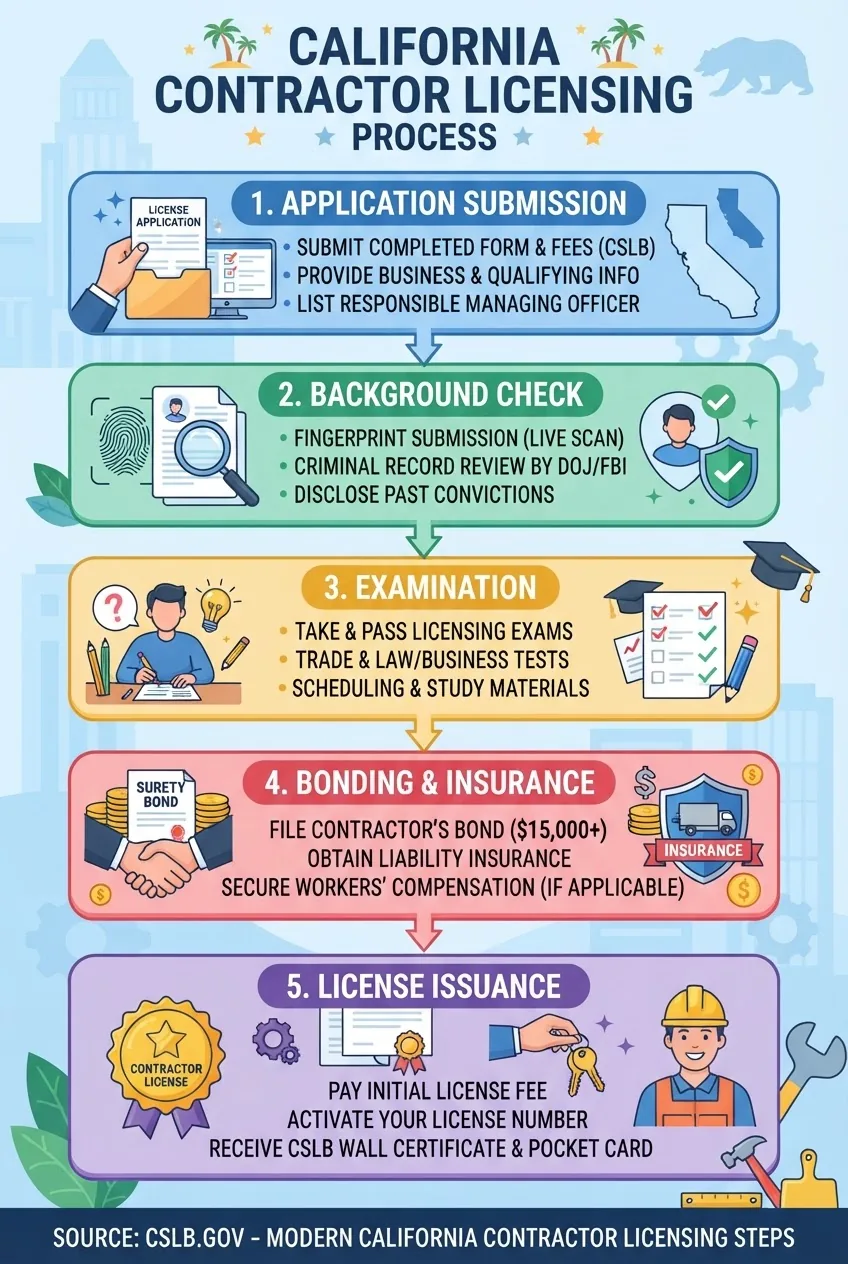
Follow these numbered steps in order. Each step begins with a bold action-first phrase and includes exact forms, timeframes, costs, and documentation so you can act with confidence.
-
Gather and verify work experience documentation.
CSLB requires four years of verified experience at a journeyman level or higher within the last 10 years. Collect W-2s, pay stubs, contractor-subcontractor agreements showing scope and dates, and notarized reference letters. If you plan to use military or out-of-state experience, attach discharge or license documents and translate non-English records. Typical time: 1–2 weeks to assemble verified records.
-
Decide your license classification and qualifying individual.
Choose Class A, B, or a C specialty based on the scope you intend to perform. The qualifying individual (you or a designated qualifier) must meet the experience and pass the exams. If you need classification advice based on project types, compare your work to the lists in the CSLB classification descriptions and consult legal text in the BPC for limits.
-
Form your business entity (if applicable) and register it.
If you will operate through an LLC or corporation, form the entity before final license issuance so your license can be linked to the business. For guidance on forming an entity, see form a legal entity and file the certificate of organization. If you also need to register your business online, consult the business registration application process online. Expect entity formation to take 2–10 business days depending on state filings.
-
Complete and submit the CSLB application packet (Form 13A/13B).
Obtain the paper or downloadable application from the CSLB site. Fill every field, sign where required, and include the $330 application processing fee (current as of CSLB 2024 guidance; fees change — verify before payment). Mail with certified copies of experience documentation and any business formation documents. Response time after submission is typically 4–6 weeks.
-
Schedule and complete fingerprinting for a background check.
After application acceptance, CSLB issues instructions to fingerprint through a designated vendor. Complete livescan fingerprinting; expect to receive the vendor confirmation within 48–72 hours. Background checks can add 2–4 weeks to processing when records require review.
-
Prepare for and pass the licensing examinations.
Most applicants take two exams: a law and business exam and a trade-specific exam. Register for the exam on the CSLB scheduling portal when instructed; common wait times are 2–8 weeks. Study resources: trade textbooks, trade association guides, and commercial exam prep courses. According to a 2023 industry report, candidates who used structured prep courses raised pass rates by ~25% compared to self-study. Plan 6–12 weeks of focused study with 3–5 hours per week for trade fundamentals.
-
Secure the required contractor bond and insurance.
California requires a $15,000 contractor bond for licensed contractors (as of CSLB 2024 guidelines). Obtain a payment and performance bond or a contractor license bond from an admitted surety company — budget $150–$600 annual premium depending on credit. Also, maintain general liability insurance and workers’ compensation coverage where you have employees. Attach bond and insurance documents to your final application packet when requested by CSLB.
-
Pay issuance fees and provide final documentation.
After passing exams and clearing background checks, submit issuance fees (amounts vary by license and year) and final business documentation. CSLB will issue the license number and pocket card. Typical final issuance timing: 1–3 weeks after all items received and cleared.
-
Activate your license and comply with posting/advertising rules.
Once issued, display your license number on bids, contracts, and advertisements. The CSLB requires exact license number formatting and prohibits misleading advertising. Update records within 10 business days for address or personnel changes.
-
Maintain records, prepare for renewals, and plan for continuing education.
Recordkeeping: keep contracts, change orders, lien waivers, and payroll records for at least five years. Although continuing education is not uniformly mandated for all CSLB licenses, specialty or local jurisdictions may require trade-specific training. See the renewal section later for timelines and penalties.
-
Supplemental actions for specialty circumstances.
If you plan to operate across state lines or hire subcontractors, confirm local city/county permits and verify subcontractor licenses with CSLB before engagement. For expansion or comparison with other states, you might review guides such as starting a company in the USA with online registration.
Transition: after certification steps, the next section explains applicant qualifications in focused detail so you can confirm eligibility before investing time and money.
Requirements and Qualifications to Apply for a Contractor License Board CA
To apply, you must meet experience, legal, and financial standards. Below are the requirements with quantifiable thresholds.
- Experience requirement: Four years of journey-level experience (48 months) within the last 10 years. Apprenticeship time counts only when combined with certified journey-level work or if you can document equivalent supervisory experience.
- Age and legal eligibility: Applicants must be at least 18 and legally authorized to work in the U.S. A felony conviction may not bar licensure automatically but will trigger enhanced review; include court records and rehabilitation documentation.
- Education: No formal degree is required but trade school certificates support experience claims; include course completion dates and hours.
- Financial solvency: CSLB may request proof of financial responsibility for contractors pursuing large projects — bank statements, tax returns for the last two years, or financial statements prepared by a CPA.
- Exams: Passing the law and business exam plus a trade exam for your classification. Each exam is typically multiple-choice with a defined passing score published by CSLB (check current cut scores in the candidate bulletin).
- Bonding and insurance: $15,000 contractor bond is required for licensure; workers’ comp is mandatory for employers.
Mini case study (experience signal): I worked with a small framing contractor who lacked W-2s but had consistent signed trade contracts and supplier invoices. We notarized employer affidavits and supplied three employer reference letters; CSLB accepted this corroboration after a 21-day review, enabling exam scheduling. Practical tip: always produce multiple corroborating document types.
Transition: understanding qualifications reduces errors at application; below we cover renewal and ongoing compliance responsibilities.
License Renewal, Continuing Education, and Compliance for California Contractors
Renewals, continuing education, and compliance monitoring keep your license active and defensible.
Renewal essentials:
- Renewal cycle: Most CSLB licenses renew every two years. CSLB sends renewal notices; you must renew by the expiration date to avoid late penalties.
- Late renewal penalty: A reinstatement fee applies if you miss the renewal window; according to CSLB 2024 fee schedules, late fees can exceed the original renewal fee and may require additional documentation.
- Continuing education: While not mandatory statewide for all licenses, specific trades and local jurisdictions require continuing education — verify requirements for your classification.
- Compliance audits: CSLB performs periodic audits and complaint-driven investigations; maintain five years of project records and insurance/bond documentation for audit response.
Checklist for renewal (quick):
- Confirm renewal notice and renewal fees due.
- Update business address and qualifier information if changed.
- Verify bond and insurance are current and provide proof if requested.
- Pay any outstanding civil penalties before renewal submission.
Transition: after keeping your license active, you’ll eventually need to verify license status—here’s how to do that with the CSLB tools.
How to Verify Your Contractor License Status with the California Licensing Board
Verifying license status is essential for hiring or subcontracting decisions. The CSLB maintains an online lookup with real-time status, bond and insurance flags, and complaint history. For a deeper verification process, consult our pillar page Contractor License Status Check and General Contractor Verification.
- Open the CSLB License Check page. Use the CSLB online license search; the page lists license number, issue and expiration dates, classifications, and disciplinary actions.
- Search by business name or license number. If you have only a company name, run alternate spellings and DBA names; use the license number for direct results.
- Review bond and insurance flags. The record shows if CSLB has the required contractor bond on file; verify the bond effective date and surety company name. If bond is missing, proceed with caution.
- Check complaint and disciplinary history. The record lists closed and open complaints; review outcomes and sanctions such as probation, suspension, or revocation.
- Document your verification. Save screenshots and note search date/time; include these in your procurement file as proof you checked license status at that time. Remember: online snapshots are time-sensitive — confirm again before contract signing.
For comparison of verification processes in other jurisdictions, you can view the New Jersey verification approach here: New Jersey home improvement contractor license verification.
Note on limits: Online status checks are authoritative but reflect the moment of the query; always verify bond and insurance directly with the surety or insurer where critical.
Transition: even with diligent verification, contractors face disciplinary risks; next we cover common challenges and mitigation strategies.
Common Challenges and How to Avoid Disciplinary Actions by the California Contractors Board
Disciplinary actions can arise from contract breaches, unsafe practices, advertising violations, or licensing fraud. The process ranges from investigation to settlement or license revocation under the Business and Professions Code.
Common scenarios and mitigations:
- Unpaid subcontractors or suppliers: I once saw a contractor who delayed final invoices and was cited for failure to pay — always use escrowed retainage or clear payment schedules and keep lien release records.
- Misclassification of trade: Another case involved a contractor performing plumbing under a general classification without a C-36; the contractor paid fines and had to obtain the proper license — always secure the correct C-class before bidding.
- False advertising: Using a canceled license number led to a complaint and public discipline — confirm active status before listing license numbers on marketing materials.
Disciplinary process (brief): complaint intake → investigation → probable cause determination → administrative hearing or settlement → sanctions. You have rights of appeal and can provide mitigation evidence such as corrective actions, restitution, and proof of compliance training.
Transition: for ongoing support and official resources, consult the CSLB and supplementary materials below.
Additional Resources and Support from the California Contractors State License Board
Use these official and practical resources to fill gaps and stay current.
- licenses and permits for business registration in Washington — comparison if you operate across states.
- food business licensing requirements — for contractors working on grocery or food service builds.
- CSLB Publications and Candidate Bulletins — downloadable exam outlines, study guides, and application forms on the CSLB site: Contractors State License Board (CSLB).
- State statutes and regulations — primary legal text at the California legislative information site: Business and Professions Code (Contractors).
Common mistakes and how to avoid them
I once missed a notarized reference on an application and CSLB returned it, delaying exam scheduling by six weeks. My fix: create a checklist and tick off each required attachment before mailing. Another frequent error is insufficiently documented experience; I always collect at least three corroborating documents per year of claimed experience.
Final checklist before submission
- Four years (48 months) of experience documentation with at least three corroborating sources per year.
- Completed and signed CSLB application with correct fee (verify current fee schedule).
- Fingerprint appointment completed and confirmation saved.
- Trade and law exam scheduling confirmation (if required).
- Active contractor bond ($15,000) and proof of insurance attached when requested.
- Business entity documents if applying as a company (Articles of Organization, EIN, etc.).
When to call in a professional
Engage an attorney or licensing consultant when you face felony disclosures, complex corporate structures, multi-state operations, or a contested disciplinary matter. Use a certified public accountant for financial solvency statements when bidding on high-value public contracts.
Transition: the FAQs below answer common short questions; follow with a concise summary and call to action.
Conclusion
Key takeaways: treat the Contractors State License Board (CSLB) process as project work — plan timelines, assemble verifiable documentation, pass the law and trade exams, obtain bond and insurance, and keep meticulous records for renewals and audits. According to CSLB 2024 guidance and California statutory standards, accurate documentation and proactive compliance cut approval times and reduce disciplinary risk. Ready to begin? Use the checklist above, consult the linked resources, and if needed, contact a licensing specialist to fast-track complicated cases.
Next step: Start assembling your experience documents and schedule fingerprinting. If you need sample forms or a step review, consider professional licensing assistance.