What you’ll achieve: By the end you will have a completed checklist and stepwise plan to submit a grocery store license application via the standard food business application workflow for your state or county. Time to complete: typical first-time applicants should allow 6–12 weeks from initial paperwork to license issuance (varies by locality). Skill level: basic business literacy and comfort with forms, permits and a modest construction or fit-out project.
Introduction to Grocery Store Licensing Requirements
This guide is targeted specifically at grocery retail operators — not restaurants, food trucks or manufacturing facilities — and focuses on the licensing nuances that matter for grocery stores: retail food sales, packaged and fresh produce handling, refrigerated and frozen storage, and the integration of grocery-specific services (delis, hot-prep counters, alcohol sales where applicable). Think of the grocery store license as the foundational “passport” that lets you legally sell unpackaged produce, cold-chain items and prepared foods under your store’s name.
Before you start, you will need the ability to: obtain a tax ID (EIN), submit scaled floor plans, complete a state or county food safety plan, and arrange a pre-opening health inspection. Typical duration of the process depends on your jurisdiction; many counties issue provisional licenses within 2–4 weeks if documentation is complete. Where construction or large fit-out is involved, allow extra time for contractor verification and certified plumbing or electrical sign-off.
Before you start
- Register your business entity (EIN, state filing or LLC articles) — see the online registration companies guide
- Gather a scaled floor plan (1:50 or 1:100) showing workflow from receiving to sales floor
- Prepare a draft food safety plan (temperature control, allergen handling, supplier verification)
- Identify your local health department contact and online portal URL
- Budget for fees: application fee, inspection fee, annual renewal fees (see Fees section)
Transition: Now that you know what you’ll need up front, the next section explains why licensing is essential and what it protects you from.
Understanding the Grocery Store License and Its Importance
A grocery store license authorizes a retail operation to sell food to the public and confirms you meet minimum health and safety standards. The license categorizes operations (for example: retail-only, retail-with-prepared-food, and retail-with-food-service) and affects inspection frequency, required employee certifications, and whether additional permits (alcohol, tobacco, specialized deli licenses) are necessary.
Benefits of licensing include:
- Legal protection — reduces civil liability and demonstrates regulatory compliance to insurers.
- Customer trust — licensed stores are more likely to be seen as safe, especially for fresh produce and prepared foods.
- Supply chain access — many suppliers and distributors require proof of license before onboarding.
Examples: a small neighborhood grocer that only sells packaged pantry goods typically receives a retail-only classification with annual inspections; a store operating a hot-prep counter or in-store deli will usually be classified as retail-with-prepared-food and may require HACCP-style controls, more frequent inspections, and employee food handler certificates.
Legal liability: licensing standards set the baseline for sanitation and hazard controls; failure to comply can result in fines, temporary closure, or loss of license. According to a 2024 industry report on retail food safety enforcement, jurisdictions with stricter classification systems audited higher-compliance stores 30% more frequently (source type: industry report).
Transition: With purpose and classification clear, follow the step-by-step application process below to prepare, submit, and track your food business application for a grocery store license.
Step-by-Step Food Business Application Process for Grocery Stores
This is the core hands-on section. Each step opens with a bold, action-first phrase and gives exact deliverables, typical timings, and contact points. Where contractors are engaged for build-out, verify contractor credentials; see the pillar reference in step 4 for contractor verification.
-
Gather and confirm your business identity documents (Days 1–7)
Deliverables: EIN (federal Tax ID), state registration or articles of organization, owner ID copies, local business tax account number if required. Complete these first; many food business portals will not accept an application without a tax ID.
How: Apply for an EIN online via the IRS website (instant issuance for most applicants) and file state formation documents through your state’s business portal. If you need guidance, follow the business registration application guide.
-
Draft a concise business plan and operational summary (Days 2–10)
Deliverables: 1–2 page business plan (mission, customer profile, hours), operational summary (daily volumes, anticipated frozen/refrigerated percentage, staff count), and supplier list with food-safety credentials. Quantify expected refrigeration needs (e.g., 3 standard 4-door reach-in refrigerators; estimated fresh produce turnover 150–300 lbs/day).
Why: Health departments use this to assess risk level and inspection frequency.
-
Prepare and submit scaled floor plans and workflow diagrams (Days 3–14)
Deliverables: scaled floor plan (metric or imperial scale), showing:
- Receiving area and drain locations (1:50 or 1/4″ = 1′ typical)
- Cold storage (each cooler/freezer labeled with capacity in cubic feet)
- Food prep zones, handwashing sinks, mop sink, and restrooms
- Sanitation station and waste disposal points
Tip: Submit both PDF and a high-resolution JPEG. If you hired contractors for fit-out, perform a contractor license verification before finalizing contracts: contractor license status check and general contractor verification.

-
Develop your written food safety plan and supplier verification (Days 4–14)
Deliverables: written procedures covering: temperature control thresholds (cold holding ≤ 41°F/5°C, hot holding ≥ 135°F/57°C), allergen segregation, cleaning schedules, pest control contracts, and receiving/supplier acceptance standards (supplier HACCP or third-party audit proof).
How-to specifics: List critical control points (CCPs) and monitoring frequency. Example: temperature log for refrigerated units — record every 4 hours during operating hours, and once per day overnight. Keep logs for 2 years in many jurisdictions.
-
Complete employee training and certification plan (Days 7–21)
Deliverables: roster of employees with planned training dates, names of certified food handlers, and plan for manager-level certification if required. Many states require at least one Certified Food Protection Manager (CFPM) per facility.
Concrete timing: enroll staff in an accredited food handler course (2–4 hours); plan for CFPM exam scheduling at least 10 days before inspection.
-
Locate and confirm zoning and local permits (Days 5–14)
Deliverables: written confirmation or permit that your chosen property is zoned for grocery retail, signage permit requirements, and trash/waste disposal agreements. Some municipalities require separate health department zoning consent letters before a food business application is accepted.
-
Assemble the application package and pay fees (Days 10–21)
Deliverables: completed food business application form, floor plans, food safety plan, proof of EIN, business plan summary, employee certification roster, and payment for application/inspection fees. Many jurisdictions accept online payment (credit card or ACH) and provide immediate confirmation.
Practical tip: Scan and name each file clearly (e.g., “FloorPlan_Store123_1of1.pdf”) to avoid rejection for unreadable uploads.
-
Schedule and prepare for pre-opening or initial inspection (Days 14–35)
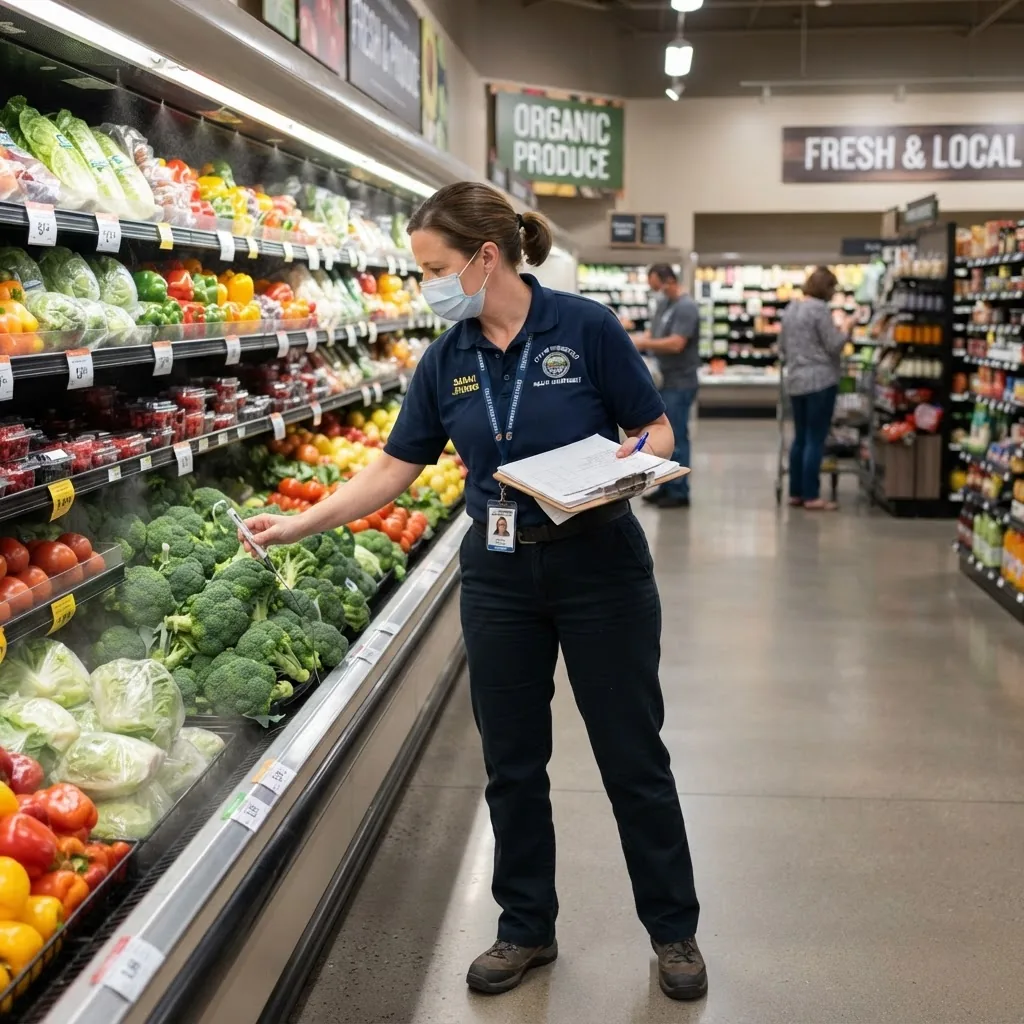
Deliverables: inspection-ready store: all refrigeration at target temperatures, handwashing sinks stocked with soap and single-use towels, chemical storage separated from food, and staff on site to answer process questions. Typical inspector checklist: equipment, temperature logs, handwashing availability, pest control, and employee hygiene.
-
Respond to conditional findings and finalize license issuance (Days 21–60)
Deliverables: documented corrective actions for any minor violations, re-inspection request if required, and finalized license/operating permit. Common timeline: minor fixes resolved in 3–10 business days; major corrections may take 2–6 weeks.
Authority note: inspectors enforce standards based on state and local law; for technical food safety guidance reference official resources such as FDA food guidance and your state health portal.
-
Create ongoing compliance and record-keeping systems (Ongoing)
Deliverables: daily temperature logs, weekly cleaning logs, monthly supplier verification reviews, employee training logs, and an annual review checklist ahead of license renewal. Store these records for the period required by your jurisdiction (commonly 2–3 years).
Software tip: use a simple cloud-based compliance app or shared spreadsheet with time-stamped entries; require a minimum of two staff sign-offs weekly for critical logs.
-
Plan renewals and audits (6–12 months ahead of expiry)
Deliverables: calendar reminders for renewal (renew typically annually), updated business information, and fee payment. Keep a buffer of 60 days to re-apply if your jurisdiction requires in-person forms or long processing times.
Transition: After the procedural steps, review the most common mistakes applicants make and how to avoid them in practice.
Common mistakes and how to avoid them (hands-on practitioner notes)
I once saw an applicant submit a floor plan drawn at the wrong scale and the health department rejected the package — don’t skip scale legends. I’ve also observed stores fail initial inspection because handwashing sinks were blocked; always leave immediate access and post sink signs.
Practical fixes I use: double-check scales at 1:50 or 1/4″=1′ before export; test refrigeration temperatures 24 hours before inspection and log three readings; pre-brief staff using a mock inspection checklist 48 hours ahead.
Transition: Now that you’ve completed the application flow, confirm the documents required to support the license — the next section lists every document typically requested and why it matters.
Key Documentation Needed for Grocery Store Licensing
The following list includes every document you are likely to be asked for on a food business application for a grocery store. Provide originals or certified copies where requested and keep digital backups in PDF (300 dpi) and named clearly.
- Business formation documents — articles of organization, operating agreement, or incorporation papers. These prove legal existence. If you haven’t formed your entity, see guidance on forming a legal entity and filing certificate of organization.
- Federal Employer Identification Number (EIN) — IRS issuance confirmation; required for tax and licensing alignment.
- Business plan summary — 1–2 pages with operational projections, staff numbers, and expected weekly inventory volumes. Used to assign risk level.
- Scaled floor plan and workflow — show receiving, storage, prep, retail floor, waste flows, and sinks. Include legend and scale; label all equipment.
- Food safety plan / HACCP summary — identify CCPs, monitoring schedules, corrective actions, and record retention periods.
- Employee training records — certificates for food handlers and Certified Food Protection Managers (CFPM) where required; include course provider names and dates.
- Supplier verification documents — proof of supplier inspections or third-party audit reports for perishable goods; include signed supplier agreements for perishables.
- Equipment specifications — manufacturer manuals for refrigeration and heating equipment, including temperature ranges and calibration schedules.
- Plumbing and grease trap documentation — when applicable, show licensed plumber sign-off and installation certificates. For certified requirements, reference certified plumbing contractor licensing requirements.
- Waste and recycling contracts — agreements showing scheduled pickup and disposal methods for food waste, cardboard, and hazardous materials like cleaning chemicals.
- Proof of insurance — liability and product liability policies with coverage amounts; many jurisdictions ask for minimum limits (example: $1,000,000 general liability).
- Payment proof — receipts for application and inspection fees.
- Photo ID and ownership documentation — driver’s license or passport for each listed owner or responsible manager.
- Zoning and land use confirmation — certificate or letter from the planning department affirming retail grocery use is permitted.
Transition: Accurate documentation reduces delays, but inspections are where compliance is verified. Read the next section for what inspectors look for and how to prepare.
Health and Safety Inspection Requirements
Health inspections for grocery stores verify that your operation preserves food safety from delivery through sale. Inspections focus on temperature control, sanitation, employee hygiene, and pest control. The exact checklist varies by jurisdiction, but most inspections examine:
- Receiving and supplier documentation (evidence of safe supplier practices)
- Cold chain maintenance (refrigerators at ≤ 41°F/5°C, freezers at 0°F/-18°C)
- Handwashing sinks accessible and stocked (soap and single-use towels)
- Food prep surfaces non-porous, cleaned and sanitized to schedule
- Proper storage (off-floor shelving, separation of ready-to-eat and raw items)
- Pest-control evidence (service contracts, traps, absence of droppings)
Inspection timeline: initial pre-opening inspections often occur within 7–21 days of application acceptance. Routine inspections for retail-only stores commonly occur annually; stores with ready-to-eat food or increased risk are inspected 2–4 times per year. As of 2024, many jurisdictions require documented daily temperature logs for refrigeration (source type: state health department guidance).
Checklist to have ready for inspector (print two copies):
- Current food business license application confirmation and fee receipt
- Scaled floor plan and equipment inventory
- Temperature logs for past 7 days
- Employee food handler certificates and training records
- Sanitation schedule and cleaning chemical Safety Data Sheets (SDS)
- Supplier invoices for perishables (past 30 days)
Preparation tips based on practitioner experience: perform an internal mock inspection 48 hours before the official date; physically walk the workflow from receiving to sales and time temperature checks at 0, 30, 60 minutes to confirm stability. If plumbing modifications were made for sinks or grease traps, ensure contractor sign-offs are available and match permits — see the contractor verification reference in the application steps.
Regulatory citations and resources: refer to FDA food guidance and model Food Code for preparation standards, and check your state health department portal for local amendments. For plumbing or mechanical compliance that affects sanitation, consult certified plumbing contractor licensing requirements.
Transition: Once you pass inspection and obtain your license, you must budget for fees and renewal obligations — explained next with example fee ranges.
Fees, Renewal, and Maintaining Compliance for Grocery Store Licenses
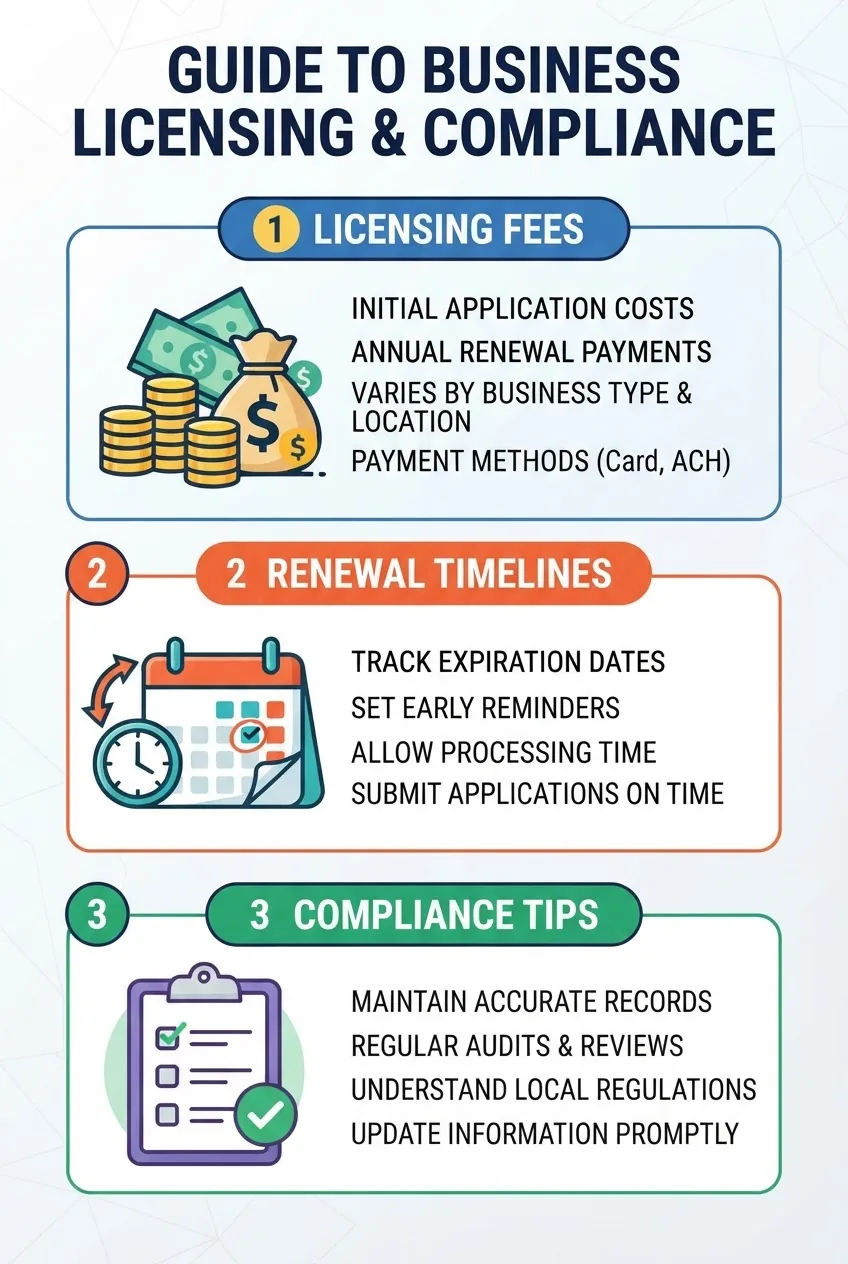
Fees and renewal cycles vary by state and county. Always verify current fees on your local health department portal. Below is a small comparative table with example ranges to help you budget. All figures are illustrative; check local sources. As of 2024 many jurisdictions list fees online (source type: state/local fee schedules).
| Region (example) | Application / Initial Fee | Annual Renewal | Inspection Fee (if charged) |
|---|---|---|---|
| County A (urban) | $150–$400 | $100–$300 | $75–$200 |
| State B (medium) | $100–$350 | $80–$250 | Often included |
| Small Town C | $50–$200 | $40–$150 | $50 flat |
Payment methods: most jurisdictions accept online payments by card or ACH; some small counties accept check only. Keep receipt numbers and capture screenshots of confirmation pages.
Renewal timelines: commonly annual and tied to your initial license issuance month. Set reminders 90 and 30 days before expiry. For multi-year licenses, confirm the term when you first receive the license. As of 2024, several states moved to e-renewals and email reminders (source type: state health department update).
Maintaining compliance: maintain temperature logs (daily), cleaning logs (daily/weekly), staff training logs (annually), and supplier records (updated quarterly). Non-compliance penalties vary: warnings for first minor violations, fines ranging from $50 to several thousand dollars for repeated or severe violations, and potential temporary closure.
Transition: While fees and renewals are manageable with a calendar system, applications still fall into common traps. The next section lists troubleshooting tactics and escalation options.
Common Challenges and Troubleshooting When Applying for a Grocery Store License
When I advise applicants, these are the recurring issues and step-by-step fixes I recommend. Treat this as a troubleshooting playbook you can implement immediately.
- Missing or incorrectly scaled floor plans
- Fix: Re-export plan at required scale (1:50 or 1/4″=1′) and include legend; use a PDF/A export to preserve scale.
- Time to correct: 1–2 business days with architect or CAD operator.
- Unclear supplier documentation
- Fix: Request signed supplier certificates of analysis or third-party audit reports; keep digital copies dated within last 12 months.
- Time to correct: 3–7 days to obtain signed supplier confirmation.
- Temperature log gaps
- Fix: Implement an immediate corrective log and record three consecutive days of readings; supply evidence of recalibrated thermometers.
- Time to correct: 48–72 hours.
- Contractor or trade permits missing
- Fix: Verify contractor license status via the contractor license verification tool and obtain final permit sign-offs.
- Time to correct: dependent on contractor; immediate verification is possible online.
- Delayed inspections
- Fix: Request status update with inspector, offer alternative dates within next 7 business days, and confirm that all corrective evidence is uploaded to portal.
- Time to resolve: often 3–14 days depending on inspector availability.
- Appeals and contesting major findings
- How-to: Submit a written corrective action plan within the timeline provided by the notice. If a closure order is issued, request an expedited hearing and retain counsel experienced in food licensing appeals.
- Timeframe: appeals timelines vary; expect 30–90 days in formal proceedings.
Practical tips to avoid delays:
- Pre-check portal upload limits and acceptable file types; many portals reject TIFF images or oversized PDFs.
- Label files with clear names and include a simple cover letter describing contents.
- Keep a rolling 90-day log of supplier invoices and temperature records for audit readiness.
Transition: Beyond the primary grocery store license, you may need other permits depending on services offered; the next section summarizes common additional permits.
Additional Permits and Licenses Often Required for Grocery Stores
Grocery stores often need more than a base food business license. Common add-ons and links to jurisdictional resources follow.
Typical additional permits:
- Alcohol sales license (local/state liquor authority)
- Tobacco retail license (local requirement in many jurisdictions)
- Signage permits from the planning department
- Waste disposal and grease trap permits
- Temporary event permits for pop-up sales or special tastings
- Food handler and manager certification requirements for employees
- Contractor permits and verifications for build-outs — see relevant contractor resources such as the California contractors board and certification and the New Jersey home improvement contractor license search.
- If operating in Washington state, consult licenses and permits for business registration in Washington for state-specific alcohol and retail rules.
Transition: If you need help locating authoritative contacts or portals, the final resources section lists the agencies and tools to use.
Resources and Contacts for Grocery Store Licensing Assistance
Use these contacts to verify policy, find forms, and get support. Start with your county health department; if you need model codes or federal guidance, use the FDA and SBA links below.
- Local/State Health Department — search your county health department portal for the food safety application center; they provide application PDFs, fee schedules, and inspector contacts.
- U.S. Food and Drug Administration (FDA) — FDA food guidance and model Food Code for general food safety rules.
- Centers for Disease Control and Prevention (CDC) — CDC food safety resources for handling and outbreak guidance.
- Small Business Administration (SBA) — SBA licensing and permits guidance for federal and local steps to start a business.
- Contractor and trade boards — verify contractor credentials with the state contractor board or through the contractor license verification resource.
- Local small business development centers (SBDC) — free counseling on licensing and finance.
Final checklist before submitting your food business application
- Entity registration and EIN obtained
- Scaled floor plan uploaded (correct scale and legend)
- Food safety plan with CCPs and monitoring schedules
- Employee certification roster with dates
- Supplier verification documents for perishables
- Plumbing/mechanical contractor sign-offs if applicable
- Application form completed and fees paid (save receipt)
- Inspection readiness: set target temperature confirmations and mock inspection complete
When to call in a professional
- If your fit-out includes significant plumbing, grease trap installation, or HVAC changes, hire a licensed contractor and verify credentials using the contractor resources above.
- If you receive a closure order or a major violation, consult a licensed health regulatory attorney or a consultant experienced in food safety appeals.
- If your store will handle complex prepared foods or large-scale deli operations, consider contracting a HACCP consultant to prepare your food safety plan.
Closing summary and CTA: You now have a stepwise roadmap, a complete document list, inspection preparation tips, and the key contacts needed to apply for a grocery store license. Start by confirming entity registration and drafting the floor plan, then follow the numbered steps above. If you’re ready to begin, gather your EIN and scaled floor plan this week and schedule supplier confirmations.