By the end of this hands-on guide you will know exactly what a certified plumbing contractor is, the typical certification pathway for a U.S. state, how long it takes (commonly 2–6 years depending on route), what you must file and show to pass a license verification, and how to independently look up plumber license status online. Skill level assumed: beginner to intermediate (no prior licensing experience required).
Before you start
- Prerequisites: high school diploma or GED, driver’s license or photo ID, basic trade math skills.
- Tools & materials: access to a computer and reliable internet, digital copies of work history or apprenticeship records, examination study guides and plumbing code book (local edition).
- Account access: email address for state board portal, payment method for fees (credit card), and access to employer records for verification.
What is a Certified Plumbing Contractor?
A certified plumbing contractor is a tradesperson who has met a state’s specific education, experience, exam, insurance and bonding requirements and holds an active license that authorizes them to contract for plumbing work. Think of this license like a driver’s license for plumbing contractors: it signals the holder has demonstrated required skills, passed code-based testing, and carries required insurance. Licensed plumbing contractors may pull permits, bid on larger residential and commercial projects, and legally advertise themselves with credentialed titles.
Examples: in California a plumbing classification (C-36) requires documented experience and passing trade and law exams; in Texas a plumbing contractor must obtain a registered license through the Texas State Board of Plumbing Examiners or local municipality depending on the work. Requirements differ by state—some use a single statewide board, others allow municipal licensing.
Key distinctions to keep in mind: a “master plumber” is often a higher classification requiring more years of experience and leadership on larger projects; a “journeyman plumber” typically can perform work under a contractor’s supervision. Licensed contractors can sign contracts and pull permits, while unlicensed individuals generally cannot and risk enforcement action.
Because definitions vary, always confirm with your state licensing board before treating titles as interchangeable. Below we transition into what states commonly require and specific elements you will encounter while pursuing certification.
Essential Licensing Requirements for Certified Plumbing Contractors
The list below covers the standard set of requirements you will face when pursuing a plumbing contractor license. Each item includes what to prepare and typical ranges so you can act immediately.
- Education and trade training — Most states require a combination of classroom instruction and practical training. Typical: 144–960 classroom hours (trade school or community college) plus on-the-job training. Prepare transcripts or certificates from accredited trade schools or college plumbing programs.
- Apprenticeship or documented work experience — Common requirement: 2–5 years of supervised plumbing work or 4,000–8,000 hours of documented experience. “Apprenticeship” is a formal program combining paid work and classes; if you follow a registered apprenticeship, request an official completion letter for your application.
- Licensing exam — Exams test plumbing trade knowledge and code compliance. Expect two parts: a technical trade exam (codes, calculations, system layouts) and a business/law exam (contract law, estimating, safety). Many states use third-party testing vendors with open book or closed book formats. Review the state exam candidate bulletin for exact topics and sample questions.
- Proof of identity and eligibility — Valid photo ID, Social Security number (or EIN for companies), and proof of lawful work status. Some boards require documentation of age (21+ in certain states for contractor licenses).
- Background check and fingerprinting — Many states require a criminal background check and fingerprints. Processing typically takes 2–6 weeks. If you have prior convictions, disclose them early and obtain any state-specific waivers required.
- Insurance and bonding — Commonly required: general liability insurance ($300,000–$1,000,000 coverage ranges) and workers’ compensation if you employ staff. Some states ask for a surety bond; typical bond amounts for plumbing contractors range from $5,000 to $50,000 depending on state and license level. Get a certificate of insurance (COI) from your insurer showing the board as certificate holder when required.
- Business registration and tax filings — If you operate as a business entity, many states expect you to register with the Secretary of State and provide an Employer Identification Number (EIN). If you haven’t registered, consult the business registration application guide for step-by-step filing and local tax registrations.
- Application forms and fees — Application fees typically range from $50 to $400, plus separate exam fees and fingerprint processing fees. Many boards accept online submissions through candidate portals; others require mailed paper forms. Expect an initial license processing window of 2–12 weeks.
- Local permits and municipal licensing — Some jurisdictions require local licensing in addition to state licensure. Example: certain cities run their own contractor registries and require local business licenses or trade permits. Check municipal requirements before bidding on city projects.
- Continuing education and CEU tracking — After initial certification, many states require continuing education for renewal (commonly 4–16 hours per renewal cycle). Keep certificates of completion and course summaries for audits.
- Specialty endorsements or classifications — Larger jobs or specific systems (medical gas, backflow prevention, commercial gas piping) may require additional endorsements. Verify whether the state uses specific license classifications and prepare supporting work logs or certificates for those specialties.
- Compliance with trade codes and standards — Expect to demonstrate knowledge of your state’s plumbing code (often based on the Uniform Plumbing Code or International Plumbing Code). Maintain up-to-date code books and reference materials during exam prep and on-the-job practice.
- Regulatory disclosures — Some boards require disclosure of prior disciplinary actions in any state or professional board; provide court or board documentation if requested. Non-disclosure can lead to delayed approval or denial.
Note: for state-specific information, consult the relevant licensing authority. For California-specific plumbing classifications and exam details, refer to the Licensing Board California guide.
Transition: With those requirements in hand, the next section walks you through a practical, step-by-step pathway from trainee to licensed contractor.
Step-by-Step Guide to Becoming a Certified Plumbing Contractor
Below is a hands-on action plan suitable for someone starting or validating an existing trade career. Expect most applicants to complete these steps in 2–6 years depending on apprenticeship length and exam scheduling.
-
1. Verify local scope and plan your route
Check whether your target jurisdiction issues statewide plumbing contractor licenses or relies on municipal permits. Decide whether you will pursue: (A) a registered apprenticeship, (B) trade-school-first then experience, or (C) worker-to-licensed transition using employer-verified hours. If you plan to register an LLC or corporation before applying, follow the form a legal entity and file the certificate of organization guide before final application submission.
-
2. Enroll in required education or apprenticeship
Action: Apply to a trade school program (144–960 hours) or a registered apprenticeship (typical 4 years / ~8,000 hours). Request official enrollment letters and keep class transcripts. If joining an apprenticeship, ensure it is registered with the state or U.S. Department of Labor so hours count toward licensing.
-
3. Track and document work hours precisely
Action: Use a work log or digital tracker. Required documentation usually includes employer-signed logs showing dates, hours, scope of tasks, and supervisor contact details. Thresholds: 4,000–8,000 total hours is common for contractor-level licenses.
-
4. Prepare for and schedule the licensing exam
Action: Order the state candidate bulletin, study code sections (Uniform Plumbing Code or IPC), and take practice tests. Typical study time: 6–16 weeks depending on your baseline. Book exams with the state or third-party vendor and pay the exam fee (commonly $100–$350).
-
5. Pass required background checks and fingerprinting
Action: Complete fingerprinting and background checks per board instructions; processing can take 2–8 weeks. If you have a background history, prepare court documents and character references in advance.
-
6. Obtain insurance and bonding
Action: Contact insurance brokers for liability and workers’ compensation quotes. Typical requirements: $300,000–$1,000,000 general liability policies and a surety bond where required. Have your insurer issue a COI listing the state board if required on the application.
-
7. Complete and submit the license application
Action: Fill out the state application with supporting documents: education transcripts, apprenticeship completion or work logs, exam results (or exam registration receipt), COI, bond, background check receipt, and application fee. Many boards accept online filing; others need a notarized and mailed packet.
-
8. Maintain documentation and pass the board review
Action: After submission, monitor your application status, respond to board inquiries within 10–20 business days, and provide any additional documentation (e.g., final apprenticeship completion letter). Typical approval windows: 2–12 weeks.
-
9. Once approved, secure permits and begin contracting
Action: Receive your license number and certificate, post the license where required, and obtain any local business licenses. If you are starting a company, consult the starting a company in USA with online registration resource to set up tax and payroll registrations.
-
10. Plan for renewal and continuing education
Action: Note your license expiration date (commonly 1–2 year cycles), enroll in required CEUs (4–16 hours per cycle), and schedule renewal payments 30–90 days before expiration to avoid late penalties. Keep CEU certificates in a digital folder for audits.
Common mistakes and how to avoid them
I once saw an applicant lose six weeks because their apprenticeship form lacked supervisor contact information; the board returned the file for correction. To avoid that, always collect signed logs with phone numbers and official company letterhead and upload a clear PDF copy. Another common error is misreporting exam dates—keep screenshots of exam confirmations. Finally, mismatched names (e.g., nickname vs. legal name) cause delays; use legal names everywhere.
Quick verification checklist before applying
- Completed work log with 4,000–8,000 hours or apprenticeship completion letter
- Transcripts or certificate of trade schooling (if required)
- Background check/fingerprint receipt
- COI showing required liability coverage and bond (if required)
- Correctly filled application and payment method ready
- Exam study plan and scheduled test date
When to call in a professional
If you face a disciplinary history, complex multi-state licensing, or need custom bond/insurance structures for large commercial work, consult a licensing attorney or an insurance broker experienced with construction trades. They can reduce processing delays and help negotiate bonds for larger project thresholds (e.g., $50,000+).
Transition: With your license obtained or your plan set, the crucial next skill is to verify credentials—whether you’re a homeowner hiring a contractor or an employer vetting applicants.
How to Look Up Plumber License and Verify Credentials
Knowing how to look up plumber license details online gives you independent confirmation of status, disciplinary history, and specialties. Below is a procedural walkthrough using official board tools and examples so you can verify any plumbing contractor confidently.
- Locate the correct licensing board website — Start at your state licensing board or municipal contractor board. Example sources include the California Contractors State License Board (CSLB) and local city licensing pages. For broader searches across trades, use the central resource: contractor license status check and general contractor verification.
- Use the board’s license lookup or search tool — Typical required fields: license number, contractor/company name, or the contractor’s name. When you have a business name, search both the license database and the Secretary of State business registry to confirm entity status. Example: search by license number to avoid false matches.
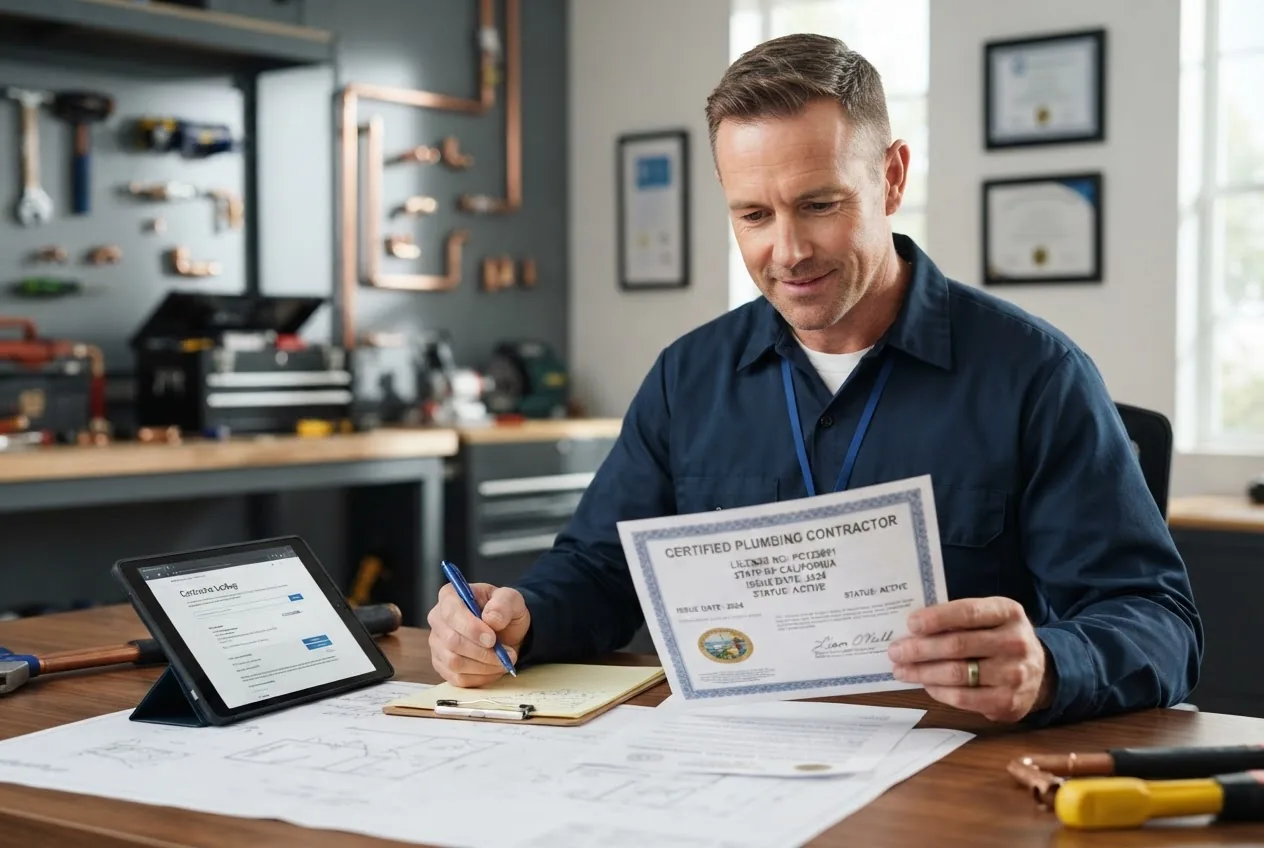
- Confirm license status and expiration — Look for explicit status fields like “Active”, “Inactive”, “Suspended”, or “Revoked”, and the expiration date. If status shows as “Expired,” do not hire the contractor for permit-required work until corrected.
- Review disciplinary history and complaints — Most boards publish final actions, fines, or suspension records. Read board orders and dates; a single old complaint is not always disqualifying, but multiple recent actions should be a red flag.
- Verify insurance and bond information — Some board lookups show current bond and insurance status; otherwise request a Certificate of Insurance (COI) from the contractor naming you or your project as an additional insured when signing contracts.
- Check specialization endorsements and classifications — Confirm the contractor holds any specific endorsements required for your job (backflow, medical gas, commercial gas). These will often appear as separate classifications or license types in the lookup results.
- Cross-check identity — Match the contractor’s legal name, license number, and business address with other public records (business registry, work references, invoices). Discrepancies merit caution and further inquiry.
- Document your verification — Print or screenshot the lookup result, including timestamp and full URL. Keep this evidence with your contract in case of later disputes or municipal inspections.
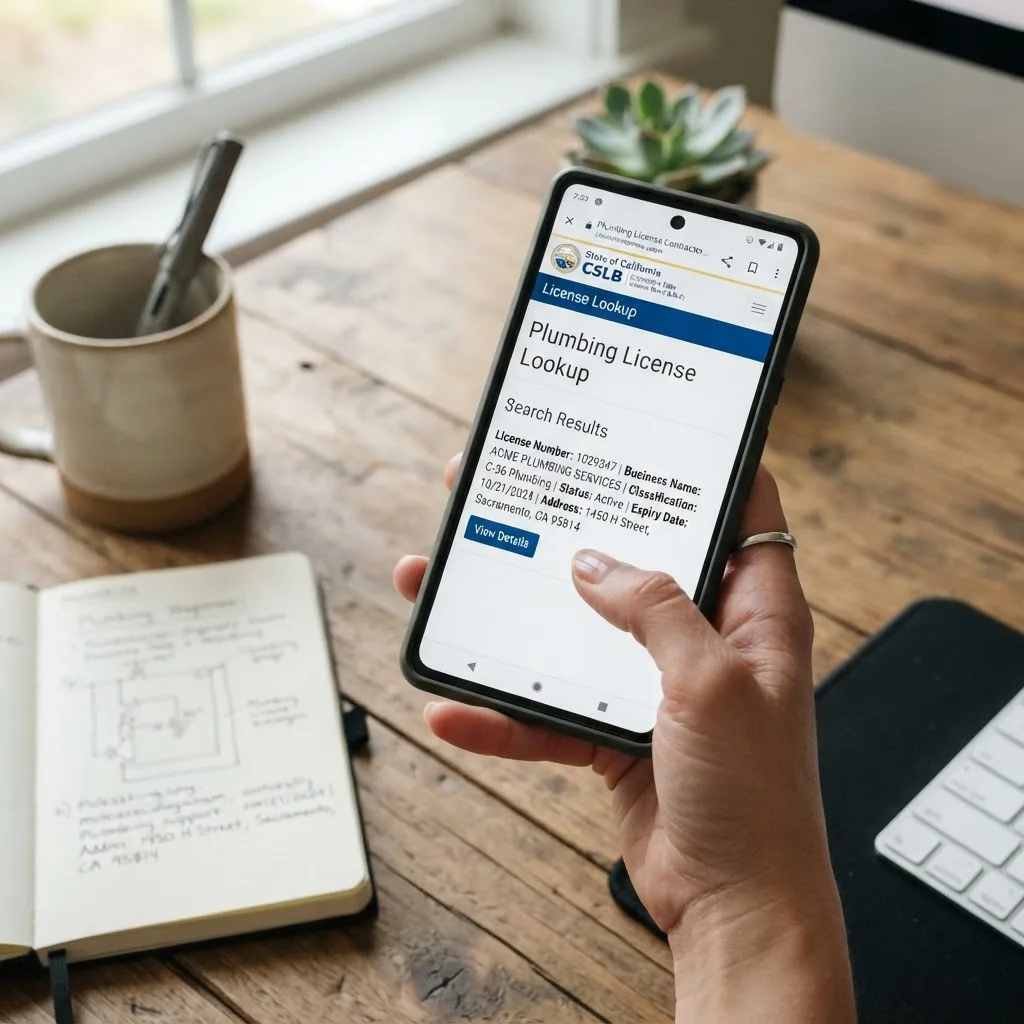
Example walkthrough (descriptive): to verify a California plumbing contractor, visit the California Contractors State License Board site, enter the contractor’s license number or name, review the status line and actions, then click “View Details” to see bond and workers’ compensation notes. According to the 2023 California Contractors State License Board summary, license lookups show both active status and any final disciplinary actions.
For a state-specific example, see the internal tool for the New Jersey home improvement contractor license search to understand how municipal and state listings can differ.
When verifying across trades, you can extend the search using the contractor license status check tool for generalized checks (useful when a company holds multiple classifications).
Practical verification tips: search by license number whenever possible, confirm the expiration date (if within 60 days of expiry ask for proof of renewal), and request a COI showing current coverage. If you encounter a returned “no record found,” contact the board directly by phone or email and request written confirmation.
Transition: Once you have a license, ongoing maintenance and compliance keep it valid; the next section explains renewal cycles and continuing education.
Maintenance and Renewal of Certified Plumbing Contractor License
Maintaining an active plumbing contractor license requires scheduled renewals, continuing education, and compliance with insurance and bonding obligations. Below is a practical maintenance plan and checklist.
Renewal cycles and fees: Most states use 1–2 year renewal cycles. Typical renewal fee ranges: $50–$350. Late renewal penalties can be 10–50% of renewal fees plus reactivation steps. According to a 2024 industry report, average renewal fees across U.S. boards place mid-range at approximately $150 per cycle.
Continuing education (CE): Common requirements: 4–16 hours per renewal cycle. CE topics usually include code updates, safety, business practices, and ethics. Keep original CE certificates—boards may audit 2–10% of renewals annually.
- 90-day pre-renewal checklist: review expiration date, enroll in required CEUs, confirm insurer will renew COI, and gather employee payroll documentation if workers’ compensation is required.
- 30-day renewal actions: file renewal online, upload CE certificates, and pay the renewal fee. Print confirmation page and save a PDF with timestamp.
- After renewal: verify online that license status is “Active” and the new expiration date is correct; keep a paper copy of the renewed certificate on-site.
Audits and compliance: Boards perform random audits focused on CE, insurance, and payroll documents. If audited, respond within the board’s specified timeframe (commonly 15–30 days) and provide certified copies of requested documents.
Record retention thresholds: keep license applications, CE records, COIs and work logs for at least 3–5 years. If you have ongoing municipal permits, retain permit copies and final inspection records for project-specific defense against future complaints.
Transition: Even with active renewal and good recordkeeping, licensing challenges occur. The next section contrasts common problems and solutions.
Common Challenges and How to Avoid Licensing Issues
This section outlines common licensing challenges, the consequences of unlicensed practice, and hands-on troubleshooting tips drawn from field experience.
| Issue | Typical cause | How to avoid / remedy |
|---|---|---|
| License suspension | Unpaid fines, insurance lapse, misconduct | Keep automated reminders for insurance and renewals; resolve complaints promptly; hire counsel if contested. |
| Unlicensed practice | Working without posted license or expired license | Verify status before hiring; contractors must provide license number and COI on request. |
| Disciplinary action | Code violations, unsafe installs, consumer complaints | Adhere to local plumbing codes, conduct inspections, and maintain project records and permits. |
| Audit failures | Missing CE proof, missing payroll/COI | Keep a centralized digital folder with scanned CE certificates and insurance documents. |
Troubleshooting tips
- If a license shows “No record found”, contact the board with contractor details and request written confirmation; keep that response.
- When a contractor claims “application pending”, ask for a written notice from the board or wait for the online status to show “Active”.
- If you find unlicensed work on your property, stop work, withhold final payment, and file a complaint with the state board—document the issue with photos and invoices.
Consequences of unlicensed practice: fines, mandatory remediation, civil liability for unsafe work, and potential criminal charges in some states. As a homeowner, always require the license number and verify it.
Transition: For authoritative guidance and to dig deeper into state rules, use the resources listed next.
Resources and External Authorities for Certified Plumbing Contractor Licensing
Below are reliable external authorities and practical resources to confirm licensing rules, board contacts, and continuing education providers.
- California Contractors State License Board — state board site for license lookup, exam candidate information, and disciplinary orders.
- Plumbing-Heating-Cooling Contractors Association (PHCC) — national trade organization with training resources, code updates, and recommended best practices.
- USA.gov Licensing Resources — centralized links to state and local licensing resources and government contacts.
Additional internal resources: if you need state-specific permit details for Washington, consult the licenses and permits for business registration in Washington. For cross-industry licensing examples, see the food business application guide.
Transition: Below is a compact final summary and call-to-action to help you act now.
Conclusion
Key takeaways: a certified plumbing contractor has passed state-specific education, experience, exam and insurance requirements. Typical pathways take 2–6 years, and maintaining licensure requires timely renewals, CEUs, and valid insurance. To verify credentials, always use the official state or municipal license lookup tool, save documentation, and request COIs before work begins. Take the first step today: gather your work logs, enroll in required training, and schedule your exam.
Ready to verify a contractor now? Use the contractor license status check and general contractor verification tool for multi-trade lookups, or visit your state board’s lookup page to look up plumber license details immediately.