

By the end of this hands-on guide you’ll have a fully scoped, prioritized household chores list, a printable weekly-and-monthly checklist, and a repeatable scheduling framework you can implement in 60–180 minutes depending on home size. Skill level: beginner to intermediate home manager — no professional cleaning or repair certification required.
Introduction to Household Chores and Routine Home Management
This guide shows how to turn scattered housework into a predictable, low-stress routine. A focused household chores checklist and routine management system reduces decision fatigue, keeps living spaces healthier, and frees time for other priorities. We’ll explain why certain tasks are daily versus weekly, give sample schedules for one- to five-person households, and link to authoritative hygiene guidance so you can set safe cleaning frequencies.
Why frequency matters: small, frequent tasks prevent dirt and clutter from compounding into large, time-consuming jobs. According to a 2024 industry report on household time use, households that use short daily routines spend 35% less time on weekly deep cleaning tasks (source: 2024 industry report). Public health bodies recommend focused hygiene actions—see the CDC guidance on household cleaning for surface disinfection and safe practices.
Before you continue, if you want a broader annual and technical plan covering seasonal systems like HVAC and roof care, consult the Complete Home Maintenance Checklist for Yearly and Monthly Care for complementary guidance.
Comprehensive Household Chores List by Frequency
Transition: With the purpose and health context covered, the next step is a practical, room-by-room and frequency-based breakdown you can copy or adapt.
-
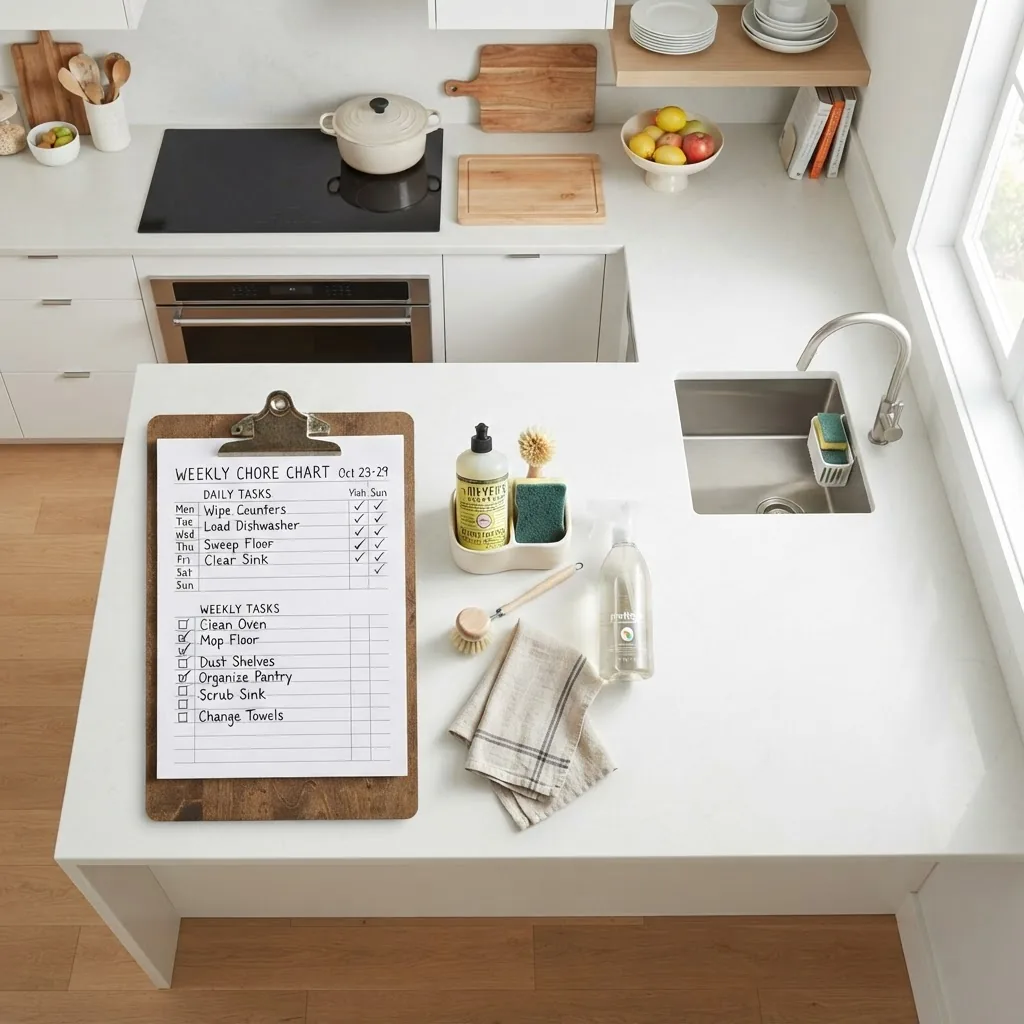
Daily cleaning chores — habit-size tasks (10–30 minutes total)
Rationale: Daily tasks prevent buildup and maintain hygiene. Do these every day or as needed depending on household activity level and presence of pets/children.
- Make beds — 2 minutes per bedroom (quick morning habit).
- Load or run dishwasher / wash dishes — 10–20 minutes per meal cycle.
- Wipe high-touch surfaces (kitchen counters, dining table, doorknobs) — 5–10 minutes; follow CDC cleaning guidance for disinfection when someone is ill: CDC guidelines for home hygiene.
- Sort mail and clear counters — 5 minutes.
- Quick sweep or vacuum high-traffic zones — 5–10 minutes using a cordless vacuum or broom.
- Tidy living areas: 10–15 minutes of 15-minute pick-up (toy bins, shoes, throws).
- Wipe bathroom sinks and spot-clean mirrors — 3–5 minutes.
- Empty small trash bins if full — 2–5 minutes.
- Daily laundry for large households (optional): run one load/day to avoid weekend piles.
-
Weekly cleaning chores — scheduled blocks (30–120 minutes)
Rationale: Weekly chores tackle areas that accumulate dirt more slowly. Aim to spread these across 2–4 sessions per week for balance.
- Vacuum entire home — 20–40 minutes depending on size and pets.
- Mop hard floors — 20–40 minutes.
- Clean bathrooms: toilets, tubs/showers, sinks — 30–60 minutes total.
- Dust surfaces (furniture, shelves, baseboards) — 20–30 minutes.
- Change bed linens — 10–15 minutes per bed.
- Clean kitchen appliances exterior (fridge doors, microwave, stovetop) — 15–30 minutes.
- Wipe cabinet fronts and backsplash — 10–20 minutes.
- Take out recycling and deep-empty kitchen trash — 10–15 minutes.
- Clean pet areas and wash bedding — 20 minutes.
- Water houseplants and check drainage — 10–15 minutes.
- Spot-treat carpets or upholstery stains — 10–20 minutes (act quickly for best results).
- Organize one “hot-spot” zone (entryway, junk drawer) — 15–30 minutes.
For deeper weekly guidance see the detailed deep cleaning checklist for tasks beyond routine weekly care.
-
Monthly chores — targeted maintenance (1–4 hours)
Rationale: Monthly chores reduce long-term wear and catch small maintenance issues early.
- Clean range hood filters and vents — 30–60 minutes.
- Vacuum and clean behind/under major appliances — 30–60 minutes.
- Descale coffee maker, kettles — 20–30 minutes.
- Clean inside the refrigerator, discard expired items — 30–45 minutes.
- Wipe interior windows and window sills — 30–60 minutes.
- Deep-clean oven (self-clean or manual) — 1–2 hours.
- Wash or vacuum curtains and clean blinds — 30–60 minutes.
- Inspect and clean bathroom grout and vents — 30–60 minutes.
- Clean and test smoke and CO detectors (replace batteries if needed) — 15–30 minutes.
- Declutter wardrobe and donate seasonal clothing — 1–2 hours.
For more technical inspections that intersect with system maintenance, pair this checklist with a professional maintenance inspection checklist.
-
Quarterly and seasonal tasks — plan ahead
- Deep-clean carpets or schedule professional cleaning — every 3–12 months depending on traffic.
- Clean gutters (seasonal) and inspect roofline — spring and fall recommended.
- Service HVAC filters, clean vents — every 3 months.
- Rotate mattresses and check under-bed areas — every 3–6 months.
- Inventory emergency supplies and first-aid kits — quarterly.
For integrated seasonal checklists see the pillar link above or the site’s monthly templates.
-
Special-purpose tasks
- Pre-event cleaning (guests, holidays): prioritize entry, bathrooms, kitchen — 2–4 hours.
- Move-in / move-out cleaning: follow a room-by-room deep clean checklist — half-day to full-day.
- When someone is ill: increase surface disinfection frequency per CDC recommendations — see CDC guidelines for home hygiene.
Transition: Now that you have the tasks and reasoning, the next section explains how to create, use, and print a practical household chores checklist customized to your household.
How to Create and Use a Household Chores Checklist
We move from inventory to action. This section is procedural: create your checklist, test it for one week, then adapt. Templates and printable options are discussed with step-by-step examples.
Before you start creating your checklist, gather these materials:
- Existing chore notes, sticky notes, and any family calendars.
- Device for digital templates (phone/tablet/computer) or paper for print.
- Timer or stopwatch (for timing tasks during the trial week).
- Basic cleaning supplies: all-purpose cleaner, microfiber cloths, vacuum, mop.
-
Inventory and categorize tasks.
Walk through each room and list tasks using the comprehensive list above. For speed, time one example of each task to create realistic durations (e.g., “vacuum living room — 12 minutes”). Record frequency: daily/weekly/monthly.
-
Prioritize by impact and time.
Assign a priority score: 1 (essential daily hygiene), 2 (weekly comfort), 3 (monthly upkeep). Use priorities to schedule higher-impact short tasks first each day.
-
Build a printable or digital template.
Two recommended structures:
- One-page weekly checklist with columns: Task | Assigned | Estimated time | Done (checkbox).
- Monthly overview calendar with color codes for weekly/biweekly/monthly tasks.
For ready-made options and downloadable designs see printable home cleaning checklist templates.
-
Assign ownership and windows.
For multi-person homes, assign tasks by person or by day: e.g., “Alice: kitchen counters & dishes (daily, 10 minutes), Sam: vacuum (Tue & Fri, 20 minutes)”. Use small time windows: mornings 7:00–8:00 or evenings 8:00–8:30 to create predictability.
-
Trial and timebox.
Run the checklist for one week. Use a timer to confirm task durations and adjust estimates. According to a 2023 household time-use study, households that timebox chores reduce total household cleaning time by an average of 18% (source: 2023 household time-use study).
-
Refine and institutionalize.
At week’s end, update frequency or ownership. Convert the working checklist to a durable format: laminated print for fridge or a recurring calendar in a scheduling app.
Checklist examples (copy-paste ready):
Weekly Checklist (one page)
Mon: Vacuum whole-house (30m), Clean bathrooms (45m). Tue: Mop floors (30m), Change linens (20m). Wed: Dust (25m), Kitchen appliance wipe (15m). Thu: Laundry (60m), Declutter entry (15m). Fri: Spot-clean upholstery (15m), Trash/recycling (15m).
Transition: After you have a checklist, decide how to schedule it throughout the week and month for best adherence.
Sample Household Chores Schedule and House Chores Calendar Ideas
This section provides templates and a decision-making table comparing digital vs. print systems so you can choose what fits your household.
| Feature | Digital Calendar / App | Print / Fridge Chart |
|---|---|---|
| Best for | People who prefer reminders, recurring tasks, and shared access. | Households that want a persistent visual cue and low-tech simplicity. |
| Set-up time | 15–30 minutes to create repeating events and assign users. | 10–20 minutes to print and post a one-page weekly chart. |
| Notifications | Yes — push/email reminders and snooze. | No — relies on visual cues and habit formation. |
| Best for delegation | High — assign tasks and track completion. | Moderate — visible accountability but manual tick-off needed. |
| Offline reliability | Depends on devices; offline access varies by app. | High — always visible. |
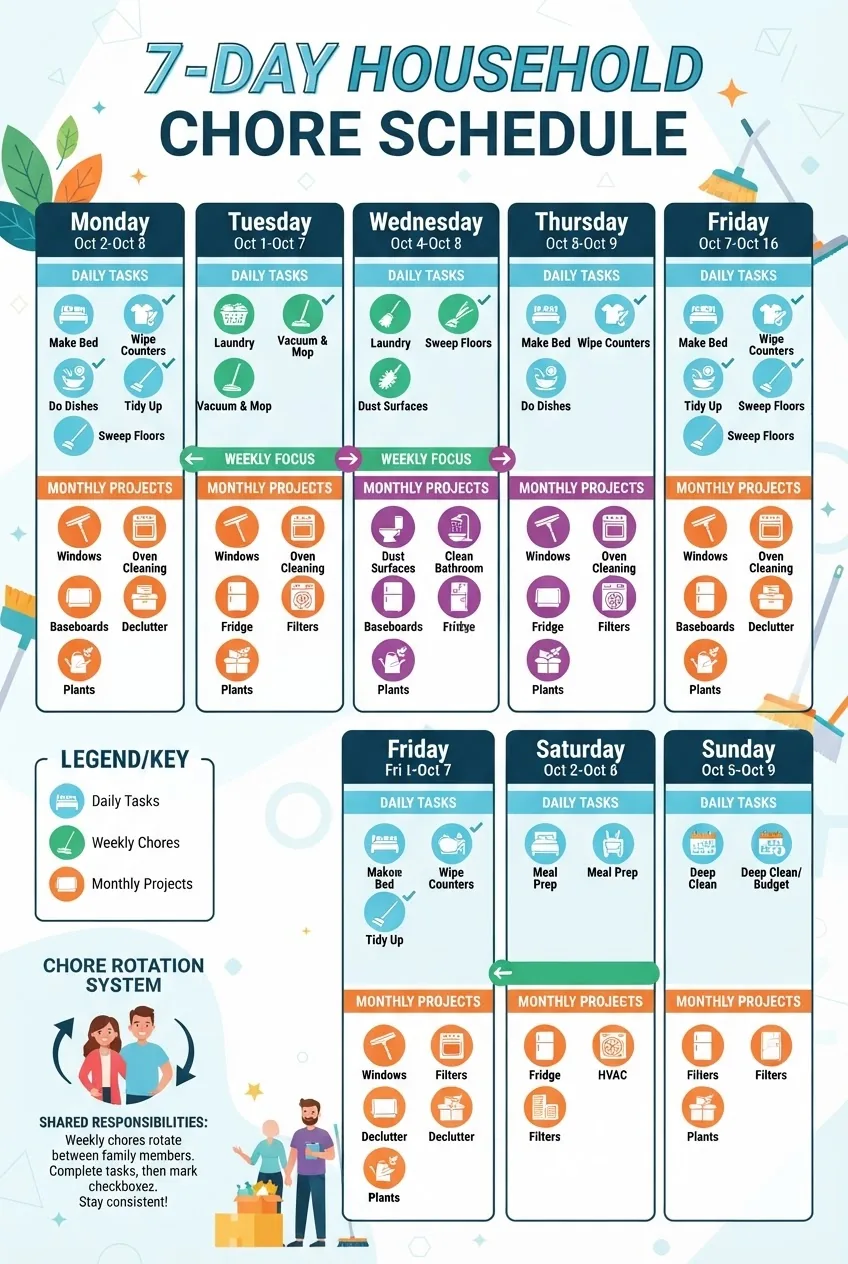
Sample seven-day schedule (one-person small apartment, estimated times)
- Daily (15–30m): Make bed, wash dishes, wipe counters, 10-minute nightly tidy.
- Monday (30m): Vacuum and mop floors.
- Wednesday (45m): Clean bathroom thoroughly, change bed linen.
- Friday (30–60m): Kitchen deep-clean (stovetop, wipe fridge surfaces), take out trash & recycling.
- First weekend of month (60–120m): Monthly chores (clean behind appliances, declutter pantry).
For templated schedules and downloadable calendars see the maintenance schedule template and the house cleaning schedule guide.
Transition: Routine is easier when chores are shareable and motivating; next we cover delegation, motivation, and time-saving techniques.
Tips for Managing and Delegating House Tasks Effectively
Good management blends realistic time estimates with simple delegation techniques. Below are practitioner-tested tips and scripts you can use to introduce chores to family members or roommates.
- Use role-based delegation: assign zones (kitchen, bathrooms, bedrooms) rather than a long list of tasks. This creates ownership and reduces micromanagement.
- Keep tasks time-boxed: limit each chore to a fixed time (e.g., 20 minutes). This lowers resistance and prevents perfectionism from derailing progress.
- Rotate responsibilities: two-week rotations prevent burnout; rotate the high-effort task (e.g., deep bathroom clean) monthly.
- Gamify for kids: simple charts with stickers and small rewards work well for children aged 4–12; ensure tasks are age-appropriate.
- Use short scripts: “Can you take the trash on Tuesdays? It’s a 10-minute job and helps us avoid overflow.” Clear, time-focused requests increase buy-in.
- Track progress publicly: a shared digital checklist or fridge chart increases accountability; combine with weekly check-ins (5 minutes).
- Simplify supplies and storage: keep basic cleaners in each bathroom/kitchen to shorten task setup time.
- Apply the 2-minute rule: if a task takes less than 2 minutes, do it immediately (making bed, wiping a spill).
- Set buffer windows: schedule chores during times when productivity is lower (early evening) to avoid conflict with work hours.
- Plan for contingencies: if someone is absent, have a backup person or simplify the week’s tasks to essentials only.
For practical daily habit formation read the site’s guide on how to keep your house clean daily and explore project ideas in efficient home maintenance projects.
Transition: You now have management techniques; next are tools and printable resources to make routine management frictionless.
Printable Housekeeping List of Chores and Tools for Routine Management
This section lists printable resources, tools, and supply recommendations keyed to task types to help you execute the checklist reliably.
Recommended printable resources:
- One-page weekly checklist (laminate for reusable dry-erase checks).
- Monthly calendar with color codes for task frequency.
- Kid-friendly chore chart with stickers and clear rewards.
- Emergency cleaning checklist for illness or unexpected guests.
Essential cleaning tools and typical quantities for a 3-bedroom home:
- Cordless vacuum with HEPA filter — 1 unit.
- Microfiber cloths — 12 (various colors for kitchen/bath to avoid cross-contamination).
- Mop and bucket or steam mop — 1.
- All-purpose cleaner, glass cleaner, bathroom cleaner, degreaser — 4 bottles.
- Spare trash bags and recycling bags — 1 box each.
- Gloves and small scrub brushes — set of 2.
- Spray bottles for DIY cleaners — 2–3.
Resources and further technical checklists: for system-level inspection or standards-friendly assessment pair your chore lists with the maintenance inspection checklist and review the healthy homes assessment checklist to align cleaning tasks with health standards.
External authoritative standards for hygiene and product safety:
- CDC home cleaning guidance
- EPA Safer Choice product guidance
- Extension resources on household management and cleaning studies
Transition: Even with tools and delegation, households run into common management challenges; the next section covers troubleshooting strategies so you can maintain momentum.
Troubleshooting Common Challenges in Household Chore Management
This section uses a how-to/problem-solution approach to address procrastination, inconsistent completion, and time constraints. If you need more than chores — repairs or specialized help — links to sibling articles are provided below.
-
Problem: Chore procrastination and avoidance.
Solution: Break tasks into 5–15 minute micro-chunks, schedule them as non-negotiable calendar events, and use a timer. If you fall behind, deprioritize non-essential tasks for one week and focus on hygiene-critical tasks (kitchen, bathroom, trash).
-
Problem: Uneven participation or family resistance.
Solution: Use role-based delegation, rotate unpleasant tasks, and make expectations explicit with checkboxes and estimated durations. Offer small incentives or swap jobs to better match preferences.
-
Problem: Overwhelm when life gets busy.
Solution: Maintain a short “minimum viable routine”: daily 15-minute tidy, three weekly 30-minute cleaning blocks, and monthly essentials only. If needed, schedule a one-day reset (2–4 hours) and simplify the following week.
-
Problem: Chores revealing maintenance issues.
Solution: For non-routine repair issues discovered during chores (e.g., persistent leaks, wiring problems), escalate to specialists. For prioritization before major transactions see repairs before selling a home; for hiring help compare affordable handyman services.
-
Problem: Tasks that require skills you don’t have.
Solution: Some jobs are better outsourced. If a chore crosses into repair or technical maintenance, consult resources on DIY home repair projects or hire specialists.
-
Problem: Budget constraints for cleaning tools or services.
Solution: Prioritize high-impact hand tools (vacuum, microfiber cloths). Consider barter or low-cost subscription cleaning services if workload spikes. For a cost-benefit view see common home maintenance problems to determine what merits professional intervention and what stays on your routine list.
Transition: Below I share practitioner experience about mistakes I’ve seen and how I avoid them when rolling out chore systems.
Common mistakes and how to avoid them
I once created an elaborate color-coded chart and expected instant buy-in; it failed because nobody knew when to do each task. I learned to set clear time windows and start with a two-week trial. Another time I under-estimated pet-related tasks; I now add 10–20 minutes daily for pet zones. Finally, I used vague task names — replace “clean kitchen” with “wipe counters (5m), sweep (7m), load dishwasher (10m)” to make tasks actionable.
Hands-on Steps: Build Your Personal Household Chore System (Core Procedure)
Below are numbered, action-first steps that walk you through building a custom household chore system tuned to your home size.
- Audit your home (30–90 minutes).
Walk each room with a notebook. Time one example of each task. Record: Task name, estimated minutes, ideal frequency, and who can perform it.
- Group and prioritize tasks (20–40 minutes).
Sort tasks into daily, weekly, monthly columns. Mark hygiene-critical tasks as Priority 1. Total up estimated minutes per day; aim for 20–60 minutes daily for a 2–4 person home.
- Create a master checklist (30–60 minutes).
Use a spreadsheet or one-page printable. Columns: Task | Frequency | Estimated time | Owner | Notes. Save a copy as your “master chore library”.
- Design a weekly schedule (15–45 minutes).
Distribute weekly tasks across the week to avoid weekend overload. Example: Monday vacuum, Wednesday bathroom clean, Friday kitchen deep clean. Add daily micro-tasks to morning or night routines.
- Assign and communicate (10–20 minutes).
Hold a 10-minute family or roommate meeting. Present the schedule, confirm who owns each task, and agree on check-in times. Use clear timing language: “Vacuum Tuesday at 7 pm — 25 minutes.”
- Implement a trial week with timers (7 days).
Use a stopwatch to track actual task times. At the end of the week, revise any mis-estimates.
- Refine and create a durable format (30 minutes).
Choose between digital recurring tasks (Google Calendar, Todoist) or a laminated fridge chart. Print the weekly checklist and place supplies near work zones. Save templates for monthly rotation.
- Review monthly and adjust (20–30 minutes).
At the end of month one, adjust frequencies, rotate tasks, and add seasonal chores to the calendar.
Compact Verification Checklist
- Master chore library completed and saved.
- Weekly schedule created and posted (digital or print).
- Owners assigned for each recurring task.
- Trial week completed with task timings recorded.
- Supplies organized and placed near work zones.
- Monthly review scheduled on calendar.
When to call in a professional
Call professionals for issues that exceed routine cleaning: persistent mold, wiring or electrical hazards, structural leaks, gas-related concerns, or major appliance repair. If routine chores uncover problems beyond surface care, use affordable handyman services or consult licensed contractors. For pre-sale prioritization see repairs before selling a home.