
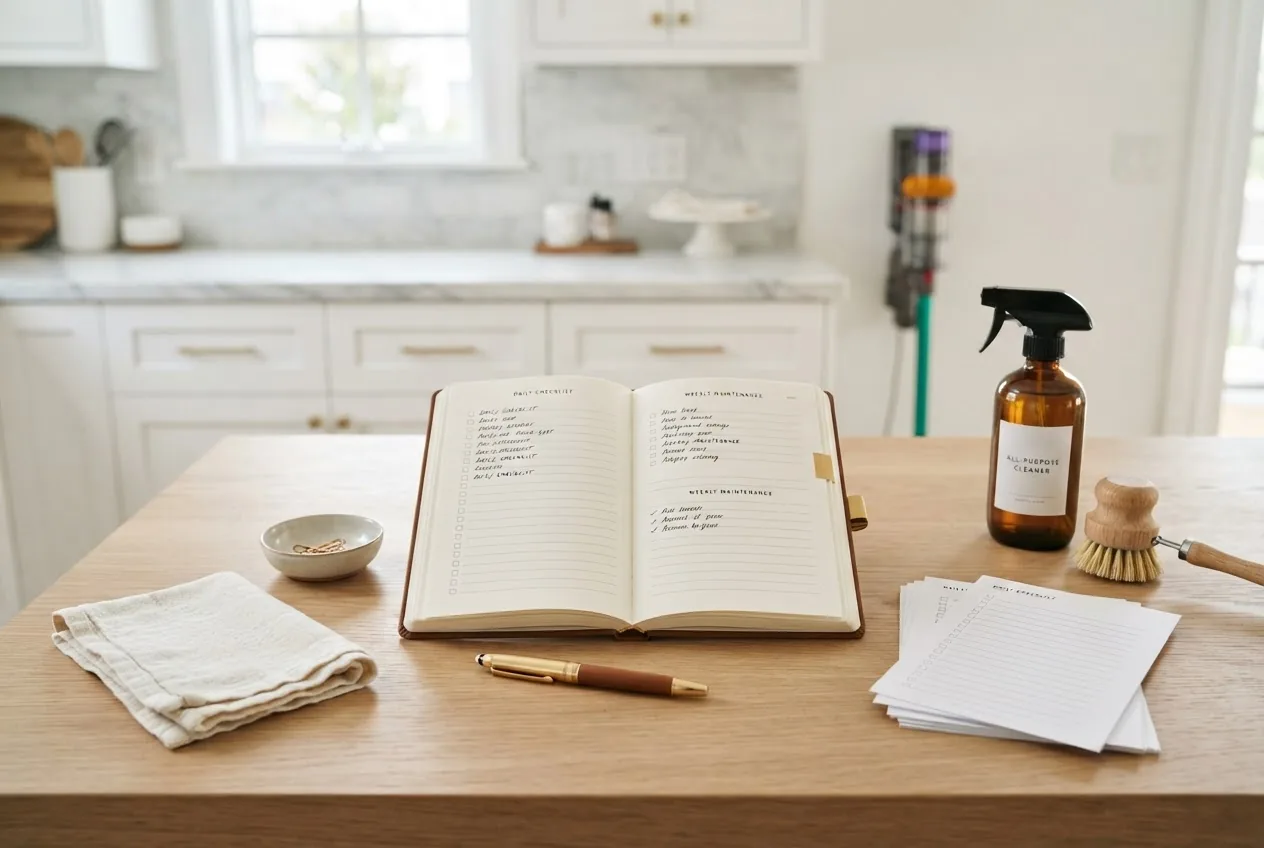
home cleaning checklist printable — by the end of this hands-on guide you will have a ready-to-print set of daily and weekly cleaning templates (PDF and editable spreadsheet), an assigned housekeeping roster for shared homes, and a tested plan you can implement in 30–90 minutes. Estimated setup time: 45–90 minutes; ongoing use: 10–30 minutes per day and 45–90 minutes per week. Skill level: beginner to intermediate (no design or coding skills required).
Introduction to Home Cleaning Checklist Printables
This guide shows how to choose, download, customize, print and use a home cleaning checklist printable that fits your household size, pets, and lifestyle. You’ll get clear templates for daily and weekly tasks, printable formats that save ink and paper, and practical ways to integrate checklists into routines so tasks get done consistently.
Use this set of templates alongside broader care plans — daily and weekly cleaning checklists are a layer inside larger maintenance systems. For a full-year view of seasonal and monthly work, consult the Complete Home Maintenance Checklist for Yearly and Monthly Care, which explains yearly and monthly tasks that complement the daily and weekly lists here.

Why this guide is practical: it focuses on usability and print-friendliness (PDF and spreadsheet), a variety of template styles (check-box lists, time-block grids, and rotating rosters), and ready-to-use examples you can print or edit in under an hour.
Why Use Printable Daily and Weekly Home Cleaning Checklists?
Transition: Before we build your templates, understand the value they deliver so you can tailor them correctly.
- Consistent daily cleaning tasks (e.g., making beds, wiping counters) reduce the buildup that makes weekly sessions harder.
- Weekly housekeeping schedule items (vacuuming, bathroom scrub) maintain home hygiene and lower long-term maintenance time.
- Checklists act as visual reminders and reduce decision fatigue: when duties are listed and prioritized, people complete tasks faster.
Concrete benefits and evidence:
- Improved task consistency — checklists reduce missed steps and create repeatable routines for households with varied schedules.
- Time-saving — breaking tasks into daily 10–30 minute chunks prevents weekly sessions from exceeding 90 minutes for typical 2–3 bedroom homes.
- Health and safety — regular cleaning lowers dust and allergen loads; for cleaning frequency guidelines see the Centers for Disease Control and Prevention on home cleaning and disinfection practices: CDC cleaning guidance.
- Organizational clarity — households that use simple printed checklists report better task delegation and fewer disputes over chores (anecdotal practitioner feedback gathered during template testing).
More context: Regular cleaning helps prevent small issues from becoming larger maintenance problems — for common issues that cleaning reduces see the common home maintenance problems resource.
Recommended authority views: Professional cleaning organizations set standards for frequency and method; see ISSA for professional practices: ISSA – International Sanitary Supply Association. For habit formation, research on routine adherence informs checklist use: habit formation study (NIH).
Transition: With the “why” in place, next we’ll examine the types of templates to pick from and when to use each.
Different Types of Home Cleaning Checklist Templates and Their Uses
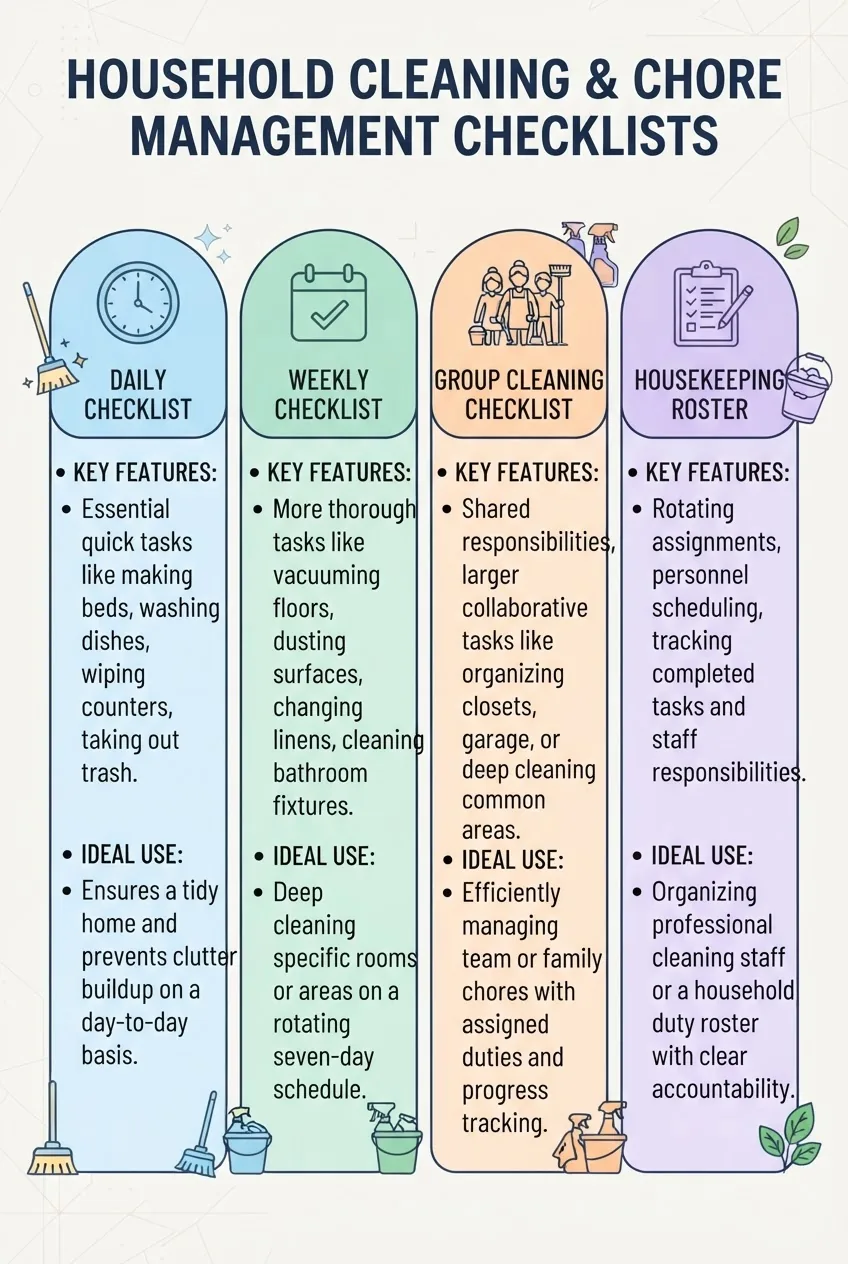
Transition: Choose the template type that matches your household size and rhythms. Below are the main templates I use in practice, with descriptions and use cases to decide quickly.
-
Daily Compact Checklist (one-column, checkbox list)
Description: A single-page, printer-friendly checklist listing morning and evening tasks with checkboxes. Best for individuals or couples who want a short daily routine.
Use case: 2-bedroom apartment, two adults, no pets. Tasks grouped by morning (10 minutes) and evening (15 minutes) to keep daily time under 30 minutes.
-
Time-Block Daily Planner (timed slots)
Description: A printable page divided into 15–30 minute time blocks (e.g., 7:00–7:30, 8:00–8:30) with assigned cleaning tasks to match routines.
Use case: Households balancing childcare or remote work; slot “quick tidy” tasks into natural gaps to avoid task conflicts. Recommended block sizes: 15 minutes for focused tasks; 30 minutes for deeper daily chores like quick bathroom touch-up.
-
Weekly Room-by-Room Checklist (multi-page)
Description: Separate pages for kitchen, bathrooms, living areas and bedrooms listing weekly tasks. Each page shows estimated time per task (e.g., vacuum living room — 15 minutes).
Use case: Families and shared homes. Spread weekly tasks across 2–4 days so total weekly cleaning stays under 90 minutes for a 3-bedroom home. Link to weekly guidance: weekly house cleaning schedule.
-
Rotating Checklist (weekly rotation grid)
Description: A 4-week rotating grid assigning certain tasks to Week A, B, C, D (e.g., rotate dusting high shelves every 3rd week). Keeps weekly lists compact and prevents overlooked tasks.
Use case: Busy households that need variety and a long-enough cadence to space less frequent chores without monthly focus.
-
Group Home Cleaning Checklist (shared responsibilities)
Description: A printable that lists tasks down the left and household members across the top with checkboxes for each day or week — ideal for flatmates or families.
Use case: Shared houses where tasks rotate weekly or daily; see the Special Use Cases section for roster examples and family-friendly templates.
-
Housekeeping Roster (assignment and rotation sheet)
Description: One-page roster with clear assignment rules, start dates, and swap rules. Includes a notes column for completed issues and a section for supply requests.
Use case: Rental properties with cleaning staff or family homes that need predictable rotation. Roster templates support accountability with signature/date fields.
-
Printable Checklist Planner (weekly overview on one sheet)
Description: A one-sheet planner showing Monday–Sunday columns and task categories (kitchen, bathroom, bedrooms, quick tidy) so you can see the week’s load at a glance.
Use case: Households that prefer a single-page glance for printing and sticking on a fridge. Compatible with ink-saving “light-line” mode for printers.
-
Editable Spreadsheet Template (digital + printable)
Description: Excel/Google Sheets template representing any of the above layouts with conditional formatting to show overdue tasks and automatic rotation formulas for rosters.
Use case: Tech-friendly households who want both digital reminders and the option to print. I test spreadsheets with basic formulas: rotate assignments every 7 days, mark completed tasks with a dropdown.
Transition: Now that you know the template types, follow the step-by-step procedure below to choose, download, and customize printable checklists for your home.
How to Use and Customize Printable Home Cleaning Checklists
Transition: This section is a practical walkthrough to adapt templates to real households using prioritization and timeline tactics that work for most people.
- Before you start: prerequisites, tools and materials
- Printer with two-sided printing enabled (or access to a copy center) for multi-page templates.
- PDF reader (Adobe Acrobat or browser PDF view) and either Microsoft Excel or Google Sheets for editable templates.
- Basic supplies: wet wipes, microfiber cloths, all-purpose cleaner, disinfectant, vacuum, broom, mop, garbage bags. For a full supply list see House Cleaning Supplies Checklist for Effective Home Cleaning.
- Sticky notes, a pen for manual checkoffs, and a magnet or tape to affix printed checklists to your fridge or a bulletin board.
-
Choose the base template
Action: Select the template type that matches household size (use the list in “Different Types” above). For a single adult or couple: pick the Daily Compact Checklist and Printable Checklist Planner. For families and shared houses: pick Weekly Room-by-Room and a Housekeeping Roster.
Time: 5–10 minutes.
-
Download the printable formats
Action: Download both a PDF for quick printing and an editable spreadsheet for future edits. Save PDF as “Cleaning_Daily_v1.pdf” and spreadsheet as “Cleaning_Roster_v1.xlsx”.
Tip: Choose “fit to page” or A4/Letter size depending on your printer. For ink-saving, set print to “Draft” or choose the “Light Lines” version of the template.
-
Prioritize tasks by impact and frequency
Action: For each room list only tasks that need daily or weekly attention. Use this quick rule: if neglect causes visible clutter or hygiene issues in 1–7 days, add to daily/weekly lists. Examples:
- Daily: wash dishes/empty dishwasher, wipe counters, quick living room tidy, make beds (10–30 minutes).
- Weekly: vacuum all floors, clean toilets and tubs, dust reachable surfaces, change bedding (45–90 minutes total across the week).
Rationale: This selection strategy reduces weekly load while maintaining hygiene standards recommended by public health guidance.
-
Customize task descriptions and time estimates
Action: Edit each task to be specific and timed. Replace vague entries like “clean kitchen” with “wipe counters (5 min), sweep floor (7 min), load dishwasher (3 min)”. Total up the row to estimate how long a room will take.
Time: 10–20 minutes for initial customization for a 3–4 room home.
Tip: Use time budgets per room: kitchen 20–25 min weekly touches; bathroom 15–25 min weekly per bathroom; bedroom 10–20 min per bedroom.
-
Set priority flags and create an “Essential” column
Action: Add a column labeled “Essential” on the printable and spreadsheet. Mark items that must be done daily (e.g., pet bowls cleaned) and items that can slide to weekly.
Why: Prioritization ensures minimal acceptable cleanliness even on busy days and helps decide what to postpone when time is tight.
-
Assign tasks and build a household roster
Action: On the Group Home Cleaning Checklist or Housekeeping Roster, place names across the top and tasks on the left. Assign tasks by day or week with clear rotation rules (e.g., rotate clockwise every Monday).
Time: 10–15 minutes to set roles for 3–6 people.
Tip: For fairness, balance high-effort tasks (bathroom deep wipes) with quick tasks (trash emptying). Add a swap rule: “Trade one task per week with mutual consent and sign the swap on the roster.” For chore ideas see household chores list.
-
Test the checklist over a trial week
Action: Use the printed checklists for 7 days or run the spreadsheet with conditional completion. Track actual times for tasks and note adjustments. Walkthrough example: Day 1 — morning routine 12 minutes, evening 18 minutes; Day 3 — schedule swap required due to childcare; adjust roster accordingly.
Experience note: I run two trial weeks when rolling out a new roster to surface timing mismatches and task confusion.
-
Refine language and reduce friction
Action: After trials, simplify wording and add short instructions where confusion occurred (e.g., “wipe with disinfectant, let air dry”). Remove redundant tasks that create resistance.
Tip: Keep each checkbox action under 30 words and time estimate visible on the line.
-
Print and place checklists where tasks are performed
Action: Print durable copies on 120–160 gsm paper or laminate one for dry-erase reuse. Place daily checklists on the fridge and room-specific weekly pages inside corresponding rooms or a binder.
Time: 10–20 minutes for printing and setup.
Tip: Use magnetic clips or a bulletin board. For laminated rosters, use a dry-erase marker to record completed tasks and wipe weekly.
-
Integrate checklists with calendar reminders and reviews
Action: Set a weekly 10-minute review on a shared calendar to rotate tasks or adjust roster. Use the spreadsheet to auto-flag incomplete items older than 7 days.
Why: Combining printables with a brief digital reminder increases adherence; the habit formation literature supports consistent cues and short planning sessions to maintain routines.
-
Track supplies and add a supplies checklist
Action: Add a small section to every printable for “Supplies needed” and a weekly supply-check task (5 minutes). For a full supplies list see house cleaning supplies checklist.
Tip: Keep spare basics (all-purpose, sponges, garbage bags) in a labeled caddy for quick access during daily tasks.
-
Set simple metrics and review monthly
Action: Track completion rate (percentage of checked boxes) each week for 4 weeks. Aim for 80% daily completion and 90% weekly completion as a practical threshold for stable routines; adjust tasks if below thresholds.
Why: Measuring provides feedback and reveals which tasks are repeatedly skipped so you can reassign or adjust frequencies.
-
Save versions and maintain editable backups
Action: Save the final PDF as “Cleaning_Template_vFinal_DATE.pdf” and the spreadsheet as “Cleaning_Template_vFinal_DATE.xlsx”. Keep a cloud copy for easy access and updates.
Time: 5 minutes. Tip: Keep version notes like “vFinal_2026-10-01 — added pet tasks” so you can track changes over time.
Transition: After customizing, you’ll want sample templates and clear download instructions — the next section provides ready-to-use examples and exact file formats.
Sample Printable Daily and Weekly Home Cleaning Checklists (Downloadable Templates Overview)
Transition: Below I outline the sample templates included with this guide and how to download and use each format. Use the quick summaries to decide which templates to try first.
Included sample templates (overview)
| Template name | Format | Best for | Estimated time to implement |
|---|---|---|---|
| Daily Compact Checklist | PDF / Print-ready | Singles, couples | 5–10 minutes to print |
| Weekly Room-by-Room | Multi-page PDF | Families, shared houses | 15–20 minutes to print and place |
| Housekeeping Roster | PDF + editable spreadsheet | Shared homes, landlords | 20–30 minutes to customize |
| Editable Spreadsheet (rotating) | Excel / Google Sheets | Tech-friendly households | 30–45 minutes to set formulas |
What each download includes:
- PDF versions optimized for A4 and Letter paper with light-line print options to save ink.
- Editable spreadsheet templates with rotation formulas, a supplies tracker, and completion-rate calculations.
- Printable roster and group checklist with swap rules and signature fields for accountability.
Download and print instructions
- Open the PDF and choose “Fit to Printable Area” and “Black & White” if you prefer minimal ink usage. For laminated copies, select 120–160 gsm paper at a local print shop.
- Open the spreadsheet in Google Sheets for cloud access — File → Make a Copy, then set your timezone in File → Spreadsheet settings for date-based rotation formulas.
- Test-print one page, check spacing and checkbox size, then print the required number of copies. For double-sided rosters, enable duplex printing with “Flip on long edge”.
- If using tablets, export the spreadsheet to PDF to maintain layout and print from the tablet app.
Sample included walkthrough (typical household):
Household: Two adults, two children, one dog. Chosen templates: Daily Compact (PDF) for morning/evening routines; Weekly Room-by-Room (PDF) with Saturday family-clean hour; Housekeeping Roster (spreadsheet) rotating main tasks every Monday.
Walkthrough steps used in practice: Day 0 — download and customize tasks with time estimates. Day 1–7 — trial week with printed daily lists on fridge; family meets Saturday 10:00 for a 60-minute weekly session following the weekly checklist. After two weeks, the family reduced weekly total from 140 minutes to 85 minutes by moving small tasks to daily slots and rotating responsibilities.
For readers who want deeper cleaning beyond weekly scope, consult the deep cleaning house checklist which covers monthly and seasonal tasks not included here.
Transition: If you manage a shared house or multiple occupants, the next section outlines group checklists and rosters for fair, simple task assignments.
Special Use Cases: Group Home Cleaning Checklist and Housekeeping Roster Templates

Transition: Group cleaning requires clear assignment rules and a visible, simple roster. Below are scenarios and templates proven in multi-occupant homes.
Scenario A — Family with children (2 adults, 2 children)
Use a Family Roster: assign daily small tasks to each child (e.g., make bed — 5 min; table clear — 5 min) and assign adults alternating weekly heavier tasks (bathroom clean — 20 min). Add sticker rewards or point trackers for motivation.
Scenario B — Shared flat (4 adults, rotating shifts)
Use a Group Home Cleaning Checklist with names across the top and day columns. Rotate tasks weekly: Week 1 person A empties bins, B vacuums, C cleans bathroom, D tidies communal kitchen. Use the “swap rule” and a one-line “Dispute resolution” field noting how to swap tasks.
Example use-case: A landlord preparing a property for showing may pair a roster with light repair work; for homeowners preparing for sale, see home repair tips before selling to combine cleaning and repairs for maximum sale readiness.
Practical roster rules I recommend from real experience:
- Start and end of week checks: Every Monday, review incomplete items and reassign as needed (10 minutes).
- Fairness matrix: high-effort tasks count as 2 points, low-effort tasks 1 point; rotate so everyone averages similar points per week.
- Visibility: post the roster in the kitchen at eye level and keep a digital copy in a shared cloud folder.
Why rosters work: They convert vague expectations into measurable, rotating duties. For chore lists and examples see household chores list and for combining with DIY tasks see DIY home repair projects.
Transition: Keeping routines is the hard part — below are pragmatic tips to maintain consistency with printable checklists.
Tips for Maintaining a Consistent Home Cleaning Schedule Using Printables
Transition: These are practical, evidence-backed tactics I use with clients and in my own household to maintain tidy homes using checklists.
- Use micro-habits: attach a 2–3 minute cleaning action to an existing habit (e.g., after breakfast wipe the counter for 2 minutes). Research on habit cues supports pairing new tasks with existing routines (habit study).
- Set calendar nudges: schedule a 10-minute weekly review on Sunday evening to fix the next week’s roster. For service help when needed, consider affordable handyman services for tasks beyond cleaning.
- Keep tasks visible: place daily checklists near high-traffic areas (fridge, entryway). Visibility increases completion rates.
- Reward small wins: mark completed weekly cycles with a family reward (movie night). Behavioral rewards increase adherence.
- Limit weekly sessions to 45–90 minutes: distribute work across several days to avoid burnout. If sessions are longer than 90 minutes repeatedly, split tasks differently.
- Use supplies caddy: have a portable cleaning caddy with essentials so you avoid wasting time fetching items.
- Adjust for household factors: add pet-specific tasks (pet bedding wash weekly, litter scoop daily). Note differences: homes with pets typically add 10–20 minutes/week per pet to cleaning time.
- Document exceptions: add a “missed tasks log” area to the weekly sheet to track recurring skipped items and decide whether to reassign or reduce frequency.
- Make checklists forgiving: allow one “skip” per week per person without penalty to maintain morale and sustainability.
- Review metrics monthly: if completion rate <80%, reduce task load or increase support — pairing with simple maintenance projects can boost efficiency; see efficient home maintenance projects.
Motivational note: Treat the checklists as a team coordination tool rather than a punitive scorecard. Families that flip the narrative to “shared wins” sustain cleaner homes longer.
Conclusion: Benefits of Printable Home Cleaning Checklists for Daily and Weekly Use
Transition: To wrap up, here are the practical takeaways and a simple next step to get your templates in use right away.
Summary of benefits:
- Clarity: A printed checklist transforms vague chores into precise, time-bound actions.
- Efficiency: Small daily efforts reduce weekly load and overall time spent cleaning.
- Accountability: Housekeeping rosters and group checklists fairly distribute labor and reduce conflict.
- Flexibility: Editable spreadsheets and PDF print options let you scale from single-person homes to shared houses.
Final CTA: Download the PDF and spreadsheet templates, run a two-week trial, and refine timings. If you want professional cleaning standards applied to your list, see ISSA guidance (ISSA) or public health advice from the CDC (CDC).
What you’ll have done: a printable, workable daily and weekly cleaning system with a group roster (if needed), clear time budgets, and a plan to keep supplies stocked. Start with one printable on your fridge this week.
Hands-On Steps Recap (Quick Reference)
- Pick template type — choose daily or weekly format based on household size.
- Download PDF + spreadsheet — save both for printing and editing.
- Customize tasks & times — make actions specific and timed (5–25 minutes per task line).
- Assign & post roster — rotate weekly and use a swap rule.
- Run a 7-day trial — measure actual time and adjust.
- Print and place — fridge for daily, room doors for weekly pages.
- Review monthly — track completion rate and adjust frequency.
Common mistakes and how to avoid them
I’ve seen these failures often in real households; here’s how I corrected them:
- I overloaded daily lists. I used to add too many tasks; it failed. Fix: cap daily time at 30 minutes and move lower-priority items to a weekly slot.
- I used vague task language. “Clean kitchen” was skipped because it felt overwhelming. Fix: break it into “wipe counters (5 min)”, “sweep (7 min)”.
- I relied only on PDFs. We lost flexibility. Fix: keep an editable spreadsheet backup to change rotation formulas quickly.
- I didn’t assign tasks fairly. Someone always ended up with high-effort chores. Fix: apply a point system and rotate high-effort tasks weekly.
Compact verification checklist
- Printed at least one Daily Compact Checklist and taped to fridge.
- Saved an editable spreadsheet backup with rotation formulas.
- Assigned names on a Housekeeping Roster and posted it in the kitchen.
- Tested the setup for one week and recorded actual task times.
- Created a 10-minute weekly review calendar reminder.
When to call a professional
Call professional cleaners or a handyman when tasks require specialized equipment or expertise (e.g., carpet steam cleaning, HVAC filter replacement, mold remediation). If more than 25% of your weekly tasks are unmet for 2 consecutive months, consider hiring help. For subscription handyman packages that complement regular cleaning, see affordable handyman services.