business registration washington: By the end of this hands-on guide you will have a prioritized, step-by-step plan to obtain necessary Washington licenses and permits, know exactly where to file, what fees to expect, and how long approvals usually take. Typical completion time: 1–6 weeks (most small businesses finish BLS registration in 1–3 business days; specialty permits may take longer). Skill level: beginner to intermediate—basic computer and document-preparation skills required.
Before you start
- Government ID and Social Security number or EIN (Employer Identification Number)
- Business trade name and physical business address (no P.O. box for many permits)
- NAICS code or description of primary business activities
- Payment method for online fees (credit card or ACH)
- Copies of professional credentials, certificates, bonds, or insurance policies if required
- Estimated start date, number of employees, and projected gross receipts for first 12 months
- Access to a scanner or smartphone camera to upload documents
Overview of Business Registration and Licensing in Washington
This section bridges the basic business registration process with Washington-specific licensing and permit requirements. It does not replace entity-formation instructions; for entity formation see the how to form a legal entity and file the certificate of organization resource linked below.
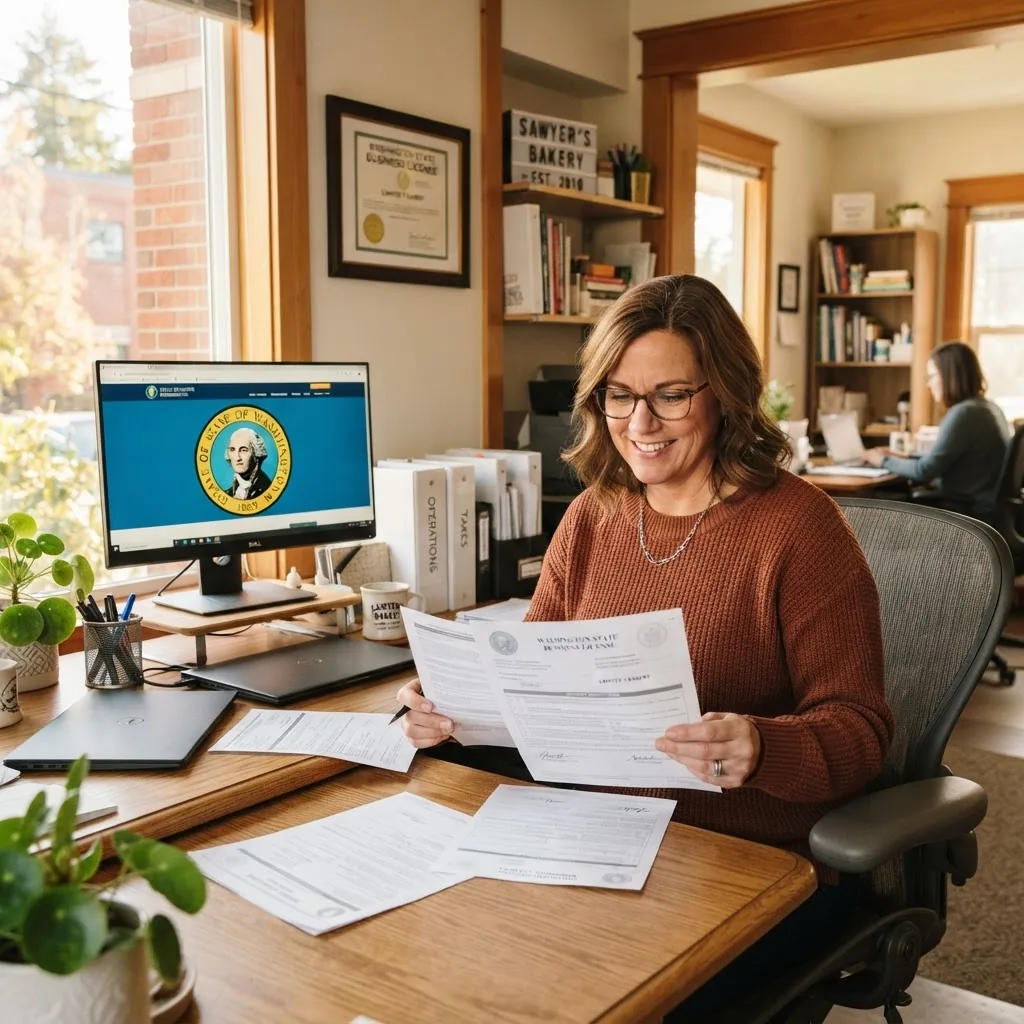
Washington separates registration and licensing into related but distinct steps. First, many businesses complete the state-level registration that creates the public record of the business and registers the business for taxation and regulatory routing—typically through the Washington State Business Licensing Service (BLS). Second, depending on industry and local rules, a business may need state-level licenses (for regulated professions), city/county business licenses, and specific permits (health, construction, environmental).
Think of registration as adding your business to the state’s administrative map, and licenses/permits as official permission slips to perform regulated activities. The primary state authorities you will interact with are:
- Washington State Department of Licensing — professional and driver licensing, contractor recognition
- Washington State Business Licensing Service (BLS) — central registration portal and basic business license
- Washington State Department of Revenue — tax registration and business tax accounts
For step-by-step help with the initial registration portion before applying for industry-specific licenses, consult the business registration application guide to get registered online and the how to form a legal entity and file the certificate of organization. For national options on online company formation, see starting a company in USA with online registration companies guide.
According to a 2024 state operations summary report, the average BLS registration is completed within 1–3 business days for standard filings, while health inspections and specialty boards average 2–6 weeks depending on inspection availability and credential review.
Transition: Next, use the checklist below to determine if your specific business needs a license or permit in Washington.
Determining If Your Business Needs a License or Permit in Washington
- Check the statewide BLS requirement: Start at the Washington State Business Licensing Service to register and view recommended licenses. The BLS will ask for your primary NAICS code and then display common state licenses linked to that activity.
- Identify regulated professions: Does your business provide a profession that requires state certification (e.g., CPA, barber, real estate broker, plumbing)? If so, you’ll need the relevant state board license before operating. Use the Department of Licensing search to confirm.
- Confirm city or county business license rules: Many cities (Seattle, Spokane, Tacoma) require a local business license and local tax registration. Check the city/county website for occupancy permits, local gross receipts taxes, or store-front conditional use permits.
- Determine trade-specific permit needs: Construction and trade businesses (electrical, plumbing, roofing) often require trade permits, inspection scheduling, and contractor registration. Confirm trade permits with the Department of Labor & Industries and Department of Licensing.
- Food and health inspections: If handling food, you’ll likely need a health permit and inspections from your county health department; consult the local public health agency and the food business application guide: food business application guide for grocery store licensing requirements.
- Environmental and land-use permits: If your business discharges wastewater, stores hazardous materials, or constructs on land, contact state Department of Ecology and local planning departments for permits and stormwater requirements.
- Professional and trade contractor check: Contractors should confirm whether general contractor or specialty licenses are required at state and local levels; see the contractor section below and the pillar reference for verification: Contractor License Status Check and General Contractor Verification.
- Ask “does my business need a license?” aloud and document answers: Make a list of activities that could be regulated (selling goods, selling alcohol, offering health services, construction, childcare, personal care services). Research each on the corresponding agency website.
- Check for special local requirements: Some cities require additional permits for signage, sidewalk use, or home-based businesses. Contact the local permitting office for zoning compliance.
- When in doubt, call the agency: If you cannot find a clear answer online, call or email the BLS or the specific licensing board. Document the agent, date, and guidance for future reference.
Transition: After you identify which licenses and permits apply, use the categorized list below to map the types of licenses you’ll likely need.
Types of Licenses and Permits Commonly Required for Washington Businesses
Below are organized categories of common licenses and permits in Washington, with brief descriptions and who typically requires them.
| Category | Who needs it | What it covers |
|---|---|---|
| State business license (via BLS) | Most businesses | Central registration, tax accounts, and referral to state agencies |
| Professional licenses | CPAs, barbers, realtors, healthcare practitioners | Credential verification, examinations, continuing education |
| Contractor and trade licenses | General contractors, plumbers, electricians | Trade certification, bonding, insurance, project-specific permits |
| Health permits (food) | Restaurants, grocery stores, food trucks | Food safety inspections, plan review, periodic inspections |
| Special permits (construction) | Any construction or alteration projects | Building permits, electrical, mechanical, plumbing permits, inspections |
| Environmental and hazardous-material permits | Manufacturers, auto shops, chemical handlers | Stormwater, wastewater discharge, air emissions controls |
| Local city/county business licenses | Retailers, offices, home-based businesses | Local tax accounts, occupancy permits, local compliance checks |
| Alcohol, cannabis, and tobacco licenses | Bars, dispensaries, tobacco retailers | Age verification, secure storage requirements, special taxes |
Trade-specific items worth noting:
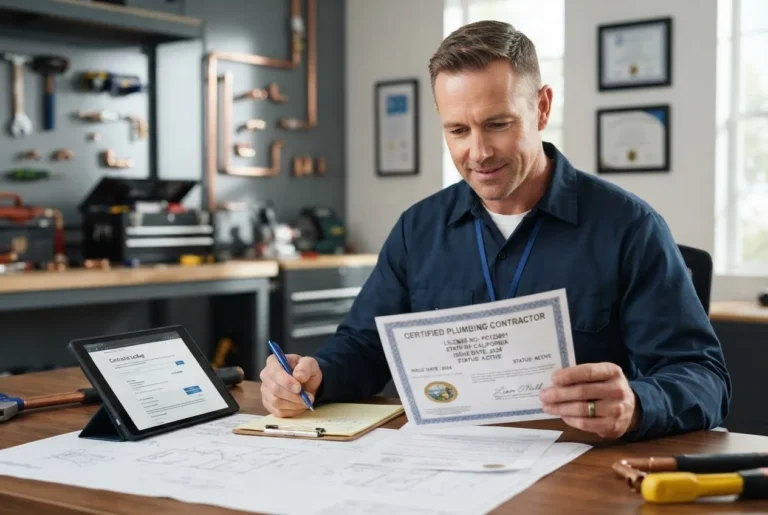
- Plumbing and mechanical trades: see the detailed certified plumbing contractor licensing requirements and verification for test, bond, and continuing education rules.
- Food retailers: consult the food business application guide for grocery store licensing requirements for plan review checklists and timelines.
Transition: With license types mapped, follow the detailed step-by-step process below to obtain your specific licenses and permits.
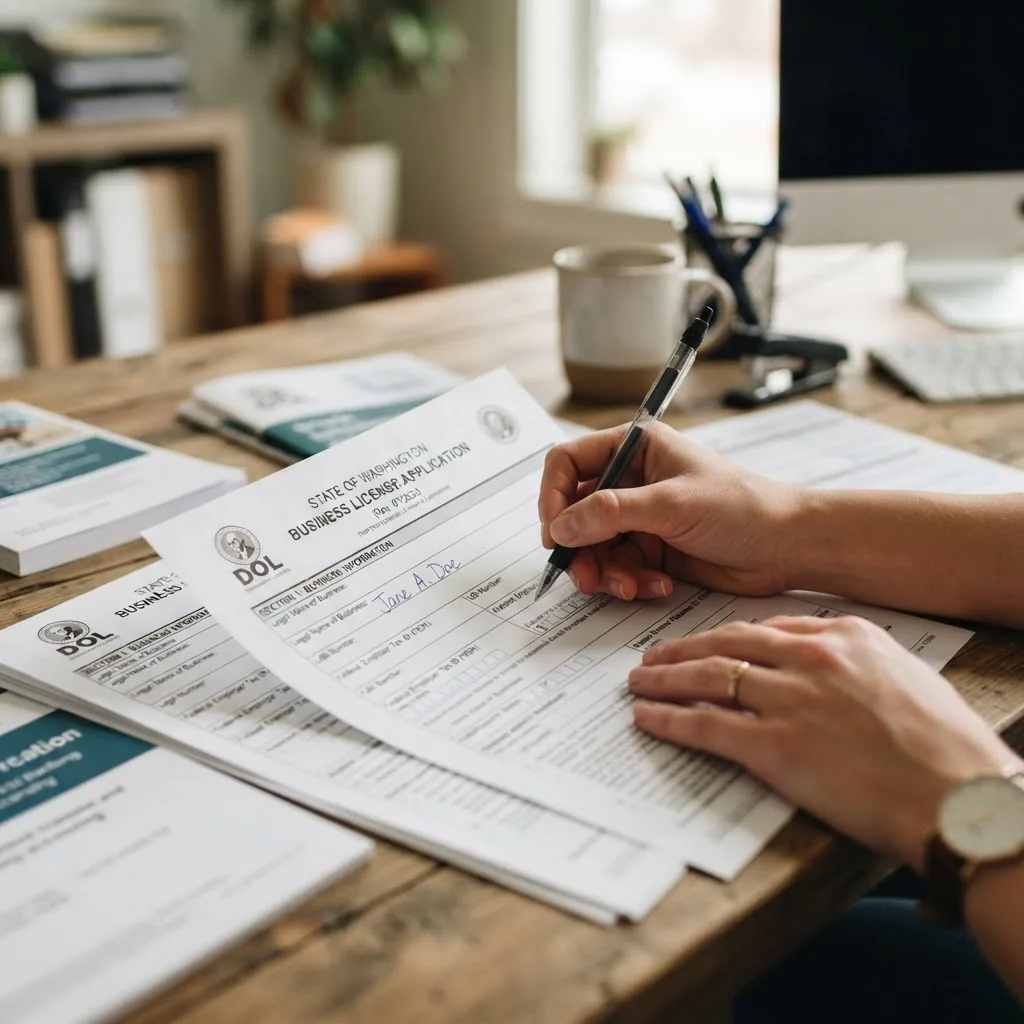
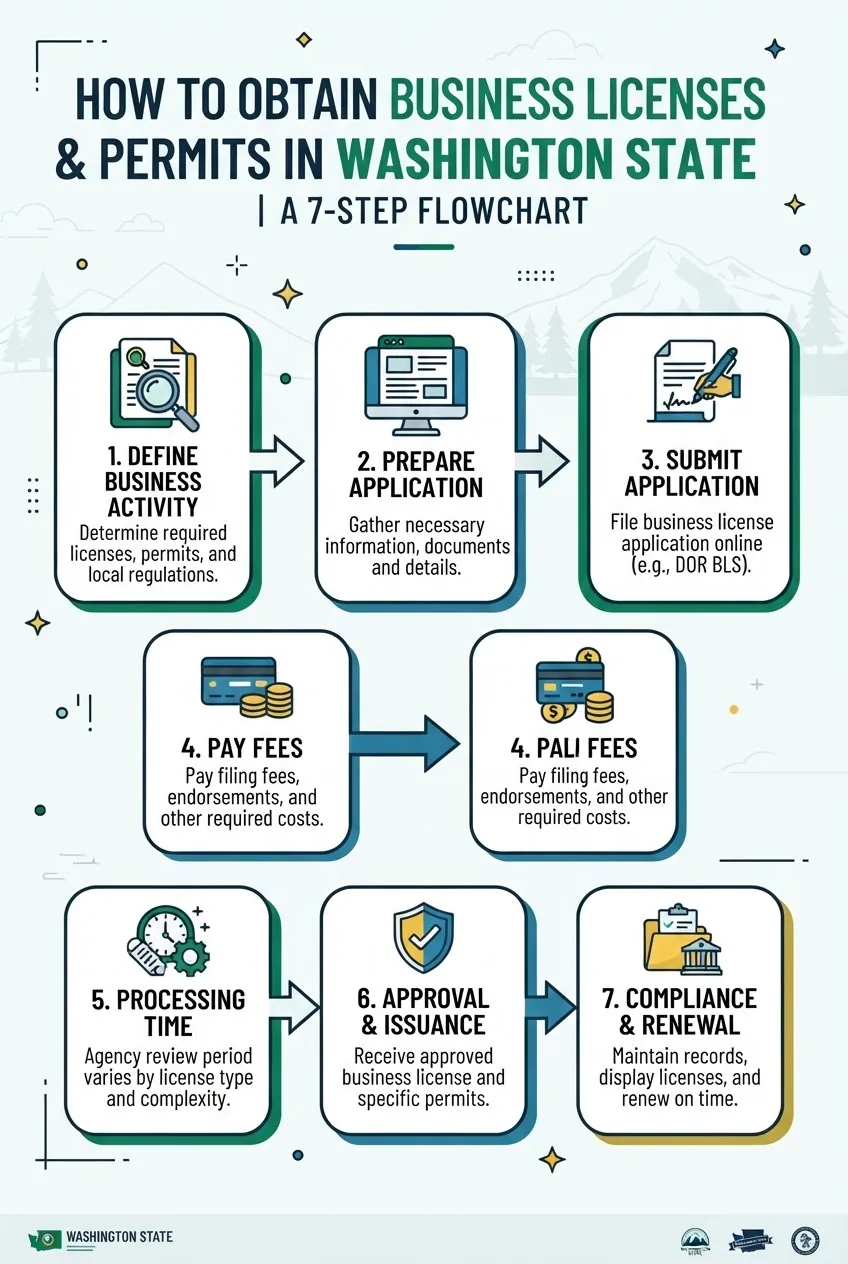
Step-by-Step Process to Obtain Necessary Licenses and Permits for Business Registration in Washington
-
Gather required documents and identify your NAICS code.
Action: Compile government-issued ID, EIN (if applicable), proof of business address, and digital copies (PDF/JPEG) of professional credentials or bonds you already hold. Lookup your primary NAICS code at the U.S. Census NAICS lookup to inform the BLS recommended license set. Estimated time: 30–90 minutes.
-
Create an account and complete the Washington State BLS registration.
Action: Visit the Washington State Business Licensing Service portal. Choose “Apply for a state business license” and follow prompts. Provide business name, start date, NAICS, ownership type, and contact information. Pay the BLS registration fee if required (often $19–$50 depending on local add-ons). Estimated time: 20–60 minutes; processing: 1–3 business days for standard applications.
Tip: Save the confirmation number and screenshot the completed form. If you need help with entity formation before this step, refer to the how to form a legal entity and file the certificate of organization.
-
Register with the Department of Revenue for tax accounts.
Action: If you will collect sales tax or have employees, register for a tax account at the Washington State Department of Revenue. Typical registrations: sales tax permit, business & occupation (B&O) tax. Required info: expected monthly gross receipts, NAICS, and estimated payroll. Processing: immediate online issuance for most sales tax permits; account activation may take 1–5 business days.
-
Identify and apply for state professional licenses and trade registrations.
Action: Use BLS referrals or visit the specific state licensing board (e.g., Department of Licensing) to apply. Examples:
- Contractor registration and specialty trade licenses (bond, insurance) — Department of Licensing and L&I coordination.
- Healthcare practitioner licensure — Washington State Department of Health.
- Cosmetology/barbering salon permits — state cosmetology board and local health.
Required documents vary: exam results, verified education, background checks, proof of insurance, bonds, and fees (range: $50–$500+ depending on board). Processing: 2–8 weeks for credential verification; expedited services sometimes available for a fee.
-
Apply for local city or county business licenses and zoning/occupancy permits.
Action: Check your city’s business portal (city of Seattle, Tacoma, Spokane etc.) and apply for a local business license if required. For storefronts or physical locations, secure zoning clearance and an occupancy permit. Typical fees: $20–$250 annually; occupancy or building plan review fees vary by project scope.
Timing: Local licenses often issue within 3–10 business days; zoning or occupancy review may require site plans and take 2–6 weeks.
-
Obtain health department permits for food-related businesses.
Action: Submit floor plans, menu, equipment details, and a completed application to your county public health agency. For grocery stores and food processors, you may need a plan review meeting. Fees: plan review $100–$1,000 depending on complexity; annual permit fees vary by jurisdiction and gross sales.
Tip: Schedule pre-inspection walkthroughs with local inspectors to avoid costly rework. Typical timeline from submission to permit issuance: 2–8 weeks, depending on corrections needed.
-
Apply for construction and trade permits (if applicable).
Action: For any structural, electrical, mechanical, or plumbing work, apply for permits at the local building department. Submit contractor license number, plans, and permit fees. For major projects, you must schedule inspections at predefined construction stages.
Fees and timelines: Single-trade permits often issue in 1–5 business days; complex multi-permit projects can take 2–8 weeks for plan review. Keep clear records of inspection reports and approvals.
-
Secure environmental and hazardous-material permits.
Action: If you handle hazardous materials, apply for necessary registrations with the Washington State Department of Ecology or local environmental agencies. Provide material safety data sheets (MSDS), spill prevention plans, and storage capacity. Expect review times of 2–6 weeks for routine registrations; complex permits longer.
-
Apply for specialized licenses (alcohol, cannabis, tobacco) if selling regulated goods.
Action: Each regulated product has its own licensing board (e.g., Liquor and Cannabis Board). Start early: background checks, fingerprinting, community notifications, and local endorsement steps are common. Application fees: $250–$2,000+, with multi-stage approvals and possible public hearings. Timeline: 3–6 months typical for cannabis retail licenses; liquor licenses vary by class and locality.
-
Pay fees, track applications, and prepare for inspections.
Action: Use the BLS confirmation number to track state referrals. Save receipts and schedule required inspections (health, building). Common fee thresholds: BLS initial filing $19–$50; city licenses $20–$250; contractor bond amounts set by trade (often $12,000+ for general contractor registration). Processing times: maintain a tracking spreadsheet and set reminders at 7, 14, and 30 days after submission.
-
Receive approvals, post required licenses, and set renewal reminders.
Action: After approvals, display licenses where required (public-facing businesses) and store digital copies. Add renewal dates to calendar—many licenses renew annually; contractor registrations often require renewal every two years with continuing education requirements for some trades.
-
Maintain compliance: insurance, bonds, records, and continuing education.
Action: Keep required liability insurance and surety bonds active, maintain payroll and tax filings, and complete any continuing education as required by your licensing board. Noncompliance can result in fines, suspension, or license revocation.
-
Document and archive all correspondence and receipts.
Action: Save agency emails, confirmation numbers, and inspection reports for at least three years. These records are essential if you receive compliance inquiries or if you sell the business.
-
Case scenario (practical example).
Action: Example—Linda, a sole proprietor starting a small café in Tacoma: she spent 3 days preparing floor plans and her food safety checklist, 1 day completing BLS and Dept. of Revenue registrations, and 4 weeks awaiting county health plan review and one pre-opening inspection. Outcome: full set of permits received in 5 weeks. This illustrates typical real-world timing and the benefit of early plan submission.
Note: Where I reference agency-specific forms or fees I rely on current 2024 published schedules; verify live fees on agency sites because schedules can change.
Transition: The next section dives deeper into contractor-specific licensing needs and verification steps.
Specific Licensing Requirements for Contractors in Washington (with reference to pillar page)
Contractors face layered requirements: state registration, trade-specific licenses, bonds and insurance, and local permits. Below are key requirements and a verification workflow to confirm compliance.
- State-level registration: All contractors must register with the Washington State Department of Labor & Industries or the Department of Licensing depending on trade. Registration often requires proof of liability insurance and worker’s compensation coverage for employees.
- Bonds and insurance: Typical bond amounts for general contractors start at $12,000 for initial registrations, with higher amounts for licensed specialty contractors based on project scope. Liability insurance minimums vary by city; confirm with local permit office.
- Trade exams and certifications: Certain trades (electrical, plumbing, HVAC) require trade-specific exams and certification before you can legally pull permits. Confirm exam providers and passing scores on the relevant trade board websites.
- Continuing education and renewal: Some specialty contractor licenses require continuing education and renewal every 1–2 years. Mark renewal windows early to avoid lapses.
- Local licensing and bonding: Many cities require local contractor licensing in addition to state registration; check municipal requirements for any additional local bonds or business licenses.
Key verification steps (quick checklist):
- Verify registration with the Department of Licensing and the Department of Labor & Industries.
- Confirm bond amounts and active surety via the issuing company.
- Check worker’s compensation accounts and insurance certificates for policy dates and coverage limits.
- Use the pillar page for online status checks: Contractor License Status Check and General Contractor Verification.
- For context outside Washington, compare processes using resources like Licensing Board California Guide for Contractors Board and Certification and New Jersey Home Improvement Contractor License Search and Verification.
According to a 2024 contractor compliance review, the most frequent contractor violations were lapses in insurance, expired bonds, and failing to renew registrations on time; proactive reminders reduced violations by 35% in tracked firms.
Transition: Maintain licenses and avoid penalties by following a strict renewal and compliance routine described next.
Renewal, Compliance, and Maintaining Your Business Licenses and Permits
- Set calendar reminders for every license: Record each license number, issuing agency, and renewal date. Recommended: set reminders at 90, 30, and 7 days before expiry.
- Keep insurance, bonds, and payroll taxes current: Renew insurance 30 days before expiration to prevent coverage gaps; confirm bonds remain active and notify bonding companies immediately if claims or changes occur.
- Complete continuing education and report requirements: Log CE hours and file proof with boards. If you miss requirements, expect administrative fines and temporary suspensions.
- File timely tax returns and payroll reports: Use the Department of Revenue portal for sales tax and B&O filings. Late filings accrue penalties and may trigger compliance audits.
- Monitor communications from licensing agencies: Most regulators send renewal notices to the email on file; maintain a dedicated licensing inbox to avoid missed notices.
Penalties for noncompliance range from warning letters to fines (often $100–$1,000+ for first offenses) to license suspension or revocation. Always check the issuing agency’s 2024 penalty schedule when planning compliance budgets.
Transition: If you encounter problems obtaining or renewing licenses, the troubleshooting guide below helps resolve common issues.
Common Challenges and Troubleshooting When Obtaining Licenses and Permits
This troubleshooting guide is drawn from practitioner experience and documented user reports.
- Problem: Application incomplete or missing documents. Solution: Revisit the checklist provided with the application, scan and upload clear PDFs, and use agency “document upload” portals where available. Always include a cover note listing attached documents.
- Problem: Proof of insurance or bond not accepted. Solution: Confirm the issuing company’s NAIC number and policy effective dates. Ask the agency for the exact acceptable nomenclature for bonds (principal vs. obligee).
- Problem: Processing delays beyond published timelines. Solution: Politely escalate—call customer service, reference your confirmation number, and request an estimated decision date. Document every call.
- Problem: License denied due to criminal history or disciplinary action. Solution: Request a written explanation of deficiencies, compile mitigating documentation (rehabilitation evidence, letters of recommendation), and use the agency appeal or waiver process.
- Problem: Conflicting city and state requirements. Solution: Comply with both; where practical, obtain the stricter standard. Use written confirmation from the city and state to demonstrate good faith if later audited.
If you repeatedly hit roadblocks, consider an administrative appeal or hiring a licensing consultant or attorney. When contacting support, always provide the application number and exact statute or regulation citation when possible to speed resolution.
Common mistakes and how to avoid them
I once saw a contractor lose two weeks because they uploaded phone photos of a bond certificate that the board could not read. I now always scan documents at 300 dpi, name files with the agency and document type (e.g., “DOL_Bond_2024.pdf”), and confirm the upload succeeded by saving the confirmation screenshot.
Another mistake: business owners assume the BLS license covers local licensing. I advise clients to contact the city licensing office directly; in one case, a retail store had to temporarily close for lack of a local occupancy permit despite having all state approvals.
Final verification checklist
- Received BLS confirmation number and saved screenshot
- Registered with Department of Revenue for required tax accounts
- Applied for and received all required state and local licenses
- Secured bonds and insurance with correct obligee wording
- Scheduled and passed required inspections (health, building)
- Set renewal reminders at 90/30/7 days
- Archived all application confirmations and agency correspondence
When to call in a professional
Hire a licensing consultant, attorney, or accountant if you face any of the following: multi-jurisdictional operations, complex environmental permits, high-value construction contracting requiring surety underwriting, license denial or disciplinary actions, or if you lack time to manage timelines and inspections. For routine BLS registration or single-license filings, most owners can complete the steps themselves.
Final note: licensing rules change. Always verify details on agency sites and keep a local copy of official guidance. For contractor verification, use the pillar page link above and for trade-specific details check the plumbing and food guides linked earlier.