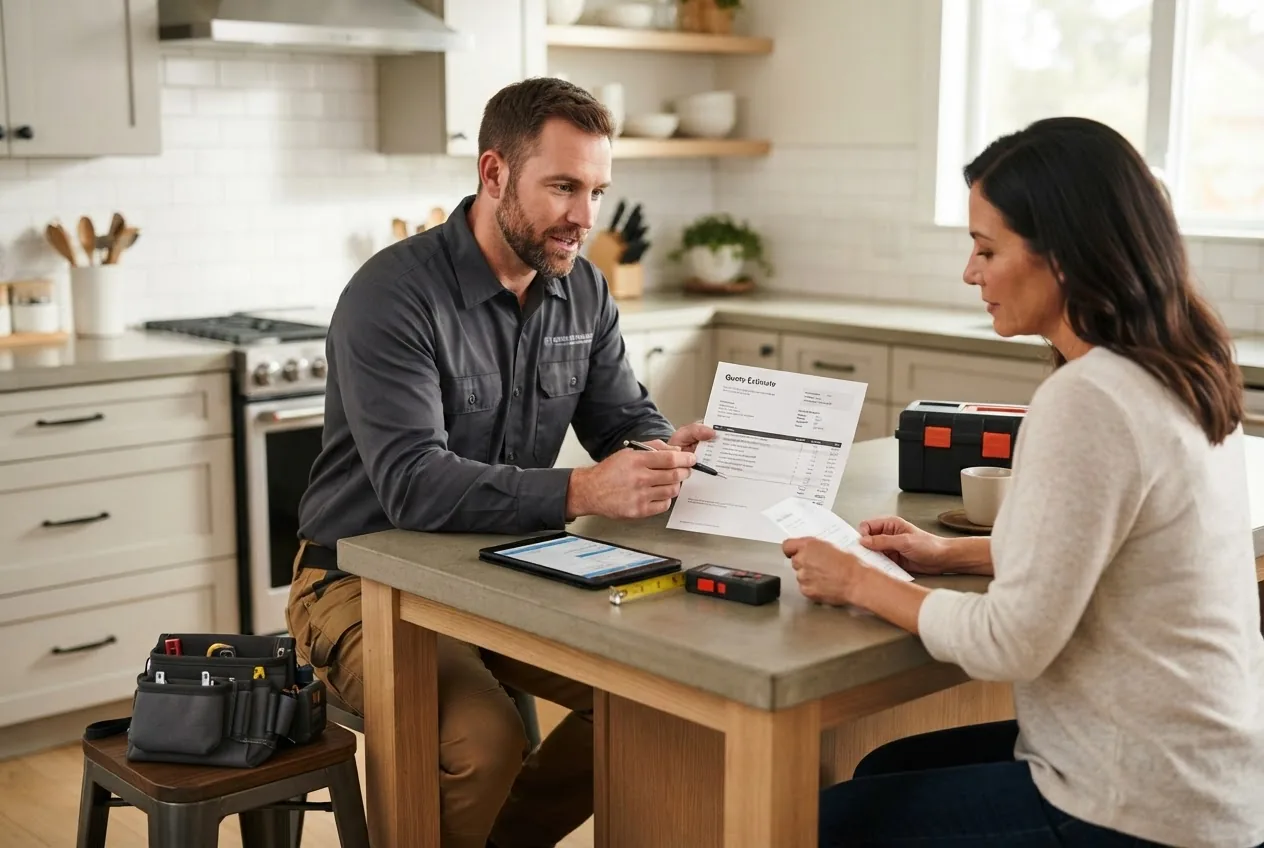
Handyman quote — by the end of this hands-on guide you will know how to request, read, compare, and negotiate accurate quotes, shortlist trusted tradespeople, and book a job with clear contract and warranty terms. Expect to spend 2–4 hours collecting and comparing quotes; basic homeowner skill level required.
Before you start
- Project description (one paragraph, 3–6 bullet points describing deliverables)
- Photos of the work area (3–6 images from multiple angles)
- Measurements: linear feet, square feet, or count of items to be replaced/installed
- Preferred timeline and date windows (3 preferred dates within 2–6 weeks)
- Budget range (low/target/high) and willingness to accept fixed or hourly pricing
- Paperwork: recent utility bills (if relevant), property deed or landlord approval for rentals
- Tools to record quotes: spreadsheet or printed quote form, calculator
Understanding Handyman Quotes: What They Include and Why They Vary
A clear handyman quote breaks the job into components so you can compare labor and materials across providers. A typical quote includes an itemized labor cost, estimated materials cost, any fixed fees, taxes, and expected timeline. Quotes vary because of hourly rates, experience, local material prices, and whether a site visit was performed.
Example breakdown for a common small project — “Replace 6 kitchen cabinet hinges and adjust doors”:
| Line item | Units | Unit price | Total |
|---|---|---|---|
| Labor (2 hours @ $65/hr) | 2.0 hr | $65.00 | $130.00 |
| Materials (6 hinges + screws) | 1 set | $24.00 | $24.00 |
| Travel / call-out fee | 1 | $35.00 | $35.00 |
| Subtotal | $189.00 | ||
| Taxes (6%) | $11.34 | ||
| Total (estimated) | $200.34 |
Why quotes differ: hourly vs. fixed pricing, whether the provider included contingency (e.g., hidden damage discovered), whether they performed a thorough site visit (a true site visit reduces unknowns), and regional labor and materials costs. A quote that lumps labor and materials into a single line makes comparisons difficult; ask for the itemized view.

Transition: once you understand what a quote contains, next learn which services handymen typically cover so you can scope your request accurately.
Common Services Covered by Handyman Quotes
- General repairs — Patching drywall, fixing door handles, replacing window latches. Quotes usually list per-item labor and parts.
- Installations — Mounting shelves or TVs, assembling furniture, hanging lights (non-hardwired). Installer supplies fasteners unless otherwise noted.
- Carpentry and trim — Baseboard repair, trim replacement, small shelving projects; priced by linear feet and labor hours.
- Painting and finishing — Touch-ups, repainting a single room, sealing trim; quotes may include surface prep time explicitly.
- Small-scale remodeling — Cabinet hardware swaps, undermount sink install (non-gas), or tile backsplash—larger remodeling shifts pricing models.
- Outdoor jobs — Fence repairs, deck board replacement, gutter cleaning; materials like pressure-treated lumber are often costed separately.
- Odd jobs / time-and-materials work — Tasks billed hourly with receipts for parts; useful for tasks with unknown scope.
- Basic plumbing & fixtures — Replacing taps, minor leak repairs, unclogging drains. For more complex plumbing, get specialty quotes.
- Electrical (minor) — Replacing switches, fixtures (non-code-impact); major wiring requires a licensed electrician.
- Preventive maintenance — Weatherproofing, caulking, seasonal checks; often offered as package visits with a set price.
If your job includes significant plumbing components, see this deeper cost reference:
Plumbing Repair Service Guide and Residential Costs
Transition: accurate scoping of those services makes quotes more reliable. The next section walks you through step-by-step how to get accurate, competitive estimates.
How to Get Accurate and Competitive Handyman Cost Estimates
Follow these steps to go from a vague idea to three comparable quotes you can trust. For plumbing-related tasks, additional cost variance examples are linked where relevant.
- Define the scope clearly: Write a 1–2 paragraph brief and 3–6 bullet-point task list. Include measurements (e.g., 12 linear ft of trim), photos, and desired materials (brand/model if relevant).
- Decide on pricing model preference: Choose fixed price for defined tasks under $2,000; choose hourly for open-ended work. Fixed price reduces surprise but may include a contingency line (5–15%).
- Request a site visit when necessary: For jobs with hidden risks (e.g., behind walls), book site visits. Site visits typically cost $0–$75 and save 10–30% in post-start change orders. If a provider offers only remote estimates, demand a clarification clause for discovered issues.
- Ask for itemized quotes: Require labor hours, hourly rate (if used), parts with quantities, travel/call-out fees, tax, and expected completion time. Example: “Labor: 4 hrs @ $70/hr; Materials: 10 linear ft trim @ $3/ft.”
- Collect at least three quotes: Contact three providers within 7–10 days of each other. Use the same scope document to ensure apples-to-apples comparison.
- Verify credentials and insurance upfront: Check photo ID, business license where applicable, and request proof of general liability insurance limits (minimum $500,000 recommended for property work).
- Clarify contract and warranty terms: Ask for a written contract for any job over $250: start/completion dates, payment schedule (e.g., 30% deposit, 60% progress, 10% on completion), warranty duration (typical 90 days to 2 years), and definitions of “completed work.”
- Use a standard quote form or template: Provide your own one-page form if a provider lacks one; include job name, scope, exclusions, materials list, labor estimate, payment terms, and signature lines. A consistent form speeds comparison and reduces omissions.
- Compare total cost and effective hourly rate: Convert fixed-price bids to an implied hourly rate by dividing labor portion by estimated hours. This reveals underpriced bids that may cut corners.
- Ask scenario questions: “If hidden water damage is found, how will you notify me and price repairs?” Accept only responses that promise written change order approval before work proceeds.
- Negotiate respectfully: Negotiate scope or materials rather than pushing price down indiscriminately. Offer a reasonable compromise: “If you can remove the call-out fee, I can pay 10% extra on completion.”
- Book with clear expectations: Confirm start date, arrival window, parking, permit responsibilities, and staging area. Request a single point of contact and a completion acceptance checklist for your signature.
For plumbing jobs included in handyman work, request extra cost insights from this specialist guide:
24 Hour Plumber Minneapolis Service Guide and Cost Overview
After Hours Plumbing Service Guide and Emergency Cost Details
Transition: after collecting quotes using the steps above, evaluate them with a rigorous checklist so you pick reliably.
Evaluating and Comparing Handyman Quotes: Key Factors to Consider
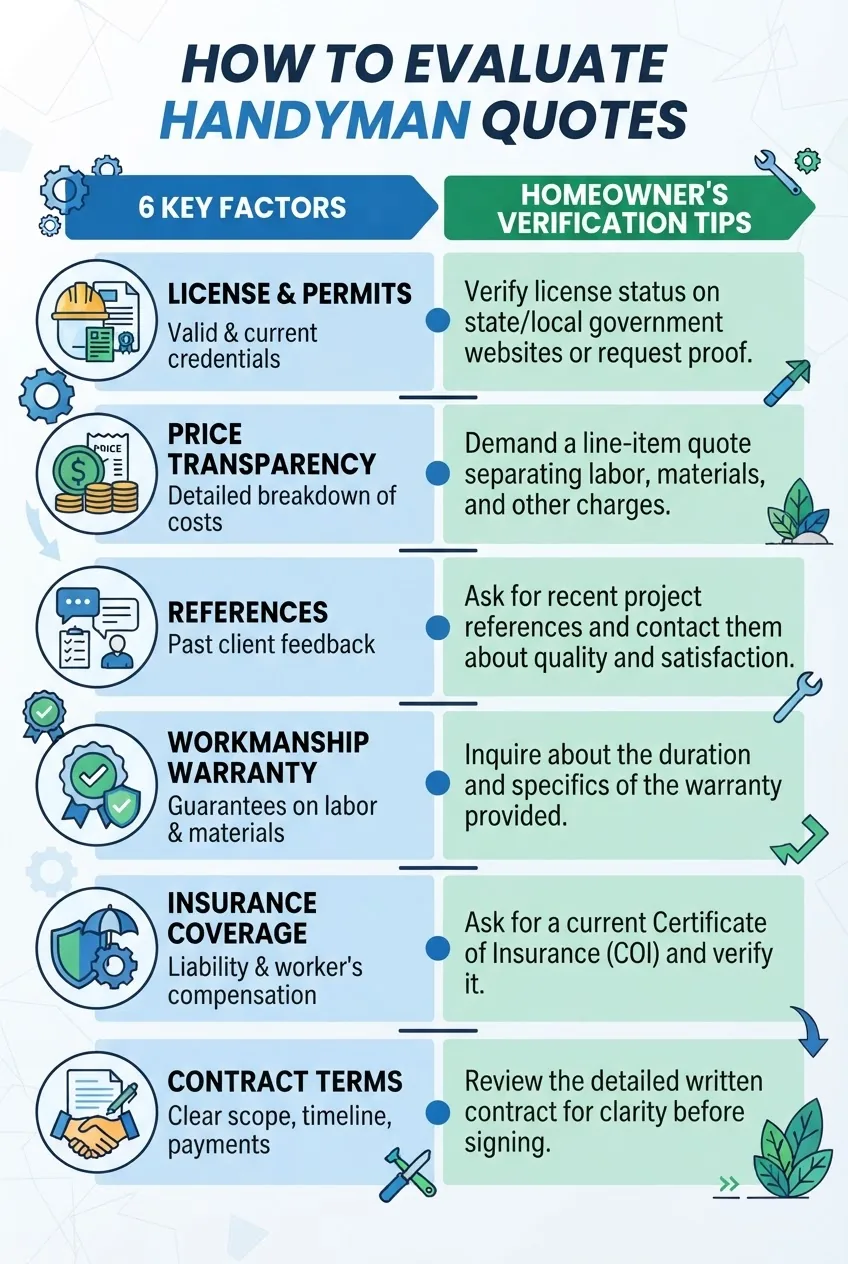
Use the comparison checklist and the example below to validate quotes. This section walks through licensing, insurance, references, and contract terms in detail.
| Factor | What to look for | Action |
|---|---|---|
| License & certifications | Any trade-specific license (electrical, gas) or local registration for contractors | Ask to see license number; verify with municipal registry or industry association. |
| Insurance | General liability and, if applicable, workers’ comp | Request certificate of insurance listing your property as worksite; verify coverage limits. |
| Price transparency | Itemized labor and parts, contingencies, and payment schedule | Reject quotes that only state lump sums without details; ask for breakdown. |
| References & reputation | Recent references (past 12 months), online reviews, and local reputation | Call two recent references and verify photos of completed work; use the FTC hiring guide advice. |
| Warranty & remedies | Written warranty length and what it covers (labor, materials) | Insist warranty in writing and include remedy steps (repair or refund) and timeframe to respond (e.g., 14 days). |
| Contract clarity | Start/completion dates, change order process, dispute resolution | Require written change orders and retain 5–10% final payment until acceptance on completion. |
Case study (real example): I received three quotes for a small bathroom vanity re-fit. One quote was $1,100 fixed (no breakdown), the second $950 but listed 8 hrs @ $60/hr + $430 materials, and the third $1,200 hourly-only. I selected the $950 bid after verifying references and insurance because the itemized quote revealed a realistic labor expectation and permitted me to swap materials to save $120.
For regional reputation and price insights, see Local Handyman Service Guide and Home Repair Cost Info.
Transition: With a shortlist and contract in hand, this next section explains the day-to-day of hiring and working with a handyman and how to manage quality and safety.
Hiring a Handyman: Best Practices for Homeowners
Hiring a reliable home maintenance man requires checks that go beyond price. Prioritize communication, documented agreements, and safety. When electrical or gas work is part of a job, parallel vetting of licensed trades is essential.

Practical best practices:
- Background checks: Ask for business registration, at least two recent references, and confirm identity. For contractors working in your home while you sleep or leave valuables accessible, consider a basic background check service.
- Communication expectations: Agree on daily arrival window (e.g., 8:00–8:30 AM), cleanup procedure, and point-of-contact phone number.
- Payment milestones: Use a deposit cap of 30% for jobs under $5,000; larger projects may use staged payments tied to clear deliverables.
- Warranty & follow-up: Get warranty period in writing (minimum 90 days; 1 year is preferred for structural work) and specify contractor responsibility for follow-up labor.
- Professional associations: Membership in trade groups or business associations is a positive signal. For craft-specific standards, consult recognized associations such as NAHB.
- Security & on-site protocol: Remove cash and valuables, secure pets, and store fragile items away from the work area. Ask the worker to carry identification and to sign in on arrival for accountability.
For jobs involving wiring or fixtures, review electrician vetting tips: Emergency Electrician Near Me Service Guide and Pricing.
Transition: next we’ll cover the numbers—typical cost ranges and what pushes prices up or down.
Typical Cost Ranges for Handyman Services and What Influences Pricing
Stat block: typical U.S. reference ranges (2024 industry averages): labor-only handyman hourly rates commonly range from $45 to $90 per hour; small jobs (under 2 hours) often incur a call-out fee of $35–$75; medium projects (half-day) run $200–$600; larger multi-day projects exceed $1,000. According to a 2024 industry report from the U.S. Bureau of Labor Statistics and regional consumer surveys, local wage and material inflation remain the biggest drivers of variability.
Price influencers explained:
- Price per hour: Skilled handymen typically charge $50–$90/hr; less experienced providers may be $35–$45/hr. Verify whether travel and minimum call-out time (e.g., 1 hour minimum) are included.
- Materials cost: Expect markups of 10–25% if the handyman supplies parts; larger suppliers might net you better component prices. For specialty materials, request receipts.
- Regional variation: Urban centers and high-cost states trend toward +15–40% vs. national averages. According to a 2024 municipal consumer cost dataset, metropolitan labor costs are typically 20% higher.
- Service complexity: Jobs requiring trade licensing, permits, or confined-space work add time and cost—permits alone can be $50–$500 depending on scope.
- Emergency vs. scheduled services: After-hours or same-day work often includes premium rates (1.5x to 2.5x regular hourly rates). See specialized HVAC and furnace guides for emergency trade pricing examples: 24 Hour Air Conditioning and Heating Repair Cost and Guide and 24 Hour Furnace Service Requirements and Repair Cost Guide.
- Travel and logistics: Long-distance travel, parking permits, or multi-stop projects add explicit travel fees (typically $0.50–$1.25 per mile or flat $35–$75 call-out).
- Warranty and guarantees: A longer warranty often correlates with higher initial pricing but reduces long-term risk.
Example: a medium bathroom fixture swap including removal, reinstall, and minor trim work in a suburban area might be: 6 hrs labor @ $65/hr = $390; materials $160; travel $45; tax $36 = estimated $631. This aligns with a 2024 regional trades report that found mid-range handyman projects average $550–$900.
Transition: practical homeowners have more questions — next we cover the most common ones.
Frequently Asked Questions About Handyman Quotes and Hiring
Below are concise answers to the most common concerns homeowners ask when they get quotes and book a handyman.
- What to expect after requesting a quote: Expect a response within 48–72 hours for non-urgent jobs; detailed site-visit quotes may take 2–7 days depending on provider schedules.
- Service guarantees and workmanship: Most handymen offer 30–365 day workmanship warranties; ensure the warranty is in writing and specifies coverage for labor and materials.
- Troubleshooting pricing differences: Convert bids to unit costs and implied hourly rates to compare; ask providers to itemize assumptions that drive lower or higher totals.
- Booking process tips: Use written confirmation (email or contract) that lists start date, scope, payment terms, and cancellation policy; keep a signed copy.
- Quality assurance on completion: Use an acceptance checklist: scope items completed, cleanup performed, no visible damage, and warranty paperwork signed before final payment.
Transition: finally, resources and the next steps to find vetted professionals and manage emergency needs are listed below.
Additional Resources and Next Steps for Homeowners Looking for Handyman Services
Recommended authoritative resources:
- FTC guidance on hiring contractors and avoiding common scams.
- National Association of Home Builders — industry standards and builder resources.
- U.S. Bureau of Labor Statistics — wage and regional cost data for trades.
If you need emergency HVAC or trade-specific emergency guidance, read our pillar HVAC emergency guide here:
24 Hour AC Repair Guide for Emergency HVAC Service Costs
Next steps you can take right now:
- Prepare the scope document and photos (30–60 minutes).
- Contact 3 local handymen and schedule site visits within 7 days.
- Use the comparison table and checklist above to select the best quote and finalize a written contract.
Hands-On Steps Summary (core actions)
- Create a one-page scope document: 200–350 words max, 3–6 bullet specs, include 3 photos and measurements.
- Schedule site visits: Book three visits within a 10-day window; expect 20–45 minutes per visit.
- Request itemized quotes: Demand labor hours, parts, travel, taxes, and a written change order policy.
- Verify credentials: Check license (if required), insurance certificate, two references dated within 12 months.
- Negotiate scope, not price: Propose material substitutions or schedule changes to reduce cost by up to 10–15%.
- Sign a contract: Include start/end dates, payment schedule (max 30% deposit), retention (max 10% until acceptance), and warranty term.
Common mistakes and how to avoid them
I once accepted a single low lump-sum quote for a kitchen shelf install; the contractor omitted trim replacement and charged a 40% change order mid-job. Now I always require an itemized scope and a written change-order approval process before any work starts.
Another time I paid full invoice up front for paint touch-ups; the job was incomplete. I now withhold 5–10% final payment until I sign the acceptance checklist specifying completed items and cleanup.
Compact checklist to verify before you sign
- Itemized quote with labor, materials, travel, taxes.
- Proof of insurance and any required license numbers verified.
- Start and completion dates, with daily arrival window.
- Written change-order process and sample change order form.
- Warranty period and remedy steps in writing.
- Payment milestones with retention clause (5–10%).
- Two recent references checked and acceptable.
When to call in a professional instead
Call a licensed specialist (electrician, plumber, HVAC technician) rather than a general handyman when the job involves: new electrical circuits, gas line work, structural framing, major roof repairs, or anything requiring a permit. For HVAC emergencies consult our specialized guides for pricing and emergency procedures:
24 Hour Air Conditioning and Heating Repair Cost and Guide
24 Hour Furnace Service Requirements and Repair Cost Guide
Conclusion
A reliable handyman quote equals clear scope, itemized costs, verified credentials, and written contract terms. Spend 2–4 hours collecting three comparable quotes, use the checklist above to evaluate them, and retain a small final payment until you sign the acceptance checklist. Ready to start? Prepare your scope document and schedule three site visits this week.