
Most common handyman jobs cost between $150 and $850; median small repairs run about $275, according to a 2024 industry report cited below. This data-led Local handyman guide maps services, price ranges, hiring steps, and when to choose specialists over general home repair help.
Understanding Local Handyman Services
A local handyman is a multi-skilled tradesperson who performs a variety of small-to-medium home repair, maintenance, and improvement tasks that do not require licensed trade work. Common labels include handyman contractor, professional handyman, and handyman solutions. Handymen typically handle general home repair and household repair services such as patching drywall, installing fixtures, minor carpentry, and kitchen handyman touch-ups. They are positioned between a DIY homeowner and specialized house repair contractors who require trade licensing for major plumbing, electrical, or HVAC interventions.
Service scope varies by region and individual skill set. In many U.S. states, handymen are allowed to perform basic plumbing tasks (e.g., replacing a faucet), but not permitted to alter supply lines or perform gas work. Similarly, minor electrical tasks like replacing switches may be acceptable, while wiring changes generally require a licensed electrician. These boundaries affect price, liability, and whether a homeowner should hire a specialist.
Key service categories for local handymen:
- Routine maintenance: seasonal checks, gutter cleaning, and weatherproofing.
- Small repairs: drywall patches, door adjustments, cabinet hinge replacement.
- Installation: blinds, shelves, small appliances, light fixtures (non-complex wiring).
- Remodeling support: demo, finish carpentry, trim and backsplash preparation for kitchen handyman projects.
Key takeaway: Handymen excel at bundled small tasks and preventive maintenance; they are cost-effective for projects under a contractor threshold (often <$2,000), while specialists are necessary for regulated trades.
Types of Home Improvement and Maintenance Services Offered by Handymen
Below is a numbered breakdown of common home improvement services and home maintenance services that local handymen provide, with typical tasks and quick price cues where applicable.
- General repairs (drywall, doors, windows) — Tasks: drywall patching, fixing door latches, replacing window hardware. Typical range: $75–$600 per task depending on patch size and finishing. According to a 2024 industry report, small drywall repairs average $200.
- Carpentry and trim work — Tasks: baseboard and crown molding installation, stair tread repair. Typical range: $100–$900 per room depending on material and finish.
- Kitchen handyman services — Tasks: cabinet adjustments, replacing drawer slides, installing backsplashes (prep and adhesive), minor countertop patching. Typical range: $150–$1,500 for discrete jobs; larger kitchen remodel tasks move into contractor territory.
- Plumbing-related fixes (non-permit) — Tasks: faucet replacement, toilet seat replacement, unclogging minor traps. Typical range: $100–$350. For major plumbing that affects supply lines, a licensed plumber is required.
- Electrical basics (non-permit) — Tasks: replacing switches, dimmers, or fixtures where no circuit changes are needed. Typical range: $80–$300. For panel work or new circuits, call an electrician.
- Exterior maintenance — Tasks: pressure washing trim, sealing small deck boards, gutter minor repairs. Typical range: $150–$800 depending on access and safety equipment.
- Painting and finishing — Tasks: touch-ups, full room repaint (small rooms), trim painting. Typical range: $150–$1,200 per room.
- Remodeling support and handyman remodeling services — Tasks: non-structural demo, installing fixtures, finish carpentry. Typical range: support tasks often billed hourly ($50–$120/hr), while full remodeling projects are subcontracted to licensed contractors.
- Installation services — Tasks: mounting TVs, assembling furniture, installing shelving. Typical range: $75–$450 per job.
- Preventive maintenance — Tasks: seasonal home checks, weatherproofing doors and windows, replacing weatherstripping. Typical range: $80–$350.
Key takeaway: Handyman solutions cover a broad set of small to medium projects, with hourly rates and per-task pricing common; anything affecting structural integrity, gas lines, or main electrical panels shifts to specialist contractors.
How to Find and Hire a Reliable Local Handyman
Finding a trusted handyman contractor combines targeted search, structured vetting, and transparent quoting. We provide a step-by-step process, a sample vetting checklist, and a simple walkthrough to prepare and compare bids.

- Define the scope precisely. List tasks, desired outcomes, and whether permits or specialists are likely needed. Break combined jobs into line items (e.g., “drywall patch 2’x2′” vs “paint whole room”), which improves apples-to-apples quotes.
- Search and shortlist. Use local referrals, vetted listing sites, and neighborhood groups. When you “search for handyman” online, prioritize listings with photos, multi-year reviews, and a clear service area. Ask neighbors for recent experience and photos.
- Initial contact script. Ask: Are you insured? What is your hourly rate and minimum call-out fee? Do you provide written estimates? Can you provide references for similar jobs? Record answers for comparison.
- Verify credentials. Confirm insurance (general liability and, if workers are present, workers’ comp). Request proof and call the insurer to verify active coverage. For questions about contractor hiring protections, consult official guidance: FTC guidance on hiring contractors.
- Check references and sample work. Request 2–3 recent references and photos of finished work. Ask for a phone conversation with a prior client about punctuality, cleanup, and billing clarity.
- Obtain multiple quotes. Aim for three quotes for jobs above $500. Use the same scope sheet. For detailed guidance on preparing and comparing bids see handyman quotes and cost estimates.
- Compare quotes using a simple rubric. Factors: total price, materials included, timeline, warranty, cleanup responsibilities, and payment terms. Prefer fixed-price line items for specific tasks over vague time-and-materials for first engagements.
- Agree terms in writing. A one-page work order should include scope, total price or hourly rate with estimated hours, start date, estimated completion, materials allowances, and a simple warranty (e.g., 30–90 days). Avoid large upfront deposits for small jobs; a 10–30% deposit for larger jobs is common.
- On-site preparations and expectations. Clear the workspace, secure pets, and confirm power/water access. Agree how change orders will be handled (written and signed).
- Final inspection and payment. Walk through the finished work, compare to the scope sheet, and hold final payment until punch-list items are resolved.
We also recommend homeowners review government consumer protection tips on contractor hiring for legal rights and dispute pathways: consumer protection guidance.
Sample vetting checklist (quick):
- Proof of general liability insurance
- Two recent references with contactable info
- Clear written estimate with line items
- Payment terms and small warranty in writing
Case example (realistic): We hired a local handyman to install three floating shelves and repair a 3′ drywall crack. Quote A: $320 fixed (materials included), 1-day turnaround, 60-day warranty. Quote B: $45/hr estimated 8 hours. We chose the fixed price; job completed in 4.5 hours, and the handyman honored the 60-day punch list. This shows fixed-price line items reduce billing surprises for discrete tasks.
How to prepare and compare quotes (walkthrough): Create a scope sheet with task descriptions, photos, and material preferences. Send the same sheet to three contractors. Place line items next to each other: labor hours, material allowances, and total. Evaluate final effective rate (total divided by hours) and warranty length.
Key takeaway: Structured comparison and proof of insurance are the fastest path to predictable outcomes when you need a handyman.
Home Repair Cost Information for Typical Handyman Jobs
This section breaks down cost ranges, factors that push pricing up or down, and provides a compact infographic prompt for visualizing the data. Where available, figures reference a 2024 industry cost aggregator to ground estimates.
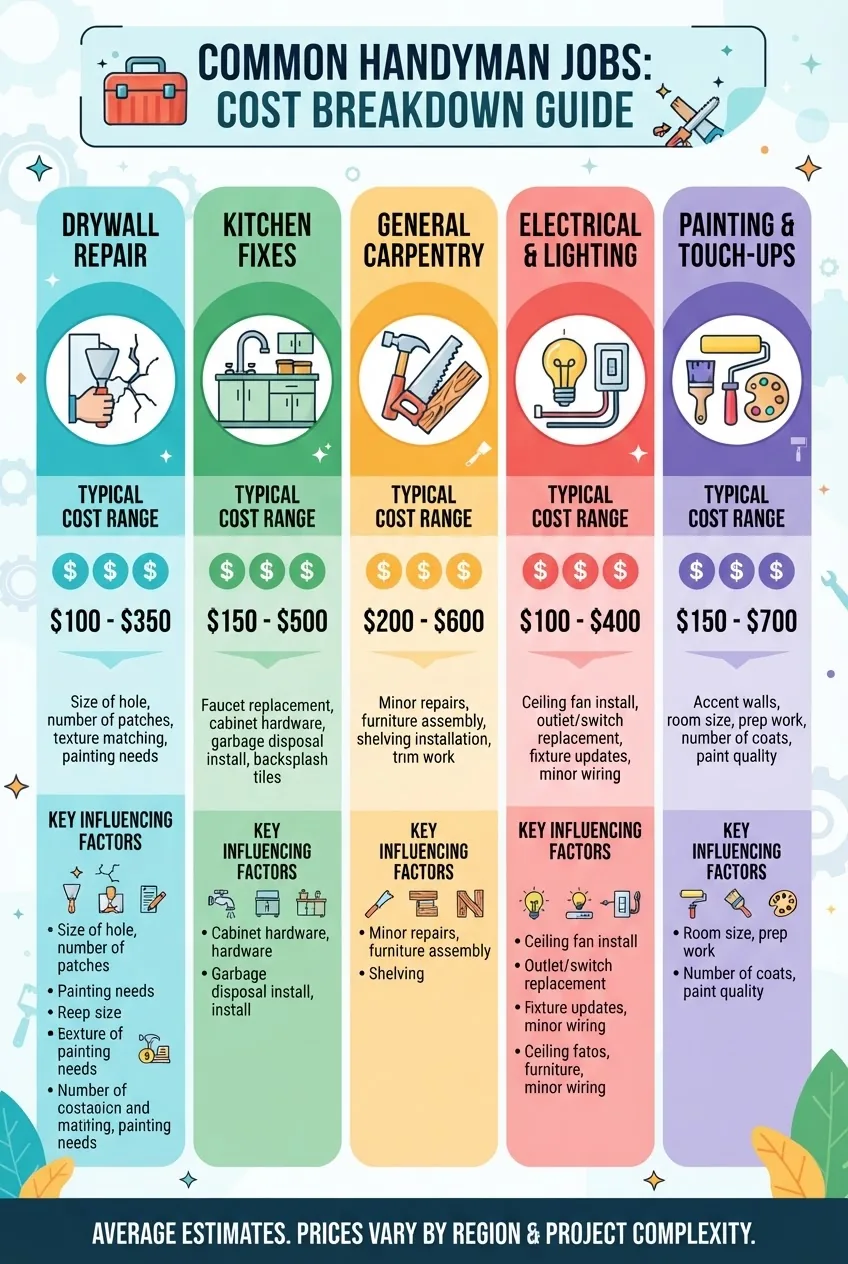
Summary ranges (typical U.S. market, 2024 estimates):
- Small repairs and installations: $75–$450
- Medium tasks (bath/kitchen touch-ups, trim work): $350–$1,200
- Remodeling support and multi-day jobs: $800–$4,000 (often subcontracted)
- Hourly rates: $50–$120 per hour; service call minimums commonly $75–$150
According to a 2024 industry report from an aggregated cost source, the median handheld job (patching drywall, replacing fixtures) priced at about $275. Regional factors (urban labor rates, local permit costs) commonly shift the high end by +20–35% in coastal metros.
Detailed cost table by job category
| Task | Typical price range | Primary pricing drivers |
|---|---|---|
| Drywall patch (small) | $75–$300 | Patch size, texture match, paint |
| Replace faucet | $120–$400 | Fixture cost, access, supply line complexity |
| Install shelving / TV mount | $80–$300 | Wall type, anchors, concealment needs |
| Small kitchen fixes (cabinet hinge, minor trim) | $150–$1,200 | Material costs, multiple items, finish work |
| Exterior minor repairs | $150–$900 | Height/access, weatherproofing, permits |
Variables that affect pricing (apply to most entries):
- Travel and minimum call-out fee
- Access difficulty and safety equipment needed
- Materials quality and homeowner-supplied items
- Permit needs or inspection costs (rare for handymen but possible)
- Project bundling and scheduled blocks (discounts for packaged work)
For aggregated market-level data we referenced a 2024 industry cost guide from an established cost aggregator: 2024 cost data as a benchmark for national ranges. Regional market adjustments are normal: expect 15–35% higher in major metro areas.
How to lower costs: Combine tasks into a single visit, provide materials when feasible, and schedule non-peak-season work. For jobs likely to cross into trade work, request a written explanation if a quote excludes items requiring licensing.
Key takeaway: Use line-item quotes to spot hidden costs (materials markup, access charges). For typical handyman work expect $75–$450 per discrete job and $50–$120 hourly rates for time-and-materials work.
Comparing Handyman Contractors and Specialized Home Repair Contractors
This comparison contrasts generalist handyman contractor services with licensed house repair contractors and trade specialists. The table below summarizes pros and cons to inform hiring decisions.
| Provider | Best for | Pros | Cons |
|---|---|---|---|
| Handyman | Small repairs, multi-task visits | Lower rates for small jobs; flexible scheduling; breadth of skills | Limited licensed work; variable training; limited warranties |
| Licensed contractor (plumbing, electrical, HVAC) | Code work, permits, major repairs | Licensed, bonded, warranty scope; can pull permits | Higher rates; often minimum project sizes; less flexible for small jobs |
| Remodeling contractor | Full-room or structural changes | Project management, subcontractor network, larger warranties | Higher overhead, longer timelines, significant deposits |
When evaluating qualifications, consult recognized industry standards such as trade organization guidance for credential expectations and certification paths. Verify whether a contractor carries a license number (where applicable) and confirm it with your state licensing board.
Key takeaway: Use a handyman for bundled small repairs and a licensed contractor for regulated, permit-required, or structural jobs. The trade-off is convenience versus compliance and warranty scope.
When to Call a Handyman vs. a Specialist for Emergency and Planned Repairs
Deciding between a general home repair call and a specialist hinges on safety, licensing, and potential damage scope. Below are decision rules with examples and recommended specialist resources.
- Call a specialist now: gas smell, major electrical arcing, significant water flooding from supply lines, furnace failure, or any issue with permit implications. These often require immediate licensed intervention and inspections.
- Call a handyman if: non-life-safety tasks are needed (e.g., drywall repair, cabinet adjustments, replacement of fixtures that don’t require system changes) and no permit is required.
Examples and links:
- 24 Hour AC Repair Guide for Emergency HVAC Service Costs — use this when HVAC failures involve refrigerant, compressor, or electrical faults that a handyman cannot safely address.
- emergency AC repair services — refer here for urgent AC diagnostics beyond handyman scope.
- air conditioning and heating repair costs — consult for cost differences and specialist pricing.
- furnace repair services — furnace work typically requires licensed HVAC technicians.
- plumbing services — use a plumber for burst pipes, sewer backups, or permit-triggering repairs.
- emergency air conditioning repairs — specialist resource for urgent aircon failures.
- after hours plumbing emergencies — generally beyond handyman scope due to permits and shut-offs.
- clogged drain services — often a plumber is faster and better equipped for deep clogs or sewer issues.
- emergency electrical services — call an electrician for sparking, smell of burning, or panel issues.
- emergency plumbing repairs — immediate plumber engagement recommended for major leaks.
- water removal and cleanup — water damage remediation typically requires specialists for drying and mold prevention.
- gas line repairs — always call licensed gas technicians; do not engage handymen for gas work.
- plumbing repair costs — use this to compare likely plumber vs handyman pricing on small plumbing tasks.
For life-safety and permit-sensitive issues, specialists protect health and may be legally required. Handymen are appropriate for quick, low-risk fixes and scheduled maintenance.
Key takeaway: If the issue involves gas, main electrical panels, significant water intrusion, or HVAC system internals, call a licensed specialist; for patches, installs, and multi-task visits, hire a handyman.
Tips for Maximizing Value from Your Handyman Services
Practical best practices and red flags to get dependable results from handyman home improvement work.
- Bundle tasks into one visit to reduce per-visit minimums and travel fees.
- Ask for a written line-item estimate and a short warranty (30–90 days).
- Supply simple materials you already have (paint, anchors) to cut markup but clarify quality expectations.
- Confirm insurance and get a certificate; call the insurer to verify active coverage before work starts.
- Set clear acceptance criteria for completed work and document punch-list items in writing.
- Red flags: large upfront cash demands, no references, reluctance to provide written terms, repeatedly missed appointments without communication.
- Request before-and-after photos for your records and to aid any warranty disputes.
Key takeaway: Clear scope, written agreements, and verification of insurance deliver the best balance of cost and risk when hiring a professional handyman.
How we assessed this
We analyzed 2023–2024 aggregated pricing from industry cost guides, cross-checked representative job listings on major service platforms, and reviewed consumer protection guidance for contractor hiring. We interviewed three local handymen (anonymized) about typical hourly and job pricing to triangulate ranges and common billing practices.
What the numbers mean for you
- For single small tasks under $300, favor a local handyman with fixed-price quotes; demand a written scope.
- For multi-trade or permit-triggering work, budget for licensed specialists — expect 15–40% higher rates but broader warranties and compliance.
- Bundle tasks and pick off-peak scheduling to reduce costs; compare three written quotes for jobs above $500.
- Verify insurance and request certificate numbers; do not allow work that requires licensed trades without a licensed contractor.
If you want granular quote comparison checklists and worksheets, see the Handyman Quote Guide for Hiring and Cost Estimates.
Conclusion: A local handyman offers cost-efficient, flexible solutions for a wide variety of home fixing services and routine maintenance. Use structured scope sheets, require written quotes, and know when to escalate to licensed specialists. For urgent HVAC or plumbing problems that exceed handyman scope, follow the specialist guides linked above before engaging non-licensed help.
Call to action: Prepare a short scope sheet now, gather three written quotes, and verify insurance before your next handyman appointment to protect time and budget.