
Contractor insurance protects contractors and clients from financial loss caused by workplace accidents, property damage, vehicle incidents, or professional errors; core policies (general liability, workers’ compensation, professional liability and commercial auto) transfer cost and legal exposure to insurers so projects can continue with less financial disruption.
What Is Contractor Insurance and Why It Matters
Answer: Contractor insurance is a set of insurance policies that protect contractors, subcontractors and clients from financial loss and legal liability arising from construction work, and it matters because it prevents a single accident or mistake from bankrupting a business or leaving a homeowner with unpaid damages.
Contractor insurance: an umbrella term for multiple policy types—like general liability, workers’ compensation and professional liability—that cover different risks contractors face while working on residential projects.
Contractor insurance’s purpose is risk protection: it pays for third-party bodily injury, property damage, defense costs, and, depending on the policy, professional mistakes or employee injuries. Consider a painter who spills solvent that damages cabinets—general liability will typically handle the homeowner’s damage claim and legal defense.
Benefits are practical: faster claim resolution for homeowners, legal defense for contractors, and lender or permit compliance for projects. For clients hiring contractors, verifying insurance reduces the chance they will be personally liable for medical bills, repair costs or lawsuits.
Example: a roofer’s crew member slips and injures a homeowner helping on-site—workers’ compensation covers the employee, while general liability covers the homeowner’s injury claim. Without coverage, the contractor or homeowner may face direct lawsuits.
For readers focused on selecting qualified help alongside insurance, see hiring skilled professionals.

Transitioning to specific policy types clarifies what each policy does and where gaps commonly occur.
Key Types of Contractor Insurance Coverage Explained
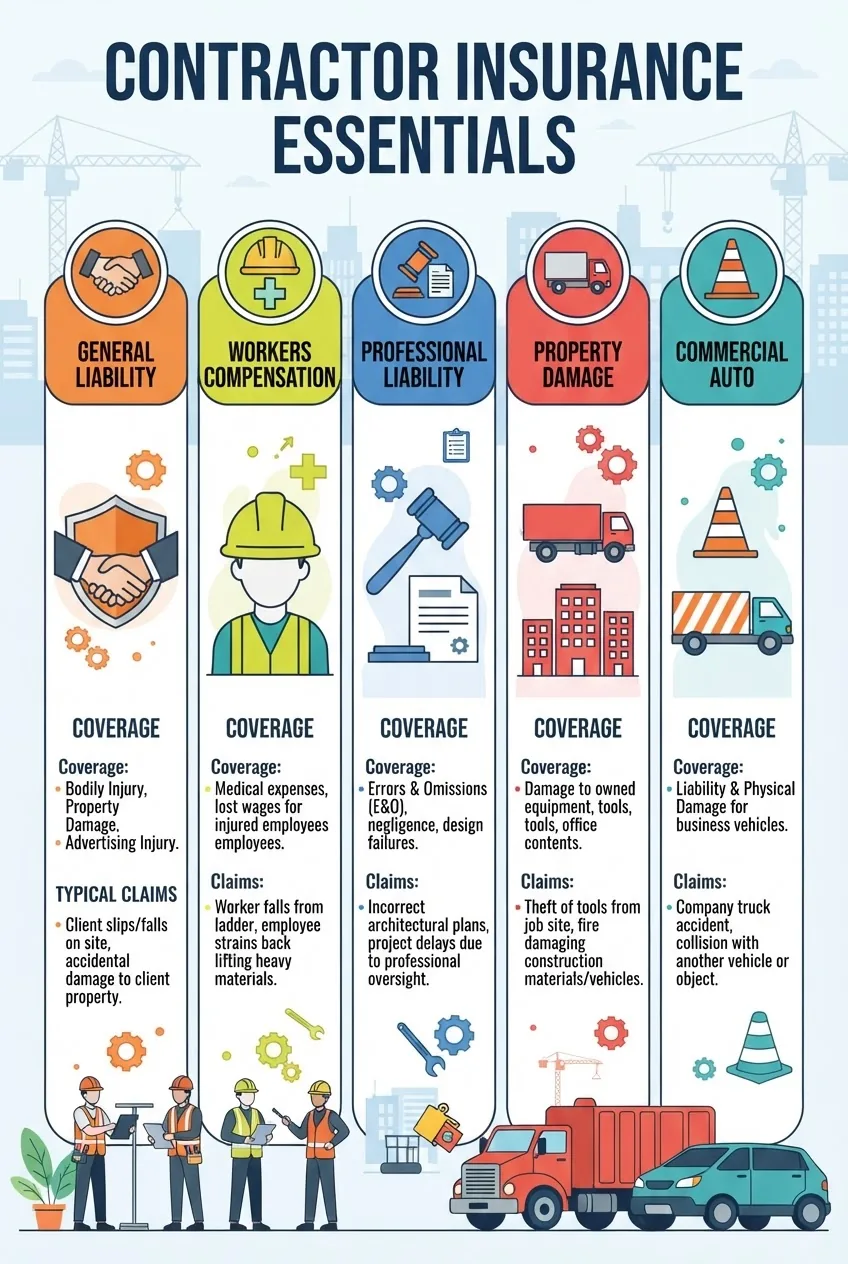
Answer: The main contractor insurance types are general liability, workers’ compensation, professional liability (errors & omissions), property damage coverage, and commercial auto insurance—each covers distinct risks and has trade-offs for cost and claim scope.
-
1. General Liability Insurance
Answer: General liability insurance covers third-party bodily injury, property damage and advertising injury claims occurring during operations, and is the baseline protection most clients require.
Definition: General liability insurance pays for third-party injury or property repair when your business operations cause damage or harm.
Pros:
- Covers slip-and-fall, dropped-tool damage, and small property damage claims.
- Pays defense costs even for groundless suits.
Cons:
- Won’t cover employee injuries (workers’ compensation required).
- Exclusions for certain pollutants, design work or professional advice.
Example: A subcontractor knocks over a ladder that damages siding—general liability covers repair and the homeowner’s medical expenses from a minor injury claim.
-
2. Workers’ Compensation Insurance
Answer: Workers’ compensation covers employees’ medical bills and lost wages for work-related injuries and is mandatory in most jurisdictions; it also limits employers’ exposure to direct lawsuits from injured workers.
Definition: Workers’ compensation is a no-fault system that pays medical and partial wage benefits to employees injured on the job.
Pros:
- Legal requirement in most states; protects both workers and employers.
- Often reduces employer liability exposure to tort claims.
Cons:
- Doesn’t cover independent contractors in all states—classification matters.
- Premiums rise with claims history and certain high-risk trades face higher rates.
Example: A carpenter falls from scaffolding and requires surgery—workers’ compensation covers medical care and a portion of lost wages while he recovers.
-
3. Professional Liability Insurance (Errors & Omissions)
Answer: Professional liability insurance covers claims arising from negligent design, faulty specifications, or mistakes in professional advice—critical for contractors offering design, engineering, estimating, or consulting services.
Definition: Professional liability (errors & omissions) covers financial losses caused by professional mistakes, omissions or negligent advice.
Pros:
- Protects against costly claims for design errors or poor workmanship that cause financial loss.
- Covers legal defense and settlements for covered professional acts.
Cons:
- Doesn’t cover on-site bodily injury or standard property damage (general liability used for that).
- Often requires clear definitions of covered services and claim-reported triggers.
Example: An HVAC contractor provides a load calculation that undersizes equipment, causing repeated failures—professional liability can cover the cost to replace equipment and associated claims.
-
4. Property Damage Coverage (Builders Risk / Inland Marine)
Answer: Property damage coverage—builders risk or inland marine—covers materials, tools, equipment and structures under construction against loss from fire, theft, vandalism or certain weather events.
Definition: Builders risk covers project property during construction; inland marine covers movable tools and equipment.
Pros:
- Protects the project’s physical assets and expensive portable tools.
- Can be tailored per-project for high-value builds.
Cons:
- Often excludes floods, earthquakes or certain unlisted perils unless added.
- May require the owner or contractor to secure the policy depending on contract terms.
Example: During a windstorm, unsecured siding panels are damaged—builders risk may cover replacement if the cause is a covered peril in the policy.
-
5. Commercial Auto Insurance
Answer: Commercial auto insurance protects business-owned or used vehicles from collision, liability for third-party injury or property damage, and often uninsured motorist claims.
Definition: Commercial auto covers vehicles used for business tasks rather than personal use.
Pros:
- Essential when trucks, vans or personal vehicles are used for deliveries, hauling materials, or transporting crews.
- Provides higher liability limits than personal policies and covers business use exclusions.
Cons:
- Higher premiums for heavy vehicles or drivers with poor records.
- Coverage gaps if non-listed drivers use vehicles without permission.
Example: A delivery driver employed by a contractor strikes a parked car—commercial auto covers repairs and liability claims beyond the driver’s personal policy limits.
-
6. Umbrella Insurance
Answer: Umbrella policies provide excess liability limits above underlying coverages like general liability and auto, useful when a single large claim could exceed primary policy limits.
Definition: Umbrella insurance kicks in after underlying policy limits are exhausted, offering broader limits and sometimes broader coverage.
Pros:
- Cost-effective way to raise liability limits into the millions.
- Can protect personal assets of contractor owners in certain claim scenarios.
Cons:
- Requires certain underlying limits to be maintained; gaps in primary policies still matter.
Example: A lawsuit awards $2M in damages after a catastrophic on-site injury—an umbrella policy can cover amounts above the $1M general liability policy.
Transition: Now that you know the types, here’s how liability coverage generally includes or excludes risks and how indemnity works in contracts.
Understanding Contractors Liability Coverage: What’s Included and What’s Not
Answer: Contractors liability coverage typically includes third-party bodily injury, property damage and defense costs up to policy limits, but excludes employee injuries, contractual liability in some cases, intentional acts, and certain environmental or professional risks unless specifically endorsed.
Definition: Liability limits are the maximum amounts an insurer will pay for covered claims, and a deductible is the amount the insured must pay before coverage applies; indemnity means one party agrees to reimburse another for losses outlined in a contract.
What liability covers
- Third-party bodily injury (e.g., homeowner or visitor injured on-site)
- Third-party property damage (e.g., accidentally damaged neighbor’s fence)
- Legal defense and settlement costs for covered claims
- Medical payments for small on-site injuries regardless of fault
Common policy exclusions and limitations
Exclusions often leave gaps if not addressed by endorsements:
- Employee injuries (workers’ compensation covers these)
- Professional errors (need professional liability)
- Pollution and environmental damage unless pollutant endorsement exists
- Intentional acts, criminal acts, or knowingly defective work
- Damage to the insured’s own tools or property without inland marine or property coverage
Short exclusion checklist:
- Employee injuries covered? (workers’ compensation)
- Professional advice included? (errors & omissions)
- Pollution and environmental coverage needed? (endorsement)
- Vehicle use covered? (commercial auto)
Indemnity and hold harmless clauses in contracts commonly shift risk between owner and contractor; courts may limit enforceability, and insurers may exclude coverage for contractual liabilities that expand exposure beyond standard risks.
Contractual liability: some policies include coverage for liabilities assumed under contract, but many insurers either exclude broad indemnities or require a specific contractual liability endorsement. Always confirm contractual liability with the insurer.
Coverage limits and deductibles: higher limits reduce homeowner exposure but increase premiums; deductibles shift smaller losses to the insured. Compare policy limits to the project’s scale—for large projects, common limits are $1M per occurrence / $2M aggregate, but this varies.
Contractual nuance: vicarious liability means a contractor can be held responsible for acts of subcontractors; requiring subcontractors to carry their own insurance and naming the contractor as an additional insured reduces this risk.
For safety standards and employer responsibilities tied to liability exposures, review applicable workplace safety rules such as OSHA guidelines.
Transition: With exclusions and limits top of mind, use a structured checklist to assess policy adequacy for any project.
How to Assess Contractor Insurance Policies for Your Project
Answer: To assess contractor insurance, review the certificate of insurance (COI), confirm policy limits and effective dates, verify additional insured and waiver of subrogation endorsements, check claims history, and confirm authenticity with the insurer—use a step-by-step checklist to document findings.
Certificate of insurance (COI): a one-page proof of insurance summarizing carrier, policy numbers, coverage types and limits; it is not the full policy.
-
Step 1 — Request the COI and policy declarations:
Ask for a Certificate of Insurance and, when needed, a copy of the policy declarations page and endorsements to confirm coverages rather than relying solely on the COI.
-
Step 2 — Verify carrier and policy numbers:
Check the insurer’s name and the listed policy numbers. Look up the insurer’s AM Best rating or regulatory standing through industry regulators such as NAIC to confirm financial strength.
-
Step 3 — Confirm policy limits and required endorsements:
Ensure limits meet contract requirements (common minimums: $1M per occurrence/$2M aggregate) and check for endorsements: additional insured, primary and noncontributory wording, and waiver of subrogation where required.
-
Step 4 — Check effective dates and retroactive coverage:
Confirm the policy is active for the project duration and that professional liability has adequate retroactive dates if work began before the current policy period.
-
Step 5 — Verify additional insured status:
When owners require it, the contractor should name the owner as an additional insured and provide the specific endorsement; a COI noting “additional insured” without an endorsement may be insufficient.
-
Step 6 — Contact the insurer or broker directly:
Call the insurer or broker using publicly available contact details (not those printed on the COI alone) to confirm policy authenticity and that the listed endorsements are in force.
-
Step 7 — Review claims history and loss runs:
Request a summary of prior claims or loss runs for the contractor over a recent period (typically 3–5 years) to understand frequency and severity of past losses; elevated claims may signal underwriting or operational issues.
-
Step 8 — Document findings:
Maintain a project file with COIs, endorsements, verification calls and notes. If uncertainties remain, consult an insurance advisor or legal counsel.
Mock COI walkthrough (fields to check):
- Insured name matches contractor company on the contract
- Policy types listed: General Liability, Workers’ Comp, Auto
- Policy numbers and effective/expiration dates
- Limits: per occurrence and aggregate amounts
- Endorsements: Additional Insured, Waiver of Subrogation
- Insurer contact info for verification
For a step-by-step verification process, see verifying contractor insurance and licensing requirements.
Transition: Understanding procedures helps with coverage checks; next, read practical liability scenarios you may encounter.
Common Contractor Insurance Liabilities and Real-World Scenarios
Answer: Common liabilities include slip-and-fall injuries, property damage, product liability, professional errors and subcontractor-caused losses—each can trigger claims under different policies or expose gaps if subcontractors are uninsured.

Scenario: A homeowner trips on tools left in a hallway and breaks a wrist during a kitchen remodel.
Coverage: General liability’s medical payments and bodily injury coverage typically applies; workers’ compensation is not involved unless the injured is an employee. If the contractor lacks GL, the homeowner may pursue the contractor directly.
Scenario: A demolition subcontractor accidentally dislodges a retaining wall, damaging a neighbor’s landscaping and foundation.
Coverage: General liability covers third-party property damage; if the subcontractor is uninsured, the primary contractor may face vicarious liability—naming subcontractors as additional insured and requiring COIs helps mitigate this risk.
Reference: According to a 2024 industry report, property-damage disputes account for a significant portion of homeowner-contractor disputes.
Scenario: An independent contractor supplies incorrect load calculations for a deck, resulting in structural failure.
Coverage: Professional liability (errors & omissions) addresses design or specification mistakes causing financial loss; general liability may not cover design professionals’ mistakes.
Scenario: A contractor’s truck strikes a pedestrian while backing up on site.
Coverage: Commercial auto provides liability and physical damage coverage; general liability may also offer some protection for non-owned vehicle liability depending on policy language.
Scenario: A subcontractor’s improper electrical work causes a fire; the homeowner sues the prime contractor and owner.
Coverage & contractual note: Indemnity clauses and additional insured endorsements are core defenses. If the subcontractor carried sufficient insurance and named the prime as additional insured, the prime’s insurer typically defends; absent that, the prime’s insurer may respond and seek subrogation.
When hiring, consider local options to reduce risk: finding reliable home contractors helps pair insurance diligence with trusted local trades.
Transition: Liability risk influences insurance cost; next, see typical price ranges and cost drivers.
Cost Factors and Typical Price Ranges for Contractor Insurance Coverage
Answer: Contractor insurance cost depends on trade, payroll and payroll-equivalent (for subcontractors), claims history, coverage limits, location, deductible size, and whether bonded or insured; typical annual premiums range widely by trade—from a few hundred dollars for low-risk sole proprietors to tens of thousands for larger crews in high-risk trades.
Costs are influenced by specific premium factors:
- Trade classification: High-risk trades (roofing, demolition) pay higher rates than low-risk trades (interior painting).
- Payroll and subcontractor costs: Workers’ comp and liability premiums are often calculated as a percentage of payroll or subcontractor payments.
- Claims history: A poor loss run increases premiums; insurers use experience modification (mod) factors for workers’ comp.
- Coverage limits and deductibles: Higher limits and lower deductibles increase premiums; adding an umbrella can be cost-effective for higher limits.
- Geographic risk: Areas with higher litigation rates or weather risks (floods, hurricanes) have higher premiums.
- Safety programs: Active safety programs and certifications can earn discounts.
- Bonding vs. insurance: Bonds cost a percentage of the bond amount and are not insurance but a guarantee—see comparison below.
| Coverage | Typical annual cost range | Notes |
|---|---|---|
| General liability ($1M/$2M) | $400–$3,000+ | Low-risk sole operators low end; higher for crews and high-risk trades. |
| Workers’ compensation | Varies widely; often 2%–15% of payroll | Trade classification & claim history drive rates. |
| Professional liability | $500–$5,000+ | Depends on revenue, services offered, and claims history. |
| Commercial auto | $750–$3,000+ | Vehicle types and driver records matter. |
| Builder’s risk / inland marine | Project-specific; often 0.1%–1% of project value | Short-term project policies priced to project value and location. |
Bonding vs. insurance: a surety bond guarantees contract completion or repayment if terms are unmet; it doesn’t pay claims like insurance—rather, the principal (contractor) or surety must ultimately reimburse the obligee. Bond premiums are usually a percentage (1%–3% typical for low-risk bonds, higher for those with weak finances).
For self-employed or independent tradespeople, see independent contractor insurance costs and coverage.
According to a 2024 industry report, preventative safety programs can reduce workers’ compensation claims frequency and lower experience modification factors, directly lowering premiums.
Transition: With cost drivers clear, contractors can act to reduce exposure and control premiums.
Tips for Contractors to Manage Risks and Reduce Liability Exposure
Answer: Contractors should implement documented safety programs, require and verify subcontractor insurance, use clear contract indemnity language, maintain current insurance reviews, and adopt loss-control practices to reduce claims and insurance costs.
How-to steps and actionable advice:
- Implement a formal safety program: Written procedures, toolbox talks, PPE requirements and documented training reduce accident frequency and signal responsibility to insurers and clients. Reference workplace safety standards like OSHA guidelines.
- Require subcontractor insurance and verify COIs: Set minimum limits, require additional insured status and waivers of subrogation, and verify COIs via direct carrier contact rather than solely paper COIs.
- Use clear contract language on indemnity: Limit broad indemnities where possible; insist on mutual or narrow indemnity provisions that align with insurer acceptance and legal enforceability.
- Maintain equipment and site controls: Lock tools, secure materials, control dust and erosion, and use barriers to reduce third-party exposure.
- Regularly review insurance with a broker: Annual insurance reviews ensure coverages match evolving operations and contract requirements.
- Adopt quality control and documentation: Photos, sign-offs and change-order records reduce disputes and clarify responsibility in claims.
- Consider technology to manage risk: Use project management and quoting tools to standardize estimates, track subcontractor insurance and store COIs. See recommendations on contractor estimate software and quoting tools.
- Purchase gap-cover endorsements: Add pollution, cyber liability or equipment floaters when relevant to avoid common coverage exclusions.
Pro tip: Documenting safety training and equipment maintenance can be as persuasive to underwriters as premium paid—insurers reward low-loss histories with better renewal terms.
Transition: The checklist and practices above reduce liability; end with a summary and actionable steps for both homeowners and contractors.
Conclusion
Answer: Contractor insurance—across general liability, workers’ compensation, professional liability, property and auto coverage—protects projects, contractors, and homeowners from financial disruption; carefully verifying COIs, confirming endorsements, managing subcontractor risk, and maintaining safety programs are the practical steps to control liability and cost.
Key takeaways:
- Identify the policies you need for the trade and project size.
- Verify COIs and endorsements directly with carriers.
- Require subcontractors to carry adequate insurance and name you as additional insured.
- Document safety, quality control and contracts to limit exposures and support insurance claims when needed.
- When unsure, consult an insurance professional or legal advisor to align contract indemnities and insurance language.
Next step: review your contractor’s COIs using the checklist in this guide and, if you need hiring support, pair coverage checks with contractor selection best practices to protect your renovation—reach out to licensed advisors or use the linked resources in this guide to get started.