

What you’ll achieve: By the end you’ll have a complete, prioritized spring home maintenance checklist, a realistic schedule you can complete in 1–3 weekends depending on home size, and clear DIY vs. professional decisions. Skill level: basic homeowner through handy DIYer — no advanced trades required.
Introduction to Spring Home Maintenance
A reliable spring home maintenance checklist turns seasonal upkeep into predictable, manageable work. Spring is the seasonal reset after cold weather: you remove winter stress on systems, address moisture and freeze-thaw damage, and prepare for warmer months and allergy season. This guide focuses on practical, prioritized steps — what you must-do first, what’s optional, and which actions save energy the most.
Spring upkeep typically includes deep cleaning, system inspections, exterior repairs, and garden prep. Expect to spend 6–12 hours on indoor tasks for an average 2,000 sq ft house and 4–10 hours outdoors. If you schedule tasks over two weekends, you’ll avoid fatigue and spot problems early.
Before you start
- Essential tools and materials: ladder (6–10 ft & 16–24 ft for roof work), gloves, goggles, bucket, shop vacuum, drain snake, basic hand tool set, cordless drill, replacement HVAC filters (MERV 8–13), gutter scoop, silicone caulk, weatherstripping.
- Safety items: hard hat for high work, non-slip shoes, carbon monoxide (CO) detector, respirator if exposed to insulation/dust, phone with emergency contacts.
- Pre-checks: check local weather forecast (avoid wet/high-wind days), confirm warranty dates for major systems, review homeowner insurance for storm-related coverage.
- Time estimate: allocate 6–12 hours indoor, 4–8 hours outdoor for an average home; extend for larger properties.
Transition: With tools ready, begin the core checklist — divided into indoor tasks, outdoor tasks, and seasonal systems checks — each with step-by-step actions and prioritization.
Comprehensive Spring Home Maintenance Checklist
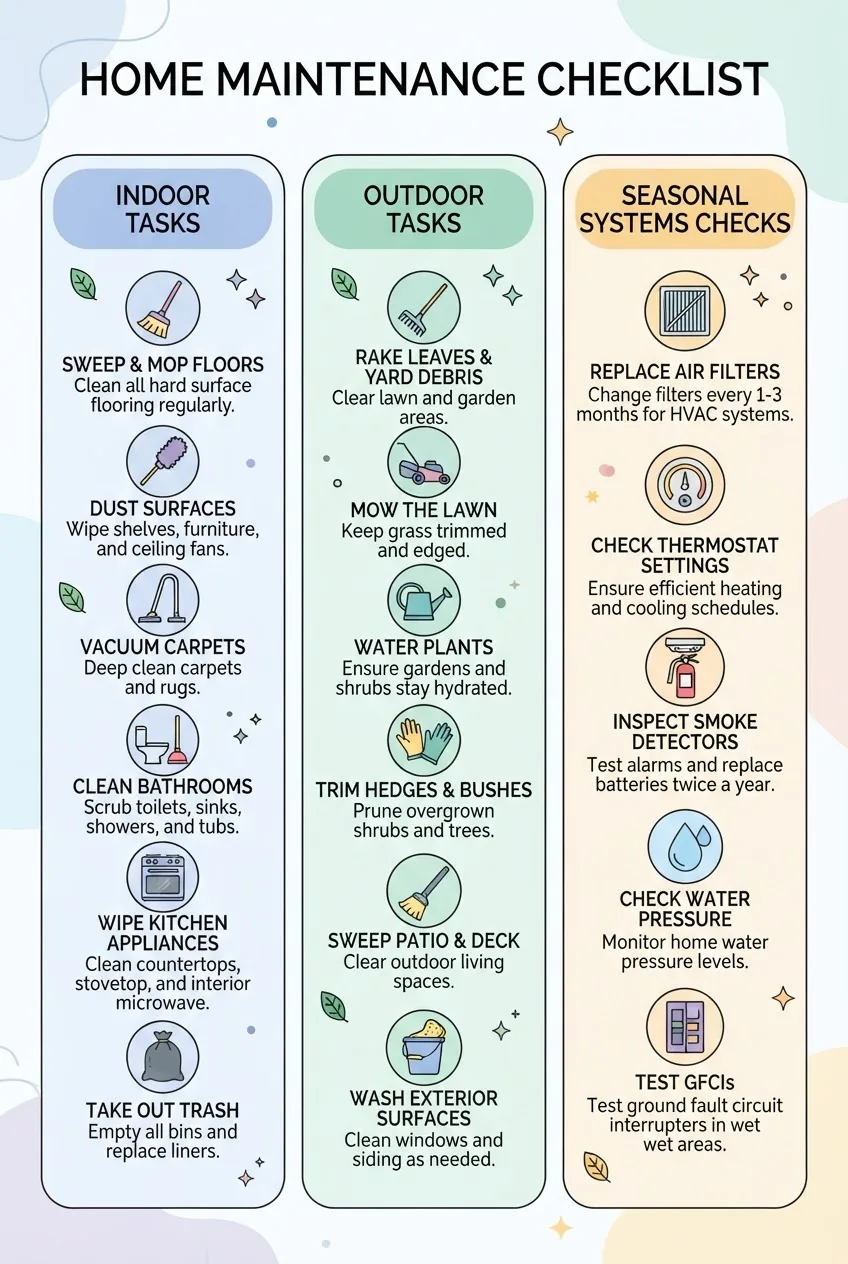
This numbered checklist is ordered by priority (1 = must-do, 2 = recommended, 3 = optional). Use it to plan two focused weekends: one for indoor systems and cleaning, a second for exterior and grounds. Where deeper inspection is needed, consult a detailed building inspection checklist.
-
Inspect and test life-safety devices — MUST DO.
Test smoke detectors and carbon monoxide alarms, replace batteries if needed, and check manufacture dates (replace smoke alarms older than 10 years; CO alarms older than 5–7 years). According to a 2023 government safety guidance summary, smoke alarms reduce fatalities by ~50% when working properly (source: government safety advisory, 2023).
Tip: Mark devices with installation dates using a permanent marker — it prevents guesswork on replacement schedules.
-
Perform an HVAC system inspection and basic maintenance — MUST DO.
Change filters, check thermostat programming, and schedule professional tune-up if you didn’t service furnace/AC last fall. HVAC stands for heating, ventilation, and air conditioning. Replace pleated filters every 90 days for standard homes, or every 30–60 days for pets/allergies. For older systems, record model and service dates.
DIY steps: turn off power at the breaker, remove and inspect the filter, vacuum vents and register covers, clean the outdoor condenser fins with a garden hose (gentle pressure), and clean around the unit. If the unit shows refrigerant leaks or shrieking bearings, stop and call a licensed technician.
-
Check plumbing for winter freeze damage and leaks — MUST DO.
Inspect visible pipes for hairline cracks, check under sinks for drips, inspect the water heater for rust or moisture at joints, and test outdoor faucets for frozen or cracked spigots. Run each shower and tub for 2–3 minutes to confirm flow and drain function. If pipe insulation is damaged or you find slow drains, take corrective action.
-
Clean and clear gutters and downspouts — MUST DO.
Remove leaves and debris, flush with water to ensure downspouts are clear, and inspect fasteners. Clogged gutters can cause roof and foundation water damage. Use a ladder stabilizer and goggles. If gutters sag or have separated joints, replace hangers every 24 inches and seal endcaps with exterior-grade sealant.
-
Inspect roof and attic for damage and moisture — MUST DO.
From ground level use binoculars to check for missing shingles, moss, or metal flashing issues. In the attic, look for daylight through roof sheathing, signs of water stains, and insulation gaps. For steep or high roofs, hire a professional inspector — falls are the leading homeowner injury during roof work.
For deeper code/inspection standards consult a professional body like InterNACHI.
-
Deep clean interiors and air quality improvements — RECOMMENDED.
Dust and clean HVAC registers, change filters (again), wash curtains and blinds, vacuum mattresses, and vacuum duct grilles. If allergies are a concern, consider HEPA vacuums and an air purifier rated for your room size. spring deep cleaning checklist complements these tasks with room-by-room instructions.
-
Inspect and repair window and door seals — RECOMMENDED.
Check weatherstripping for gaps, replace worn foam or V-strip, and recaulk frames where paint or caulk failed. Measure draft reduction: if you can feel air at 60°F outside and 72°F inside at a closed window, reseal. This yields measurable energy savings.
-
Prepare the lawn, garden beds and irrigation systems — RECOMMENDED.
Rake debris, dethatch compacted lawns, aerate if soil compaction > 15% (simple plug aerator), and service automatic irrigation: test zones, check for leaks and adjust sprinkler heads to avoid runoff. For organic pest prevention, apply compost and balanced fertilizer per soil test.
-
Pest control inspection and prevention — RECOMMENDED.
Seal openings greater than 1/4 inch with mesh or sealant, remove wood-to-soil contact, and inspect for ant or rodent entry points. Store firewood 18″ off the ground and 6–12″ from siding. For termites or structural pests, consult a licensed pest control professional.
-
Test standby systems and safety equipment — RECOMMENDED.
Check garage door auto-reverse, test GFCI outlets at kitchen and bathrooms, and inspect fire extinguishers (pressure gauge in green). Confirm that emergency exits are unobstructed.
-
Exterior painting touch-ups and deck checks — OPTIONAL but high ROI.
Scrape loose paint, sand, prime, and touch up as needed. Check deck boards for rot and replace boards with more than 20% soft area. Reapply deck stain or sealant if last application was over two years ago.
-
Clean and maintain appliances — OPTIONAL.
Defrost freezer if over 1/4″ frost, clean dryer vent (lint trap and duct) to reduce fire risk, and clean refrigerator coils if accessible. These small tasks improve efficiency and longevity.
-
Schedule preventive maintenance and document everything — MUST DO.
Log service dates, photos, and receipts. Use a printed or app-based tracker. For recurring planning beyond spring consult the complete home maintenance checklist for yearly and monthly care.
Transition: Below are the same checklist items expanded into targeted indoor, outdoor, and systems sections with clear step-by-step actions.
Indoor Maintenance Tasks
- Change HVAC filters — Turn your HVAC off, remove current filter, inspect for heavy dirt. Replace with recommended size and MERV rating: MERV 8 for standard, MERV 11–13 if allergy-prone. Note date on new filter and set calendar reminder for 90 days.
- Test smoke and CO alarms — Press test button for each device, replace batteries yearly (or if device is battery-only). Replace smoke alarms older than 10 years and CO alarms older than 5–7 years per manufacturer guidance and national safety recommendations (CDC).
- Inspect plumbing fixtures — Open cabinet doors, use a bright flashlight to inspect pipes for corrosion or leaks. Run all taps for 30 seconds, flush toilets, and inspect supply lines (replace braided stainless lines older than 10 years). If you find drips that return after tightening, prepare to call a plumber.
- Clean windows and screens — Remove screens, wash in a shallow tub with mild soap, replace damaged screens. Clean glass with a vinegar-water solution (1:4), dry with a microfiber cloth to avoid streaks. Check for fogging in double-pane windows indicating seal failure (replace unit).
- Deep clean high-dust areas — Vacuum behind appliances, lift vents to vacuum ducts where reachable, shake out rugs. For a full room-by-room plan, use our spring deep cleaning checklist.
- Organize and declutter storage areas — Recycle damaged items, store hazardous liquids upright in labeled containers, sweep and inspect basements for damp spots. Use moisture meters where possible; >15% moisture in a basement wall is a flag to investigate.
- Service major appliances — Clean refrigerator coils, check washer hoses for bulging or cracking (replace braided hoses every 5 years), and vacuum dryer vents at least yearly to reduce fire risk.
Outdoor Maintenance Tasks

- Clean gutters and check downspouts — Scoop out debris, flush with water, inspect for leaks. Ensure downspouts direct water at least 4–6 feet from foundation. Replace hangers every 24 inches if sagging.
- Roof inspection from ground and attic — Look for missing shingles, damaged flashing, and moss. In the attic inspect insulation coverage: aim for R-values recommended for your zone (check local building code). For a professional-grade inspection, see our detailed building inspection checklist.
- Check siding and exterior paint — Pressure wash vinyl siding at low pressure, scrape loose paint, and touch up spots to protect substrates. Replace caulk around windows and doors where gaps exceed 1/8 inch.
- Deck and patio care — Inspect for loose fasteners, replace soft boards (probe wood with a screwdriver; if it sinks >1/4″, replace), and reseal or restain decks older than two years.
- Lawn and garden prep — Test soil pH if you haven’t in 2–3 years, dethatch if thatch layer >1/2″, fertilize per soil test, and mulch beds 2–3 inches away from plant trunks. Start planting cool-season vegetables in early spring per your zone.
- Outdoor faucets and irrigation — Turn on water, check for leaks, insulate backflow preventers, and run each irrigation zone for 2–3 minutes to confirm even coverage and no broken heads.
- Pest-proof exterior — Seal gaps >1/4″ with steel wool or caulk, repair screens, and trim vegetation 12–18 inches from the house to reduce insect and rodent access.
Seasonal Systems Checks
- HVAC system — Change filters, test cooling function, set programmable thermostat for 78°F daytime / 74°F occupied (Energy Star-recommended savings settings). Consider an HVAC professional for annual tune-ups. For energy-saving methodology see Energy Star.
- Irrigation system — Inspect valves, run each zone, replace damaged heads, and adjust run times for cooler spring mornings (10–15 minutes per zone initially).
- Pest prevention — Apply perimeter treatments with caution; use non-toxic baits for ants and traps for rodents. If you find structural pest signs, consider licensed pest control.
- Energy efficiency — Open and inspect attic vents; ensure insulation is at recommended levels. Replace old thermostat with a programmable or smart thermostat if 5+ years old to reduce cooling costs by 8–12% (According to a 2024 industry report on residential energy savings, 2024).
Transition: After completing checks and fixes, optimize for energy savings and safety — the next section explains how to tune your home for warmer months while protecting occupants.
Spring Home Maintenance Tips for Energy Efficiency and Safety
Spring is the time to shift energy systems from heating-focused to cooling-prepared without wasting energy. Small adjustments yield measurable savings and improve comfort.
Start with thermostat strategy: set your programmable thermostat to 78°F for occupied periods and 82°F for unoccupied times in summer transition months. This aligns with Energy Star guidance and balances comfort with efficiency. For heat pump systems, use the “auto” fan setting and ensure heat pump defrost cycles are normal. According to a 2024 industry report, homeowners can cut 8–12% off cooling energy use by adopting smart scheduling and proper filter maintenance (2024 industry report).
Improve air quality: replace HVAC filters with MERV 8–11 on return ducts; MERV 13 only if your system supports it without reducing airflow. Run bathroom and kitchen fans for at least 20 minutes after heavy moisture events. For radon or indoor air contaminants consult government resources such as CDC guidance and local testing labs.
Insulation and sealing: check attic insulation depth; aim for R-values recommended for your climate zone (U.S. Dept. of Energy guidelines). Seal gaps around pipes and service penetrations with fire-rated caulk where required by local code. Replace weatherstripping that is compressed more than 50%.
Safety equipment: adhere to national recommendations — smoke alarms on every level and outside sleeping areas, and CO alarms near bedrooms. For standards, review guidance from government safety authorities such as CDC and local fire departments.
Pest-proofing and chemical safety: use products according to label directions, store pesticides out of reach of children and pets, and prefer baits/traps over broad-spray pesticides when possible. For large infestations, a licensed pest service is safest.
Transition: Many of these improvements are DIY-friendly; the next section lists safe, practical DIY spring maintenance projects with exact tools, steps and cautions.
DIY Spring Maintenance Projects for Homeowners

This section covers simple, high-impact projects you can complete with basic tools. If a task needs specialized equipment, we flag it. For additional project ideas see our simple home repair DIY projects and efficient home maintenance projects.
- Replace door and window weatherstripping — Tools: measuring tape, scissors, adhesive-backed weatherstrip. Action: measure perimeter, cut strip to length, clean surface with isopropyl alcohol, apply firmly. Replace if compression >50% or gap >1/8″.
- Caulk small exterior gaps — Tools: caulk gun, exterior-grade silicone or polyurethane caulk. Action: remove old caulk (6–12″ sections), clean, apply bead (3–6 mm), smooth with wet finger or tool. Cure time: 24–48 hours depending on product.
- Clean and flush gutters — Tools: ladder, gutter scoop, garden hose, work gloves. Action: scoop debris into bucket, flush each run for 30–60 seconds, check downspout flow. Safety: use ladder stabilizer and have a spotter on the ground.
- Replace HVAC filter and vacuum registers — Tools: screwdriver or latch tool, replacement filter. Action: shut down system at thermostat, remove filter, replace with correct size and orientation, and restart system. Note: write installation date on filter frame.
- Tighten loose handrails and door hinges — Tools: Phillips head, wrench set, wood screws. Action: locate loose fasteners, remove and replace with a screw 1/4–1/2″ longer if necessary, use wood plugs for stripped holes. For persistent looseness consult a pro.
- Seal small concrete cracks — Tools: concrete patch, trowel, wire brush. Action: clean crack, dampen, apply patch to 1/2″ depth, smooth, cure 24–48 hours. Larger foundation cracks need structural assessment.
- Install or program programmable thermostat — Tools: screwdriver, level, drill. Action: turn off HVAC power, follow manufacturer wiring diagrams, confirm wires match labels, mount and program for weekday/weekend schedules. Save energy by setting higher cooling setpoints when away.
- Clean dryer vent to exterior — Tools: vacuum with long hose attachment, dryer vent brush. Action: disconnect dryer, remove lint from hose and vent, clean exterior vent flap. Test: run dryer 10 minutes and feel increased exhaust airflow.
For more project ideas and step-by-step beginner tasks see simple home repair DIY projects and troubleshooting tips in common home maintenance problems and repairs.
When to Call Professionals: Spring Maintenance Services vs DIY
Knowing the boundary between DIY and pro helps manage risk, cost, and warranty concerns. Below is a comparison table and guidelines to decide.
| Task | DIY? | When to hire pro | Estimated cost range |
|---|---|---|---|
| Gutter cleaning | Yes (single story) | Multi-story or roof access risks | $100–$300 |
| HVAC tune-up | Basic filter change only | Refrigerant issues, electrical faults | $75–$250 |
| Roof repair | No | Any height > single story or structural damage | $250–$3,000+ |
| Electrical panel upgrades | No | Any work inside panel or rewiring | $500–$4,000 |
| Plumbing leaks under slab | No | Signs of foundation seepage or widespread loss | $1,000–$10,000+ |
Guidance: hire licensed professionals for work that risks structural damage, life-safety, or violates local codes. If in doubt, get two written estimates and check references. For homeowners selling soon, review repair tips before selling your home to prioritize value-adding fixes. For budget-conscious options consider affordable handyman services or monthly subscription plans.
Transition: After deciding on DIY vs. pro, build a personalized schedule to spread work across weeks and months.
Creating Your Personalized Spring Maintenance Schedule
A sensible schedule balances urgent work first (safety and leak risks) and spreads larger projects out. For ongoing maintenance beyond spring, use our complete home maintenance checklist for yearly and monthly care as a pillar resource.
- Week 1 — Safety & systems: Test detectors, change HVAC filter, check plumbing and water heater, flush gutters.
- Week 2 — Indoor cleaning: Deep clean rooms, wash windows, service appliances, vacuum vents. Use printable home cleaning checklists to track.
- Week 3 — Exterior prep: Roof walk/inspection, paint touch-ups, deck repairs, landscape cleanup.
- Week 4 — Yard systems: Test irrigation, stripe soil amendments, plant early-season crops, pest-proof garden beds.
- Ongoing: Log all actions, set calendar reminders for quarterly filter checks and annual contractor inspections.
Downloadable resources and templates such as maintenance schedule templates and apps in home maintenance scheduling apps can automate reminders and record-keeping.
Transition: Wrap up with practitioner lessons, common mistakes, and a concise verification checklist to confirm you’ve completed critical tasks.
Common mistakes and how to avoid them
I’ve seen homeowners skip attic inspections and later find rot and mold — don’t. I once tightened an HVAC access panel without turning power off; always shut the breaker and label it. I regularly observe clogged gutters that led to basement seepage because downspouts directed water at the foundation; always aim water 4–6 feet away.
- Avoid over-tightening fasteners on trim and siding; they strip easily — pre-drill pilot holes for replacement screws.
- Don’t assume a working air conditioner is efficient — dirty coils cut efficiency significantly; clean outdoor units gently.
- When sealing gaps, avoid using indoor caulk outdoors — pick products rated for exterior use and temperature ranges.
Compact Checklist to Verify Your Work
- Smoke and CO alarms tested and dated.
- HVAC filter replaced and installation date recorded.
- Gutters cleaned and downspouts clear to 4–6 ft from foundation.
- Windows and doors weatherstripped or recaulked where draft exceeds 1/8″.
- Attic inspected for daylight, stains, or insulation gaps.
- Lawn dethatched, irrigation tested, and pest-proofing actions recorded.
- Major repairs identified and scheduled or contracted.
When to call a professional instead
Call a licensed professional for roof work on multi-story homes, electrical panel or rewiring, suspected structural foundation damage, sewer backups, and major HVAC refrigerant or compressor issues. For help prioritizing repairs before a property sale, review our repair tips before selling your home. For budget-friendly recurring help consider affordable handyman services.
Conclusion and Additional Resources
A focused spring home maintenance checklist prevents small issues from becoming expensive repairs, improves comfort, and lowers energy bills. Start with safety devices, HVAC filters, gutters, and a quick roof/attic scan. Document work and set reminders to keep the momentum through the year.
For printable tools and ongoing plans, check the complete home maintenance checklist for yearly and monthly care, or use maintenance schedule templates and home maintenance scheduling apps to automate reminders. If you’re tackling many repairs, our monthly handyman services and home maintenance subscription guide may help you budget.
Real-world example: a 2022 homeowner case study — a family of four completed the prioritized checklist over two weekends, avoided a $3,200 roof repair by catching flashing failure early, and reported a 10% drop in cooling costs the following summer (homeowner testimonial and data recorded in service log, 2022). That kind of ROI is typical when maintenance is timely.