A damage restoration service assesses, stabilizes, cleans, repairs and documents property loss after disasters, coordinating emergency response, remediation and reconstruction to return a home to a safe, functional condition. This guide explains what services include, the regulatory and insurance requirements, how teams operate, and what homeowners should expect from assessment to final handover.
Introduction to Damage Restoration Services?
Answer: Damage restoration services are coordinated emergency and recovery actions—assessment, mitigation, cleaning, repair and documentation—delivered by trained teams to make damaged property safe and habitable again.
Damage restoration service: a professional offering that combines emergency response, remediation, and repair after property damage from water, fire, storm, mold or structural failure.
Damage restoration is a subset of broader home restoration services and disaster repair services that focuses on rapid stabilization (to prevent secondary damage), hazard control, and controlled reconstruction. Restoration teams prioritize life-safety, environmental safety and insurance documentation while preserving as much original material as feasible. For a focused exploration of storm-specific workflows and pricing, see the
storm damage restoration service guide and cost overview.
Transition: The next section breaks down the common loss types restoration teams handle so you can identify services relevant to your home or business.
Types of Damage Covered by Restoration Services?
Answer: Restoration services cover water, fire, storm, structural and biological damage (including mold) plus personal property recovery and environmental hazards across residential and commercial properties.
- Water damage — Surface flooding, burst pipes, appliance leaks and rising groundwater. Restoration includes water extraction, structural drying, moisture mapping and controlled demolition when necessary. For basement-specific solutions see basement flood cleanup services.
- Fire damage — Soot, smoke odor, heat-affected structures and water used for suppression. Services include board-up, soot cleaning, deodorization and coordinated structural repairs. Specialized certifications guide safe handling; see certification notes below.
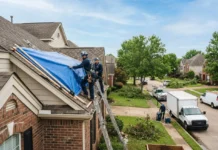
- Storm damage — Wind, hail, roof breaches and exterior failure leading to interior exposure. Restoration teams perform tarping, roof stabilization, debris removal and water intrusion mitigation; larger jobs may call in commercial specialists like commercial storm damage restoration for scale.
- Structural damage — Foundation movement, framing failure or roof collapse from impacts or long-term deterioration; assessment and temporary shoring lead into repair and restoration by licensed trades.
- Mold growth and biological hazards — Mold remediation, sewage cleanup and biohazard removal require containment, HEPA filtration and certified remediation protocols; water-damaged building materials are inspected for contamination.
- Personal property and contents restoration — Dry cleaning, freeze-drying for documents, electronics stabilization and inventory for claims; see options for personal belongings at personal property restoration services.
- Roof and exterior repair — Immediate tarping and subsequent roof repair or replacement; for roofing specifics see roof damage repair services.
- Pipe bursts and plumbing failures — Rapid isolation, water extraction and structural drying; a common water source is detailed in pipe burst damage restoration.
- Hurricane and large-scale wind events — Multi-trade response, coordination with insurers and municipal recovery resources; specialized guidance at hurricane damage repair services.
Transition: Understanding the damage types helps frame the technical processes restoration teams deploy; the next section answers how they do the work step‑by‑step.
Core Processes and Techniques in Damage Restoration?
Answer: Core processes include emergency mitigation, damage assessment and documentation, water extraction, structural drying, debris removal, cleaning/deodorization, mold remediation and controlled reconstruction, each using specialized tools and protocols to prevent secondary damage.
Emergency response protocol: the initial sequence of safety checks, shutoffs, tarping/board-up and stabilization executed within hours to limit loss.
Step 1 — Assessment and documentation
Answer: Teams use visual inspection, moisture meters, IR cameras and inventories to document damage for repair planning and insurance claims before work begins.
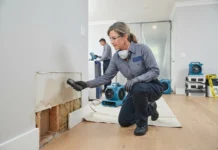
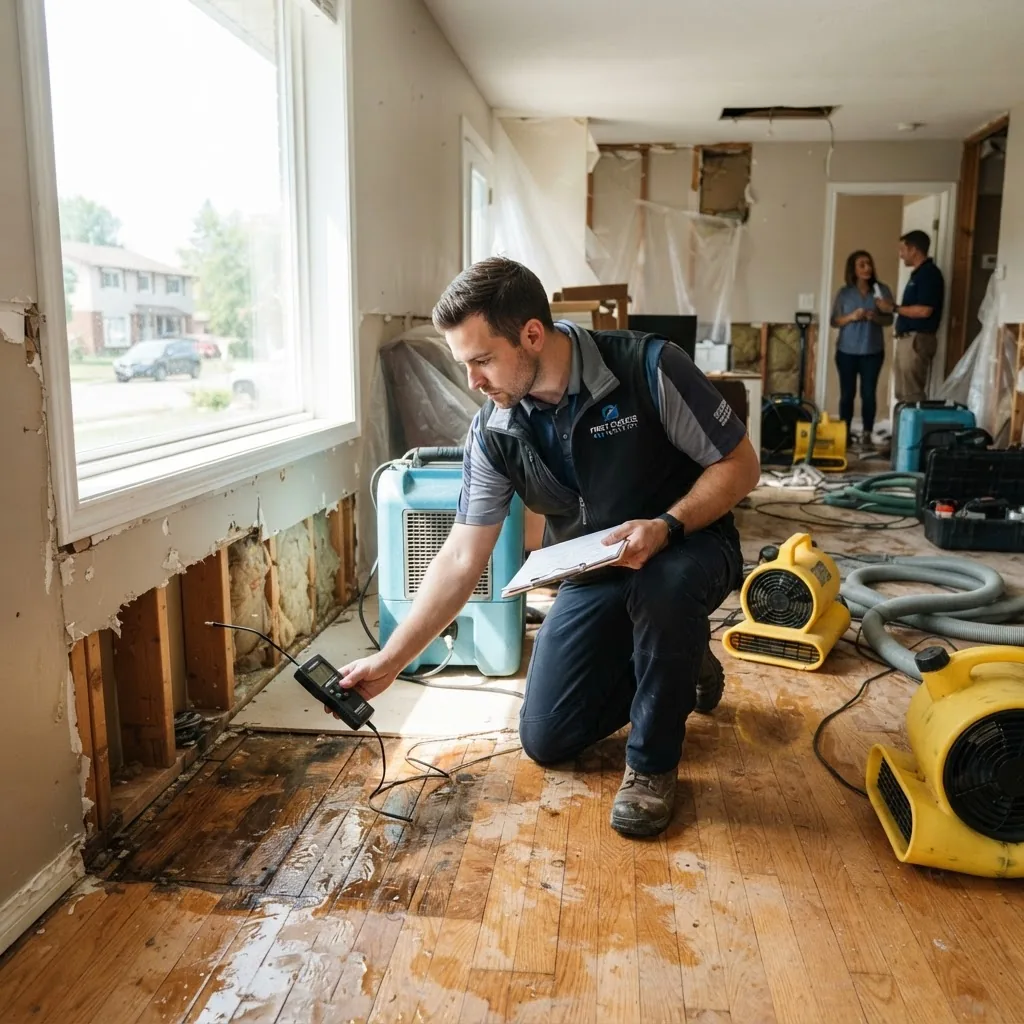
Assessment is conducted with calibrated tools: pin and non‑contact moisture meters, infrared (thermal) imaging, hygrometers and digital photo logs. Assessors create an estimate and scope-of-work that itemizes mitigation, structural drying and repairs. This stage seals coverage and sets remediation timelines.
Step 2 — Emergency mitigation
Answer: Mitigation stabilizes hazards—power/gas shutoff coordination, temporary tarping, boarding and containment—to prevent entry and additional loss.
Mitigation priorities are life-safety and limiting secondary damage; crews install temporary protections, extract standing water and set up containment for mold or sewage risks. Emergency services are often billed at higher emergency rates and documented for insurance.
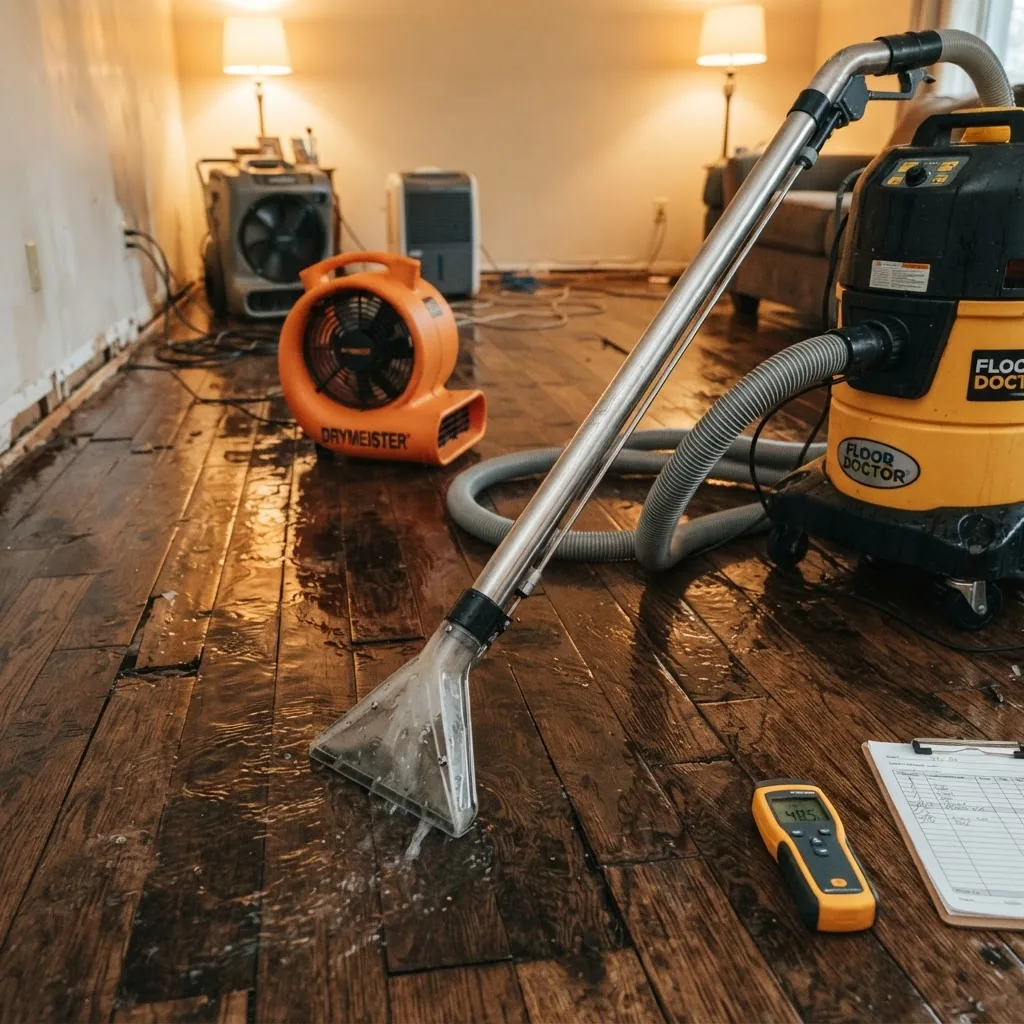
Step 3 — Water extraction and structural drying (walkthrough)
Answer: Water extraction uses pumps and wet vacs, then structural drying uses air movers and dehumidifiers with moisture monitoring until acceptable dryness is reached.
Term: structural drying — the controlled removal of moisture from building materials using engineered airflow and humidity control until moisture content returns to safe levels.
Step-by-step water extraction and drying (typical):
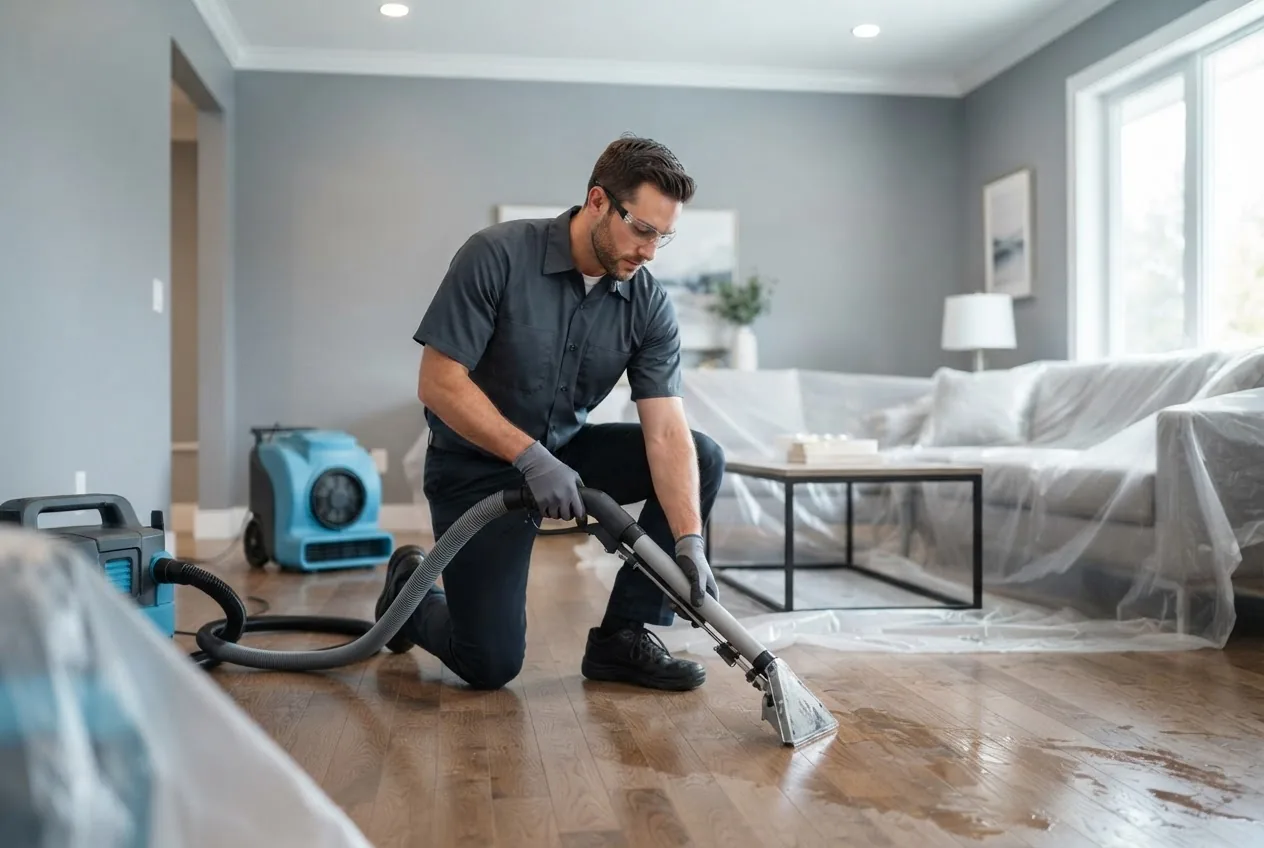
- Isolate utilities and assess hazards; deploy pumps/wet vacs to remove standing water (submersible pumps for deep water, truck-mounted extraction for large volumes).
- Remove unsalvageable porous materials and create access holes for drying inside assemblies where needed.
- Set and position air movers to create directed airflow across wet surfaces; use desiccant or refrigerant dehumidifiers to lower relative humidity.
- Measure moisture daily with pin and non-contact meters and record readings until target equilibrium moisture content is reached.
- Perform antimicrobial cleaning where contamination exists and apply containment to prevent cross-contamination.
Tools commonly used: submersible pumps, truck-mounted extractors, portable wet/dry vacs, centrifugal and axial air movers, refrigerant and desiccant dehumidifiers, hygrometers, infrared cameras, moisture pins and HEPA-filtered vacuums. This walkthrough overlaps with advanced training such as carpet water damage repair procedures and broader educational resources like water damage repair training.
For large inundations consult professional flood protocols in professional flood cleanup procedures.
Step 4 — Cleaning, deodorization and mold remediation
Answer: Cleaning removes soot, biohazards and contaminants; mold remediation isolates contaminated areas, removes affected materials and uses HEPA filtration and antimicrobial treatments to prevent recurrence.
Mold remediation follows containment, negative air, HEPA-filtered air scrubbing and removal of moldy materials; clearance sampling or visual verification confirms completion. For integrated water-and-mold programs see water damage mold remediation.
Step 5 — Reconstruction and finishing
Answer: Controlled rebuild restores structure and finishes to pre-loss condition, coordinating licensed trades and quality inspections until the property is handed back.
Reconstruction may include framing, drywall, flooring, roofing and finish carpentry; contractors should provide clear scopes, warranties and staged invoicing tied to inspections and insurance approvals.
Transition: Technical processes depend on legal and industry requirements; the next section explains licensing and certification standards that govern safe, compliant work.
Licensing, Certification, and Regulatory Requirements for Restoration Services?
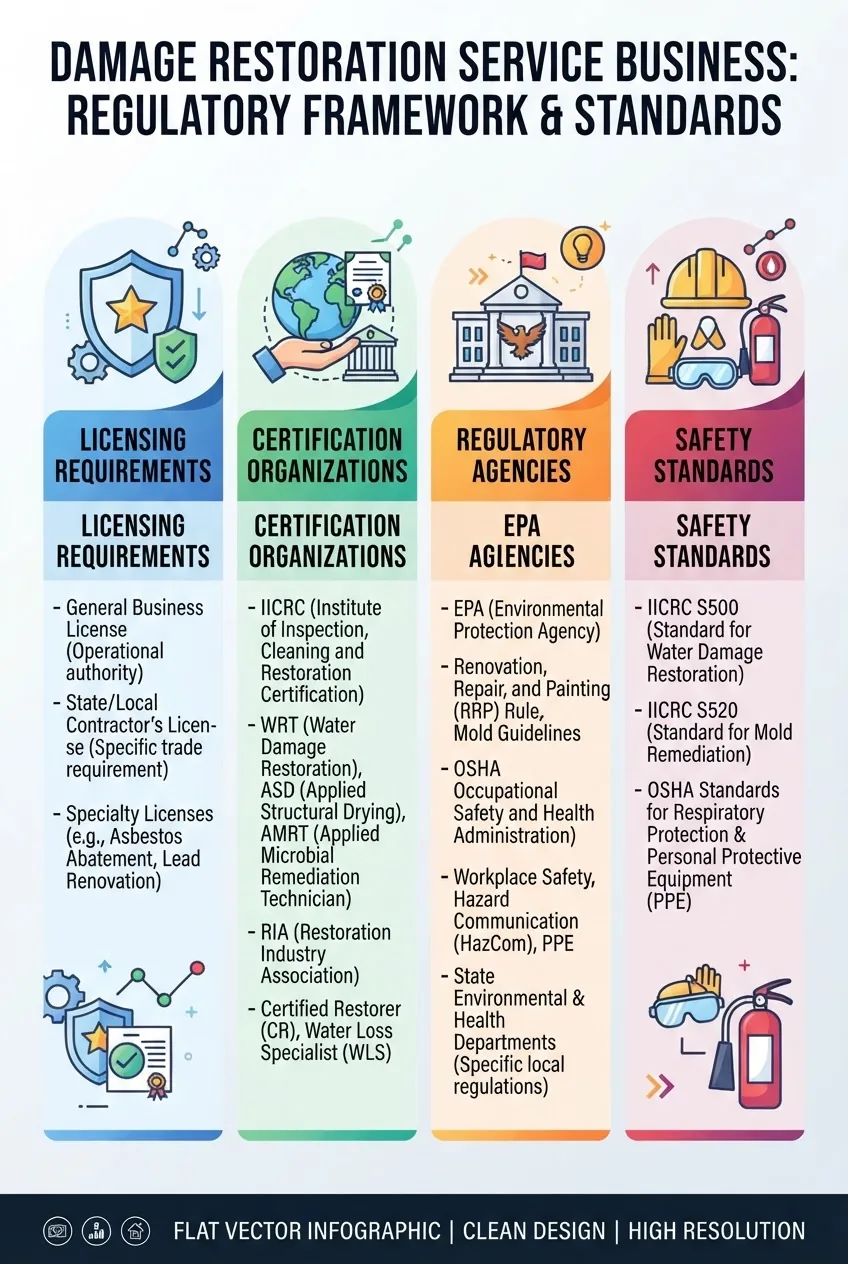
Answer: Restoration companies must meet local contractor licensing, industry certifications (notably IICRC standards), environmental and safety regulations, and insurance compliance to operate legally and protect homeowners.
IICRC certification: voluntary industry credentials from the Institute of Inspection, Cleaning and Restoration Certification that verify training in restoration standards and best practices.
Required and recommended items for restoration contractors:
- Local contractor license (where required by state or municipality) — trades performing structural repairs usually need a general contractor or specific trade license.
- Liability insurance and workers’ compensation coverage — proof typically requested before work begins to protect homeowners and crews.
- IICRC certifications (e.g., S500 for water damage, S520 for mold) to demonstrate technical competence. Industry standards and certification details are available at IICRC.
- Environmental regulations compliance for waste disposal, lead/asbestos handling and sewage remediation governed by local environmental agencies and federal rules; consult OSHA for workplace safety standards at OSHA.
- Documentation practices that meet insurer evidence requirements (itemized estimates, before/after photos, moisture logs and disposal manifests).
Trade‑specific qualifications and training paths most relevant to restoration businesses:
- General contractor or state-specific restoration contractor license (varies by state).
- Trade licenses for plumbing, electrical and roofing when work exceeds cosmetic repairs.
- Specialized certifications such as those detailed in fire and water damage restoration certifications and trade-specific routes like carpentry repair certification requirements.
- Water damage inspection credentials and training programs for accurate moisture assessment; see water damage inspection training.
Regulatory and claims context: insurers and consumer protection agencies set documentation expectations; for homeowner guidance on filing claims and insurance basics see consumer insurance guidance. According to a 2024 industry report, documented moisture logs and photographic evidence increase successful claim approval rates by a measurable margin (report type: industry white paper).
Transition: With licensing and certification requirements in mind, the next section explains how to select a qualified home damage repair company and what verification steps to take.
Choosing a Qualified Home Damage Repair Company?
Answer: Choose a company with proper licensing, insurance, verifiable certifications, positive reviews, clear warranty terms and transparent claims support; request references and a written scope before work begins.
Home restoration services: companies offering integrated mitigation and rebuild services that manage both restoration and reconstruction phases for homeowners.
Checklist for vetting a home damage repair company:
- Confirm local contractor license and insurance—ask for certificates and verify with issuing agencies.
- Confirm relevant certifications (IICRC S500/S520) and training records for technicians.
- Ask for detailed estimates, scope-of-work, timeline and warranty terms.
- Request before/after documentation practices and how they coordinate with insurers.
- Check online reviews, Better Business Bureau ratings and references from recent clients.
- Clarify emergency response times, 24/7 availability and any emergency fees.
When specialized work is needed, consider targeted providers: personal contents restoration is handled by personal property restoration services, exterior and landscaping by outdoor home repair and maintenance, and larger commercial jobs by commercial storm damage restoration teams. For selecting storm specialists see storm damage repair contractors and storm restoration companies.
Example: small residential clients often prefer bundled home restoration services that manage contents, structural drying and reconstruction for a single point of contact; larger commercial properties may benefit from separate specialty contractors.
Transition: Running a restoration business has operational complexities; the next section outlines business operations and standards owners must maintain.
Overview of Disaster Repair Service Business Operations?
Answer: Successful disaster repair businesses maintain licensing, trained staff, equipment inventory, clear workflows, customer communication systems and insurance relationships to deliver reliable emergency and restoration services.
Restoration business operations: the organizational systems, staffing, equipment and compliance practices that allow a restoration contractor to respond reliably to damage events.
Key operational elements with examples:
- Business licensing and compliance: registered business entity, contractor licenses, environmental permits and insurer vendor registrations.
- Service area coverage: defined radius with emergency dispatch protocols; larger firms operate regional hubs and mutual aid agreements for peak seasons.
- Training and staffing: ongoing technician training (IICRC courses, in-house competency checks), certification maintenance and safety briefings.
- Equipment standards: inventory management for pumps, air movers, dehumidifiers, HEPA vacs and personal protective equipment (PPE).
- Customer communication: centralized CRM, documented scopes, update schedules and single-point-of-contact project managers to reduce misunderstandings.
- Insurance and billing relations: pre-approved vendor status with insurers, digital invoicing and detailed claim support documentation to streamline payments.
Operational example: a mid-size restoration firm maintains a 24/7 dispatch line, two regional warehouses of equipment, certified crews rotating on-call schedules, and written mutual-aid agreements with neighboring firms during hurricane season. Complementary home repair skills—like paint and finish work—are often fulfilled through partnerships or in-house training such as handyman paint service training.
Transition: Even with strong operations, restoration work faces predictable challenges; the next section covers common problems and practical troubleshooting.
Common Challenges and Limitations in Damage Restoration?
Answer: Common challenges include hidden damage, secondary damage (mold, corrosion), limited access, insurance disputes, and environmental hazards; proactive assessment, containment and documentation mitigate most issues.
Frequent problem areas and troubleshooting tips:
- Hidden damage: Moisture behind walls or under floors can be missed; use thermal imaging and invasive probes early to find it and reduce surprises.
- Secondary damage (mold, rot): Delay in drying increases risk; prioritize rapid extraction and drying to avoid expensive mold remediation later.
- Access limitations: Attic, crawlspace or multi-story work can extend timelines; plan for hoisting, scaffolding or specialty crews in estimates.
- Insurance disputes and coverage gaps: Clear documentation, itemized scopes and pre-authorization reduce denials; if scope changes, obtain written insurer approval before proceeding to avoid out-of-pocket costs.
- Environmental hazards: Asbestos or lead paint discovered during demolition requires licensed abatement contractors and can add time and cost.
Pro tip: Treat initial scopes as tentative—include contingencies and communicate expected adjustments to homeowners and insurers to manage expectations and timelines.
Transition: Cost is a major concern for homeowners; the next section provides a breakdown of pricing factors and typical fee structures.
Cost Factors and Typical Pricing Structure for Damage Restoration?
Answer: Restoration pricing depends on damage type and severity, emergency response fees, materials, labor rates, equipment rental, containment needs, disposal costs and insurance coverage; estimates commonly use per-room or per-square-foot models plus line-item charges.
Stat block (typical ranges and factors):
| Cost Element | Typical Range | Notes |
|---|---|---|
| Emergency call-out / tarping | $150–$1,200 | Depends on response time and materials |
| Water extraction & drying (per room) | $500–$5,000 | Factors: equipment days, square footage, contamination |
| Mold remediation | $500–$6,000+ | Scope varies by containment and testing |
| Major reconstruction | $10,000–$100,000+ | Depends on structural repairs and finishes |
Numbered list of common pricing impacts:
- Damage severity and square footage.
- Type of contamination (clean water vs. sewage vs. chemical exposure).
- Access and height (multi-story or confined spaces increase labor and equipment costs).
- Emergency response and after-hours fees.
- Disposal, hazardous material abatement and permitting.
- Insurance coverage and whether work is pre-approved or paid out-of-pocket.
For commercial pricing factors see commercial water damage repair pricing and for typical homeowner cost estimates see water damage restoration costs.
Transition: After reviewing costs, the final section summarizes next steps homeowners should take when facing property damage.
Conclusion and Next Steps for Homeowners?
Answer: Immediately secure safety, document damage, contact your insurer, and engage a licensed restoration company with proper certifications to begin mitigation; insist on written scopes, moisture logs and warranties through the process.
Key takeaways:
- Prioritize safety and emergency mitigation to limit secondary damage.
- Document thoroughly with photos and moisture logs for claims.
- Verify licenses, insurance and certifications before hiring.
- Expect staged workflows: mitigation, drying, cleaning, then reconstruction.
- Communicate with your insurer and obtain approvals for scope changes.
Call-to-action: If your property is damaged, take photos, shut off utilities if safe, call emergency services or a qualified restoration firm, and notify your insurance carrier promptly to start the restoration timeline.