Carpet water damage repair training will leave you able to assess carpet saturation, perform emergency extraction, dry and sanitize fiber and pad systems, and decide when replacement is needed. Expect a realistic learning path of 2–8 weeks depending on hands-on hours; this guide assumes a competent DIYer or entry-level technician.
Before you start: prerequisites, basic tools and materials
- Prerequisites: basic home repair experience, ability to lift 40–50 lb, and familiarity with electrical safety around water.
- Documentation: ID, proof of prior training (if any), and local business licensing info if you plan to offer services.
- Essential PPE and consumables: N95 or P100 respirator, nitrile gloves, eye protection, disposable shoe covers, and anti-microbial cleaning agents.
- Starter tools: wet/dry vacuum or extractor, moisture meter, air mover(s), dehumidifier, carpet wands, carpet stretcher (if repair), knee pads.
- Assess the scene and source — Confirm the water category (clean, grey, black) and stop the source. Measure carpet and pad moisture with a moisture meter; target surface Relative Humidity (RH) < 60% within 48 hours after drying begins. Log conditions for training practice.
- Prioritize safety and containment — Cut power if water reaches electrical fixtures. Use cable covers and ground-fault interrupters on equipment. Establish an access-and-evacuation plan before extraction.
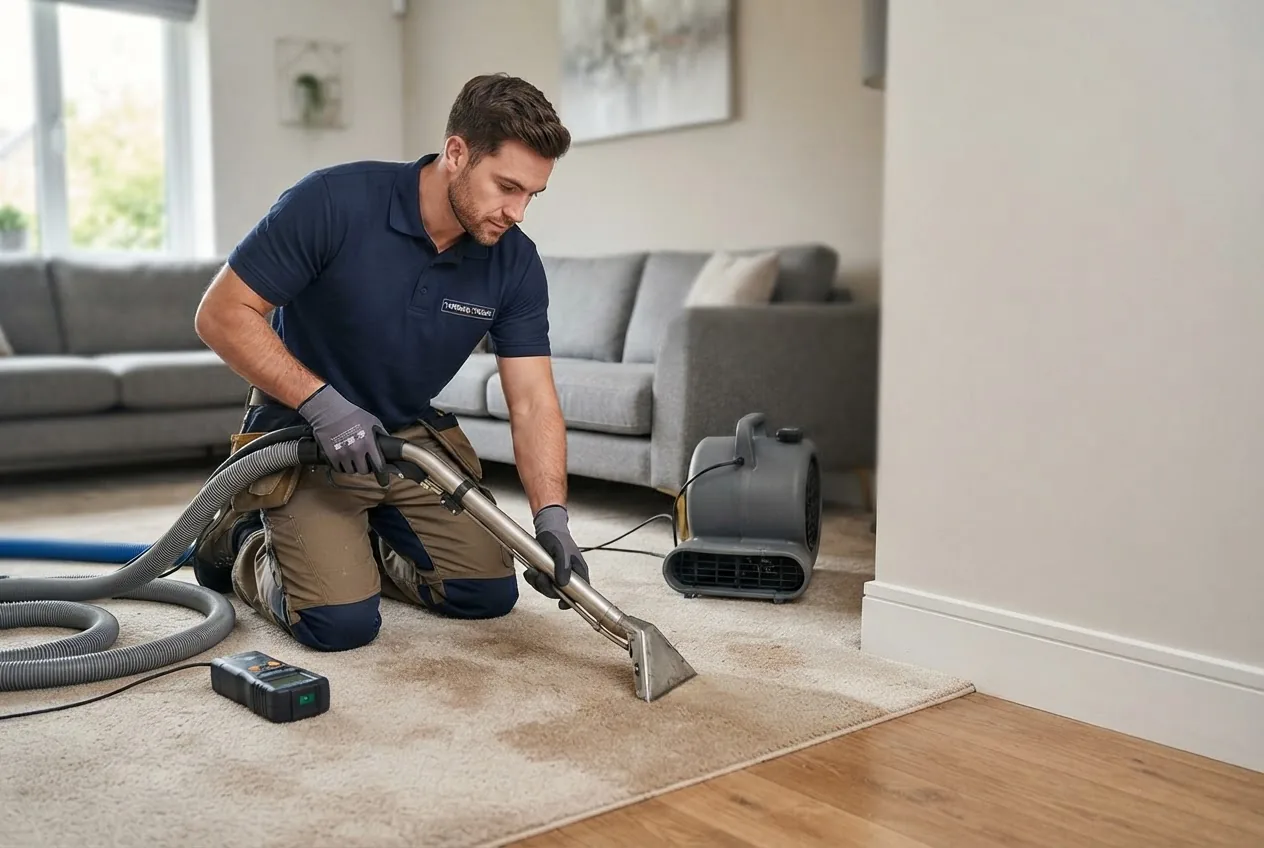
- Perform emergency carpet water extraction — Use a portable extractor or truck-mounted wand to remove standing water; work from the perimeter toward the exit. Aim for >90% surface water removal; typical pass time: 15–30 minutes for a 12×12 room with a commercial extractor.
- Lift carpet for pad inspection — Roll back carpet at seams, inspect the pad, and tag saturated spots. Replace pad when compressive deformation >15% or when it remains wet after 24–48 hours of drying.
- Set up drying system — Position 2–4 air movers on low for every 100–150 sq ft of carpet and one dehumidifier sized to remove 25–40 pints/day per 1,000 sq ft; monitor until carpet and subfloor reach equilibrium (moisture readings drop to baseline plus 2–3% for wood or manufacturer tile thresholds).
- Sanitize and treat for mold prevention — Apply EPA-registered antimicrobial to high-risk areas after extraction and before final drying; follow product label for dwell times.
- Complete repairs and reinstallation — Stretch and reattach carpet, replace pad where necessary, and seam repair. Use adhesive and seam tape per manufacturer specs.
- Quality check and documentation — Take moisture meter readings in carpet face fiber, backing, pad (if retained), subfloor; document pre/post levels and equipment run-times for client records or certification portfolios.
- Continuous learning and certification steps — Enroll in targeted courses for advanced extraction, odor control, and carpet repair techniques; maintain continuing education credits where required.
- Estimate and cost communication — Prepare transparent quotes separating extraction, drying, cleaning, and repair costs; include contingencies for hidden damage.
Introduction to Carpet Water Damage Repair
This section explains fundamentals, causes, and the specific challenges of restoring carpets after saturation. Start by learning definitions and categories so your field decisions are accurate.
What is carpet water damage repair? It’s the set of assessment, extraction, drying, cleaning, and repair techniques focused on carpet systems (pile fiber, backing, and pad) to return a floor to safe, useable condition while minimizing replacement. Common carpet-specific issues include wicking, fiber delamination, dye migration, and pad contamination.
Types of carpet damage to expect: surface staining, delamination, pad compression, mold growth in backing or pad, and subfloor moisture transfer that leads to cupping or buckling. Typical sources are leaks, overflows, plumbing failure, and storm-related infiltration.
Common causes and scenarios: roof leaks and storm runoff, burst pipes, appliance failures, and localized spills. For broader disaster context and how carpet damage fits inside full-structure restoration, see the storm damage restoration service guide and cost overview.
One frequent causal example: a failed supply line under a second-floor bathroom soaks carpeting below. Immediate actions — shut off water, extract standing water, and log humidity — often determine whether the carpet and pad can be saved. For pipe-caused incidents learn more about common plumbing failures at pipe burst damage restoration and for storm-driven flooding read about storm damage cleanup services.
Transition: with fundamentals clear, next we examine course options that teach these practical skills and how training modules map to real-world tasks.
Overview of Carpet Water Damage Repair Courses
Courses vary from single-day practical workshops to multi-week certification programs. Most are structured to combine classroom theory (damage categories, drying science) with hands-on labs (extraction wands, equipment setup, seam repair). Many providers list modules, required hours, and assessment criteria upfront.
Typical course delivery models:
- Short practical workshops (1–3 days): focus on extraction techniques and drying system setups.
- Certificate courses (2–6 weeks): include comprehensive modules, assessments, and at least 16–40 hands-on hours.
- Advanced multi-topic certifications (4–12 weeks): bundle carpet repair with odor control, upholstery, and microbial mitigation; often aimed at contractors.
- Self-paced online theory + in-person practicum: theory via e-learning (10–20 hours) with a 1–3 day hands-on lab.
Numbered list of typical course modules:
- Module 1 — Water damage fundamentals: water categories (1–3), pathways, and carpet-specific failure modes.
- Module 2 — Health and safety: PPE selection, electrical isolation, and chemical handling.
- Module 3 — Inspection and documentation: moisture mapping, photo documentation, and claims reporting.
- Module 4 — Emergency carpet water extraction: portable extractors, truck-mounted systems, wand techniques, and suction settings.
- Module 5 — Drying science and equipment deployment: air movers, dehumidifiers, airflow patterns, and psychrometrics basics.
- Module 6 — Cleaning and sanitizing: detergent selection, antimicrobial application, and odor control.
- Module 7 — Carpet repair and replacement: seam repairs, patching, pad replacement, and stretcher use.
- Module 8 — Special scenarios: pet stains, dye migration, and adhesive issues.
- Module 9 — Business practices: estimating, invoicing, customer communication, and safety compliance.
- Module 10 — Field practicum and assessment: real-world jobs under instructor supervision and documented competency checks.
Course duration and assessment: condensed workshops typically deliver 8–24 classroom hours and 4–12 lab hours; certificate programs often require 40–120 hours with a practical exam. Many employers prefer technicians who’ve completed at least 24 hands-on hours with verified competencies.
Where to find courses: local trade schools, industry associations, and manufacturer-authorized training programs. For training focused on inspection techniques, see water damage inspection training. For broader water damage repair entry-level training, review water damage repair training.
Transition: below we break down the exact skills taught, so you can match course modules to on-the-job tasks.
Key Skills Taught in Repair Courses
- Emergency carpet water extraction — Proper wand technique, suction pressure adjustment, working patterns (perimeter-to-exit), and pass counts; students practice achieving >90% surface water removal and documenting extract volume.
- Drying techniques — Air mover placement (two air movers per 100 sq ft guideline), dehumidifier sizing (pints/day per 1,000 sq ft), and running schedules (continuous for 24–72+ hours); students learn to measure equilibrium using moisture meters and hygrometers.
- Mold prevention — Time-to-dry thresholds, antimicrobial selection and application rates, and ventilation strategies that reduce RH below 60% within 48 hours to minimize mold risk.
- Damage assessment — Differentiating salvageable carpets from those requiring replacement based on pad condition, dye migration, backing breakdown, and subfloor contamination; includes photo-documentation standards.
- Carpet repair skills — Seam repair, patch techniques, power stretching settings, and trim/finish methods; students practice with carpet remnants.
- Equipment operation and maintenance — Setting extractor PSI, pump checks, wand maintenance, dehumidifier condensate handling, and electrical load balancing for multiple 120/240V devices.
- Client communication and reporting — Creating clear estimates that separate extraction, drying, cleaning, and repair; basic invoicing and consumer education on post-drying care.
Transition: hands-on competence is often validated through formal certification; the next section covers accreditation, standards and recognized credentials.
Certification and Accreditation for Carpet Water Damage Repair
Certification gives technicians and employers verifiable proof of competency. Accredited bodies and manufacturer programs offer different scopes: some focus narrowly on carpet systems while others bundle fire and water restoration topics.
Common certification paths:
- Industry association certificates (e.g., IICRC specialty certifications) for practice-based credibility.
- Manufacturer-specific programs for equipment proficiency (extractors, dehumidifiers, and specialized cleaners).
- State or local trade licenses where required for contracting work.
As per current certification standards, documented hands-on hours and passing a practical exam are frequent requirements. For recognized multi-damage credentials that include carpet modules, see fire and water damage restoration certifications.
Additional external authority and accreditation references:
- IICRC (Institute of Inspection, Cleaning and Restoration Certification) — widely recognized industry standards and certification schemata.
- OSHA — occupational safety rules and electrical/wet-environment guidance for technicians.
- EPA guidance on mold — public-health-oriented resource for microbial concerns in water-damaged materials.
Related certifications and adjacent trades: if you’re considering expanding skillsets, compare carpet-specific credentials with general home trades like carpentry repair certification requirements.
Transition: certification involves costs — below is a detailed cost breakdown so you can budget for tuition, credentialing, and equipment.
Cost Breakdown of Carpet Water Damage Repair Training
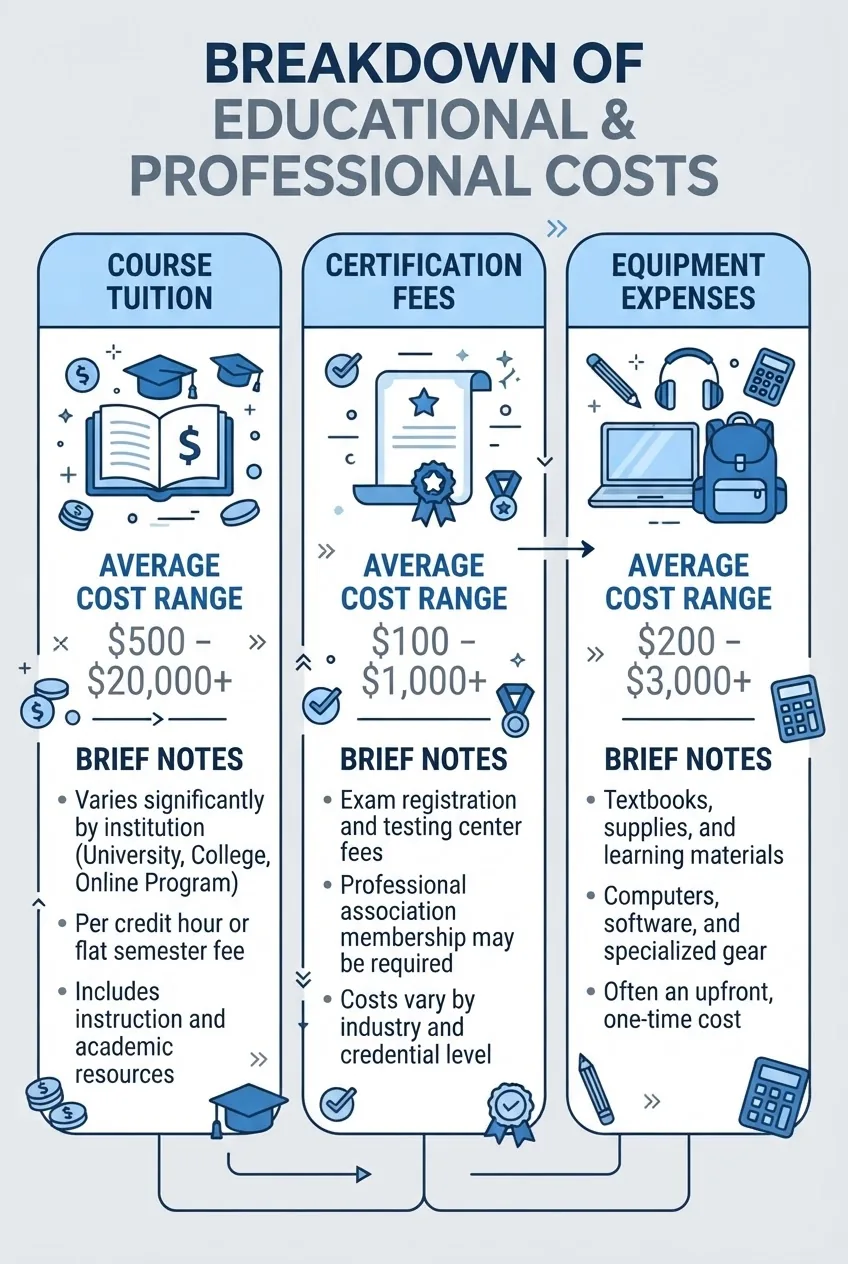
Costs vary by provider, course length, and region. This breakdown separates tuition, certification fees, equipment expense, and ongoing costs. Bear in mind regional variance; estimates are midpoint ranges based on 2023–2024 industry pricing reports.
| Cost type | Typical range (USD) | Notes |
|---|---|---|
| Short practical workshop (1–3 days) | $150–$650 | Focused extraction/drying labs; less hands-on time. |
| Certificate courses (2–6 weeks) | $800–$3,200 | Includes classroom and 16–40 hands-on hours. |
| Advanced multi-topic certification | $1,500–$6,000 | Often bundled with business modules and multi-damage training. |
| Certification exam/credential fee | $50–$450 | Depends on cert body and recertification cycle. |
| Personal starter equipment | $800–$6,000 | Includes portable extractor ($400–$3,000), air movers ($60–$300 each), dehumidifier ($600–$2,500). |
| Advanced/Truck-mounted equipment | $15,000–$60,000+ | For business owners scaling to commercial jobs. |
| Consumables and PPE (annual) | $200–$1,200 | Sanitizers, cleaning agents, replacement hoses and filters. |
Breakdown notes and financing options
- Tuition: shorter workshops are budget-friendly for a single skill; certificate courses provide portfolio hours employers expect.
- Certification fees: factor in recertification (every 1–3 years) and continuing education costs.
- Equipment expense: prioritize a quality portable extractor and one or two air movers for initial fieldwork; later invest in a commercial dehumidifier.
- Financial aid: some trade schools and community colleges offer payment plans or vocational grants; ask providers directly.
- Cost comparison context: compare these training costs against professional service bills — for example, average professional carpet extraction and drying for a single-story 200 sq ft job may range from $300–$1,200 depending on extraction complexity. For broader service cost context see flood cleanup professional service costs and water damage restoration costs.
Transition: cost planning is necessary, but the core technical competency is emergency extraction; the next section provides step-by-step extraction techniques used in the field.
Emergency Carpet Water Extraction Techniques
Emergency carpet water extraction is the immediate, high-value action that reduces secondary damage and the need for replacement. The steps below are a field-tested procedure taught in workshops and practicum labs.
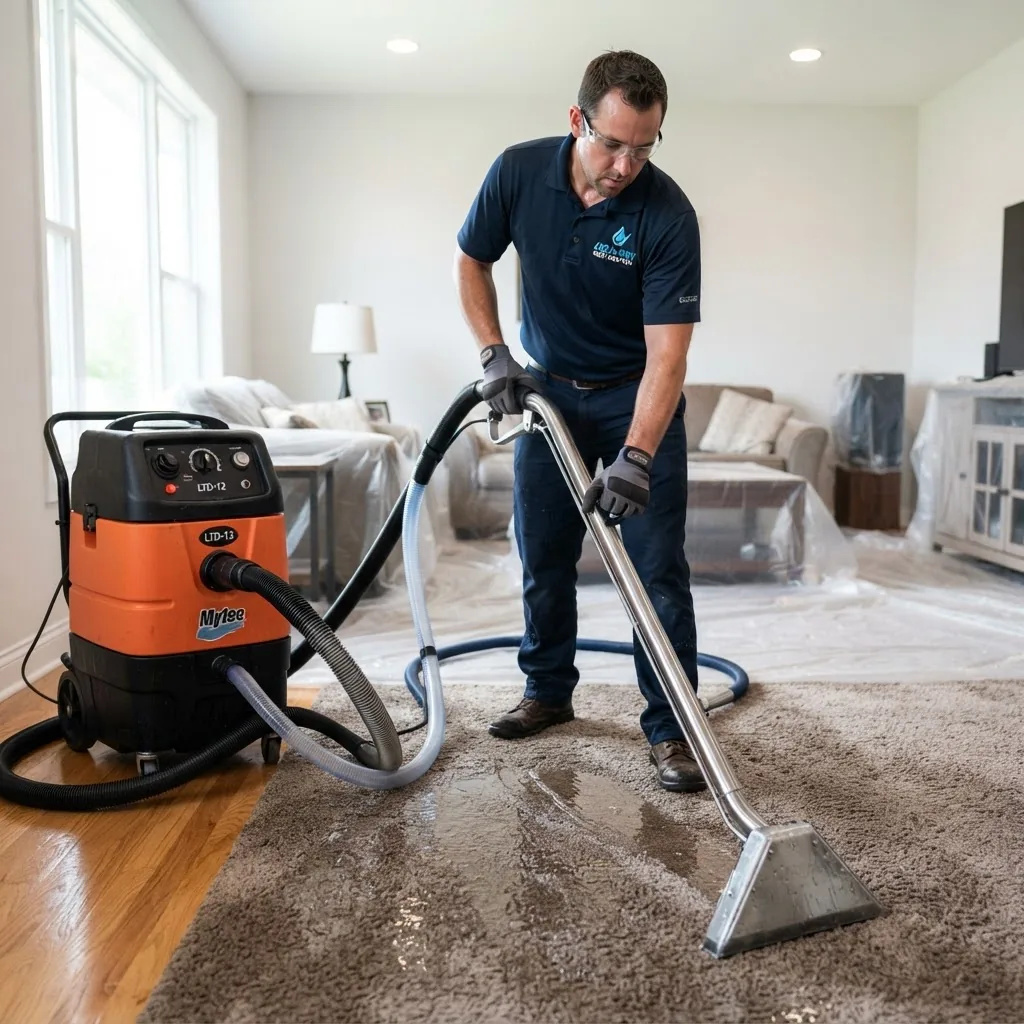
- Secure the scene and stop the source — Confirm safety: power off circuits if water reaches outlets; isolate the leak. Time target: within first 10–30 minutes of arrival for residential calls.
- Evaluate water category and room layout — Categorize as clean (Category 1), grey (Category 2), or black (Category 3). Use category to determine PPE and containment. For wide-area contamination, plan for pad removal; target assessment time: 5–15 minutes.
- Remove standing water with low-lift pumps (if deep) — If standing water >1 inch deep, start with a sump pump or submersible pump before extractor. Pump rate target: 15–30 gallons per minute with appropriate hoses.
- Use extractor passes efficiently — For carpeted areas, run wide overlapping passes with a carpet extraction wand; keep nozzle at a 30–45° angle, slow consistent speed (approx. 1 ft/sec), and use multiple passes until the wand picks up minimal moisture (clear solution in recovery tank). Aim to remove 85–95% of surface water during extraction stage.
- Back-roll or lift carpet for pad inspection — Roll carpet back in 3–6 ft sections to inspect pad and subfloor. Replace pad when saturated beyond recovery or when contamination category is 3. If pad is replaced, note pad thickness and density for proper matching.
- Set up targeted drying — Place air movers at 30–45° to carpet surface, creating a circular airflow pattern; two air movers per 100–150 sq ft is a practical rule. Dehumidifier sizing: select a unit able to remove at least 25–40 pints/day per 1,000 sq ft for moderate humidity; adjust up for humid climates.
- Monitor moisture and humidity — Use a moisture meter for carpet fiber/backing readings and a hygrometer for room RH and temperature. Record readings every 12 hours until equilibrium is reached — defined as two consecutive readings 12 hours apart with <3% variance in structural materials or RH < 60% and falling.
- Sanitize and treat for odors — After extraction and once most free water is removed, apply an EPA-registered antimicrobial to backing and pad salvageable areas. Use low-foaming detergents for carpet cleaning; extract thoroughly to remove residual chemicals.
- Reinstall or replace pad and finish — If pad was removed and replaced, allow subfloor to come to moisture equilibrium before re-laying pad (typically 24–72 hours). Re-stretch carpet using a power stretcher, not knee kicker alone, to avoid seam issues.
- Document and communicate — Log extraction volumes, equipment run hours, moisture readings, and any decisions to replace materials. Provide the client with a clear summary and drying timeline.
- When extraction isn’t enough — If backing delamination, dye migration, or persistent odors exist after 48–72 hours of proper drying, plan replacement and advise the client with documented reasons.
Related resources and broader emergency extraction contexts: for basement-focused scenarios, see basement flood cleanup services, and for hurricane-related carpet flooding situations consult hurricane damage repair services. For roof-leak related carpet flooding see roofing fix services and costs.
For professional water removal equipment comparisons and full-service contexts consult professional water removal services.
Transition: successfully extracting and drying carpets depends heavily on the right equipment; the next section details essential tools and how to choose them.
Career Opportunities and Industry Demand Post-Certification
Completing targeted carpet water damage repair training positions you for several career paths: technician roles at restoration companies, self-employed specialist services, insurance-contract work, or expansion into adjacent trades. According to a 2024 industry report, demand for skilled carpet restoration technicians rose by approximately 6–9% year-over-year in regions with aging housing stock and frequent storms.
Job types and sample salary ranges (U.S. estimates, 2024 industry data):
- Entry-level restoration technician: $30,000–$45,000 annually.
- Certified technician / lead: $45,000–$65,000 annually.
- Business owner / truck-mount operator: $60,000–$120,000+ depending on market and contracts.
Where technicians find work: independent restoration businesses, property management companies, insurance vendors, and specialty carpet cleaning firms. Employers often prefer candidates with documented hands-on hours and certifications from recognized bodies.
Career pathway examples (hypothetical):
I trained in a six-week certificate program, logged 40 field hours, then joined a restoration company as a junior tech; within 18 months I was leading job sites handling complex carpet replacements and estimates.
For career avenues in commercial restoration, review commercial storm damage restoration services and employer types like storm restoration companies. If you plan to specialize, consider cross-training in related trades such as handyman paint service training, and outdoor home repair courses for complementary offerings.
Business structures and employer types: you may work for a personal property restoration companies, a full-service mitigation contractor, or a water mitigation company services. For contractor-focused career options see storm damage repair contractors.
Transition: now that you understand the job market, let’s cover the essential tools you’ll use daily and why each matters.
Equipment and Tools Essential for Carpet Water Damage Repair
This section lists the core tools, typical specs, and purchase guidance for technicians starting out or expanding a fleet. Proper selection affects drying times and restoration outcomes.
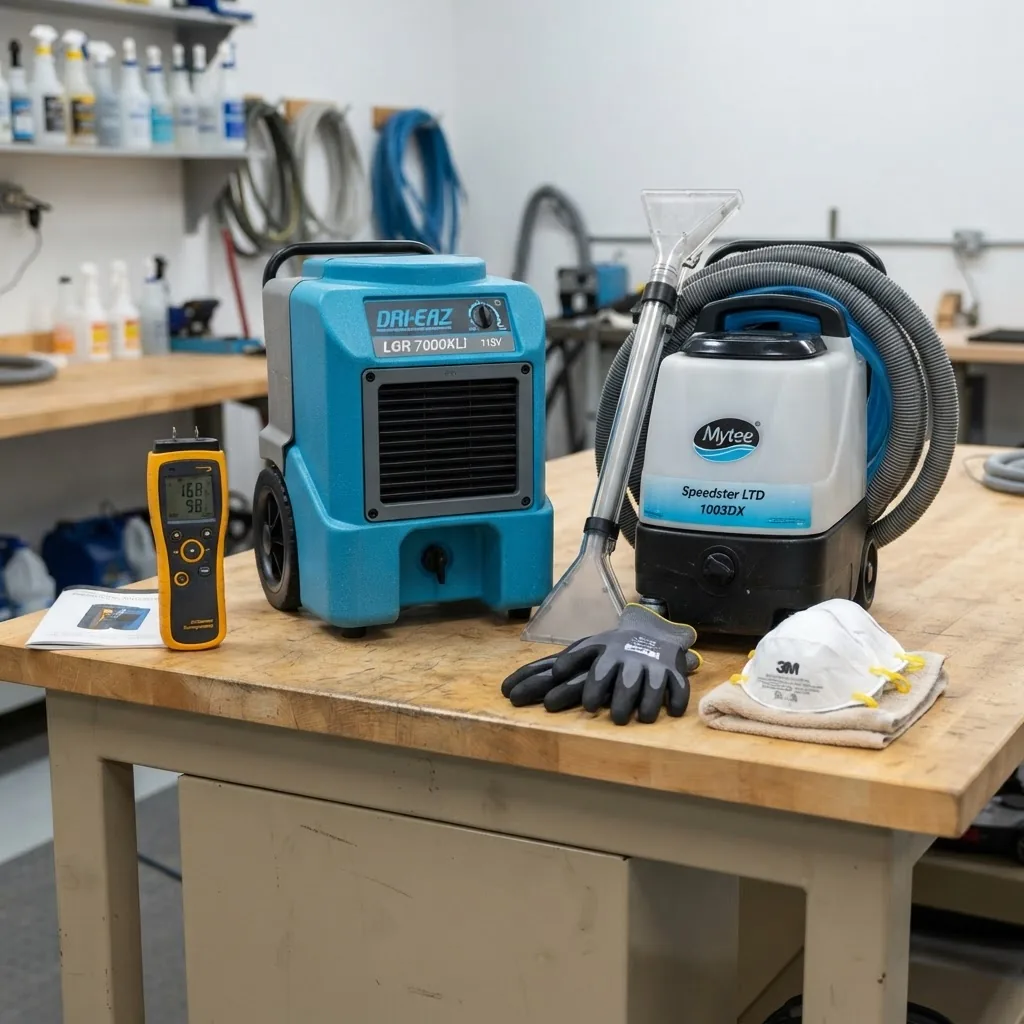
- Portable carpet extractor — 6–20 gallon recovery tank, adjustable vacuum, 1.5–3.0 HP pump. Use for smaller jobs and detailed wand work; cost $400–$3,000.
- Truck-mounted extractor — high-flow, continuous suction for fast extraction on larger jobs; common for contractors scaling operations.
- Air movers — centrifugal blowers rated 900–1,400 CFM; place at 30–45° angles. Typical count: 2–4 per 200 sq ft for carpet projects.
- Desiccant or refrigerant dehumidifier — refrigerant units for standard conditions; desiccant units for low-temp or high-RH conditions. Size by pints/day required for space.
- Moisture meters — pin-type for wood/subfloor, pinless for carpet face/backing; calibration frequency: every 6–12 months.
- Wet/dry vacuums and pumps — for preliminary standing water removal; submersible pumps rated for solids may be needed for black water.
- Carpet tools — seam irons, power stretchers, knee kickers, seam tape, and patching supplies.
- PPE and health gear — respirators, gloves, boot covers, and eye protection for Category 2–3 jobs.
- Small hand tools — utility knives, pry bars, knee pads, and measuring devices.
For heavy-duty and commercial-grade equipment used in larger facilities consult the standards and suppliers listed in commercial water damage repair services.
Transition: with tools in hand, you must follow safety and environmental procedures to protect occupants and yourself; the next section outlines required precautions and regulatory references.
Health, Safety, and Environmental Considerations
Working with water-damaged carpets introduces hazards: electrical risk, microbial growth, chemical exposure, and improper disposal. Follow documented safety practices and local regulations.
Key safety actions and standards:
- Electrical safety — de-energize circuits when water has contacted outlets; use GFCI-protected equipment. Follow guidance from damage restoration service requirements and government pages such as https://www.osha.gov for worker protections.
- Mold risk — monitor RH; treat surfaces when indicators of microbial growth appear. For cost context and remediation thresholds see water damage and mold remediation costs.
- Chemical handling — use EPA-registered antimicrobials according to label; store SDS for each product onsite.
- Waste disposal — contaminated pads or carpet may be classified as construction waste; follow local regulations for disposal and recycling.
External authoritative resources:
- EPA — mold guidance for health-oriented precautions and when to involve public health.
- OSHA for worker safety and handling electrical hazards in wet environments.
Limitations and variability: training and operational standards evolve; costs and equipment specifications vary by region and manufacturer. According to a 2023 industry report, recommended drying targets and equipment run-times have tightened in colder climates to prevent prolonged humidity exposure.
Transition: having covered safety and tools, below are hands-on practitioner tips, common mistakes, and a checklist you can use on real jobs.
Conclusion and Next Steps for Prospective Trainees
By completing targeted carpet water damage repair training and combining it with practical hours, you will be able to respond quickly to carpet flooding events, restore salvageable carpets, and provide transparent cost estimates. Next steps: enroll in a course that includes a minimum of 16–24 hands-on hours, invest in a quality portable extractor and two air movers, and pursue a recognized certification within 12 months of training.
Call to action: start by requesting syllabi and lab-hour breakdowns from at least three providers, compare pricing against the cost table above, and schedule a hands-on practicum session this quarter.
Common mistakes and how to avoid them
These are lessons I’ve learned on job sites and while training students — real observed failures and the fixes I teach:
- I once under-estimated pad saturation and left a soaked pad in place; within 48 hours the client reported a musty odor. Fix: always lift and inspect pad; when in doubt, replace the pad and document the reason.
- I used too few air movers for a large room and stopped monitoring RH; drying stalled at 65% RH. Fix: follow the two-per-100–150 sq ft rule and log hygrometer readings every 12 hours.
- I neglected to shut a nearby circuit off before deploying a truck-mounted extractor; this created an electrical hazard. Fix: always confirm circuit status and use GFCI-protected cords and equipment.
Compact checklist to verify your work
- Source stopped and site secured.
- Water category documented and PPE used accordingly.
- Standing water removed (>85% surface removal during extraction).
- Air movers and dehumidifier placed and running; equipment log started.
- Moisture meter and hygrometer readings recorded every 12 hours.
- Pad condition verified; replaced if saturated or contaminated.
- Sanitizer applied where required; dwell times observed per label.
- Final readings show equilibrium (2 consecutive checks with <3% variance) or RH <60%.
- Client receives a documented report with photos, readings, and next steps.
When to call in a professional
- Category 3 (black water) contamination, sewage, or hazardous chemical exposure.
- Widespread flooding affecting multiple rooms or structure-level damage.
- Visible mold growth extending beyond 10 sq ft or persistent odors after 72 hours of drying.
- Electrical hazards present or suspected structural compromise.