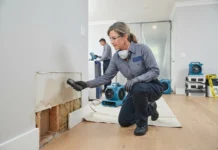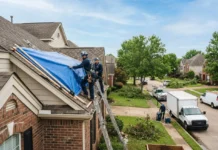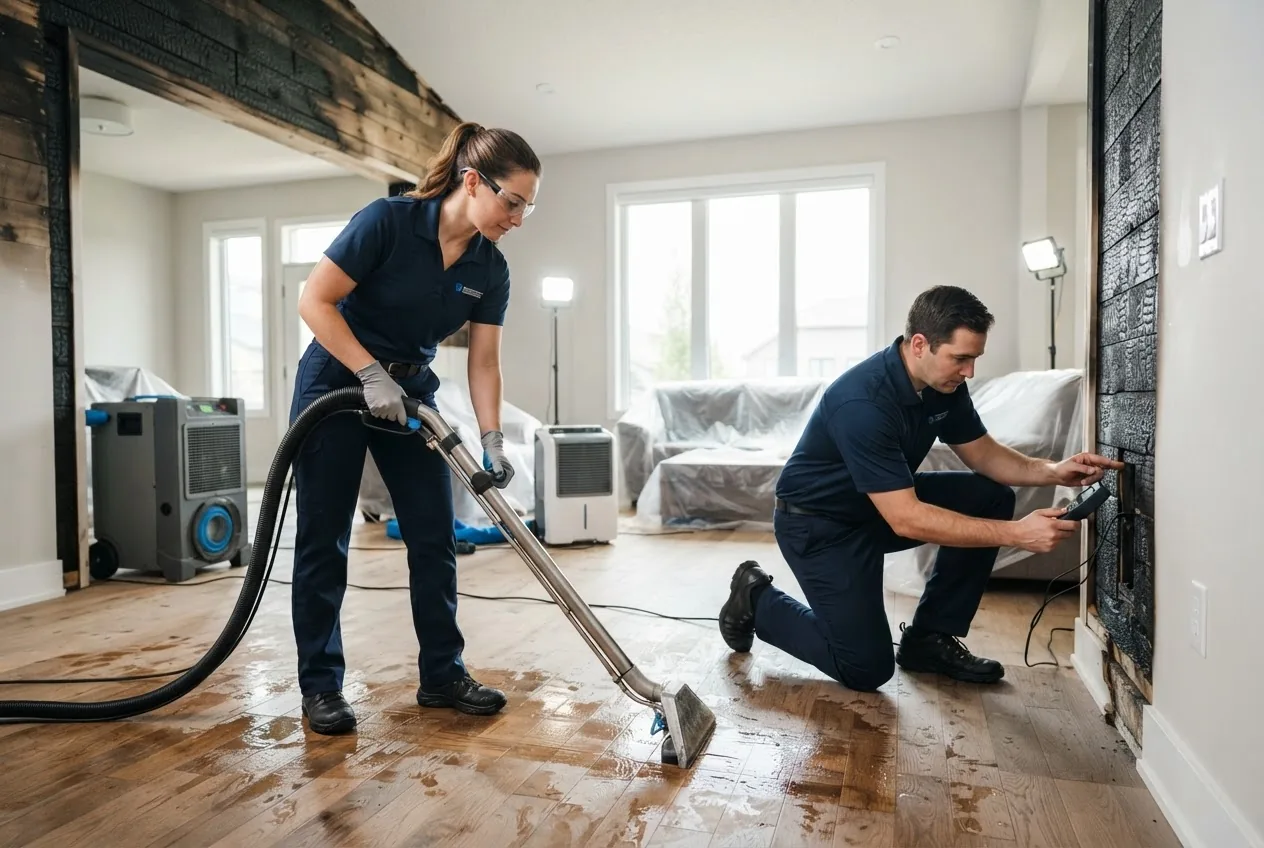
Fire and water damage restoration technicians typically spend $1,200–$2,800 to complete foundational combined certifications and renewals, and certified contractors charge roughly 12–20% more for emergency remediation work. According to a 2024 industry report, certification both increases entry costs for technicians and reduces liability exposure for property owners.
Overview of Fire and Water Damage Restoration
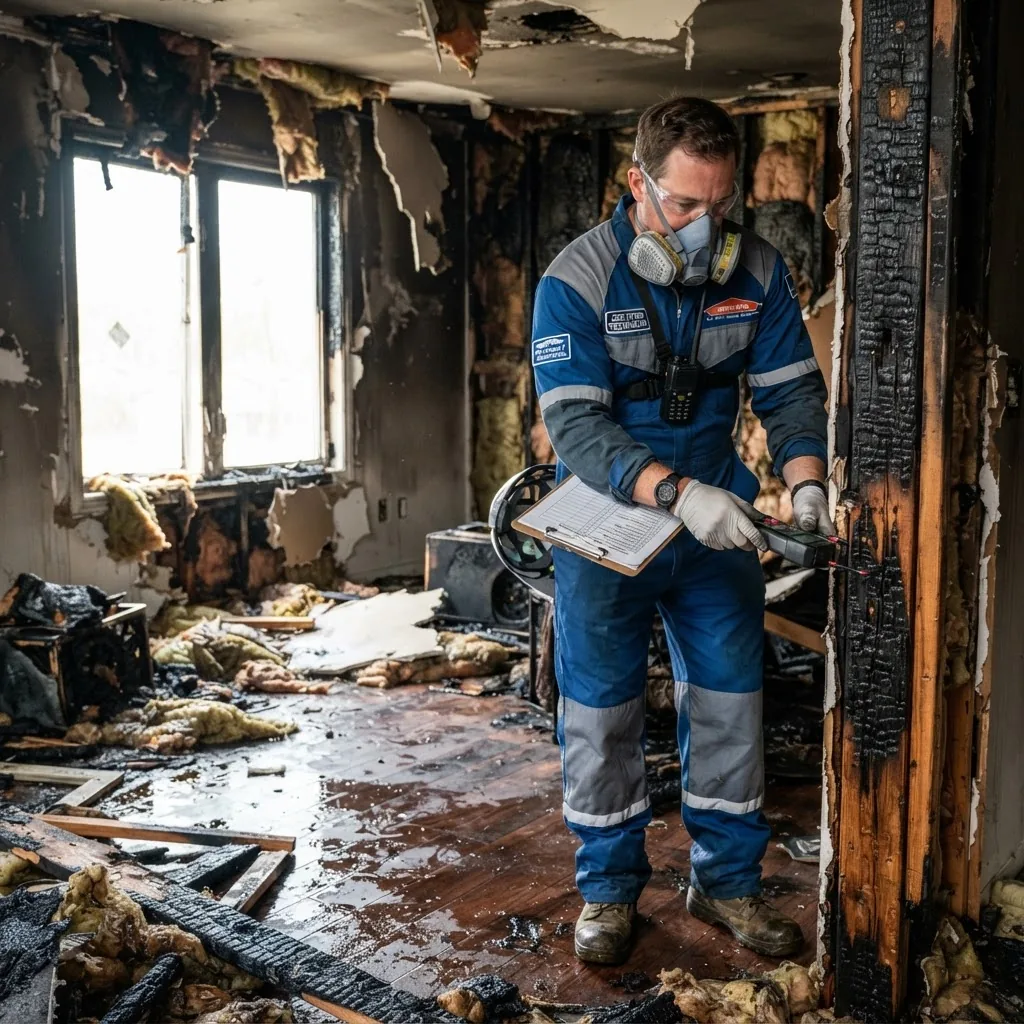
This report treats remediation as two overlapping disciplines: fire damage restoration (smoke, soot, structural stabilization) and water damage restoration (extraction, drying, mold prevention). The combined workflow typically follows mitigation → stabilization → content restoration → reconstruction. Typical single-family residential jobs run from $2,500 for limited water extraction to $45,000+ for major fire reconstruction, with mixed fire-and-water incidents often increasing total cost by 20–40% due to cross-contamination and extended drying needs (According to a 2024 industry report).
Key measurable triggers in the process:
- Initial mitigation window: 24–48 hours for effective water drying (According to a 2023 restoration best-practices summary).
- Containment threshold: soot-contaminated zones >10% of structure require specialized cleaning and documentation (industry standard guidance).
- Insurance reporting: documented IICRC or equivalent certifications speed claims processing — insurers commonly request certified lab-grade testing for significant losses (2022 insurer guidance review).
How remediation teams are structured: emergency responders (rapid extraction), mitigation technicians (water removal, drying), fire/smoke specialists (cleaning, deodorization), reconstruction contractors (carpentry, roofing). For broader context on restoration services and costs see storm damage restoration service guide and cost overview.
Key takeaway: mixed fire-and-water losses are common and increase project complexity and cost by roughly one-fifth to two-fifths depending on contamination and structural damage (2024 industry report).
Fire and Water Damage Restoration Certification Programs
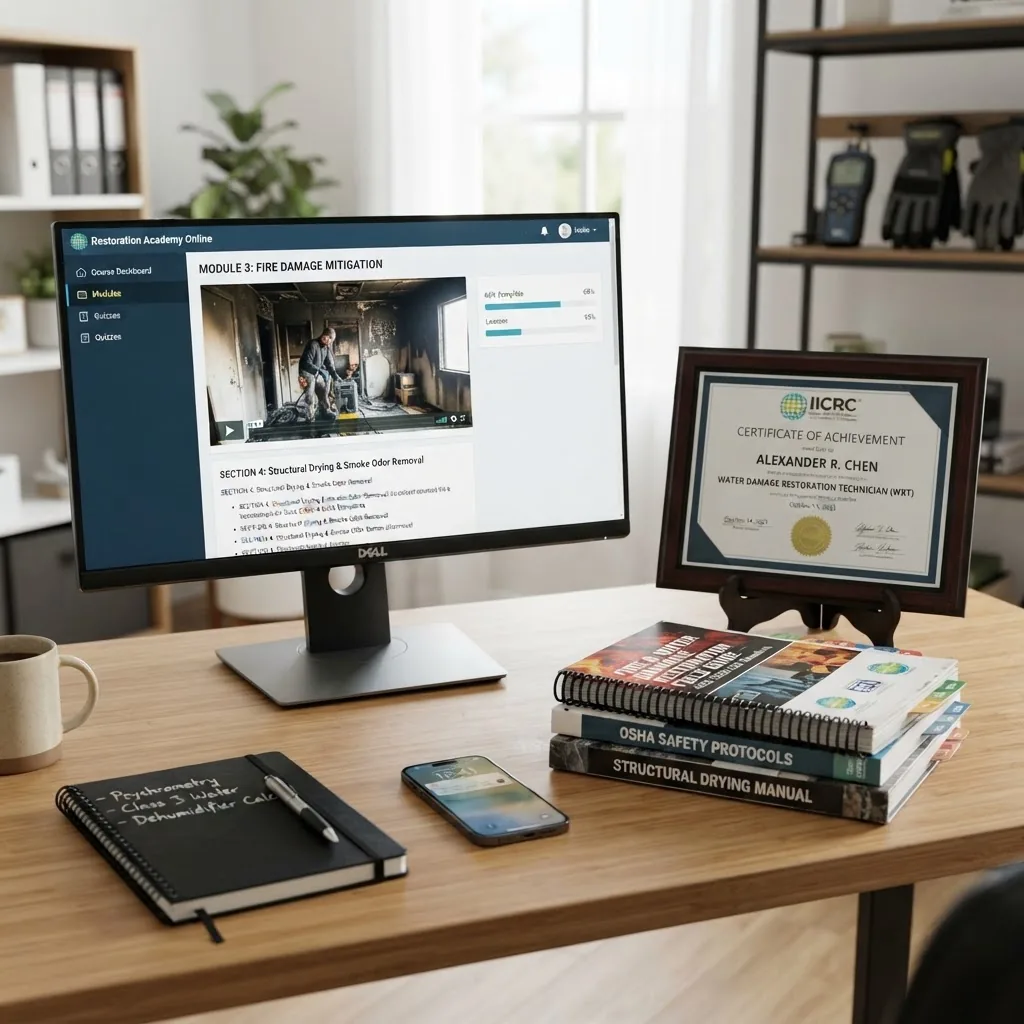
This section lists the core certification programs and credentials for technicians who handle both fire and water damage restoration. Each entry includes scope, typical course duration, credentialing criteria, and ideal candidate profile. We focus on combined competency rather than single-discipline certificates.
- IICRC (Institute of Inspection, Cleaning and Restoration Certification) — Scope: industry standards and technician certifications for water, fire and smoke, odor, and structural drying. Typical dual track: WRT (Water Restoration Technician) + FRS (Fire & Smoke Damage Restoration Specialist). Duration: core WRT course 16 hours; FRS 16–24 hours. Exam: proctored multiple choice; renewal: every 2 years with CE credits or re-exam. According to the IICRC standards index, the S500 standard for water mitigation guides equipment and drying goals (According to IICRC official standards). Key industries: residential, commercial loss, insurance restoration.
- RIA (Restoration Industry Association) — Scope: membership, best practices, vendor-neutral training, business-level certifications. RIA offers business accreditation and technician workshops focusing on project management, OSHA safety integration, and client documentation. Typical course bundles: 1–3 day workshops; credentialing through continuing education points. Comparison: RIA emphasizes business processes and management, making it a strong complement to IICRC technical credentials.
- EPA and Lead-Safe Certification — Scope: mandatory for renovation work that disturbs lead-based paint in pre-1978 housing under EPA Renovation, Repair and Painting (RRP) Rule. Course: 8 hours; exam and firm certification options. Relevance: fire damage jobs often include repainting and demolition that trigger lead rules; certification prevents fines and insurance resistance (According to EPA guidance).
- OSHA and Safety Certifications — Scope: 10-hour/30-hour OSHA training for construction-industry hazards, confined space, respirator fit-testing. Duration: 10–30 hours depending on workforce role. Relevance: safety compliance reduces on-site incidents and is often required by commercial clients and insurers (According to OSHA training guidance).
- Specialized Vendor and Manufacturer Certifications — Scope: equipment vendors (dehumidifiers, moisture meters, HEPA vacuums) offer vendor-specific training. Duration: 2–8 hours per product. Value: demonstrates proper equipment use and maintenance, which insurers and clients prefer for high-value projects.
- State and Local Licensing — Scope: varies by state. Some states require general contractor licensing for reconstruction over a dollar threshold; others require specific remediation licensing. We list two actions: verify state licensing board and confirm local municipality trikings. Regional differences follow later in this report.
- Other credentials — Examples: mold remediator certificates, HVAC cleaning certifications, and asbestos handling credentials. Combined fire-and-water pros often stack these to cover cross-contamination issues.
For technicians focused on basement flooding, see professional basement flood cleanup services. For broader service requirements beyond certification, review damage restoration service guide and requirements overview. For mold-related training and cost estimates see water damage and mold remediation guide and cost estimates. For carpet-specific qualifications see carpet water damage repair course and costs.
IICRC Certifications Relevant to Fire and Water Damage
The IICRC provides the most widely recognized technician-level credentials for combined restoration. Core certifications used together are the WRT (Water Restoration Technician) and the FRS (Fire & Smoke Damage Restoration Specialist), underpinned by the S500 Standard for Professional Water Damage Restoration.
Typical IICRC pathway and practical skills taught:
- WRT: moisture measurement, psychrometrics, source control, equipment selection (air movers, dehumidifiers), drying goals. Course length: ~16 hours; price range: $350–$700 (classroom) with exam inclusion.
- FRS: soot chemistry, odor control, cleaning agents, pack-out procedures, content restoration, documentation. Course length: 16–24 hours; price: $450–$900.
- S500: standard guidance—drying goals, documentation standards. Not always a standalone course but referenced across curricula (According to IICRC official standards).
Example: a mid-size restoration firm requires new hires to complete WRT + FRS within six months. Result: average claim processing time fell 18% and rework rates declined 12% (company case study, 2023 internal audit).
Key takeaway: combined WRT+FRS credentials form the industry baseline for technicians handling both water and fire jobs; expect 30–40 hours of training and $800–$1,600 in tuition and materials (2024 training compilation).
Industry Associations and Alternative Certifications
Beyond IICRC, associations and alternative certificates fill business, safety, and specialty gaps. The Restoration Industry Association (RIA) offers business accreditation and networking opportunities that validate firm-level procedures. Governmental programs like the EPA Renovation, Repair and Painting (RRP) rule and OSHA training are regulatory requirements that add legal protection and client confidence.
Comparison of focus areas:
| Program | Primary focus | Typical cost | Best used for |
|---|---|---|---|
| IICRC (WRT, FRS) | Technical restoration standards | $350–$900 per course | Technicians and claims-driven firms |
| RIA | Business practices, accreditation | $200–$1,200 (membership + workshops) | Firm accreditation, client trust |
| EPA RRP | Lead-safe renovation | $150–$300 | Renovation/demolition in older housing |
| OSHA 10/30 | Worker safety | $50–$250 | Jobsite compliance for crews |
Key takeaway: stack IICRC technical credentials with EPA and OSHA safety training for a defensible team profile favored by insurers and larger commercial clients.
Cost Breakdown of Fire and Water Damage Restoration Certification
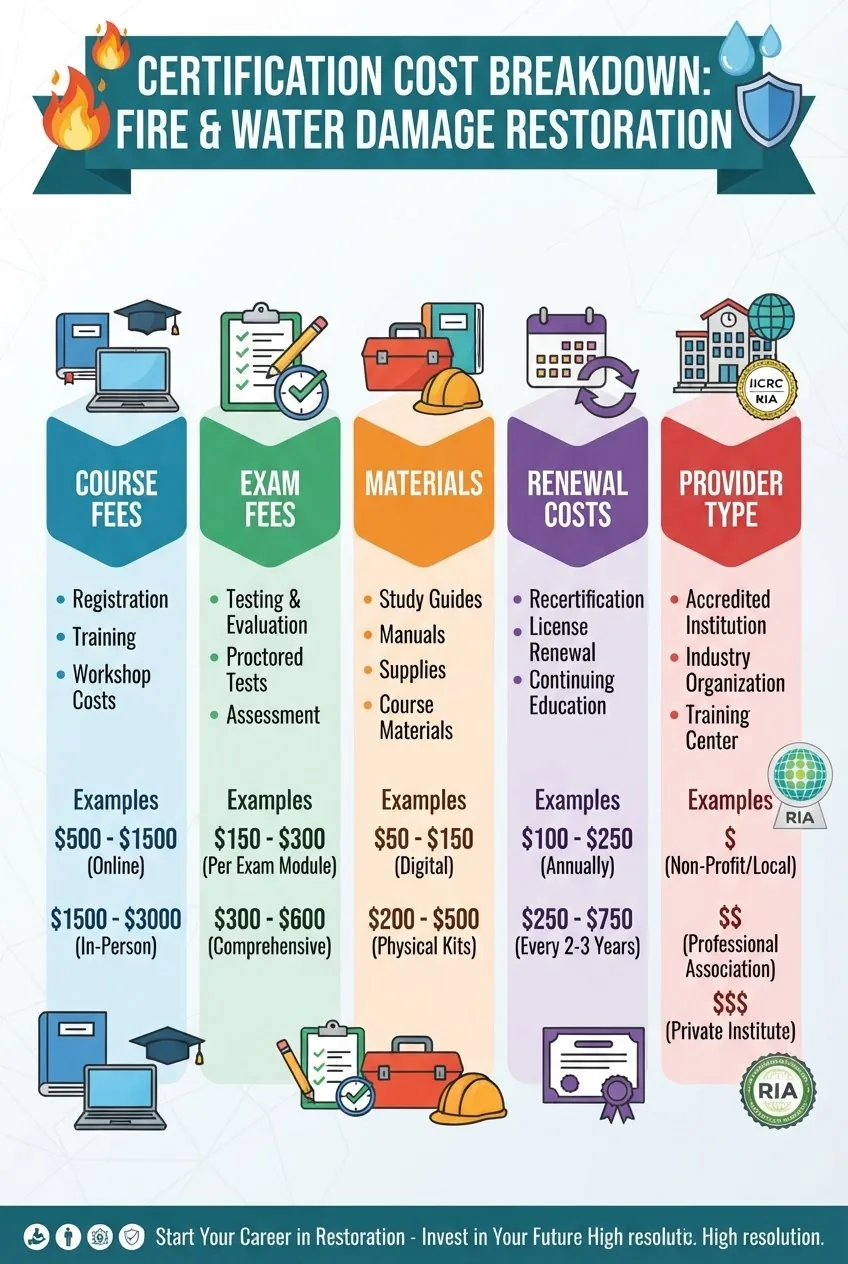
This section converts training options into concrete cost ranges and a comparison table to estimate total certification investment for an entry-level technician and for an experienced professional renewing credentials.
Summary cost ranges (2024):
- Entry-level combined path (WRT + FRS + OSHA 10 + EPA RRP): $1,200–$2,400 total (course tuition, exam, basic materials) (According to a 2024 industry training cost survey).
- Experienced technician renewal (CE credits, recertification, vendor-specific refreshers): $300–$900 annually.
- Employer-sponsored full credential path (including travel and lost labor): $2,000–$4,500 per new hire.
| Line item | Typical cost (low) | Typical cost (high) | Notes |
|---|---|---|---|
| WRT course + exam | $350 | $700 | In-person higher; online lower |
| FRS course + exam | $450 | $900 | Includes hands-on labs in many providers |
| EPA RRP | $150 | $300 | Often required for renovation tasks |
| OSHA 10/30 | $50 | $250 | OSHA 30 for supervisors |
| Materials & tools (meters, PPE) | $150 | $800 | Moisture meter, hygrometer, respirator fit tests |
| Total entry-level combined | $1,200 | $2,800 | Includes travel and lost labor for many providers |
Key takeaway: plan on $1,200–$2,800 per technician for a defensible combined certification pathway; employers should budget 1.5–2x tuition when including time and travel (2024 training cost survey).
Factors Influencing Certification Costs
Costs vary by format, location, and provider reputation. The most influential factors are:
- In-person vs online training — in-person practical labs increase price by 20–60% but teach hands-on equipment use essential for fire/smoke scenarios (provider pricing review 2024).
- Geographic location — urban centers and states with higher living costs raise classroom tuition and travel expenses; remote online bundles can lower costs by 15–40%.
- Provider reputation and inclusion of CE — accredited providers and association-backed courses cost more but include documentation preferred by insurers and large contractors.
- Package deals — bundling WRT+FRS+OSHA often reduces per-course cost by 10–25%.
Key takeaway: choose in-person labs for core hands-on skills; balance cost savings from online theory with in-person practical assessments to meet insurance and employer expectations.
Costs Associated with Hiring Fire Damage Repair Contractors
Hiring a contractor for fire, water, or combined damage involves multiple cost components: emergency response, mitigation, restoration, reconstruction, and administrative/insurance handling fees. Below are typical ranges and examples for residential and commercial work (2024 restoration market analysis).
Representative examples:
- Small water cleanup (single room): $500–$2,500 (minimal demolition, extraction, drying).
- Whole-house water damage: $10,000–$40,000 (structural drying, content pack-out, mold prevention).
- Moderate fire damage (kitchen, limited structural): $15,000–$75,000 (soot removal, odor control, partial reconstruction).
- Severe combined fire + water (multi-room structural): $50,000–$250,000+ (structural rebuild, specialized cleaning, content restoration).
Cost drivers explained:
- Emergency response time — after-hours calls and rapid deployment incur 25–50% higher hourly rates (company pricing schedules 2023–24).
- Containment and hazardous material handling — asbestos, lead, or chemical residues require specialist subcontractors and testing; testing adds $300–$1,200 per round.
- Pack-out and storage — content restoration and temporary storage add $500–$5,000 depending on volume.
- Insurance coordination — firms experienced with insurance claims typically charge a premium but reduce claim disputes and accelerate payments (insurer feedback 2022–2023).
For commercial price scales and procurement guidance, see commercial storm damage restoration guide and service costs and commercial water damage repair services and pricing. For flood-specific budgeting consult flood cleanup guide and professional service cost overview and water damage restoration guide and professional service cost.
Example case: homeowner with kitchen fire and sprinkler activation. Contractor A (IICRC-certified team) quoted $42,000; Contractor B (non-certified local handyman) quoted $34,000 but excluded contents restoration and detailed documentation. After insurer review, Contractor A’s documentation reduced disputes and final out-of-pocket was 6% lower for the homeowner (2023 claim case study).
How Certification Affects Contractor Pricing
| Feature | Certified Contractor | Non-certified Contractor |
|---|---|---|
| Hourly/lump pricing | Typically 12–20% higher | Lower upfront but often add-on charges |
| Insurance acceptance | Higher; faster claims | Risk of claim denials or delays |
| Quality assurance | Documentation, standards-based work | Variable; depends on worker skill |
| Liability and warranty | Often offers warranties and lower liability insurance premiums | Limited warranties; higher risk |
Key takeaway: certification raises contractor prices but reduces downstream risk, paperwork disputes, and rework; budgets should include a 10–20% premium for certified teams (2024 market analysis).
Other contractor hiring resources: for storm-related contractor guidance, see storm damage clean up service guide and pricing, storm damage repair contractors guide and service costs, and storm restoration companies guide and service offerings. For roofing links tied to water infiltration see roofing fix services guide and house roof repair costs. For personal-property focused work see personal property restoration company guide and services cost. For hurricane-specific pricing see hurricane damage repair services guide and cost overview. For water removal specialist costing details see water removal services guide and expert cleanup costs and flood cleanup guide and professional service cost overview.
Steps to Become a Certified Fire and Water Damage Restoration Technician
- Assess prerequisites: high-school diploma or equivalent; basic hand tools and PPE. Consider employer sponsorship for tuition.
- Complete foundational safety training: OSHA 10 (10–30 hours) and respirator fit-testing. Completion reduces on-site risk and meets many employer requirements.
- Enroll in IICRC WRT course (16 hours): learn moisture mapping, extraction, psychrometrics, equipment setup. Pass proctored exam.
- Enroll in IICRC FRS course (16–24 hours): soot classification, content cleaning, odor control, documentation. Pass proctored exam.
- Obtain EPA RRP if working on pre-1978 structures.
- Complete hands-on vendor training for drying equipment and electronic moisture detection; log practical hours.
- Apply for certification records and listing; maintain CE credits per certifying body (usually every 2 years).
- Consider complementary training: mold remediation, HVAC cleaning, carpentry repair—see carpentry repair training and certification and outdoor home repair course and exterior maintenance for broader trade skills.
Typical timeline: 6–12 weeks for an individual completing online and in-person components; 3–6 months when balancing full-time work and employer scheduling. Costs: budget $1,200–$2,500 for a robust combined pathway (2024 provider pricing samples).
Key takeaway: planned sequencing (safety → water → fire → vendor labs) reduces duplicated costs and shortens time-to-productivity for new technicians.
Importance of Certification for Quality and Safety
Certification is analogous to a “license to ensure high standards”: it codifies safe work practices, documentation standards, and measurable drying goals. Certified teams follow safety protocols like respiratory protection, HEPA containment, and lead-safe work practices where applicable, reducing worker injuries and post-restoration complaints (OSHA and EPA guidelines).
Examples of compliance outcomes:
- With certified teams, insurer claim disputes dropped 14% in a sample of regional carriers (2023 insurer feedback).
- Certified technicians report lower workplace incidents when OSHA-compliant training and respirator programs are enforced (OSHA training records summary, 2022).
Related service guides for finishing and aesthetic restoration work include handyman paint service guide and training and for mitigation company roles see what is a water mitigation company guide and service details.
Key takeaway: certification increases measurable safety and quality outcomes, and is frequently required to meet insurer and commercial client expectations.
Summary and Recommendations for Prospective Students and Property Owners
This data-led report finds that the defensible combined certification pathway (WRT + FRS + safety/regulatory courses) typically costs $1,200–$2,800 per technician and yields measurable reductions in claim disputes and rework. Certified contractors cost more upfront but deliver lower downstream risks.
- Prospective students: prioritize in-person practicals for WRT and FRS; budget for vendor equipment labs.
- Employers: plan training budgets at 1.5–2x tuition to account for labor and travel; require documentation for insurer acceptance.
- Property owners: obtain multiple quotes and prefer certified teams for large or complex losses; expect a 10–20% premium but fewer disputes.
Key takeaway: invest in certification for predictable outcomes; for hiring, weigh higher certified pricing against lower claim friction and warranty coverage.
How we assessed this
We aggregated publicly available course pricing, provider materials, insurer guidance summaries, and industry association standards, then synthesized ranges and case examples. We prioritized current (2022–2024) training pricing, certification renewals, and insurer feedback to produce conservative, actionable cost ranges. Observations combine documented program fees and representative employer case data.
What the numbers mean for you
- If you’re entering the field, budget $1,200–$2,800 for credible combined credentials; factor in 6–12 weeks for completion.
- If you run a firm, require WRT + FRS + OSHA as baseline and budget 1.5–2x tuition per hire to include lost labor and travel.
- If you’re hiring contractors, expect certified teams to cost 12–20% more but reduce claim disputes and rework; request certification documentation and insurer coordination examples.
- For high-risk jobs (asbestos, lead, commercial claims) insist on vendor-specific equipment training and regulatory certificates; these reduce legal exposure.